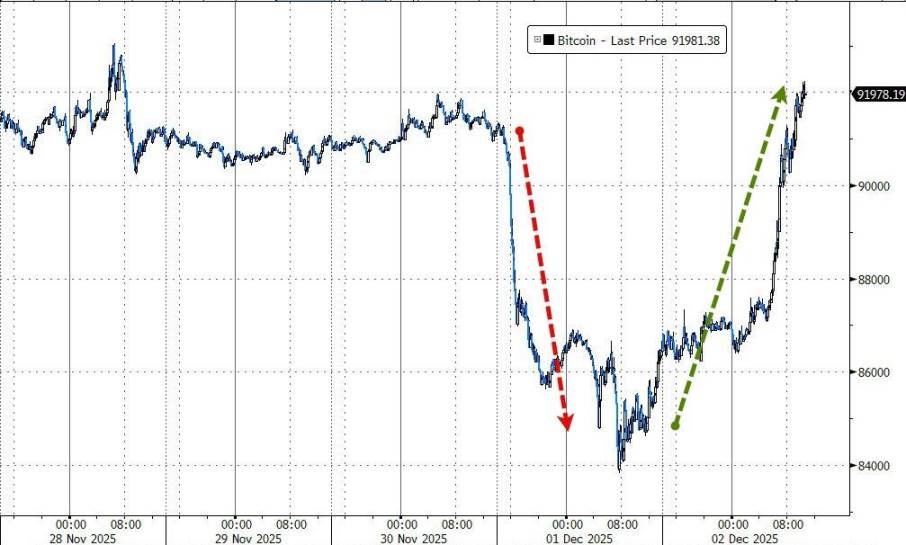
The rebound of global risk assets on Tuesday: the "significant changes" of asset management giant Vanguard.

CN
12 hours ago

The conservative giant that once firmly resisted cryptocurrency assets has finally compromised, officially opening Bitcoin ETF trading permissions to 8 million customers.

Written by: Ye Zhen

Source: Wall Street Insights

On Tuesday, cryptocurrencies like Bitcoin led a rebound in risk assets, driven by a significant shift from global asset management giant Vanguard.

After a sharp decline on Monday, Bitcoin strongly reclaimed the $90,000 mark on Tuesday, with a daily increase of over 6%, while Ethereum returned above $3,000.

At the same time, Trump hinted that his economic advisor Kevin Hassett is a potential candidate for the Federal Reserve chair, combined with stabilization in Japanese bond auctions, which put slight pressure on U.S. Treasury yields and the dollar index, alleviating market liquidity anxiety and significantly boosting global risk assets.

Vanguard confirmed on Tuesday that customers can now purchase third-party cryptocurrency ETFs and mutual funds, such as BlackRock's iShares Bitcoin Trust ETF, through its brokerage platform. This marks the first time this conservative investment management giant has opened cryptocurrency investment channels to its 8 million self-directed brokerage customers.

Bloomberg analyst Eric Balchunas pointed out that this is a typical "Vanguard effect." On the first trading day after Vanguard's shift, Bitcoin surged immediately during the U.S. stock market opening, and BlackRock's IBIT saw trading volume exceed $1 billion within the first 30 minutes of trading, indicating that even conservative investors are looking to "spice up" their portfolios.

Previously, Vanguard had firmly refused to enter the cryptocurrency space, arguing that digital assets are too speculative and volatile, which does not align with its core philosophy of maintaining a long-term balanced investment portfolio. The current shift reflects ongoing pressure from retail and institutional demand, as well as concerns about missing out on rapidly growing market opportunities.

As BlackRock achieves great success with its Bitcoin ETF, Vanguard's loosening stance on this emerging asset class will have profound implications for future capital flows.

Vanguard's Major Change: From "Resistance" to "Openness"

The core driving force behind this reversal in market sentiment stems from the change in attitude of Vanguard, the world's second-largest asset management company. According to Bloomberg, starting Tuesday, Vanguard allows customers with brokerage accounts to buy and trade ETFs and mutual funds that primarily hold cryptocurrencies (such as BlackRock's IBIT).

This decision is a clear compromise. Since the U.S. approved the listing of Bitcoin spot ETFs in January 2024, Vanguard has prohibited trading such products on its platform, citing "high volatility and speculation of digital assets, which are not suitable for long-term investment portfolios." However, as Bitcoin ETFs attracted billions of dollars in assets, and BlackRock's IBIT reached a scale of $70 billion even after a pullback, the sustained demand from customers (both retail and institutional) forced Vanguard to change its position.

Additionally, Vanguard's current CEO Salim Ramji, a former executive at BlackRock and a long-time advocate of blockchain technology, is seen as one of the internal factors behind this policy shift. Vanguard executive Andrew Kadjeski stated that cryptocurrency ETFs have withstood market volatility and that management processes have matured.

However, Vanguard still maintains a degree of restraint: the company has made it clear that there are currently no plans to launch its own cryptocurrency investment products, and leveraged and inverse cryptocurrency products remain excluded from the platform.

The Duel of Giants Faces Reshuffling

Vanguard's move brings its long-standing "duel" with BlackRock back into the spotlight. According to the book "The First Lesson in Global ETF Investment," the two companies represent fundamentally different investment philosophies and business models.

BlackRock represents "technique." Founder Larry Fink, a top bond trader, established BlackRock with the goal of "making better trades." Its core competitiveness lies in its powerful risk management system "Aladdin" and a comprehensive product lineup. BlackRock's iShares has over 400 ETFs covering various global assets. For BlackRock, ETFs are tools to meet customer trading needs and build portfolios, so it does not shy away from any asset class. Whether promoting ESG investments to mitigate "climate risk" or being the first to launch a Bitcoin spot ETF (with IBIT's assets exceeding $10 billion within 7 weeks of listing, far surpassing Vanguard's expectations and breaking the 3-year record set by gold ETFs), BlackRock is committed to being the best "shovel seller" in the market.

Vanguard adheres to "principle." Although founder John Bogle has passed away, his philosophy remains the soul of Vanguard: the best long-term choice for investors is to hold a broadly diversified index, and Vanguard's mission is to minimize costs. Thanks to its unique "mutual ownership" structure, Vanguard has very low fees, with only over 80 ETFs primarily focused on broad market indices like VOO and VTI. Its customer base mainly consists of long-term investors and advisors who are sensitive to fees.

The differences between the two companies are vividly reflected in the spot Bitcoin ETF. BlackRock submitted its application as early as June 2023, and its IBIT ETF surpassed $10 billion in assets just 7 weeks after listing, setting a record that was 3 years faster than the gold ETF GLD. In contrast, Vanguard only allowed customers to trade third-party cryptocurrency products this week.

The market is realistic. As Vanguard's share in the U.S. ETF market continues to approach and even threaten to surpass BlackRock, the spot Bitcoin ETF has become a key variable. Faced with BlackRock's significant first-mover advantage in the cryptocurrency space and strong customer demand for diversified allocations, Vanguard ultimately chose to ease its trading channels.

Although Vanguard's adjustment of its cryptocurrency policy is somewhat late, the potential demand from its 8 million self-directed customers should not be underestimated. This change could not only affect short-term capital flows but also reshape the long-term competitive landscape between the two giants.

免责声明:本文章仅代表作者个人观点,不代表本平台的立场和观点。本文章仅供信息分享,不构成对任何人的任何投资建议。用户与作者之间的任何争议,与本平台无关。如网页中刊载的文章或图片涉及侵权,请提供相关的权利证明和身份证明发送邮件到support@aicoin.com,本平台相关工作人员将会进行核查。

Share To
APP

X

Telegram

Facebook

Reddit

CopyLink