Speaker: QinbaFrank
Editor: Uweb
Editor’s Note: This article is the full transcript of QinbaFrank's lecture at the Uweb Business School in Hong Kong, organized and transcribed based on classroom recordings, handouts, and on-site notes. For the sake of dissemination and learning, the content has been structured and optimized; the viewpoints and conclusions in the text have not been verified point by point with the lecturer or academically reviewed. In case of any content discrepancies, the statements made on the day of the lecture shall prevail.
As the global economy enters a new phase of high volatility and uncertainty, the reshaping of the geopolitical landscape, the switching of monetary policy cycles, and the accelerated transformation of industrial structures have become key variables determining the direction of capital markets. How to systematically grasp market logic from a macro and industrial perspective is the core proposition for investors.
On the morning of September 29, 2025, the Uweb Business School in Hong Kong invited macro-financial expert QinbaFrank to give a systematic lecture on the theme of "Market Trends from a Macroeconomic and Industrial Perspective." The course focused on the logic of macroeconomic operation, combined with the interaction between industrial cycles and the digital asset market, proposing an "integrated two wings" analytical framework to provide investors with ideas for identifying trends and pricing logic in a complex market environment. Below is the full transcript of the lecture:
Thank you to Uweb and Principal Yu for the invitation. Today, I will share some of my views on the macro economy and the digital asset field. I worked in major internet companies for many years, and after 2020 and 2021, I focused more on secondary fields. In 2022, I started writing some content on Twitter, exchanging ideas with many friends.
Today, I will elaborate from several angles. First, from a macro perspective, what is my understanding or perception of the current market state? It has been more than half a year since Trump took office; what is the policy framework he has constructed during his second term? Under this policy framework, what state does he hope to promote in the crypto industry?
Next, I will also talk about AI, which is another important theme I am focusing on. Starting in 2023, my investment themes are threefold: A, B, and C. A is AI; B is Battery, which refers to the new energy industry centered around batteries; C is Crypto. At that time, I only focused on these three areas and did not pay attention to others.
Finally, I will share some of my personal, rudimentary thoughts on the industry for your reference.
Part One: What are the Current Market Focuses from a Macro Perspective?
At the beginning of the course, I will pose three questions, which are the three important topics that everyone is most concerned about in the current digital asset and US stock markets.
Topic One: The Trend of Inflation Determines the Subsequent Path of Interest Rate Cuts

After a gap of 9 months, interest rates were cut again last year, and the product market has fully anticipated this. What people are more concerned about is that although the Federal Reserve provided a dot plot after the interest rate cut last week, expecting to lower rates again twice by the end of the year, everyone knows that the Federal Reserve has abandoned forward guidance over the past two years and is now deeply reliant on data, adjusting based on changes in data, and will not be forced to cut rates again at the end of October and December.
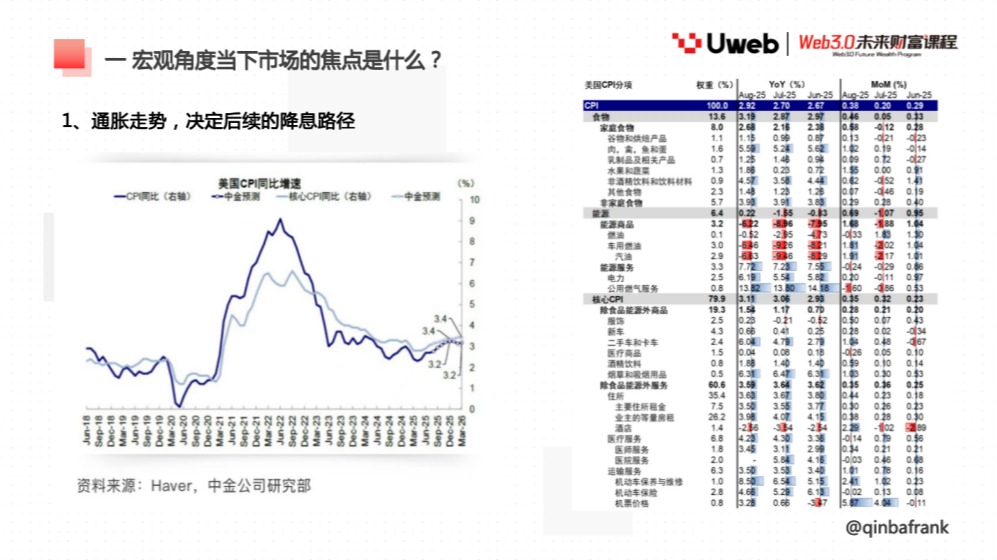
The core point here is that with a slowdown in the labor market, the focus will shift to inflation, and the trend of inflation will determine the speed of subsequent interest rate cuts. From the recently released US inflation and PCE data for September, we can see that US inflation is currently at a relatively mild low point and is beginning a gradual upward phase.
As we all know, the tariff war began in February of this year. The US has raised import tariffs from the previous 3% to around 14% now. This means that the cost of imported goods is rising, and the rising costs will be passed on to the products.
Analyzing the CPI situation from the past two or three quarters, the transmission path and rhythm of tariffs on product prices have been lower than market expectations. Although inflation has surged, actual inflation was below expectations before July, and July and August met expectations.
Service sector inflation remains a stubborn issue. The US economy is highly dependent on consumers, and American consumption mainly relies on wealth levels. About 40% of Americans' wealth comes from equity assets; when the stock market rises, the wealth effect is evident, and people are naturally willing to spend money.
The core issue lies with the producers, exporters, importers, wholesalers, retailers, and corporate consumers in the entire import supply chain. In short, all links in the supply chain share the responsibility of distributing or bearing the costs of rising tariffs.
Why was the transmission rhythm, path, and speed of tariffed goods lower than expected before August? Because US importers, wholesalers, and retailers bear 90% of the costs, while the actual consumers and end product prices only account for 10%.
According to a report by CICC analyzing the current burden distribution of tariffs across various links in the supply chain, they believe that the entire tariff process is a process of moderate increase, and it is possible that by the end of this year or early next year, the core CPI will be around 3.1 to 3.4. After that, they believe it may peak, start to slightly bottom out, and then begin to weaken.
This is merely a conceptual issue; we need to treat it as a framework or basis for prediction and deduction. I consider it the most conservative prediction, i.e., the most pessimistic scenario.
On September 2, I posted a tweet on Twitter, where many people asked what would happen after the interest rate cut. I believe that after the interest rate cut, it may return to a pause situation, i.e., the Federal Reserve may pause again. The deduced path is that there may be one or two rate cuts in September and early November, provided that the non-farm payrolls in August do not exceed expectations.
If inflation in November and December hovers around 3%, then we can consider that with CPI reaching 3% and core CPI at 3.2% or 3.3%, it will be difficult for the Federal Reserve to cut rates, and they may pause. In this case, the market will certainly see more pessimistic forces, i.e., US inflation will surge.
But my view is not like that.
The first point: The actual prices of goods in the US have been rising since the 1960s. Although they have been rising, sometimes inflation is increasing, and sometimes it is decreasing. The core issue is that the relative value is usually calculated year-on-year; that is, comparing this year with last year, and month-on-month; that is, comparing this month with last month. Therefore, there will be a base effect; if this year's base is high, then next year's relative base will decrease.
The second point is that I believe this time it is a rise in costs, not a decline in supply. The core of the hyperinflation we experienced in the 1970s and in 2021 and 2022 was the disruption of supply chains. In the 1970s, two Middle Eastern wars led to oil embargoes, causing supply chain disruptions. In 2021 and 2022, the pandemic caused a complete disruption of global supply chains, including maritime transport, which was a very important factor in the hyperinflation, coupled with the unlimited quantitative easing policy in 2020. This time, the transmission of tariffs is a rise in costs; according to estimates from Bank of America and Morgan Stanley, US consumers bear only 10% of the tariff costs, so this is merely a rise in costs, not a supply disruption. In this case, future inflation will still fall after peaking; it is just a matter of time and pace for the decline.
The pessimistic scenario may occur in September. If the data released in August is still acceptable, then the probability of the Federal Reserve cutting rates at the end of October is very high, because inflation is still in a controllable stage; secondly, the labor market continues to slow down. According to the pessimistic scenario, if CPI reaches 3.0, I believe that in December, they may pause and need to wait further.
The optimistic scenario is that the overall rhythm and magnitude of tariff and product inflation are milder than expected. We may have already lowered in November, and it may not even reach 3, only 2.9 or 3 before it appears. I believe this is the topic we are most concerned about in the current market.
Topic Two: Is the US Starting to Recede? Is it a Soft Landing or a Hard Landing?
This is a topic that has been widely discussed. My conclusion is: the economy is gradually slowing down, and we are still quite far from recession; the probability of a soft landing is very high. We will focus on several key indicators: PMI (Manufacturing and Services), GDP, the labor market, and retail consumption.
PMI: The PMI index for the US in July and August was both above expectations. (50 is the dividing line; above 50 means economic expansion, below 50 means economic contraction.)
GDP: A few days ago, the GDP for the second quarter of the US was released on Thursday night. The second quarter was when tariffs caused the greatest panic, yet the actual GDP was far above market expectations.
Labor costs and the retail market: The US PCE data shows that consumer spending year-on-year growth exceeded expectations, with a monthly rate around 0.4 to 0.5. If consumption is not an issue, then the US economy is not an issue. About 70% of US GDP comes from consumption. The consumption market is good, but the labor market is indeed slowing down. I believe the reasons for the slowdown in the labor market are as follows.
First, companies are uncertain about the entire market, especially regarding the aftermath of tariffs, leading them to be more cautious and temporarily refrain from hiring, which results in a decrease in new job numbers. Second, since Trump took office this year, the US government has implemented measures to expel immigrants. Most of the new jobs in the US in 2023 and 2024 come from illegal immigrants. The immigration rate in the US has almost plummeted, with very few new immigrants, and many immigrants have already been deported. You may have seen many cases of US immigration enforcement in California in the second quarter.
When observing an economy, in addition to looking at surface GDP and PMI, we should pay more attention to productivity indices and retail aspects. Many of you here are entrepreneurs and seasoned investors; when we observe a company, we need to consider not only its revenue and balance sheet but also governance-related aspects.

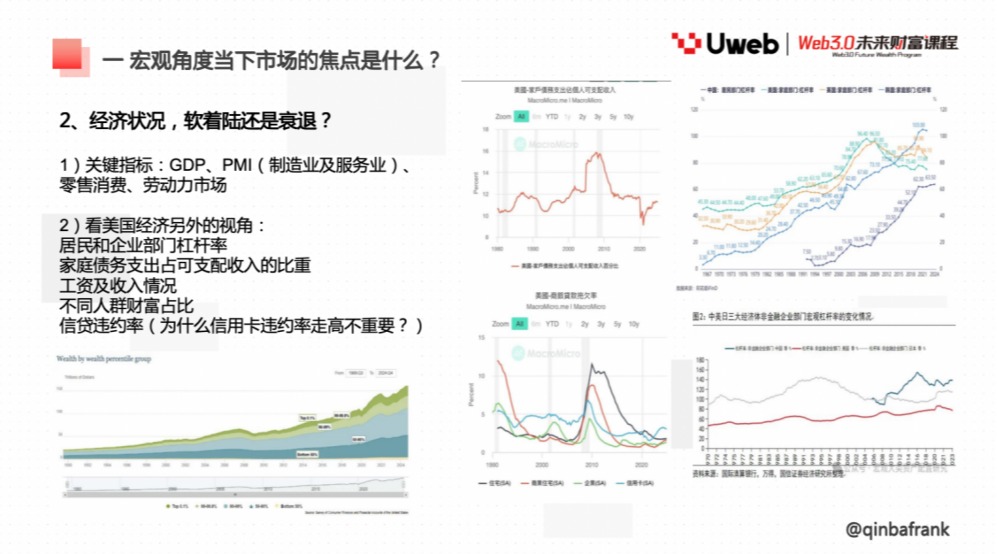
First, since 2008, the leverage ratio of US households and resident enterprises has been declining. This is the ratio of household debt to disposable income in the US. The peak of the debt-to-disposable income ratio was in 2008, and it has only recently returned to the state before the pandemic, not yet back to the state of 2019. The debt of US households is at a very low level compared to other disposable incomes. If the leverage ratio of enterprises and households is low, it means they have a strong ability to withstand risks, and in this case, the probability of a major crisis occurring is small, greater than 5 points.
Second, the polarization in the US is very severe. The top 10% of households in the US hold 50% of the wealth, while the next 10%-50% hold 40% of the wealth, meaning that the upper middle class in the US holds 90% of the wealth, and these groups account for 95% of overall consumer spending. The lower groups may only account for 10% of wealth, with their consumption share being only in single digits.
On August 5 last year, due to Japan's interest rate hike and a flash crash in the US regional market, I wrote a lot of tweets, mentioning that there was no need to worry. At that time, there was also a lot of media coverage about the US credit card default rates surging.
First, credit card spending constitutes a relatively small part of the entire consumer strategy in the US, amounting to about several hundred billion dollars. Secondly, many people link the credit card crisis to the subprime mortgage crisis of the past. The subprime crisis involved not only basic home mortgages but also many investment banks on Wall Street packaging and combining a large number of mortgages as subprime loans, which significantly increased leverage. Credit card loans are a form of credit, and the degree of over-packaging and leveraging in credit loans is very low.
Credit cards primarily target middle- and low-income groups in the US, who have relatively little wealth, with most being "moonlight" consumers (spending all their income). This leads to the entire process. I believe the role of credit cards is a question many people raise. Finally, since the interest rate cuts began in September of last year, the dollar rate has started to decline from its low point. Credit card defaults correspond to interest rate assessments. The higher the interest rate, the higher the default rate. When interest rates decrease, the default rate also declines, as the cost of borrowing decreases.

Third, there is economic data. The core focus now is on the future: whether it can generate profits, how productivity can be improved, and whether efficiency can be enhanced. This is the largest main theme in the current world. I am a technology optimist from an internet background, and from my observation of the development history of the world, the technological revolution is the greatest driving force; other aspects are not as important. The advancement of productivity has driven the development of the entire world, from the steam engine to railways, the Age of Exploration, to automobiles, steel, and finally to the information sector, according to the planning of the semiconductor and information industry. The mobile internet industry will inevitably accompany the technological revolution and the progress of productivity.
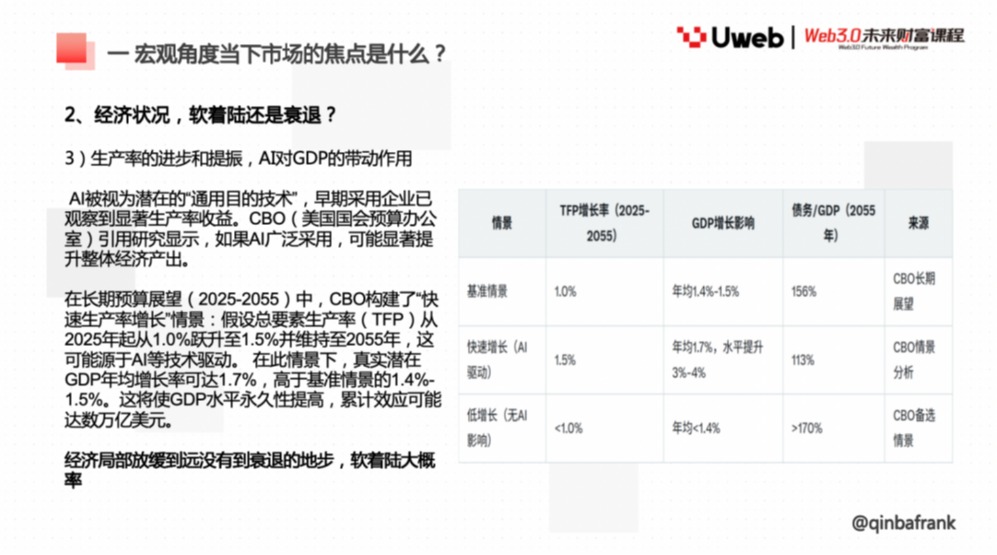
The core issue now is AI's contribution to productivity improvement. This is based on calculations from the US Office of Management and Budget, which suggest that companies adopting AI can improve production efficiency in three ways: a basic scenario of a 1% increase, and a rapid growth scenario of 1.5%. In this case, it could raise GDP from around 1% to 3% or even higher; currently, US GDP is about 1.5%-2%.
From the three perspectives mentioned earlier, my personal conclusion is that although the US is currently in a state of partial slowdown, it is still quite far from recession. I believe a soft landing is a high-probability event.
Topic Three: Can the US Debt Issue Continue? Is it a Risk or a Crisis?
This is a topic of greater concern, namely whether the US debt is sustainable. We have seen many viewpoints suggesting that the US debt is facing a crisis and that the US cannot cope, especially in April of this year when this viewpoint became quite prevalent.
In early April, I tweeted: "I believe that for ordinary investors, the concern about the duration of a US recession will far exceed the typical investment career of an average person."
If there is a recession, it is also a long-cycle variable. I gave an example: in 1900, the industrial production value and GDP of the US had already surpassed that of the UK, but the US did not replace the UK as the world's number one power until 1945, after World War II, going through a 40-year period. From this perspective, many people believe that as the East rises and the West declines, China will also rise; if we truly observe that money, it actually requires a long cycle.

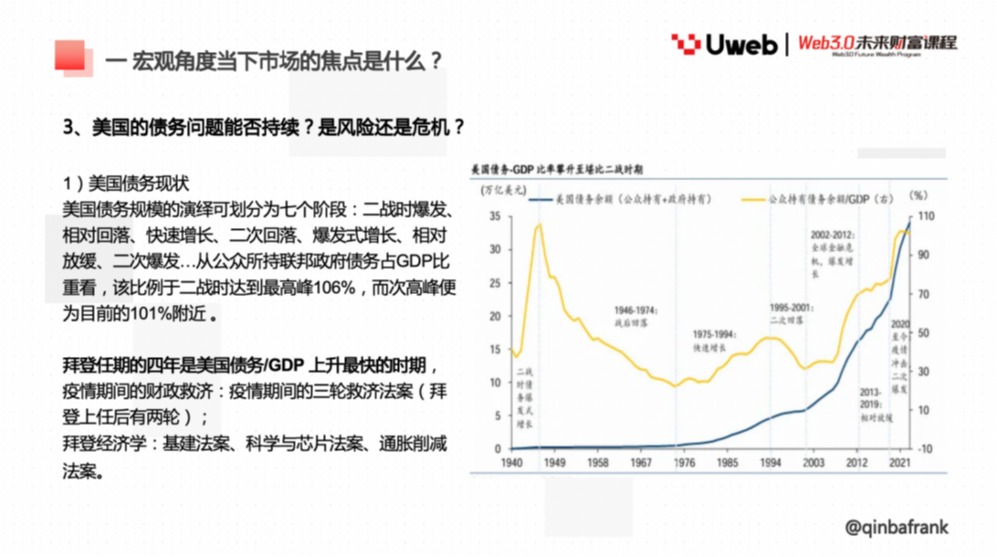
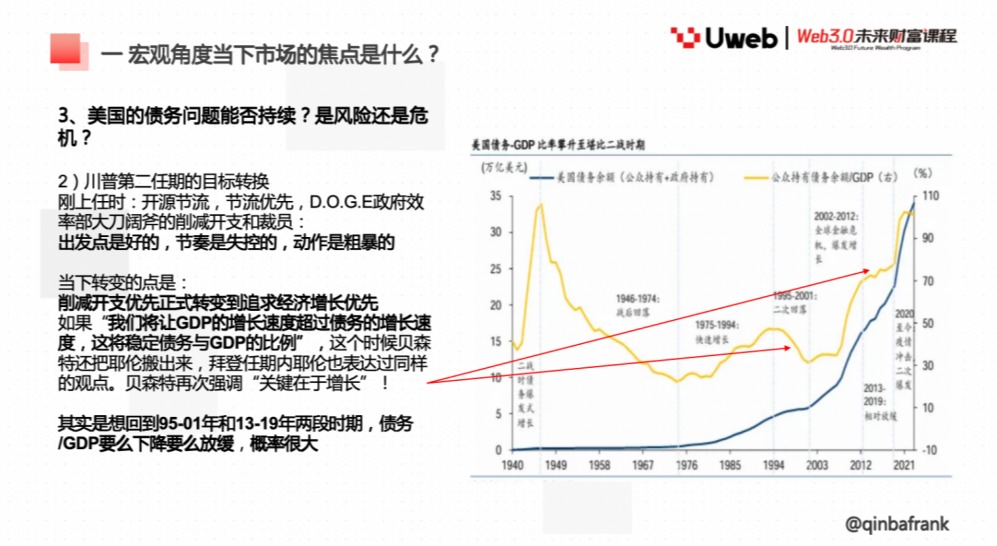
What is the current state of US debt? The blue part of this chart represents the absolute value of US debt, which has indeed been rising steadily. The yellow part represents the ratio of US debt to GDP, in simple terms, the leverage ratio, which is your debt relative to your income level.
After 2024, the issue of US debt suddenly became a very significant topic, with Trump, Musk, US investment banks, media, social media, investors, institutional investors, and ordinary investors all paying attention. In 2020, the ratio of US debt to GDP was 80%, and by the end of Biden's four-year term, it is expected to reach 100%. This means that in the last year of Trump and Biden's four years, from 2020 to 2024, the ratio of US debt to GDP suddenly increased from below 80% to just over 100%.
From the campaign topics in the second half of last year to the topics in the first half of this year, and then to Trump’s inauguration, Musk became the head of the government efficiency department, and many issues arose due to the significant increase in US debt to GDP over the past four years, far exceeding a healthy level for the economy.
Currently, Japan has the highest debt-to-GDP ratio globally, around 200-250%. Although China's government debt to GDP ratio may be 75%, when including local debts or hidden debts, many estimates indeed reach levels of 100 or 150.
If your debt exceeds your annual income or economic growth, people will indeed worry about sustainability issues.
Therefore, we need to objectively address the debt issue. During the pandemic, Biden implemented three rounds of relief bills, starting from July or August of 2022, which was also the bottom of our last cycle. Over the past two years, the Biden administration has pushed three initiatives, including Yellen serving as Treasury Secretary, which led to three infrastructure plans: the Infrastructure Bill, the Science and Chips Bill, and the Inflation Reduction Act. These three bills constitute the main cornerstones of the fiscal expansion 1.0 era. The Inflation Reduction Act belongs to fiscal expansion 2.0.

From this perspective, when Trump took office, they believed that US debt was unsustainable, so they proposed two supplementary prescriptions.
The first: increasing revenue and cutting expenditure. Increasing revenue refers to tariffs, while cutting expenditure refers to the large layoffs and reforms in Musk's government efficiency department, which had a significant impact on the market. The intention was good, but the pace got out of control, as everyone in business knows. I mentioned in early January that Musk's approach could easily lead to layoffs affecting critical areas. Previously, in 2022, Musk acquired Twitter, and after the acquisition, he made drastic layoffs. A month later, there was chaos, as many key engineers were laid off and later found to be indispensable talents, leading to their rehiring. This chaos continued until Musk stepped back and returned to the company.
The second time: the core focus shifted from prioritizing expenditure cuts to pursuing economic growth, only needing to slow down or reduce the debt-to-GDP ratio. Last year, the US debt-to-GDP ratio peaked at 110%, and now it has slightly decreased to 105%. If in the next two years, the US debt-to-GDP ratio can drop below 100%, say to 90%, will people still consider debt a problem?
As long as the economy and GDP grow faster, and debt grows slowly, but the ratio has decreased, from the perspective of corporate procurement, such a leverage ratio is healthier. This is the fiscal goal led by Basant during the Trump era: to slow down or reduce debt.
The core point is the dollar or US debt, but I believe these issues are the second important problem. The first important issue is its connection to the comprehensive national power of the US, related to the US's overall strength and leadership position. As long as the US's comprehensive national power and leadership position do not disappear, it will always find various ways to solve this problem.
So is US debt a crisis or a risk?

What you usually hear is the term "debt crisis."
When we conduct market simulations or analyses, the first thing we need to establish is the time frame: is it short-term, medium-term, or long-term? The second is to strengthen the degree of risk. Risks are not all the same; each different level of risk has different impacts and influences on the market.
I believe the difference between a crisis and a risk is that a crisis occurs when there are significant problems with underlying assets. For example, the subprime crisis involved a complete collapse of the US real estate market, where all underlying assets collapsed; the second example is the European debt crisis from 2011 to 2012, where countries like Greece, Italy, and Spain defaulted on their debts, leading to a complete collapse of all underlying assets based on the government bond market and its various derivatives. This is what I consider a crisis.
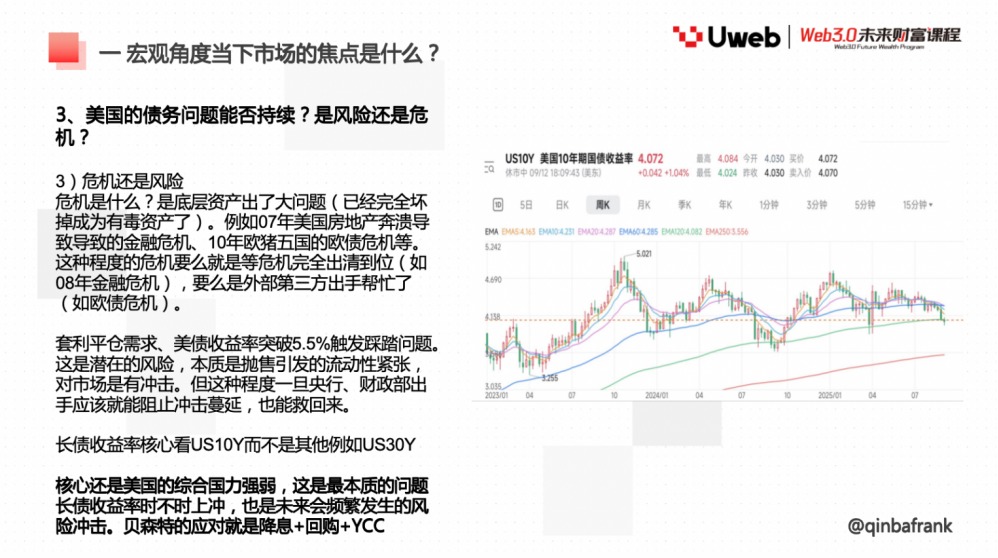
Risk, on the other hand, is the unsustainability of US debt. As a long-term bondholder, the US Treasury provides me with a higher risk premium; holding US debt requires a higher yield, such as the yield cap you see; this is the term structure premium. Last July, when Japan raised interest rates, the US data was significantly below market expectations, and from July 31 to August 5, BTC dropped from 60,000 to 49,000, and the US stock market nearly experienced a circuit breaker. This was a liquidity issue, where everyone was frantically selling, pushing up Treasury yields and affecting market sentiment. I believe these issues are essentially risks; the essence of risk is a liquidity issue. Whether it is the Federal Reserve or the Treasury, they currently have a very ample arsenal and weapons at their disposal.
The last time we saw the 10-year yield reach 5% was in October 2023, when the 10-year yield had grown to around 5.
What did the US do at that time? Powell threw out expectations of interest rate cuts, and the Treasury began repurchasing. They mobilized two major hedge funds on Wall Street, one of which publicly shorted US debt in August 2023, driving down US debt prices and causing yields to soar. In October 2023, he suddenly tweeted that he had closed his short position on US debt and switched to a long position, mobilizing government and market forces to pull US debt back up.
The market often mentions the 30-year Treasury yield rising to 5%, but I have always emphasized that the 30-year Treasury yield is not important; we need to focus on the 10-year Treasury yield because the 10-year yield is the basic standard for risk-free returns. A 30-year period is too long, and a 5-year period is too short; 10 years is just right for a good long economic cycle. This is a customary practice, not a regulation.
Therefore, the 10-year Treasury yield is the issue the market needs to pay the most attention to. If it surges significantly, it will put a lot of pressure on the entire risk market. If it remains low, then domestic market pressure is not that great. If the 30-year Treasury yield is relatively low, the 10-year yield can still be acceptable. In reality, there is not that much risk.
We need to pay attention to what the market impact would be if the 10-year yield suddenly surged after 10 years. Based on my previous observations, if the 10-year Treasury yield exceeds 4.6, the entire market will come under pressure, and upward momentum will be insufficient.
This year, you could clearly see this number around 4.9 and 4.6 in June, and the US Treasury has already made multiple repurchases to support the dollar price and increase yields. Basant is more focused on this aspect; he does not want the 10-year Treasury yield to surge above 4.6, and it has repeatedly hovered around 4.59, suddenly seeing significant changes and actions in the Treasury market.
In July, some media reported that the Treasury was repurchasing in June while Wall Street had already taken action in June. Basant was previously a fund manager on Wall Street; he was a fund manager for Soros and has a significant influence on Wall Street, with many allies in the US bond market. He can mobilize his circle of friends to do this.
Our conclusion from various analyses is that there is no crisis in US debt during Trump's term, but there are risks, and these risks continuously impact the market and affect market sentiment.

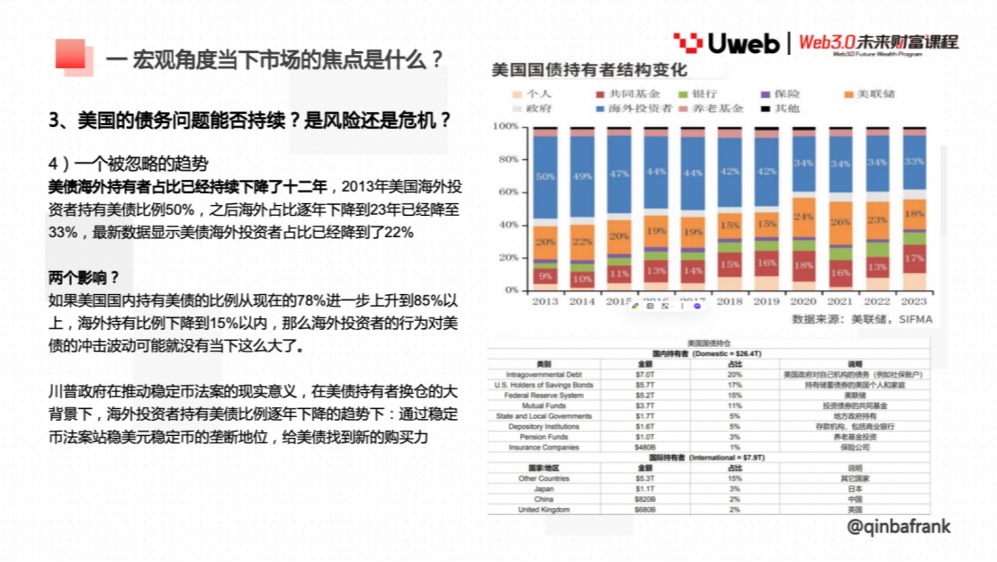
Of course, there is also a misconception. Many people believe that foreign investors are selling off dollars, but that is not the case. The proportion of US Treasury bonds held by overseas investors, including foreign central banks, art funds, and individual investors, has been significantly declining since 2013, dropping from over 50% in 2013 to around 22% by late April and early May of this year.
After July and August, Trump resolved the conflicts between Iran and Israel, and US overseas investors began to increase their holdings again, with recent data showing it has rebounded to about 25%.
The previously mentioned shift in holdings of US stocks and bonds by overseas investors has been a trend for over a decade, not just in the past two years. If this trend continues, it will have two impacts:
If the proportion of US Treasury bonds held by overseas investors decreases from the current 25% to 15%, the proportion of domestic investors in the US, including the Federal Reserve, the US government, corporate banks, art funds, or individuals, using dollars will increase from the current 75% to over 85%. Why does Japan's national debt-to-GDP ratio reach 200% or even 250%? The Bank of Japan accounts for about 70%, along with banks like Mitsubishi and Sumitomo, meaning the Japanese government holds about 90%. This indicates that the behavior of overseas investors has less impact on US Treasury trends, while domestic investors have a much larger influence on overseas factors.
Stablecoin legislation. Starting in 2023, several factors have driven the need to find new purchasing power for US Treasury bonds, turning attention to the crypto space. I will elaborate on why they are pursuing this later.
Overall, major crises such as debt defaults should not pose significant problems, but actual risk shocks may occur every ten years in the future.
Part Two: Overview of Trump 2.0 Era Policies

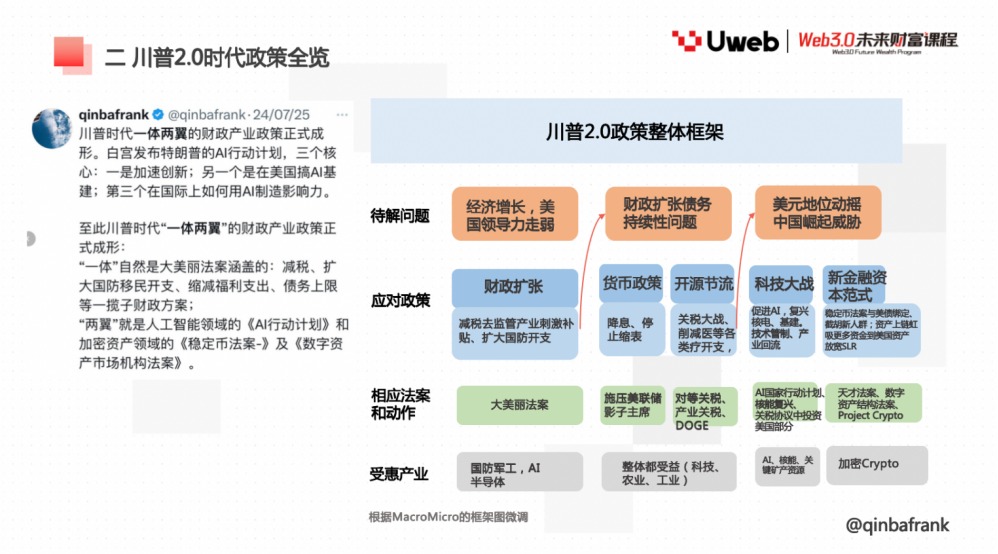
This section will explore how to view the policy framework of Trump's second term. In July, I mentioned that Trump's "One Body, Two Wings" industrial policy had officially taken shape. The "One Body" refers to the "Great Beautiful Act," while the "Two Wings" refer to two industries: AI and Crypto, where AI refers to the "AI Action Plan," and Crypto refers to the "Stablecoin Act" and the "Digital Asset Market Institutional Act." This overall framework addresses the following issues:
- How to address the slowdown in US economic growth and the issue of economic growth engines?
The response policy to this issue includes fiscal expansion, tax cuts, new donations, industrial stimulus subsidies, and increased defense spending. The aim is to reduce burdens on businesses and eliminate all unnecessary obstacles. Recently, the US government has invested in banks, replacing 10% of Intel's shares with government subsidies, corresponding to the "Great Beautiful Act."
- How to address the sustainability of fiscal expansion?
One solution is the monetary policy provided by Treasury Secretary Basant and Trump's team, which includes interest rate cuts and halting balance sheet reduction.
Why has Trump been so forceful in pressuring and complaining since April? I want to tell you that the current US debt is about $37 trillion, with annual interest payments of about $1.1 trillion. US banks previously calculated that if the Federal Reserve's interest rate were lowered by one point, the annual debt interest expenditure would decrease by $300 billion. Another point is that the effective tax rate for US tariffs in 2024 is 3%, while this year it is 14%, with a nominal rate of 17% due to exemptions, etc.
The increase in tariffs this year has brought in over $300 billion in tariff revenue for the US, which may reach over $400 billion next year. This also indicates that Trump's actions this year, even causing a market crash in April, yield results equivalent to the effect of the Federal Reserve lowering rates by one point. The underlying logic is that lower interest rates can drive economic growth, leading to a rebound in credit, allowing both corporate and consumer credit to continue to grow.
Interest rate cuts are no longer just a monetary issue but have become a political task and pursuit, aimed at solving the sustainability of fiscal expansion.
The core point of the second solution is that addressing the debt issue requires both increasing revenue and cutting expenditures, such as reducing interest payments and cutting various medical expenses. From a cost-cutting perspective, we saw the stock market crash in April, and Trump retreated. By May and June, he began to focus on the renovation of the Federal Reserve building, arguing that the cost overruns were a national disgrace. On the other hand, from a revenue-increasing perspective, tariff revenues have reached over $30 billion in July and also over $30 billion in August. The foreign exchange revenue for 2024 is projected to be $70 billion, and the increase in tariffs this year could bring the government $300 billion in fiscal revenue.
The new deficit in the "Great Beautiful Act" is projected to be $5 trillion over ten years, meaning an annual new deficit of $500 billion. If this $300 billion can continue to grow next year, it means it can cover the annual new deficit.
We see that the issue of false medical expenses has recently attracted media attention regarding the US government shutdown. To understand this issue, one must first understand the US fiscal framework: the "Great Beautiful Act" is the overall fiscal expenditure framework for Trump's second term; in addition, the US government's fiscal year starts in October, and before each fiscal year begins, Congress from both parties reaches an agreement to form the annual financial framework, which is a smaller framework within the overall larger framework, making this time of year a point of contention between the two parties.
The point of contention this time is based on the 2026 annual fiscal expenditure bill, where the Democrats hope to increase healthcare spending by $1 trillion, while Trump believes many Americans are enjoying unnecessary healthcare, which he considers wasteful, and this is where the problem gets stuck.
- The weakening of the dollar's status and the threat of China's rise.
Currently, US fiscal policy is still expanding, equivalent to printing money through fiscal means, and the problem that arises from printing money is whether the dollar will weaken. Correspondingly, the rise of China poses a threat to the US.
In my understanding, there are two main indices to focus on regarding the dollar: one is the dollar index. During Trump's term, it was characterized by a "strong dollar position, weak dollar exchange rate." We see many people worried that a significant drop in the dollar index will affect the US. In fact, between 2010 and 2019, the dollar index's lowest point was 90, and the highest was only around 100. The current value is 97, which is still at the upper end of the dollar index's fluctuation range over the past decade.
I believe that a weakening dollar index is highly probable, but whether a weakening dollar will affect the dollar's status is another question. The dollar index is related to the economy, interest rates, and the situations of various countries, such as the euro, yen, pound, Canadian dollar, and Swiss franc. The dollar's status is essentially related to the comprehensive national power of the US, which reflects the global confidence in the US. Specifically, this includes: 1. The proportion of dollars in global central bank foreign exchange reserves; 2. The proportion of global transactions settled in dollars; 3. The fact that many global assets, such as stocks, bonds, commodities, and digital assets, are priced in dollars.
To address this issue, two solutions have been proposed: a technological war and a new financial capital paradigm.
The technological war refers to the development of AI. US tech giants invest about hundreds of billions of dollars each year, frantically building data centers and continuously advancing technological iterations. At the same time, they suppress competitors' upward paths, particularly targeting China in key technologies, such as chips.
There is also a revival of nuclear power. Why is the revival of nuclear power so important? As mentioned earlier, the US is vigorously developing AI, which requires a large amount of computing power, and computing power requires a significant amount of electricity. Currently, the US still faces a severe electricity shortage, and its power system does not have ultra-high voltage transmission lines like China.
Additionally, tariff agreements have already been signed with Japan, South Korea, and the EU. For example, Japan needs to invest about $500 billion in the US, and the EU is similar, with companies like Nissan, Honda, and Toyota investing in US firms. This week, Trump led a large US trade delegation on a state visit to the UK, where several US tech giants are investing in data centers. Building data centers requires water sources, electricity, and facilities, and the US's actions can be understood as securing a foothold for data centers, effectively blocking future entrants. This is also why the US has unusually invested in data centers in the UK, essentially to establish a presence and seize future European AI infrastructure discourse.
What is the new financial capital paradigm? I believe it involves stablecoins and asset tokenization.
Back in March, when everyone was quite pessimistic, I was focusing on stablecoins and wrote an article about the impending wave of stablecoins.
The core points of stablecoins include: the purchasing power of US Treasury bonds; on-chain asset pricing power; and, more importantly, the fact that countries are currently de-dollarizing, but stablecoins, through on-chain dollars, have captured all the young people or digital asset communities in emerging markets, encouraging them to start using dollars for transactions. In the past two years, many U-card products have emerged in the market, allowing direct consumption through USDT. This means that one can use dollar stablecoins for transactions and actual consumption, and this process has no relation to their local currency.
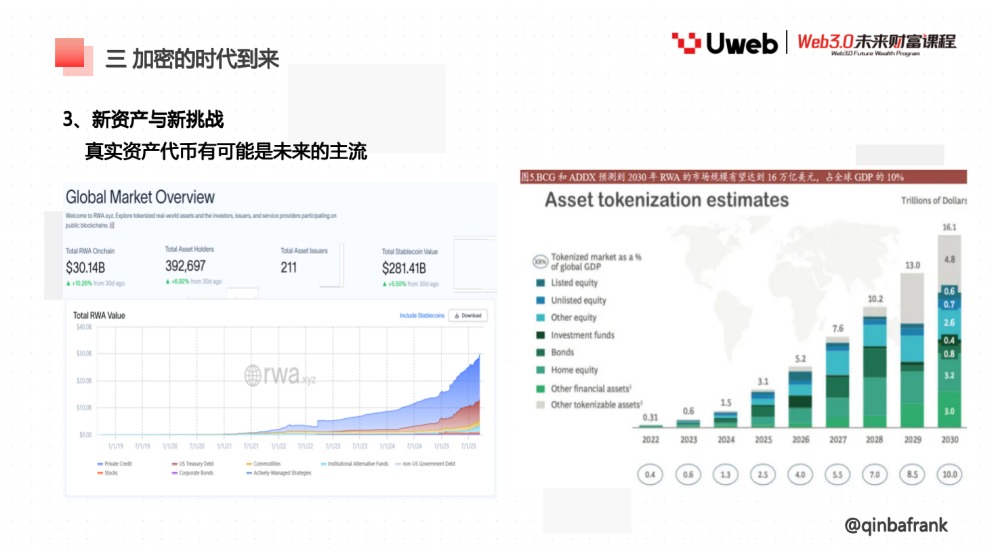
From May until now, the SEC has promoted asset tokenization, and distributed ledger technology has advantages over traditional securities, enabling many previously unattainable financial activities, essentially pushing all US assets onto the blockchain to attract global capital. Stablecoins and Real World Assets (RWA) serve as different channels to attract global funds.
Previously, the dollar flowed from the Federal Reserve to various central banks and users, following a wholesale model. Now, through stablecoins, the dollar's distribution path has shifted from wholesale to retail, directly delivering goods to customers using stablecoins.
Global non-US investors have faced many restrictions when investing in US assets historically, which has been an advantage. Americans have also recognized this advantage, retaining global emerging funds alongside US assets through this method. I believe this is what they aim to achieve in the currency war of the new financial institutional paradigm, corresponding to the "Genius Act."
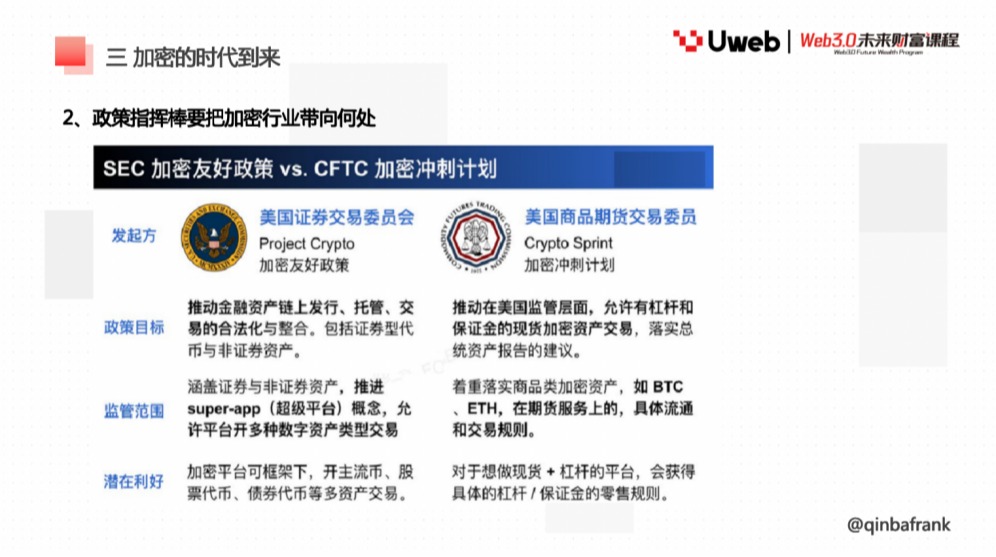
The "Genius Act" discusses stablecoins, while the "Digital Asset Structure Act" is, in my view, even more important. Recently, the SEC chairman and the White House's cryptocurrency committee gathered in December to discuss the implementation of the act.
The "Digital Asset Structure Act" first outlines the jurisdictional issues of US regulatory agencies over the entire crypto industry. After the FTX collapse, the US has been very unfriendly towards the entire crypto industry in 2023-2024, initiating many lawsuits. Of course, part of the reason is the competition for jurisdiction among US regulatory agencies, such as the SEC and CFTC. The members and chairpersons of the SEC and CFTC committees have publicly debated several times, essentially competing for jurisdiction, which could lead to substantial penalty revenues. Second, it aims to clarify the boundaries of crypto asset categories, determining whether they are classified as securities or commodities. This is the blueprint I believe the Trump 2.0 policy development will construct in the coming years.
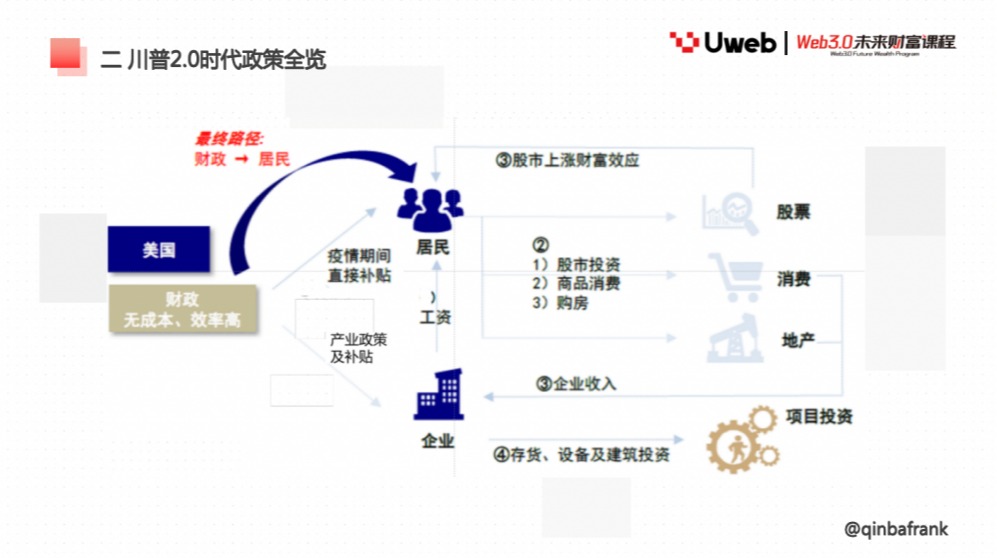
What I just discussed was Trump's era of fiscal expansion 2.0; the era of fiscal expansion 1.0 in the US should be considered to have started with the Biden administration. At the end of 2022, US stocks and crypto assets hit bottom, and from 2023 to 2024, we are in a phase of interest rate hikes by the Federal Reserve. The fiscal policy during the interest rate hike and reduction process in 2024 is very urgent, with rates approaching 5% and a monthly reduction of about $95 billion. Although the market is continuously being drained, it is still rising. Where does the underlying liquidity come from? The liquidity comes from three bills passed by Biden after August 2022: the Infrastructure Bill, the Science and Chips Bill, and the Inflation Reduction Act, which provided substantial funding for US infrastructure, AI, chips, and other areas, all drawn from the balance of the US Treasury's accounts.

This is the logic of the US fiscal cycle: fiscal spending is costless and more efficient, with funds distributed to residents and businesses. Businesses generate more purchasing power through spending, while residents choose to invest or consume through banks, creating a cyclical process. After the pandemic in 2020, the US enjoyed the advantages of fiscal stimulus, and this year I believe we have already entered the second cycle, which concerns the liquidity of the dollar.
There are two perspectives on macroeconomics in the Trump 2.0 era.
First, the weight of policy far exceeds the direction of the economy and Federal Reserve policy. In a tweet I posted at the beginning of this year, I mentioned that the influence of Trump's policies on the macro market is much greater than the economic trends and Federal Reserve direction. In the short term, there are expectations; in the medium term, there are growing pains; and in the long term, it is generally favorable. We saw the issue of growing pains in February and April.
In the past two years, US stocks have been sailing smoothly, but by February, we saw a gusty market, fluctuating up and down. The core reasons are twofold: first, US stocks are at a high level, creating a natural demand for valuation cuts. At that time, many believed AI was a bubble, but I thought that while US tech stocks were expensive, they were not bubbles. A bubble refers to a situation without fundamentals, purely speculative. So, what is the situation with US tech stocks?
In the second quarter earnings reports, Microsoft saw profit growth of around 20%, and Meta's profit grew by about 30%, with quarterly profits between $28 billion and $30 billion, and a quarterly cash flow of $20 billion, allowing for an annual accumulation of $100 billion. Such companies may be considered expensive, but they are not bubbles. Of course, some companies do have bubbles, particularly smaller companies and those with poor fundamentals, which we need to view rationally.
Around April 9, the uncertainty in the macro market peaked. At that time, Trump was acting erratically, but he would certainly pull the market back; otherwise, his actions would be meaningless. My analysis at that time was to pay attention to whether Trump was pushing for negotiations. He began negotiations with China, the US, Japan, South Korea, and the EU. The specific progress was not important; what mattered was the attitude displayed. If there was a willingness to negotiate, market confidence would surely be restored.
At that time, many people discussed the pessimistic issue of dollar decline. While it is indeed a problem, it is a long-term issue, and this long-term perspective may even exceed the length of an average person's investment career and professional life. Therefore, I believe we can remain vigilant, but we should not let a long-term trend dictate our investment decisions over three or five months. However, I am uncertain whether he can use one extraordinary trend to determine our potential decisions over three months, five months, or even a year. This is my first point: the impact of 2.0 era policies outweighs the direction of the economy and Federal Reserve policies.
Second, we are in an era of large-scale fiscal policy, where fiscal policy leads and monetary policy follows.
As I mentioned earlier, interest rate cuts have shifted from being an economic and financial issue to a monetary and political issue. The core point is that after the pandemic, the Federal Reserve adopted unlimited quantitative easing, applying nearly all monetary policy tools to the extreme, after which fiscal policy began to gradually take effect. By 2022, inflation reached historic highs, entering a phase of rapid monetary contraction, at which point fiscal policy had to take action and began to lead the development of the economic industry.
Third, we are in an era dominated by political economy and strongman will.
The first manifestation of strongman will is seen in the tariff war: many past economic theories, economic policies, and monetary finance concepts are no longer applicable today. Trump's tariff war can be described as something born out of nothing; before he took office, US trade was still dominated by free trade. However, Trump believed that his allies and trading partners were taking too much advantage. He provided significant military protection to allies and exported a lot of technology, yet the US had only a 3% tariff on the EU, while the EU imposed a 10% tariff on the US, and Japan's import tariff on the US was 15%.
From Trump's perspective, the US truly established free trade through the Marshall Plan, granting significant advantages to allies like South Korea and Japan. I believe the tariff issue was something that had previously gone unnoticed, but Trump saw it as a problem. He did not want to be taken advantage of anymore and sought to reclaim money to increase fiscal revenue.
This is the essence of strongman will; he has a strong determination to drive this development. The result is that not only have tariffs increased, but the US has also secured a total investment of $1-2 trillion from Japan, South Korea, the EU, and other regions. Many may say this is just a promise and that reality will fall short, but even with a discount, there will still be hundreds of billions or over a trillion dollars invested in the US.
Yesterday, conditions for drug tariff exemptions were announced. If pharmaceutical companies from various countries want to obtain exemptions, they must set up factories in the US, and the condition for setting up factories is that the first investment must be recognized as starting investment in the US. This is also a manifestation of strongman will.
The second manifestation of strongman will is seen in the actions taken against the Federal Reserve, which has become the main script for the macro market since April. This includes threats to fire Powell, using the renovation of the Federal Reserve building as leverage, and the intensive interviewing of candidates for the next Federal Reserve chair by Basant. Typically, the Federal Reserve chair's term ends in May of the following year, and according to US customs, this should be completed in the quarter before the chair's term ends, such as in January or February of next year. However, a new shadow chair may be appointed in October, using a shadow Federal Reserve chair to interfere with the current operations of the Federal Reserve. The negative impact is that it could affect the independence of the Federal Reserve, while the positive aspect is that the new chair will likely align with Trump and be more moderate.
At this point, some may argue that this affects the independence of the Federal Reserve, but let's consider: which central bank in the world is truly independent? The Federal Reserve was established in 1913, and for nearly forty years, it was under the Treasury Department. Later, a bill was passed to remove the Federal Reserve from the Treasury's jurisdiction, making it answerable to Congress. Following a series of changes, a paradigm was formed for financial and capital markets. These paradigms became established orders, and now that order has been disrupted.
Returning to the core fundamentals, will the disruption of order cause problems for technology's contribution to industrial and economic growth? Will the economy face recession? If these issues do not arise, then the independence of the Federal Reserve is not a problem. If these issues do arise, then the Federal Reserve can make significant changes. The market will not choose to adjust downward; that is something you will have to manage.
The third manifestation of strongman will is reflected in Basant's repurchase actions. After the passage of the Great Beautiful Act in July, the US debt ceiling was raised by over $2 trillion for four years, and in mid-July, the Treasury began to enter a phase of excessive development. In the first half of this year, the Treasury did not issue many bonds, yet it did not exceed the overall debt ceiling. But now, there is excessive issuance. Do people think this will have a significant impact on the market? Looking back at June 2023, the Federal Reserve began excessive bond issuance, and Bitcoin, which started at $31,000 in July, began to decline, dropping to $24,000 by September.
US stocks began to fall in August, with a decline of about 15%, representing a medium-level adjustment. By October 2023, the US began to recover, with the 10-year Treasury yield rising to 5%. Many believed the market was on the verge of collapse. At that time, Powell, Yellen, and several Wall Street bigwigs joined forces to stabilize the market, reversing overall market expectations and initiating a rise in US stocks and digital assets from October 2023 to March 2024. During this process, Bitcoin rose from around $27,000 to $37,000, and the Treasury's account recovered from $100 billion to $900 billion. This occurred on September 15, with Basant expecting to complete the recovery of the Treasury account by the end of September, amounting to about $850 billion.
Based on the $300 billion calculation from July, from July to September, the Treasury withdrew nearly $500 billion from the market, and the market's reaction was completely different from the previous doomsday state. He issued bonds and also conducted a domestic repurchase in August. The proportion of short-term bonds was greater than that of long-term bonds, while the long-term bond ratio for 2023 was very high.
This is equivalent to a designed intervention, allowing the entire market to smoothly navigate the outflow period, which I think is quite impressive.
In this process, Basant is a very important key figure. As one of the few rational members of the White House, he has led this year's tariff war and is the main driver of tariff trade negotiations. His role is even greater than that of the chair of the US Trade Commission and the Secretary of Commerce. When Trump attempted to defeat Powell several times, Basant pulled him back and advised him against such actions, suggesting that other means and methods could be used. At the same time, Basant actively promoted negotiations on the Great Beautiful Act and cooperation with Congress. I believe this is a positive situation. If he continues to perform as he has this year, he will be an outstanding Treasury Secretary, possibly ranking among the top few.
This is an understanding of economics from a political perspective, examining it through the will of key policymakers and leaders. The issue here is that the power of the tiger is unpredictable; a single word can elevate or diminish it. For many decision-makers, a market price drop may not be a significant issue, but for ordinary people, it feels like the sky is falling. For them, this is a cost, and for ordinary people, it may be a deviation.
I believe there are still risks in the future, mainly in the following three areas:
- First, we need a higher risk premium for compensation, which will drive up long-term bond yields. This viewpoint is from the perspective of policymakers; we should not question their determination, but we can question the effectiveness of their policies. The desire to act, the ability to act, and the extent to which they can act are the sources of turbulence in the bond market.
- Second, there is the previously mentioned inflation issue.
- The third issue is the structural imbalance in the labor market, which I believe will be a persistent problem over the next 5 to 10 years. In June of this year, the CEO of Microsoft asked why there is a need for profitable layoffs. In the past, layoffs were understood as a response to financial difficulties, cutting costs to readjust when not making profits, but now, companies are laying off more as they earn more. The CEO of Coinbase also stated that currently, 50% of the company's code is completed by AI. AI acts like your analyst; as a leader, you need to learn to ask it questions and then check the answers.
Thus, the wave of unemployment brought about by AI replacement will gradually emerge, starting from the information services industry to the internet and software sectors, and will eventually involve law, financial services, automation, and industrial fields. Many programmers in Silicon Valley now feel a sense of sadness at work because they know their jobs will be replaced in the future. This is the problem we face, but the market does not yet have a new set of indicators to guide it. In the future, the market will continue to oscillate between recession and non-recession. A lack of substantial recession does not preclude a wave of recession trading.
When forecasting future trends and opportunities, we should focus on opportunities first and then consider risks; we cannot generalize.
Part Three: The Arrival of the Crypto Era

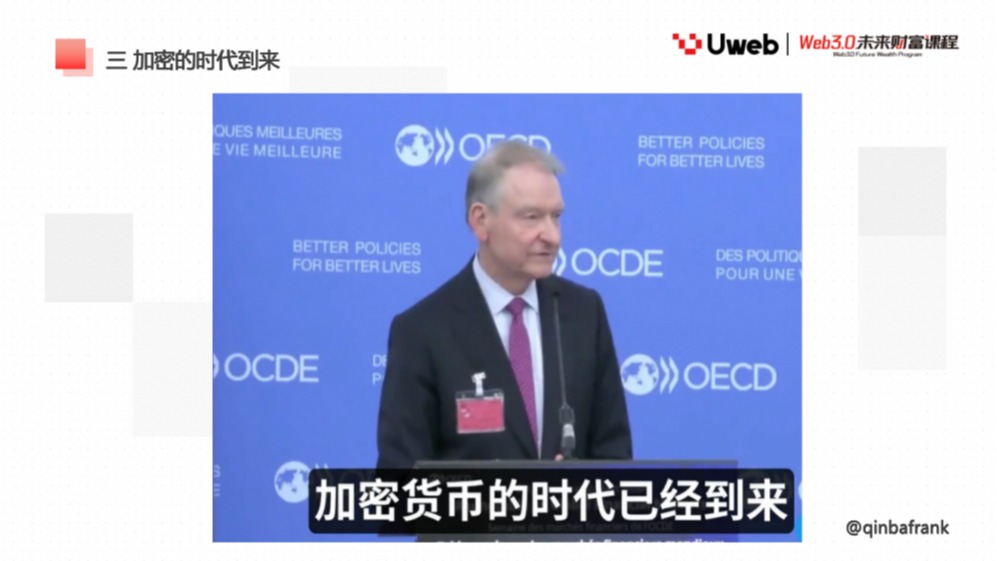
SEC Chairman Paul Atkins stated at a meeting of the OECD in early September this year that the crypto era has arrived.
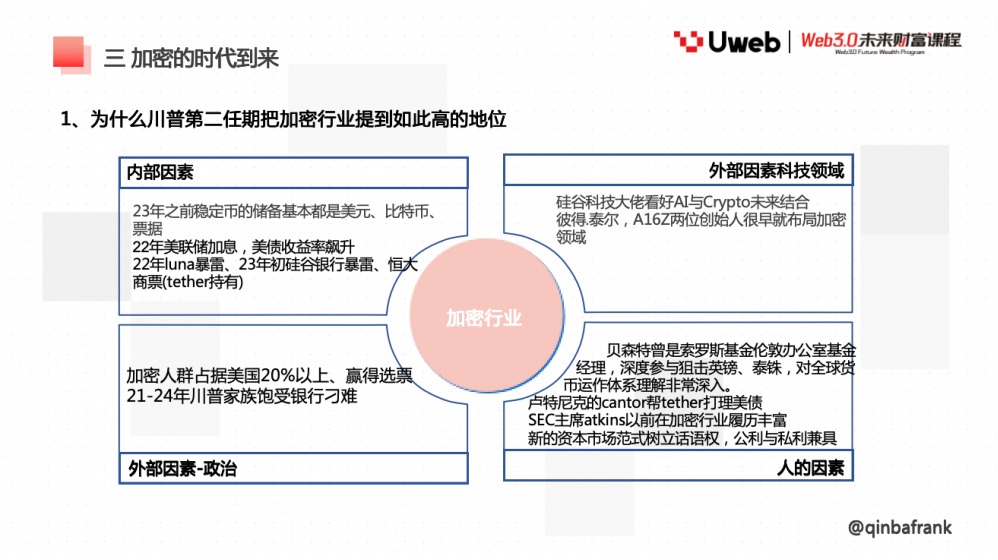
After the FTX collapse in 2022, although the prices in the entire crypto industry rose afterward, both China and the US faced very severe industrial policies. The SEC sued Circle, Coinbase, and Binance, which settled for $4 billion. Almost all exchanges have been sued, and at that time, they were facing a very harsh industrial policy environment. However, from the second half of 2024 to this year, we found that the entire US, including Trump, Best, and the US crypto industry, has been paying attention to this issue. From our perspective or my observations, there are several main factors:

The first factor is internal. A large amount of dollar reserves from stablecoins shifted to US Treasuries from the second half of 2022 to the first half of 2023.
Before 2022, the dollar reserves of stablecoins were largely in cash, with USDC's reserve assets being all cash before the end of 2022, while USDT's reserves included some cash, a small portion in Bitcoin, and commercial paper. However, this changed from the second half of 2022 to the first half of 2023. This was mainly due to the collapse of Luna, which used tens of thousands of BTC as reserves for its algorithmic stablecoin.
It was ultimately discovered that even with BTC as reserves, the collapse happened very quickly; secondly, in early 2023, the collapse of Silicon Valley Bank caused USDC to depeg, dropping to around $0.88. At that time, 85% of USDC's dollar reserves were in Bank of New York Mellon, and 15% were in Silicon Valley Bank. If Silicon Valley Bank had indeed declared bankruptcy, from the most pessimistic view, Circle would have lost 15% of its dollar reserves. The third factor was the collapse of Evergrande's commercial paper, which Tether also held. These events, combined with the Federal Reserve's aggressive interest rate hikes in 2022, which suddenly raised rates to 5%, prompted stablecoin issuers to begin a large-scale shift of dollar reserves from Bitcoin, cash, and commercial paper to US Treasuries.
In the first half of 2024, we observed that Circle had essentially converted its reserves into ultra-short bonds with maturities of less than 12 days. Tether currently has converted 80% of its dollar reserves into US Treasuries, specifically short-term bonds with maturities of less than 6 months, as short-term bonds carry very low risk. Their prices may fluctuate, but they can be held to maturity with relatively low risk, allowing for the recovery of principal.
The second factor is external technological factors. Tom Lee and Strategy's Michael Saylor are two giants in the crypto field during this cycle. Michael Saylor is the Wall Street spokesperson for Bitcoin, while Tom Lee is the Wall Street spokesperson for Ethereum.
Peter Thiel is one of the earliest supporters of Trump among Silicon Valley elites, and to support Trump, he decided to move out of Silicon Valley. He is the founder of PayPal and also the founder of Palantir, a defense and military technology company, as well as the founder of Founders Fund.
Founders Fund was the largest shareholder of Facebook at the time, issuing a $100,000 check to Facebook when Zuckerberg had not yet dropped out of Harvard. At the same time, he established the Thiel Fellowship for dropouts, giving Vitalik Buterin a $100,000 check in 2013, thus supporting Ethereum early on. This year's vice president, Vance, was the vice president of Founders Fund at that time. The White House's cryptocurrency and AI director served as the operations director when he founded PayPal and is also one of the largest institutional shareholders of Ethereum. This person has surpassed traditional tech giants.
The two founders of A16Z have a series of dialogues on YouTube, which I recommend everyone to check out. One episode discusses their understanding of AI, crypto, and the changes happening in the tech field, and why Silicon Valley is collectively shifting to the right in 2023 and 2024.
Silicon Valley has previously had a Democratic background, but during last year's election, Peter Thiel, Musk, and A16Z all supported Trump, as they were optimistic about the combination of AI and crypto. Trump's biggest foundation during his first term was Koch Industries. Koch Industries is the largest privately held company in the US, primarily engaged in energy and infrastructure, with the Koch brothers consistently ranking among the top 10 on the US billionaire list.
In the current cycle, Trump has parted ways with them, and his supporters have shifted from energy and military-industrial complex enterprises to tech and finance composite enterprises. One is Silicon Valley, and the other is represented by Best and Secretary of Commerce Lutnik, the new elite spokespersons of Wall Street. This has somewhat influenced the Republican campaign team's view of the crypto industry during last year's election process.
The third factor is political. Simply put, for votes, political forces in the US can make compromises. According to data from Coinbase, there are about 100 million monthly active users, with US users accounting for 70%, approximately 60-70 million, which is about 20% of the total US population. Since these users are all adults, if we exclude the proportion of children, it could reach around 30%.
This is the first time the crypto industry feels so important that it begins to influence some policy processes in the US. Previously, this industry was a marginal group, starting from zero, including early geeks who may not have anticipated that one day they would influence elections.
The fourth factor is the human factor. The first is Best, who is a fund manager at Soros's London office and was deeply involved in Soros's attack on the British pound and the Thai baht. He was also one of the traders who attacked the pound. Best's mentors are Soros and Druckenmiller, with Druckenmiller being another partner of Soros, who has a deep understanding of the global monetary system.
The second is Lutnik. Lutnik is the founder of Cantor, the largest bond fund management company on Wall Street in the US. After the second half of 2023, 80% of Tether's dollar reserves are almost managed by Cantor, which also holds 5% of Tether's shares.
From the resumes of these individuals, we can see that they have extensive experience in the crypto industry. They have also observed that a large amount of stablecoin reserves has shifted from cash, commercial paper, and Bitcoin to US Treasuries, with a strong growth momentum, and the issuance of stablecoins is increasing rapidly. If 80-90% of these are in dollars, this represents a huge new purchasing power in dollars. Currently, several major stablecoin issuers have transformed into holders of US Treasuries, occupying a share of US convertible bonds, with their holdings ranking among the top 10. They naturally think of this as a new source of purchasing power for US Treasuries. I mentioned earlier that stablecoins are capturing the on-chain populations of non-US countries through on-chain methods, and many are using U-cards to bypass their local currencies for payments.
Moreover, the new capital paradigm combines public and private interests. The driving forces behind this round of fiscal and treasury companies are Cantor and Galaxy, many of whom are engaged in consulting and advisory work. They help find shells, conduct issuance, private placements, financing, and other tasks. The traditional Wall Street interest structure has already formed, and these new tech and finance composites cannot stand out on the original battlefield; they can only seize maximum benefits by overtaking on a new battlefield.
All these factors have driven the crypto field from various regulatory lawsuits in the first half of 2023 and 2024 to the current situation of deregulation and withdrawal of lawsuits.
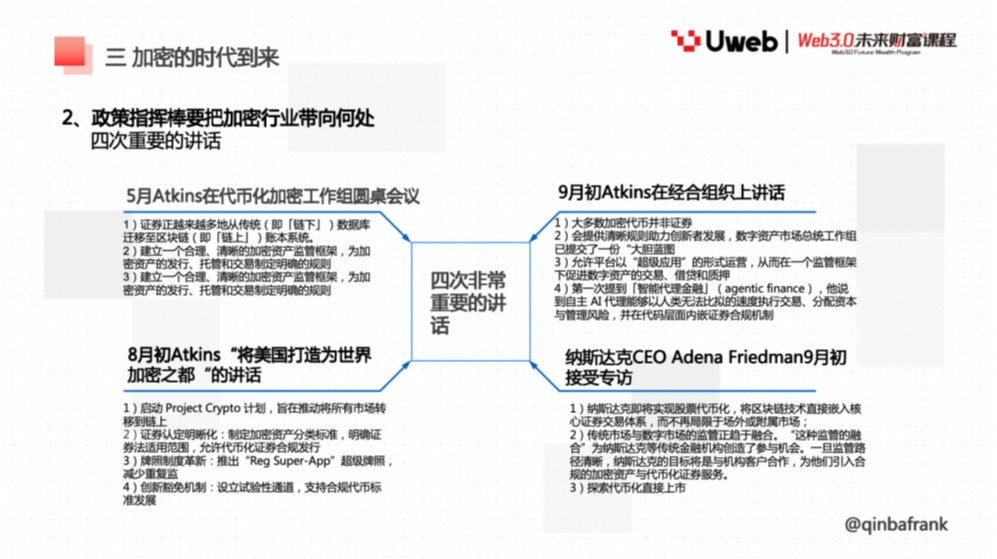
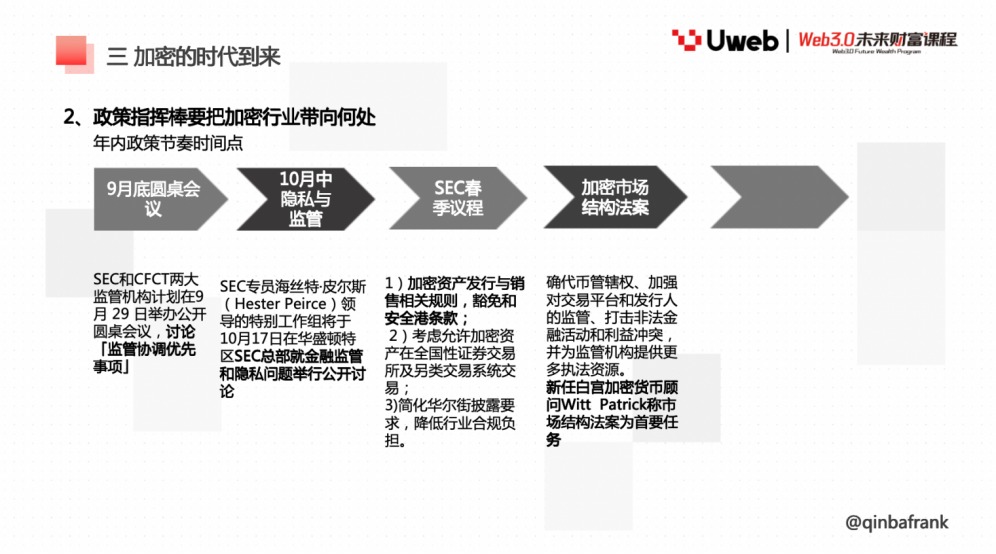
Everyone believes that the current market is driven by policies and traditional ETF funds. If we want to deeply understand macro-driven policies, we need to pay attention to where policies will take the market. I believe these four speeches are very important.

In May, SEC Chairman Atkins mentioned for the first time in the tokenization working group that securities are increasingly moving from off-chain to on-chain, and he needs to establish a compliance framework. He believes that the market's attention to his speech should have started with the Project Crypto proposed in August, promoting the transfer of all US stock assets to on-chain and clarifying the applicability of securities laws, introducing a super license that covers investment trading, wealth management, and custody. In September, he delivered a speech at the OECD.
Then, at the end of August, Nasdaq announced its intention to apply for a tokenized market for US stocks. Many believe this involves stock tokenization; however, Nasdaq's CEO stated in an interview in early September that it does not only involve US stocks but aims to directly embed blockchain technology into the traditional securities trading system, utilizing distributed ledgers and transforming the traditional securities trading model. Once regulation is clarified, compliant crypto assets and tokenized securities will be introduced.
I believe that this year or next year, we may be able to trade Bitcoin and Ethereum directly on Nasdaq. Another noteworthy development is direct listings through tokenization.
I recommend everyone carefully read the original content of these four speeches, as it can help deepen your understanding.

In 2023 and 2024, there is a competition for jurisdiction between the SEC and CFTC. This year, they began to cooperate, and the Digital Asset Market Regulatory Act passed this year may unify the US regulatory departments into a single committee to work together, rather than acting independently or competing for power.
Currently, there are multiple departments regulating the crypto industry in the US, such as the SEC, CFTC, the US Department of Justice, the New York Department of Financial Services, the Financial Crimes Enforcement Network of the Treasury, and the Office of the Comptroller of the Currency under the Federal Reserve. We often see these departments in the media, and most of them operate independently, enforcing laws separately, and sometimes even duplicating enforcement, which is also a problem that US regulation needs to address. Next, the SEC and CFTC will hold meetings to discuss regulatory priorities, that is, how the two agencies can jointly regulate the industry. There will also be a privacy meeting in October.

I believe it is very important to ensure the safety of crypto innovation exemptions. Innovation exemptions refer to drawing a red line for this industry, allowing anything that is not strictly prohibited to be done, including the issuance and trading of tokens, as well as some operations in DeFi. Additionally, it pertains to how to achieve unified regulation, coordinated by one department or committee, not all support, as there are still many matters that need to be prohibited.
We also pay attention to ETFs. Bitcoin and Ethereum ETFs are based on the Securities Act of 1933 and are fully spot ETFs, meaning that the funds investors use to purchase the ETF must fully flow into the spot market to buy the underlying assets. The current ETFs for DOGE, XRP, and SOL are based on the Investment Company Act of 1940, which does not fully anchor to the spot market but can anchor to various derivatives, including options and futures.
Since the SEC Chairman's speech in May regarding the tokenization project working group, xStocks has launched US stock tokenization on Solana, collaborating with exchanges like Kraken. Later, Robinhood introduced US stock tokens, along with Ondo. By September, Nasdaq was also applying for this, and if the cycle is optimistic, it should be achievable by mid-2026. Many current models involve partnerships with brokerages and banks, where banks act as funding channels and brokerages handle securities custody. They register the securities on-chain, after which stock tokens and derivatives are created, meaning contracts based on stock tokens that then enter wallets in various accounts.
In traditional stock trading, stocks issued on exchanges require registration. For example, to trade a certain stock on Nasdaq, it must first be registered with the Depository Trust & Clearing Corporation (DTCC) in the US. Stocks are only traded on Nasdaq, and the transfer of stock ownership requires registration and settlement with the DTCC. My understanding is that Nasdaq does not intend to issue US stock tokenization separately but rather to embed blockchain into the underlying system. The benefit of this approach is that it allows for shared liquidity; once US stocks are launched, all orders for on-chain stock trading will be integrated into a single order book for matching, managed by the DTCC, which will oversee US stocks and smart contracts, specifically allowing these stocks to be brought on-chain.
Several major market makers for US stocks are not only market makers for Nasdaq and the New York Stock Exchange but also for Coinbase and Binance. They simultaneously provide products on-chain, allowing us to trade on DEX or CEX. I believe traditional stock forms may disappear, and the future will be tokenized, which is what they aim to achieve.
This path is very long, and many businesses have already taken the lead, with cases of regulatory lag emerging, which I will discuss later. I believe the concept of real assets is very important, in addition to the large-scale tokenization of US stocks we currently see. The rebound market for small-cap US stocks can directly issue stock tokenization, and since there are only options and no perpetual contracts for US stocks, if a small-cap stock mints on-chain and simultaneously opens a perpetual contract, with both the token and stock rising together, I believe capital market players will thrive.
I think this will have a significant impact on the future of the crypto market. Over the past two years, whether in VC coins or the entire ecosystem, the core issue has been a lack of implementation; it has essentially been air.
Looking back from 2023 to now, the wealth effect of US stocks far exceeds that of the digital asset market, with Bitcoin's gains not matching those of Nvidia. Some large tech companies in the US, including some mid and small-cap stocks, as well as the AI sector, have seen many gains reaching tenfold or even higher in recent years. However, in the crypto market, aside from meme coins, very few have achieved tenfold returns; almost none, but the issue with meme coins is their lack of sustainability. Many altcoins or meme coin trends last only a few days or a week, and if one is not careful, it can easily lead to a rollercoaster ride.
I believe the financial market is a capital paradigm, and the core issue lies in the poor wealth effect, which leads many to migrate. I have seen many traders or investors in native digital assets who previously did not invest in US stocks begin to shift their funds to US stocks since the second half of last year. This is driven by the wealth effect; when funds reach a certain scale, they may focus more on stability rather than high volatility.
Additionally, there is the tokenization of private equity in unlisted companies, and some companies are already doing this. Nasdaq itself has a market for trading equity in unlisted companies, which can explore direct tokenization of IPOs.
I believe some crowdfunding models from back in the day will also perform well under the new circumstances, such as ICOs. We must be aware that many project teams face very high moral hazards, meaning they have significant power but very few obligations. The significant power refers to the ability to modify various aspects of the project. The minimal obligations mean that as long as investors unlock their investments, the task is complete, and the project can then rest on its laurels.
This was the case in 2016 and 2017, when the foundation model was formed to evade regulation. This includes the article mentioned earlier by a16z in August, which stated that it is time to change the foundation model in the crypto industry. Currently, the rights and responsibilities in the foundation model are highly unequal, with great power and relatively small obligations and responsibilities, which is also the dilemma faced by many crypto VCs today.
In 2021, the financing scale for crypto VCs was generally in the tens of millions of dollars; amounts of $100 million or $2.1 billion were considered relatively large. However, by 2022 and 2023, we saw a16z's third round of financing reach $2.7 billion, followed by a fourth round of $5 billion. Early VC investments were micro-models; for instance, if a VC had $100 million, they planned to invest $5 million in each project, meaning they would invest in 20 projects, but this required reviewing 1,000 to 2,000 projects. Larger VCs can only invest in big projects; if a VC's scale expands to $1 billion, 1% of that is $10 million, meaning they need to invest in 100 projects, which requires monitoring thousands of projects and staffing more people to improve efficiency.
The previous market cycle was very hot, with loose liquidity pushing up first-round market and VC fees, leading to a natural demand for large projects. At the same time, many excellent founders were introduced during this cycle, many of whom had backgrounds in major tech companies or financial executives in Silicon Valley, along with many VC investors.
Before 2021, if a project raised $20 million to $30 million in early financing, it was already quite good. By 2022, many outstanding early-stage founders could raise $100 million in their first round of financing, with some private placements reaching $1 billion, $2 billion, or even $5 billion. As monetary tightening began, primarily relying on fiscal policy, the leverage effect of fiscal policy was not strong, and liquidity was limited, leading to the market being unable to support such large projects. By the end of 2023, some projects reached a market cap of $1 billion to $2 billion upon listing, and such high valuations require greater liquidity support; if that support is insufficient, a decline becomes the only pathway. The main reasons are threefold:
First, the expansion of the first market has pushed up the valuations of many projects, but the market's liquid funds are not abundant. Second, the past few cycles have been narrative cycles, such as the ICOs of 2017-2018 and the DeFi, Metaverse, and Web3 trends of 2020-2021. However, the market cannot always rely on momentum-driven narratives; we can pay for narratives, but if after two cycles the narrative has not materialized, the market will also show fatigue. Third, the approval of ETFs has opened up traditional funding channels into digital assets, bringing in a lot of "old money." This old money places greater emphasis on certainty of returns. In the past, there were many assets with hundredfold or thousandfold increases, but for many traditional funds, the first consideration is certainty and whether the asset can sustain its development, which is a very important point.
At the same time, market investors are becoming increasingly mature, with more old money entering; a more mature market will actually become more differentiated, which is the essence of an efficient market. I recommend two books: "The Great International" and "A Century of Hong Kong Stocks," which can provide a clearer understanding of the development of capital markets.
In April 2024, I proposed the view that digital assets have entered a new normal, just as US stocks have shown differentiation. Of course, the differentiation in US stocks has not just emerged in the past two years; it has always existed, but in recent years, the rapid development of large tech companies has led to increasing market monopolization and higher profit margins.
Currently, there are about 5,000 companies in the US stock market, with the top 100 companies accounting for 93% of the market capitalization. The next 3,000 companies collectively account for only 5% of the total market cap, with an average market cap of only $1 billion. The daily trading volume of these 3,000 companies is only between $1.5 million and $2 million. Therefore, as the capital market matures, it becomes more differentiated, as people are now more rational; investors either pay for value or for growth. A more mature market will increasingly reward these two aspects.
Thus, I also say that the digital asset market has entered a new normal. In the past, many people's investment logic was that the bottom of the big cycle had arrived, and they only wanted to wait for takeoff. Now, this strategy is becoming less suitable. This means that in addition to timing, one must also choose the right place. People should no longer expect a comprehensive altcoin season; that will not happen again. There will only be localized hotspots, and it is wise to focus on some main projects.
At the same time, with the on-chain of real assets, this exerts pressure on altcoins. The wealth effect of these assets is not inferior to that of altcoins and has sustainability. Although many small-cap US stocks also experience volatility, as long as there is fundamental support, their sustainability will be very strong. There are still opportunities; the crypto space lacks quality assets. Currently, there are thousands of tokens in the digital asset market, but truly high-quality ones are few. For example, on Hyperliquid, which has the largest on-chain trading volume, only a few assets like Bitcoin and Ethereum have significant trading volume, while other assets have little to no trading volume. Additionally, on AAVE, almost all TVL is in Ethereum or wBTC, because using other assets as collateral can lead to significant price fluctuations, making liquidation easy.
Therefore, I believe the logic of real assets going on-chain has significant advantages for DeFi. A large number of quality assets can be used as collateral, greatly expanding this space. We see why DeFi's TVL has only returned to the peak of 2021; the core issue is the lack of quality assets. Without quality assets, leverage cannot be increased. Only with a greater supply of quality assets can this matter be supported.

Currently, the RWA amount reported on the RWA.xyz website is about $30 billion, with the largest being private placement bonds. The private placement bond is Figure, which recently listed on the US stock market; I refer to it as the first RWA stock. Figure is a real estate on-chain project in the US, which has sparked significant controversy, and we will discuss this later.
Over the past year, CEX has faced significant challenges from on-chain DEX. I believe that in the next five years or even longer, we will increasingly feel the impact of the trend of US stock tokenization on exchanges, as asset operations and user operations undergo tremendous changes. Currently, the responsibilities of exchanges are mainly focused on earning interest on deposits and Launchpad activities, but these methods and operational strategies will face significant challenges in the future: US stock tokens may not have new listings or airdrops, and user operation methods or growth strategies will also change. Which platforms can truly bridge stocks and commercial assets? This is also why Robinhood is so strong.
I have been discussing Robinhood for several years; it serves as a stronghold for retail investors in US stocks, and there is significant potential. The market is currently showing a trend toward retail participation, and I will elaborate on why the market is becoming more retail-oriented.
A new batch of DEXs will emerge on-chain, primarily based on derivatives of these real asset tokens, including contracts, options, and binary options. This is also why CEXs have been aggressively promoting xStocks recently, as some exchanges are falling behind on-chain DEXs.
Currently, users are migrating from centralized to on-chain platforms, and from centralized assets to US stock token projects. This year, we have seen a shift from digital assets to US stocks, and as assets go on-chain, there will be no need for further migration. For example, the trading volume of Ondo's US stock tokens is the largest, reaching two to three hundred million dollars, and two weeks ago, the top 10 had already achieved a daily trading volume of 50 million dollars.
The above content discusses the impact on digital asset markets and exchanges. Next, I want to share that the conflict caused by business and regulation is very severe, specifically regarding the Figure project.
Figure, founded by the creator of a US stock campus loan company, is primarily focused on moving real estate loans onto the blockchain. The founders of Figure and DefiLlama recently had a dispute on Twitter. Figure claims to have approximately 13 billion dollars in real estate loans, which have been placed on its self-developed Provenance blockchain, which is a permissioned or consortium blockchain.
DefiLlama, on the other hand, stated that the data seen on-chain only amounts to a few hundred million dollars, questioning the authenticity of Figure's assets. This sparked a series of controversies, from questioning the authenticity of on-chain data to whether the loan business is also fraudulent. A newly listed IPO company like Figure should have all its business and financial data rigorously audited by a third-party auditing firm. The cost of fraud for a publicly listed company in the US is enormous; if discovered, the company would face massive compensation, and the core team could face imprisonment, while the auditing firm would also face severe penalties from the SEC. Therefore, I believe that Figure's business data is likely to be authentic.
So where does the problem lie? In fact, DefiLlama's TVL only records the user-uploaded data on the protocol but does not reflect their actual held assets. Figure has only a portion of its business data on-chain because it involves real estate loans. Most of the business data processes still occur off-chain. This is not a technical issue but rather a legal system that is not yet fully developed. Under the US securities framework, the transfer agent, which is the entity responsible for the settlement and registration of securities, is the legally recognized holder of ownership certificates. This transfer agent is the DTCC mentioned earlier, which conducts transfers on its electronic ledger to be legally recognized. The legal system recognizes off-chain activities, but DefiLlama only counts on-chain data, leading to a disconnect caused by business advancement and regulatory lag, a problem that will increasingly arise in the future. Therefore, I am very much looking forward to the SEC's innovative developments. In the future, on-chain registration could also become a final legal act.
Part Four: Crypto Controversies and Major Turnover Periods
1. Crypto Controversies
This is a previous crypto controversy of mine. Since the start of DeFi, GameFi, gaming, and social applications in 2021, everyone has been looking forward to more applications in the industry. When I worked at an internet company, there was a saying in traditional tech companies about achieving tenfold efficiency. This means that when technology improves the efficiency of existing businesses by more than ten times, users will automatically migrate. The crypto industry has been working on adoption for many years but is still stuck at the trading level.
Essentially, in traditional businesses, blockchain is not a productive force but rather a production relationship, and its enhancement of many businesses is not significant. For example, the slow speed and high gas fees on-chain are insufficient to support high-frequency or massive user interactions. However, in the issuance, trading, and circulation of on-chain assets, anyone can issue assets. Assets can be quickly migrated seamlessly from one exchange to another, from one wallet to another. SEC Chairman Atkins mentioned in May during the tokenization crypto working group roundtable that "on-chain securities also have the potential to reshape the securities market, encompassing all aspects of issuing, trading, holding, and using securities. For example, on-chain securities can achieve automatic distribution of dividends through smart contracts.
Tokenization can also enhance capital formation, transforming originally illiquid assets into tradable investment opportunities, and blockchain technology is expected to expand the various new uses of securities." The reasons they are promoting this are that such contracts or tokenization have advantages over traditional securities; secondly, it enhances capital, meaning integrating all US assets onto the blockchain, allowing more funds to be closely tied to US assets. This is similar to stablecoins, both representing a new era's strategy.
Therefore, I believe the crypto industry represents a new capital paradigm, signifying more efficient asset issuance and liquidity. The future may not be the social, e-commerce, or gaming applications we expect, but rather a blend with existing businesses, forming hybrid models. For example, I could use tokenization to transform existing business scenarios or merge real assets with tokens.
Another point regarding the controversy is the combination with AI. If in the future, the on-chain is an agent and the off-chain is a bot, their interactions could utilize smart contracts and digital assets. There is already a case where Coinbase partnered with Google Pay to develop a protocol that allows agents to autonomously make payments, marking a shift from communication to transactions between machines.
2. Major Turnover Periods
The major turnover period is a concept I created. The cycle we are experiencing is driven by traditional funds, ETFs, crypto policies, and compliance. There are two parties in this cycle: buyers and sellers. The buyers are traditional listed companies, and in the future, there will be more listed companies and fund management companies. For example, recently, Trump mentioned that US pensions have begun to invest in cryptocurrencies, although the policy has not yet been implemented. The sellers are long-term holders and low-cost investors.
Why do I say that asset attributes are becoming more solid? For instance, Bitcoin, as a risk asset, was previously considered digital gold. In April of this year, I recognized several new concepts belonging to super-equity assets, which are assets not controlled by any strongman or government. I believe this year is the first time in the past five years that Bitcoin's decline has aligned with the decline of the US stock market. From February to April, the Nasdaq fell by 26%, the S&P by 18%, and Bitcoin dropped from 110,000 to 70,000, which is a 33% decline—this is the same magnitude, something that has never happened before. Previously, Bitcoin and the Nasdaq would have a multiplier effect of 2 or 3; for example, if the Nasdaq fell by 15%, Bitcoin would fall by 30%; if the Nasdaq fell by 20%, Bitcoin would be halved.
Another reason why I say asset attributes are becoming more solid is the typical example of Ethereum. First, Ethereum is a relatively safe place and has not encountered major issues. The second aspect is the push for asset tokenization. Why did Tommy Lee promote BitMine as an Ethereum wealth company? Because he sees the trend of asset tokenization and believes Ethereum will benefit from it. This is due to both internal and external factors: the assets themselves are good, with a rich degree of decentralization and security; at the same time, the policy trend has driven many traditional funds to begin investing. From December of last year to April of this year, Ethereum's price dropped from 4,600 to 1,600 dollars, and the concentration of Ethereum's chips has significantly increased, with a core group of people being optimistic, which represents the buyers.
Of course, buyers will not keep buying indefinitely. The inflow of buyer funds is influenced by policy expectations and macroeconomic conditions, with the flow sometimes strengthening, sometimes weakening, or even reversing. For example, if I am more optimistic, I will not sell or will sell less; if I think it is not good, I will throw it out.
This is what I wrote on April 21: From a long-term perspective, the world is becoming increasingly divided, necessitating super-sovereign assets. This super-sovereignty is reflected in being unaffected by institutional mechanisms and strongman politics, with no party able to completely dominate. Bitcoin, Ethereum, and Solana, which emerged in early August, all benefit from this trend.
Currently, the amount held is approximately 175 billion dollars in ETFs held by national reserves and some treasury companies. Many US institutions began entering the Ethereum market in the second quarter. In the short term, the strength or weakness of the economy, inflation trends, and expectations will all affect the liquidity expectations of buyer funds. Positive expectations will accelerate inflows, while negative expectations will weaken them or even lead to outflows. In the medium to long term, we need to observe whether the asset attributes are solid and at what stage the large-scale procurement process is.
From my perspective, first, the penetration rate is relatively low; second, institutionalization has just begun; third, there are cyclical issues. This reflects a decrease in volatility. From Bitcoin's perspective, this year is the first time the Nasdaq and Bitcoin have shown a similar downward trend.
This is essentially a long-term, silent large-scale turnover. I do not believe this signifies an eternal bull market; cycles are changing, but that does not mean there are no cycles. Everyone must remember that assets will not only rise indefinitely; there will definitely be adjustments. For example, as inflation begins, market expectations of recession will slow the flow of buyer funds, or even lead to outflows for hedging; the whales and long-term holders in the digital asset market will also need to take profits, which will bring about a market adjustment.
Therefore, my judgment is: if the net inflow of digital asset ETFs gradually increases, and the costs for short-term on-chain holders gradually rise, this indicates a possibility for the market to move upward; if the ETF proportion is negative, and the net inflow of exchanges rises simultaneously, it will trigger a redistribution path.
Whenever the price reaches a new level, it will trigger some early investors or employees to sell their funds. In recent years, we have seen many Bitcoin wallets from before 2013 and 2015 moving, as well as early Ethereum ICO wallets. Because once the price rises to a certain level, it will inevitably raise many people's doubts. If buyer funds are strong, they will absorb all the selling funds. If macro expectations are poor, such as the recent interest rate cuts, I have also mentioned that there may be a possibility of selling the news, and this wave of selling may exceed expectations.
Another important form in the major turnover is DAT (Digital Asset Treasury). Bitcoin, Ethereum, and Solana all have corresponding treasury companies that issue stocks, conduct private financing, and then use the funds to buy coins. This is also a form of operation. Some US institutions cannot directly invest in digital assets; many institutions need to go through a committee to confirm their purchases of digital assets, but they can buy stocks. Therefore, this connects them with many traditional financial institutions and serves as a pathway to increase the risk transmission of crypto assets.
The essence of MicroStrategy is just that; its core is financial play, typically involving the following models: passive single-asset holding, active single-asset trading, and multi-asset portfolios. Different models correspond to different risk management actions.
Do these models carry risks? I believe that from a model perspective, there is no risk, but people do carry risks.
For example, MicroStrategy began its transformation in 2020, initially issuing stocks to buy Bitcoin, later issuing convertible bonds and perpetual bonds. They hold over 600,000 Bitcoins, with annual interest costs of about 100 to 200 million dollars. They weathered the 2022 bear market without selling Bitcoin. Looking at Ethereum's treasury, such as BitMine, they currently appear to be equity financing, directly issuing stocks at market price to raise funds to purchase Ethereum. From this model perspective, there is no risk. The price of coins will certainly fluctuate; it just depends on whether they can withstand it. The CEO of MicroStrategy stated that he issues stocks to buy coins and issues stocks to pay interest. As long as he can raise funds through stock issuance to cover interest costs each year, that is sufficient.
If it's just a matter of human risk. Many leaders of DAT companies now believe they are the next MicroStrategy. Are they genuinely optimistic about this asset, or are they just looking to speculate on stocks? Perhaps when the market declines, they will run faster than others, leading to various pessimistic events.
In the third part, we mainly analyzed why the crypto industry has shifted from being widely criticized to becoming a regulatory darling, and where the new regulations will take the crypto space. We also discussed the major turnover period, how we view the market price framework, who the buyers and sellers are, and the nature of the game between them, as well as the strength and weakness relationships.
Part Five: Accelerated by the AI Wave
Next, I want to discuss another aspect that I am paying attention to, which is also of great concern to everyone: Is there a huge bubble in AI?
My view is that there will be a bubble in the short term, but the overall bubble has not yet formed. First, the growth rate is slowing down. We can observe when the user growth of ChatGPT stagnates; we can consider this approach. OpenAI's revenue last year was about 3 billion dollars, and this year it has reached 13 billion dollars. Second, an AI programming company is expected to have a revenue of about 10 billion dollars this year, compared to only a few billion last year. Many companies in the US are now using AI for large-scale programming, which they may have been doing for over a decade, and as mentioned earlier, many companies in the US are using it, which is the goal of the customers. Large models are being used for programming, so I believe the speed is changing.
Currently, the applications of those large AI models I see seem to be limited, such as Duolingo primarily for learning English, some language translation, and in the defense and military sectors, as well as in the US industrial sector using AI for detection, etc. We are focusing on the earnings season of US stocks. Although I only focus on tech stocks, I also pay attention to the earnings reports of commercial companies like Amazon and Walmart, particularly whether their application scenarios for AI are increasing, what their statements about AI are, and whether they believe AI is enhancing their performance or business.
The extent of this enhancement is actually significant, but why do we not feel it as deeply? The internet or mobile internet has reformed traditional industries, targeting many inefficiencies and complex processes in traditional industries, which are evident limitations or drawbacks. The internet inherently achieves centralization, breaking down personnel efficiency, and the efficiency is actually very fast. Even with the advantages of internet technology so evident, it took 10 or 20 years to reach today's internet level.
AI's situation is even more different. AI is the human brain, the thinking, our software. In the past, software has been well optimized, meaning the average governance cost in society. AI must exceed the average governance cost of society for us to see significant value.
The first point is that Sam has said that when the level of cognition is reduced to a sufficiently large extent, about 1000 times or more, you will find that it greatly enhances efficiency.
The second point is that we previously mentioned the concept of penetration rate when investing in the internet and new energy vehicles. I believe that investing in tech stocks involves the issue of penetration rate. The penetration rate refers to the proportion of a technology's application in the industry and society as a whole. Typically, 1-5% represents the early stage, and 10% is the critical period of moving from germination to mainstream. This is a leap. If it exceeds 10%, it indicates that the technology is effective.
Due to the early batch of beneficiaries starting to use it and already seeing results, it can easily enter a rapid growth phase, quickly penetrating from 10% to 30%. I have a very clear feeling about this. In 2013, when I first entered the mobile internet, after a few years of development, by 2017, the smartphone usage rate had reached 45%. A significant reason for entering the digital asset space was realizing that the mobile internet industry no longer had dividends. The same goes for new energy vehicles.
Goldman Sachs released a report on AI adoption in the US for the third quarter this year, showing that AI adoption among US companies reached 9.7% by the end of the third quarter, about to cross the 10% threshold. I believe it is highly likely to cross the 10% threshold, and once it does, it will enter an accelerated state. The development speed of AI will be faster than we imagine, and it will accelerate forward in the future.
From a timeline perspective, tech companies like Nvidia, Meta, Microsoft, Facebook, and Google are now laying out their AI strategies with business and data support, which is different from the companies in 2000 that had little or no revenue.
Microsoft's profit growth rate in the second quarter was 35%, with a PE ratio of less than 40, and a quarterly profit of 26 billion dollars; Meta's profit growth rate in the second quarter was 38%, achieving 20 billion dollars in a single quarter; Google had a quarterly growth rate of around 20%, with profits increasing by 30 billion dollars. This means these large tech companies can accumulate 100 billion dollars in a year.
Last June, I tweeted: "I believe Palantir has the potential to become the number one arms dealer of the future, the Lockheed Martin and Raytheon of the AI era." At that time, Palantir's stock price was 20, and this year it is 190. Palantir monopolizes the US Department of Defense, CIA, US Army, Navy, and Air Force, and this week, during Trump's visit to the UK, it also secured an order from the UK Ministry of Defense.
I believe that the entire weapon system and defense will need to be rebuilt around AI in the future. Last year, I spent a lot of time researching and tweeting about Palantir.
Do you think there is a bubble? I believe there is. A company with a PE ratio of about 600 will face severe valuation cuts when it encounters a valuation kill, with its stock price dropping from 120 to 60 between February and April this year. My judgment on US stocks is that when adjustments occur, it is a triple kill: killing valuation, killing performance, and killing logic. Killing valuation means that when prices rise too much, valuations are brought down to a reasonable level. But as long as performance continues to rise, and the growth rate does not decline or fall sharply, the logic will not change, and future rebounds will also be the most intense. Killing performance refers to performance disasters, such as significantly missing expectations or even losses, indicating that the business has entered a bottleneck period. The most terrifying is killing logic. After April this year, US stocks fell sharply, which felt like a killing logic moment because the market feared a collapse.
In 2022, Meta's entire metaverse business faced a disaster, with the company suffering significant losses, and its market value plummeting by 25% overnight from 1 trillion. This is killing logic. Afterward, it seized on AI and found a new logic.
There are also autonomous driving robots, where there are many examples of utilizing AI or using AI to spur other industries. The integration of AI and crypto is an example I mentioned earlier. On September 16, Coinbase and Google launched Agent Payments—a smart payment protocol. On-chain agents can not only interact and communicate with each other through API calls but can also pay fees to each other using stablecoins.
The development of agents represented by Agent and bot is migrating from the information and financial levels. In the future, machines can interact, communicate, and collaborate with each other. Mutual opening is a very important point. This is just the beginning and cannot be realized immediately, but this is my positioning for the future new economic cycle. Analyzing from a 5 or 10-year dimension, the combination of AI and crypto accelerates the promotion of the entire industry and productivity.
I believe that in the future, about two-thirds of the economy may shift off-chain, and one-third will move on-chain, with a high degree of integration between on-chain and off-chain. The future economy will be such that interactions between people can only create a part of it, such as buying, selling, trading, and communication; another part of the economy will come from transactions between people and machines, which will also create significant value. I have always believed that technological progress is the greatest driving force for development.
Part Six: Some Shallow Thoughts on Future Investments
The earlier parts of the course mainly discussed my analysis framework for personal macro and Trump's development policies. Next, I will discuss what kind of blueprint the combination of AI and crypto will build for this industry. As I have said before, do not doubt their determination, but you can question their effectiveness. In other words, we need to remain rational and continue to observe how large the gap is between the final results and the envisioned blueprint.
Finally, I want to share my thoughts on investment.
First, choose core assets.
I tend to be trend-oriented and long-term, holding assets for at least a quarter or longer. My reflection is that over the past two years, the vast majority of stocks have not outperformed Bitcoin, and most companies in the US stock market have not outperformed Nvidia. However, Bitcoin and Nvidia happen to be the first assets seen in the US stock market and the crypto space over the past two years, and many people have not held onto them or did not have them at all. Some people think that if they invest in smaller assets, they might have stronger explosive potential and grow faster. Therefore, I believe that in the future, beta may be the biggest alpha. Perhaps some assets will significantly outperform Nvidia or Bitcoin at some point, and at that time, it will be necessary to observe over a longer period. During offensive periods, one can choose other assets, while during defensive periods, one should choose core assets.
In the US stock market, it is important not to overly focus on the fundamentals of major tech stocks because the fundamentals are generally good and have no practical significance. Instead, attention should be paid to the technical aspects, determining when to take profits and when to buy the dip. When the market declines, one should dare to buy rather than blindly chase highs and sell lows. Of course, this can only be done with core assets; non-core assets are a different matter.
In the AI era, the winner-takes-all effect will become increasingly evident. Previously, it was the 1, 2, 8 rule, gradually shifting to the 1, 9 rule, and in the future, it will be the 1, 99 rule. This also confirms the 100-year history of the US stock market, where the proportion of the top 10 tech stocks has gradually increased. Before ChatGPT, half of the top ten stocks were tech companies, and the other half were non-tech companies, but now all of the top ten are tech companies. The further concentration of resources and capital, technological barriers, economies of scale, data network effects, and the speed of iteration and first-mover advantages are all at play.
In the past, many traditional companies reached a ceiling when they hit 10 billion or 100 billion because they were limited by their physical or offline aspects, leading to management radius issues and many efficiency problems. However, the internet, AI, or mobile internet do not have these issues. Now, many tech giants have tens of thousands or even hundreds of thousands of employees, and managing tens of thousands of people is not much different from managing a few thousand. The core issue is the automation of office processes. For example, tools like Lark and Feishu can visualize all workflows, greatly enhancing the management radius and solving management limitations through technology. On the other hand, through the low-cost large-scale development of the internet, a department or team can provide services to hundreds of thousands or even millions of people.
Therefore, in the future, it is essential to focus on the leaders, whether in stocks or digital assets, and only pay attention to core assets. Small funds can take a chance on some alpha assets, but large funds must be placed in core assets.
Core assets will rise first when the market is bullish. If risk appetite increases, one can shift to other positions. Essentially, this corresponds to certainty and growth potential. The core of price investment first requires certainty; we need to determine whether this asset will still exist in 5 or 10 years. Most of the crypto market is just a wave, which is a normal situation. After being listed on exchanges, during good market conditions, prices can rise by millions or even tens of millions of dollars, and some can attract even more funds. However, as mentioned earlier, the responsibilities and rights of project parties are often unequal. Few people, like Vitalik Buterin, who already have substantial funds, continue to work tirelessly. Most founders in the crypto space quickly cash out after making money, and many are now in a state of complacency.
After considering certainty, we then look at growth potential. Growth potential can be divided into several categories, such as stock profits based on performance growth rates; value stocks focus on cash flow and PE ratios. When I looked at Palantir, I believed its investment space was very large, and its price was around 15 dollars at that time. Another example is Robinhood, which acquired a Bitstamp company and deeply engaged in the digital asset ecosystem. Later, in July this year, it launched US stock tokenization, which is essentially not US stock tokenization but a contract for difference. However, it aims to seize this field and occupy users' minds, establishing a position in the US stock tokenization space. Subsequently, its stock price rose from 80-90 to 120-130, highlighting the importance of growth potential.
The so-called growth potential specifically refers to how many institutions are adopting it and the speed of their adoption. I believe that for the competition, we need to observe whether it can stand on the current side. For Bitcoin, it has no competitors in the realm of digital gold or fully collateralized products. It broke through from assets like LTC and BCH in 2017 and 2018, and after experiencing these, Bitcoin has no rivals in this track. Ethereum, on the other hand, faces many challenges in the public chain space, such as Solana, but it has a very high chance of success.
Growth potential and certainty correspond to its position in the entire industry chain. The core is the competitive landscape, and we need to pay attention to whether the competition is sparse, one strong and many strong, three divisions of the world, or a hundred boats competing. The worst scenario is a hundred boats competing, where each is about the same; the best is sparse competition, like Nvidia in the GPU space, which monopolizes 90% of the computing power. In the large model field, it is one strong and many strong, with OpenAI dominating other AI companies. Tech stocks are actually divided into three or five parts, with each having its own advantages, which requires us to evaluate and deepen our understanding of core assets.
The future will be an era of high volatility, and only core assets can withstand this volatility. On March 12, I saw Bitcoin's price at over 7,000, and an hour later, it dropped to over 3,000. I was a bit skeptical and could only buy it with tears, as there was nothing else to do.
Second, the new normal of the crypto market.
Another point is the "new normal of the crypto market" that I mentioned earlier. You can refer to my previous tweets, where I discussed my thoughts on why altcoins performed so poorly last year, along with the logic and reasons behind it. I believe that the more mature the market, the more it differentiates, and the Matthew effect becomes more pronounced: the strong get stronger, and the weak get weaker, unless one day there is truly unlimited quantitative easing and super strong liquidity that allows us to embrace these worthless assets because they grow faster.
In the digital asset space, the most growth-oriented and certain targets will attract the most market funds, and this effect will only strengthen in the future.
Third, are there still cycles in the crypto market?
Another topic is whether cycles still exist. We cannot discuss the topic of an eternal bull market; no market's assets only rise without falling forever. Cycles are merely changing, not absent. Future cycles may shift from a four-year cycle to a macro-driven cycle. According to the traditional four-year cycle calculation, by the end of this year, it will be about time. Will there be a significant downturn next year? I believe the volatility is gradually decreasing, as seen from February to April this year, where Bitcoin's decline was at the same level as the US stock market, a situation that has not occurred in the past five years. If there is a significant decline, it must be due to a major macroeconomic negative or shock, rather than other factors.
Another point I want to mention is the US stock market. We can observe the adjustments and growth paths in US history. Once touched, it almost develops upward without looking back. Essentially, I believe this reflects the solid underlying purpose of the US stock market, which encourages people to buy the dip. However, the asset logic in the crypto market is not solid and requires adjustment; the crypto market is more influenced by emotional expectations and capital.
At least this is still the case for now. For example, under the framework of major turnover, factors affecting buyers include whether there is liquidity and whether the flow is fast or slow.
Below is my summary of the reference for market adjustment levels:
In my personal judgment system, the adjustment range of the US stock market (taking the Nasdaq as an example; the S&P usually has a slightly smaller range than the Nasdaq):
-10% up or down is considered a small adjustment;
-15% to -20% up or down is considered a medium adjustment;
-25% to -30% or more is considered a large adjustment.
In the past twenty years, there have been four major adjustments:
1) From early 2022 to November, the Nasdaq fell by 28%, and the S&P fell by 32%, mainly due to inflation reaching a forty-year high and the Federal Reserve's fastest interest rate hikes in nearly a decade;
2) In March 2020, both the Nasdaq and S&P experienced declines of over 30% within a month, primarily due to the liquidity shock caused by the global spread of the pandemic;
3) From October 2018 to the end of December 2018, the Nasdaq fell by 25%, and the S&P fell by 21%, mainly due to the Federal Reserve's last phase of rapid interest rate hikes and the US-China trade war;
4) From October 2007 to March 2009, the Nasdaq fell by 56%, and the S&P fell by 58%, primarily due to the financial crisis.
Medium-level adjustments:
1) In July-August 2024, the Nasdaq fell by 17%, and the S&P fell by 11%, due to recession fears and the retreat of carry trades;
2) From August to October 2023, the Nasdaq fell by 15%, and the S&P fell by 11%, due to inflation rebound and treasury buyback crisis;
3) From July 2015 to February 2016, the Nasdaq fell by 20%, and the S&P fell by 15%, due to the first interest rate hike, tech stock valuation digestion, and Brexit;
4) From May to November 2011, the Nasdaq fell by 20%, and the S&P fell by 23%, mainly due to the European debt crisis and the slowdown of the US economy.
The period from February to April this year was special, with the Nasdaq falling by 27% and the S&P by 18%, the former being a major adjustment and the latter a medium adjustment.
I believe the judgment framework is very small; we are in a medium adjustment without past references. You can check and search for what happened at that time to understand the original issues.
Another point is the strength of the US stock market. From a capital perspective, there is a long-term net inflow of capital. In the past two years, about 1 trillion dollars has been used each year for stock buybacks by listed companies. Apple started buybacks in 2017, effectively reducing its circulating shares by 20%. It has repurchased about 500 billion dollars, equivalent to 20% of its stock. Another point is the innovation-driven business, analyzing global industries. At the same time, the scarcity of core assets is relatively rare among equity assets.
I believe that market volatility will inevitably increase in the future. The reasons for the increase in volatility include:
The rise of AI and the fall of the middle class, leading to increased gambling tendencies for transitions. Previously, market opportunities were abundant, and college graduates could easily find jobs. Recently, Harvard University published a paper analyzing job postings from over 100,000 companies in the US from 2022 to now, equivalent to analyzing nearly three years' worth of job postings from platforms like Zhaopin and Boss Zhipin. It found that since the end of 2022, the number of high-level positions being recruited by American companies has continued to rise, while lower-level positions have sharply declined. This is due to the increasing application of GPT in large models, which has replaced many entry-level jobs, contributing to the structural changes in the US labor market.
Abundant productivity means that even if one cannot find a job, it is okay; one can do any job to meet basic needs and enjoy many national benefits. The future will be an entertainment market, similar to the movie "Ready Player One." In the future, entertainment will thrive, and you will only need to watch movies, play games, and invest; trading will also become a financial consumption and entertainment activity.
Retail investor dominance. Previously, people thought the US stock market was institutionalized, but now the power of retail investors is very strong, including the short squeeze on Wall Street in 2021. The reversal of the US stock market in April this year was mainly based on retail investors, as most institutions only entered the market in June. However, retail dominance also means the market will be more emotional.
An era dominated by strong individuals. As mentioned earlier, we are now in an era dominated by strong individuals, where one word can lead to prosperity or decline. When times are good, they are better; when times are bad, they are worse. Trump is not a stable strongman but a volatile one. These factors will lead to increased market volatility, which is what is referred to as gusty conditions. The relationship between rises and falls is very complex, which is why many have found previous market performances uncomfortable.
From a trading perspective, I believe that going long on volatility is a very good trading strategy. For ordinary people, my view is to embrace core assets, which are used for bottom fishing, avoiding emotional fluctuations or market crashes that could affect one's judgment. There is a book called "The Stock Market During World War II," which is excellent and discusses the changes in various countries' stock markets during the war.
A few days ago, I participated in a Space event where everyone discussed that the biggest risk recently is the potential government shutdown in the US. The "Great American Beautiful Act" is a four-year fiscal spending framework that requires approval of a new spending plan at the beginning of each fiscal year.
The Democrats want to increase healthcare spending, but Republicans, especially Trump, are strongly opposed to this issue. Will this have an impact? Rather than looking at the market's performance after a shutdown, we should observe the trends in the coming week. This situation is not a black swan; it should be considered a gray rhino.
Finally, I will share my four analytical perspectives, including: changes in technical paradigms, management of policy systems, circulation of currency, and geopolitical and supply shocks.
Before the pandemic in 2018, we only needed to focus on these three points: paradigm, policy system, and currency liquidity. But now, in the era of de-globalization, we also need to pay attention to geopolitical and supply shocks. My view is that macro factors dominate expectations, expectations influence emotions, emotions change supply and demand, and supply and demand drive prices. We are now in an era of high volatility, emotional responses, and anticipatory runs, where many positive developments have already been fully priced in and triggered multiple times in the market.
This is what I wanted to share with you today. I hope everyone can have a smoother experience in future investments. Let's work hard together and communicate more. Thank you all.
免责声明:本文章仅代表作者个人观点,不代表本平台的立场和观点。本文章仅供信息分享,不构成对任何人的任何投资建议。用户与作者之间的任何争议,与本平台无关。如网页中刊载的文章或图片涉及侵权,请提供相关的权利证明和身份证明发送邮件到support@aicoin.com,本平台相关工作人员将会进行核查。