The wave of cryptocurrency companies going public is coming, how should we play the on-chain Pre IPO?

CN
5 months ago

In June of this year, internet brokerage giant Robinhood launched a new service for European users, offering trading opportunities for "stock tokens" of top private unicorn companies like OpenAI and SpaceX. Robinhood even airdropped a small amount of OpenAI and SpaceX tokens to eligible new users as a way to attract them.

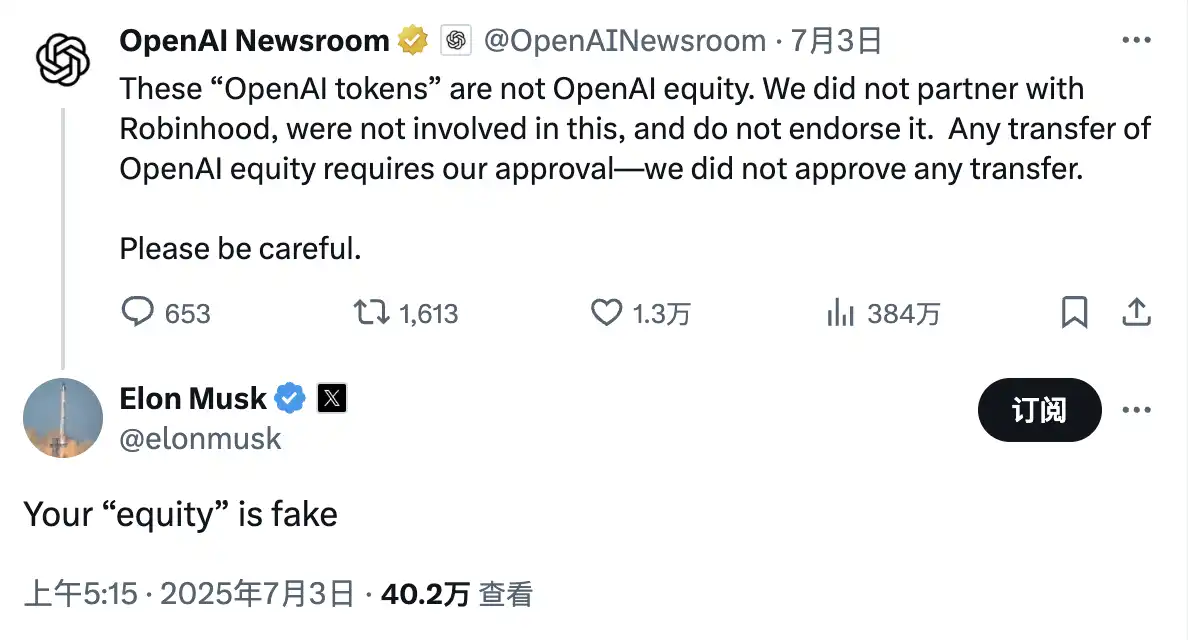
However, this move was immediately opposed by OpenAI. OpenAI officially clarified on X, stating, "These OpenAI tokens do not represent equity in OpenAI, and we have no partnership with Robinhood." Under this announcement, Elon Musk did not directly comment on Robinhood's tokens, but he retweeted and commented on OpenAI's statement, sarcastically saying, "Your own 'equity' is the fake one." This jab not only mocked OpenAI's capital operations after becoming a profit-driven entity but also highlighted the strong resistance from private companies regarding the loss of "pricing power" over their shares.

Despite the skepticism, the attempts by traditional brokerages reflect a strong market interest in on-chain Pre-IPO asset trading. The reason is simple: the enormous benefits of the primary market have long been monopolized by a few institutions and high-net-worth individuals, with many star companies experiencing exponential growth in valuation at the time of going public (or being acquired). For example, design software company Figma, which failed to complete its acquisition by Adobe due to antitrust issues, went public independently in 2025 with an initial price of $33 per share, closing on its first day at $115.5, a staggering increase of 250%; this price corresponded to a market capitalization of nearly $68 billion, far exceeding the $20 billion valuation discussed during Adobe's acquisition negotiations. Similarly, the recently listed cryptocurrency exchange Bullish saw its stock surge by 290% after opening.
These cases indicate that investing in such companies before they go public could yield returns of several times or even dozens of times. However, traditionally, it has been relatively difficult and complex for ordinary investors to participate in such opportunities. The appeal of the on-chain Pre-IPO concept lies in allowing retail investors to share in the appreciation dividends of future public star companies in advance.

The Scale and Barriers of the Private Equity Market

Over the past few decades, the global private equity market has grown rapidly and is vast but highly closed off. According to research by Yann Robard, a partner at Dawson Management, in the article "Why Private Equity Wins: Reflections on a Quarter Century of Outstanding Performance," the value created by the private market over the past 25 years is about three times that of the public stock market during the same period. Many excellent companies delay or even bypass going public, obtaining billions of dollars in funding through multiple rounds of private financing. For instance, OpenAI received $6.6 billion from investors like Microsoft and SoftBank in October 2024, and in March 2025, it completed a massive $40 billion financing round, becoming the largest private financing case in history. With ample private funding, many companies can remain private for a long time or avoid going public altogether. The result is that enormous growth dividends are generated before a company goes public, but only institutional investors can participate in these gains, completely excluding ordinary people.

A comparison chart of value creation in the private market versus the public stock market over the past 25 years, source: Dawsonpartners

Traditionally, a few secondary trading platforms aimed at wealthy investors (such as Forge and EquityZen in the U.S.) have provided limited channels for Pre-IPO share transfers. However, these platforms generally adopt a peer-to-peer matching model, with high trading thresholds, usually only targeting accredited investors, often requiring a minimum investment of tens of thousands of dollars. This OTC model leads to poor market liquidity, a lack of price discovery mechanisms, and low trading efficiency. Moreover, many unicorn companies have highly restrictive bylaws regarding share transfers, and employees or early shareholders often need company approval to sell their shares.

Under the existing regulatory framework, the secondary market for private equity is almost closed off to ordinary investors. However, this barrier has slowly begun to open some "gaps." For example, in June of this year, the Nasdaq Private Market (NPM) launched Tape D, a real-time dataset for private companies that enhances price transparency and valuation visibility for private and pre-IPO companies, allowing users to access desired information via API. This also provides a more equitable environment for "oracles."

The Pre-IPO market is not new to the crypto space. In recent years, this model has struggled to scale due to limitations in technology performance, compliance environments, and insufficient investor education. However, the situation is gradually maturing, with significant improvements in blockchain scalability and user experience, and increasingly complete infrastructure for custody, KYC/AML, etc. At the same time, AI and crypto companies are frequently approaching IPO milestones, providing new narratives and investment demands for early involvement in these high-growth targets. Compared to locking funds into highly volatile crypto assets, Pre-IPO tokenized products offer structured and predictable exit paths beyond mere speculation, attracting more funds seeking diversified allocations.

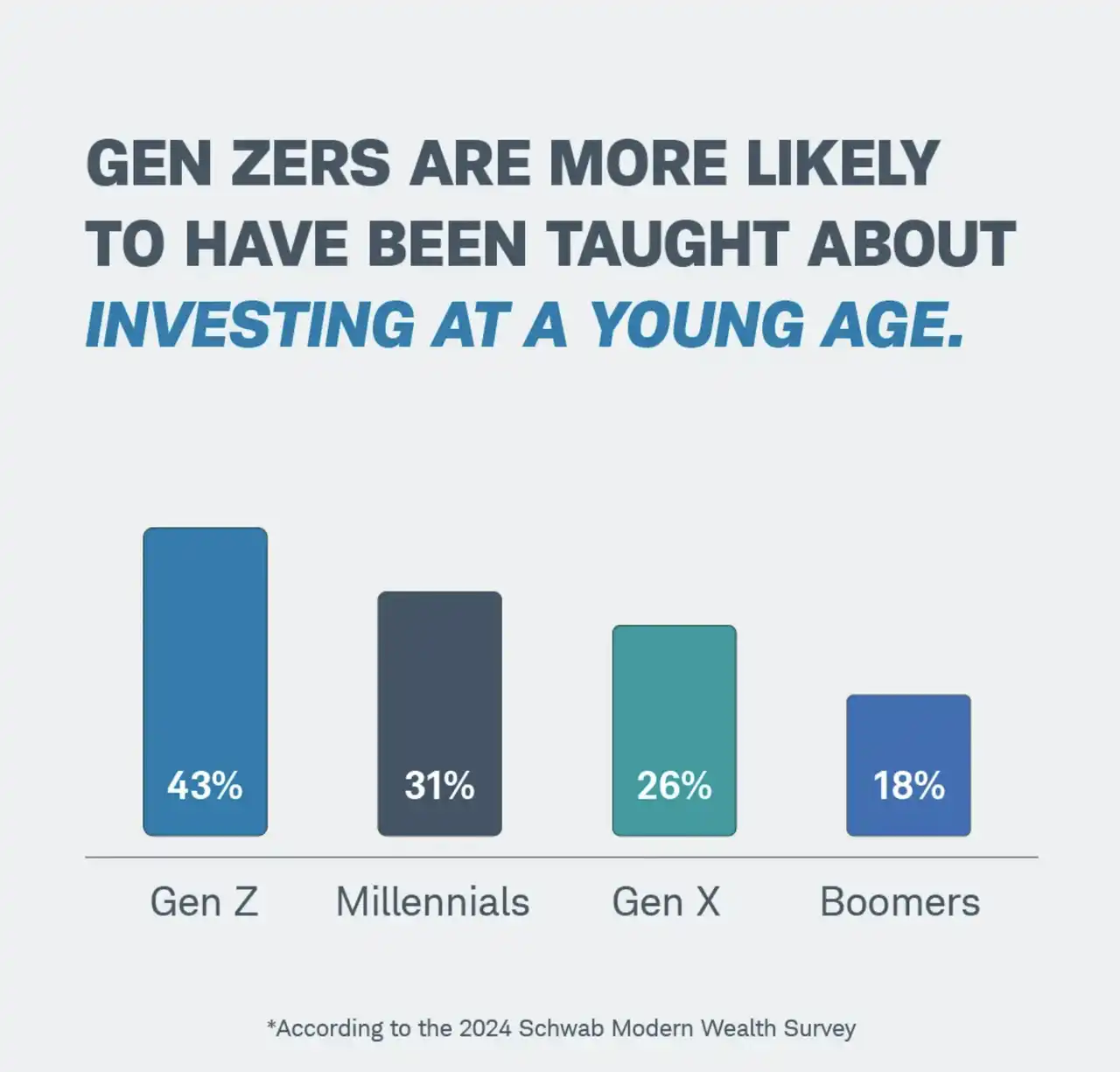
More importantly, millennials and Gen Z are becoming the main force in investing; they prefer direct investments, frequent trading, and actively seek high-potential private equity opportunities, such as SpaceX, OpenAI, and Anthropic. However, under traditional frameworks, they can hardly access these transactions. If the Pre-IPO market can leverage on-chain tokenization to break down unlisted equity into smaller units with low entry barriers and introduce transparent secondary liquidity mechanisms, it could provide these young investors with cost-controlled, self-managed investment access that aligns with their values, as well as an unprecedented global retail incremental funding pool for private equity.

Gen Z and millennials are more inclined to invest rather than put money into pensions; more detailed data across multiple dimensions can be found in Jarsy's Medium report.

Through tokenization, the originally expensive and scarce unlisted equity can be split into small digital tokens and traded on-chain 24/7. Smart contracts can also automatically execute rights such as dividends and voting, enhancing transparency and efficiency. More importantly, if these tokens can be traded on DEX or compliant platforms, market makers and liquidity pools can provide continuous quotes, avoiding the liquidity issues of pure peer-to-peer trading. Theoretically, private equity tokenization could allow global retail investors to participate in the growth of top private companies with extremely low entry barriers and improve the price discovery mechanism, making pricing more market-oriented and transparent.

Of course, the grander the vision, the more constrained the reality. Traditional regulatory complexities, private companies' resistance, and the complexities of technical integration are all unresolved challenges on the current tokenization path. Nevertheless, over the past year, with shifts in policy direction, we have seen a wave of projects exploring on-chain Pre-IPO trading emerge. Some focus on derivatives and leveraged trading, while others concentrate on the tokenized transfer of actual equity.

On-Chain Trading of Pre-IPO

This category of platforms focuses on the trading experience, often not directly holding the actual equity of the target company but allowing users to bet on the valuation fluctuations of unlisted companies through derivatives or other mechanisms. The advantage of this approach is a low entry threshold and no involvement in complex equity delivery processes; however, the challenge lies in pricing basis and compliance risks.

Ventuals: "Pre-IPO Perpetual Contracts" with 10x Leverage on Hyperliquid

Ventuals is a new project incubated by Paradigm, founded by Alvin Hsia, who is also a co-founder of the recently popular content platform Subs.fun and previously collaborated with Paradigm as an EIR (Entrepreneur in Residence) to co-develop the end-to-end data platform Shadow.

Ventuals aims to allow users to trade perpetual contracts for unlisted companies on the Hyperliquid blockchain. This model is similar to contract trading commonly seen in the crypto market, but the underlying asset is replaced with a valuation index of popular startups. The core advantage of Ventuals is that it can provide a trading market without needing to hold the underlying stocks, making it more akin to prediction platforms like Polymarket, which allows it to bypass many traditional securities regulatory requirements (such as identity verification and accredited investor qualifications).

The platform creates custom perpetual contract markets using Hyperliquid's HIP-3 standard and employs an "optimistic oracle" mechanism to obtain valuation data: anyone can submit valuation data for a company and stake collateral; if no one challenges it, the price takes effect; if there is a dispute, it is resolved through on-chain voting. This mechanism brings the previously hard-to-obtain consensus on private valuations on-chain, providing a basis for pricing.

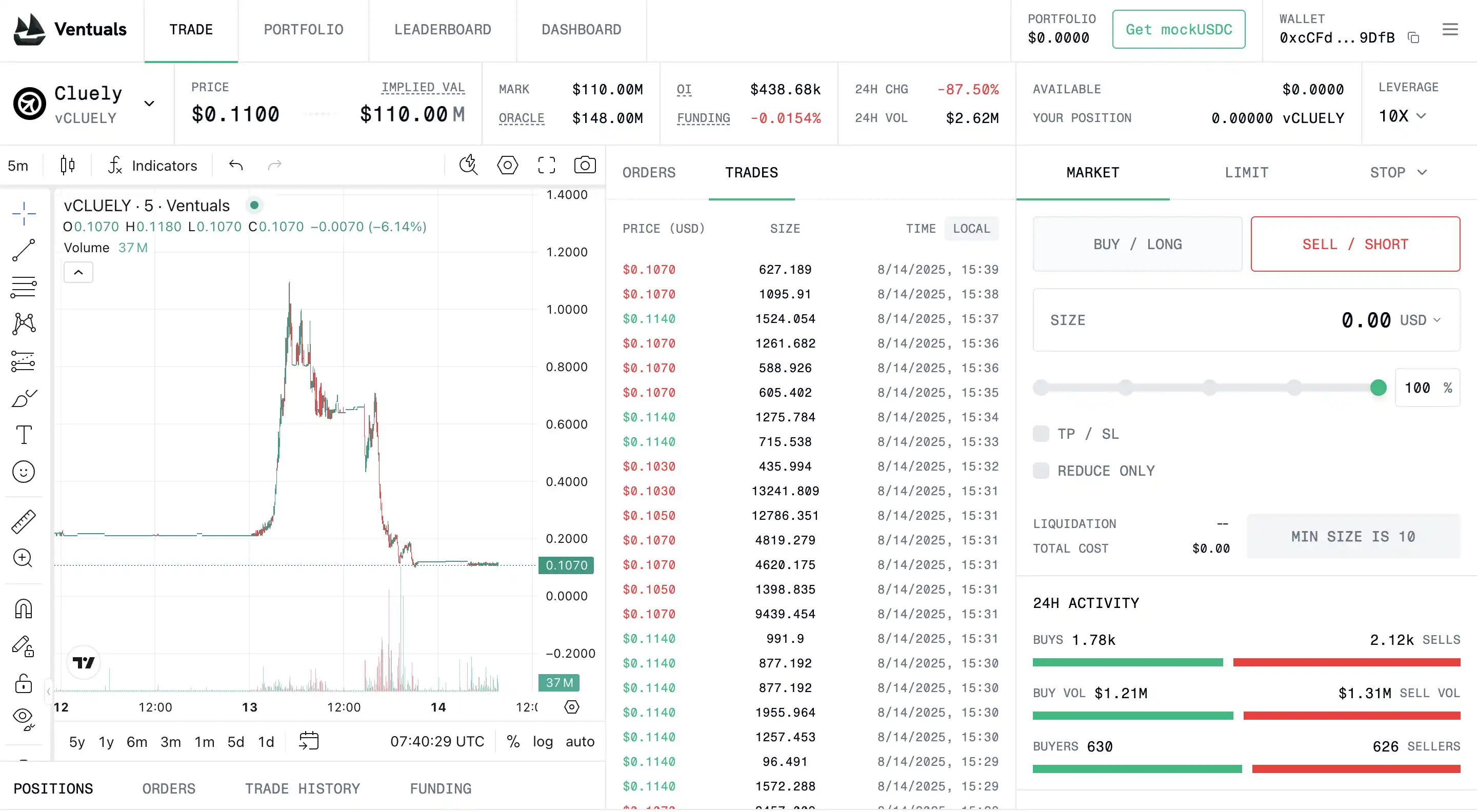
Ventuals' pricing method is also interesting; it does not directly use the price from the company's most recent funding round but anchors the token price by dividing the company's valuation by 1 billion. For example, if OpenAI's latest valuation is $350 billion, the initial price of 1 vOAI token is set at $350. This design lowers the trading threshold and makes the price appear intuitive. However, the problem is that private company valuations are inherently opaque and updated infrequently, primarily relying on occasional funding or secondary trading information. While Ventuals has introduced technologies like oracles and EMA (Exponential Moving Average) to smooth prices, information asymmetry remains a significant issue: when the underlying data is lagging or distorted, derivative trading based on it may amplify market volatility. Platforms like Polymarket that utilize oracles have encountered issues due to these flaws, and when the volume is larger, the rapid trading process may lead Ventuals to face even greater challenges.

Thanks to the founding team that used investors' money to buy Ferraris, the market's valuation of them has plummeted, source: Ventuals

As a trading platform, Ventuals' biggest selling point is the opportunity to go long or short with leverage of up to 10 times, allowing users to "bet big with a small amount." However, the platform is still in the testing phase (currently operating on a testnet). Ventuals is taking a completely decentralized derivatives route, attempting to create a global Pre-IPO exchange without the need for trusted intermediaries through high-performance on-chain matching (Hyperliquid's capability of 100,000 orders per second). Of course, the compliance challenges it faces are still enormous; although it does not hold actual shares, these contracts essentially bet on security prices and may still be viewed by regulators as securities derivatives. Additionally, who provides liquidity and who guarantees the accuracy of the oracle remains unknown.

Earlybird: A Long/Short Market for Pre-IPO on Solana

Earlybird was developed by the team behind the NFT marketplace Hyperspace on Solana (which ceased operations in 2024, with Twitter even directly renamed from Hyperspace to Earlybird). It similarly aims to allow users to "go long or short on companies before their IPO," positioning itself as a next-generation private equity trading platform for retail investors. The team has received investments from top crypto venture capital firms (such as Dragonfly and Pantera) and has accumulated experience in the Solana NFT space, now shifting focus to the Pre-IPO track.

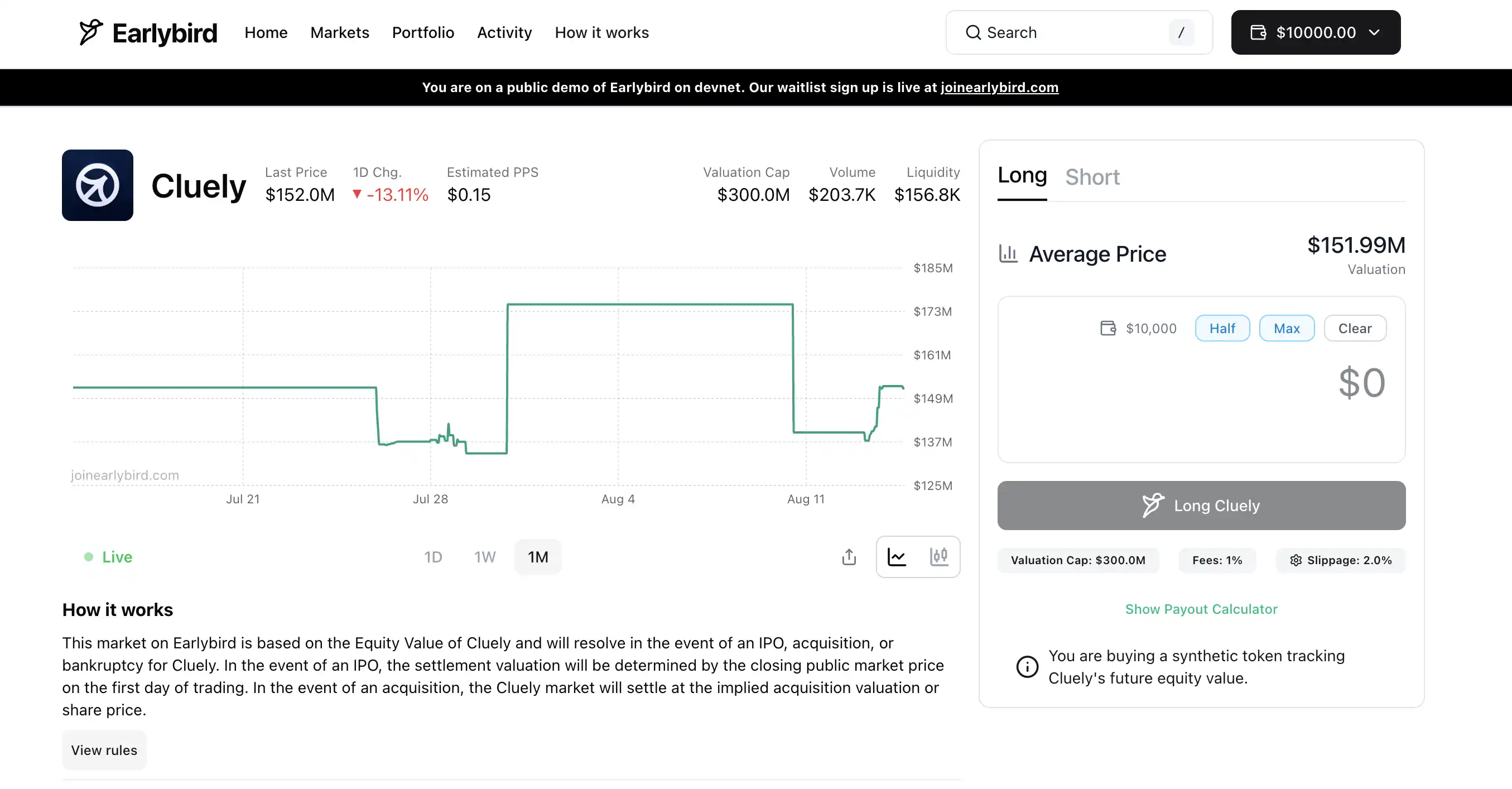
It seems that the prices given by the oracles of the two platforms are somewhat different; it remains to be seen whether this will be fixed after launch. In the future, there may be opportunities for cross-platform arbitrage with Polymarket.

The founding team of Earlybird includes Kamil Mafoud and Santhosh Narayan, co-founders of Hyperspace. It is said that after Hyperspace shut down its NFT business in 2024, this team began focusing on the development of Earlybird. In fact, for them, a "Pre-IPO platform" may be more familiar than an "NFT platform," as both have experience working at Morgan Stanley and have been investment analysts for many years. Their Wall Street connections may be more important in this field than those in cryptocurrency.

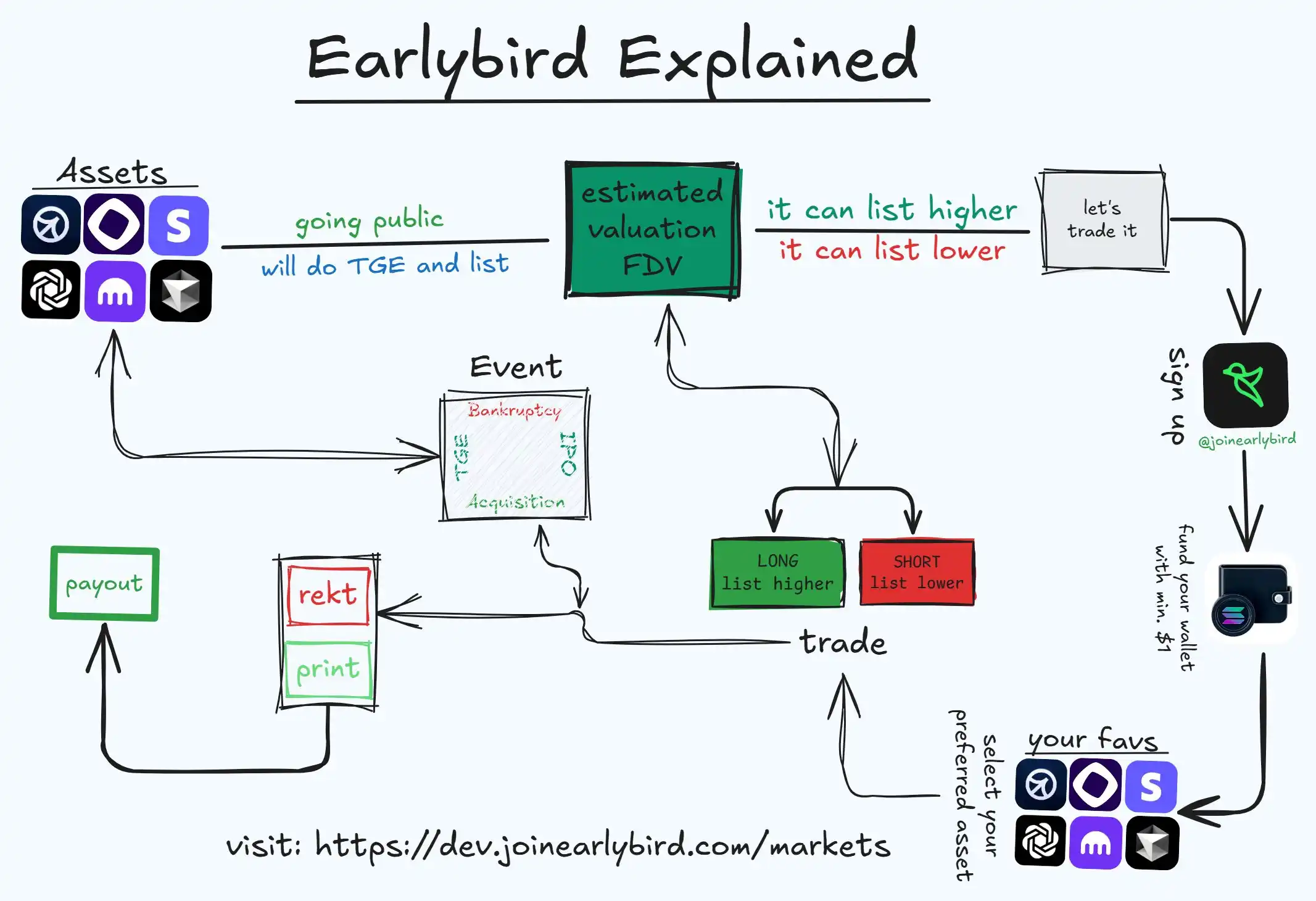
The specific product form of Earlybird has not been fully disclosed (the platform is still in a closed testing phase under an application system), but users can access the product experience through the Dev testnet (which offers a $10,000 trial experience, lol). From its promotion, it is likely to be similar to Ventuals, utilizing on-chain derivatives or simulated assets to allow users to bet on the valuation fluctuations of unlisted companies. The high-speed, low-fee on-chain environment of Solana is also suitable for building real-time trading markets. The team may adopt an order book or AMM market-making mechanism to provide more continuous liquidity than traditional OTC. It is worth mentioning that there have already been practices of similar Pre-IPO asset trading on Solana, such as PreStocks, and earlier on-chain U.S. stocks (like the now-defunct mStock synthetic asset on Mango Markets).

The trading logic of Earlybird, source: @0xprotonkid

From a market positioning perspective, Earlybird may take a more open and decentralized route, with relatively relaxed restrictions on user regions and qualifications. In short, Earlybird is an active explorer of the Pre-IPO track within the Solana camp. Like Ventuals, it has chosen the approach of "not touching real equity, but achieving the market through derivatives." Its success largely depends on whether it can solve the two core issues of valuation pricing and compliance risk control.

PreStock (backed by Republic): The "Good Kid" in Equity Token Trading Platforms

Compared to the "light asset" models of Ventuals and Earlybird, PreStocks is closer to traditional stock trading, just moved on-chain. PreStocks was founded by a team in Singapore, backed by the established private equity platform Republic Capital, holding real private company shares through special purpose vehicles (SPVs) and issuing 1:1 pegged tokens.

In simple terms, if PreStocks buys a batch of original shares of OpenAI through an SPV, it will mint "pOPENAI" tokens on Solana in proportion to one token per share for users to trade. Each token is backed by real stock, allowing investors holding the token to enjoy economic rights almost identical to holding shares (such as capital gains from stock price increases and future IPO realizations), but without direct legal shareholder status or receiving dividends.

PreStocks currently supports token trading for 22 private companies, including well-known unicorns like OpenAI and Canva. Users only need a Solana wallet and can buy and sell these tokens for as little as a few dollars, with no investment threshold restrictions. Tokens on PreStocks can be freely transferred on-chain, traded or lent on DEX platforms, and even provide liquidity to earn trading fees, or be used to build new structured products. PreStocks integrates the Jupiter aggregator and Meteora market makers to achieve 24/7 trading and instant settlement.

To ensure that each token has real stock backing, PreStocks is held by a regulated custodian that owns the underlying stocks and promises to disclose audit reports regularly. However, the team has not yet publicly disclosed detailed proof of holdings, only claiming that all tokens are 100% fully collateralized. Given the involvement of unlisted company equity, PreStocks faces significant compliance pressure, which is why it has blocked users from major jurisdictions like the U.S. (on-chain buying and selling does not require KYC, but minting or redeeming PreStocks does require KYC). The company's registration in Singapore is also due to relatively lenient regulations.

Xavier Ekkel, the founder of PreStocks, has stated that its vision is to make private equity investment as simple as trading public stocks. By providing retail investors with zero-threshold access to unicorns, PreStocks has indeed weakened the monopoly of traditional secondary markets to some extent. However, this model also has clear limitations. First is liquidity: due to the limited sources of shares for each company (currently, the market cap of a single company's token on PreStocks is usually only a few hundred thousand dollars), market depth is shallow, and large buy and sell orders can impact prices. In contrast, established secondary institutions like Forge handle median transaction sizes exceeding $5 million and have institutional-level order management systems, meaning that PreStocks' trading system would need a broader user base to support it.

Secondly, its scalability is also limited by the "1:1 shareholding" model. For each new target, PreStocks must negotiate the purchase of real shares offline, which requires communication with sellers (employees, VCs, funds, etc.) on a case-by-case basis, a lengthy process constrained by the willingness of the target company. Furthermore, PreStocks itself is not a licensed securities exchange and operates more in a gray area; if regulatory attitudes change, the platform may be forced to restrict or withdraw related assets.

Overall, PreStocks has adopted a more tangible path than derivatives, using real capital to "buy a path" for retail investors. Its advantage lies in the greater protection of investors' rights (with real shares backing, future IPOs can provide real payouts), but the downside is high operational costs and significant compliance challenges. I believe Republic is more interested in developing PreStocks into a "high liquidity trading platform" for distributing its mirror tokens, as it operates under Reg CF rules, limiting investments to $5,000 and requiring a one-year lock-up. Additionally, liquidity and "lock-up" restrictions on the compliant centralized trading platform INX it acquired contradict the product's original intent, leading to the choice of PreStocks as a "detour."

Further Reading: "Figma is set to have the largest IPO in the U.S. this year; can you buy its private equity on Republic?"

Focusing on Real Equity Tokenization Platforms

This category of platforms directly offers end investors the opportunity to purchase equity in unlisted companies, essentially a form of on-chain securities issuance or private crowdfunding. They typically require holding or locking real stocks, using tokens as proof to allow investors to share in future profits. This model is closer to traditional finance but leverages blockchain for registration and circulation, often operated by traditional financial companies or fintech firms.

Jarsy: A Group Buying Website for Equity Tokens

Among the many Pre-IPO projects, Jarsy has made steady progress. It quietly launched on the Arbitrum network in 2024, with the company Jarsy, Inc. headquartered in San Francisco, USA. Founded by Hanqin, Chunyang Shen, Yiying Hu, and others, the founding team includes former executives from Uber China and the engineering head of Afterpay, who have a deep understanding of internet product operations and regulations. Jarsy has secured $5 million in investments from institutions like Breyer Capital, with notable investors including Evan Cheng, CEO of Mysten Labs, Nathan McCauley, CEO of Anchorage, and Richard Liu, CEO of Huma Finance. Jarsy's mission is to "democratize private investment using blockchain," providing ordinary investors with a channel to purchase equity in unicorn companies through strict 1:1 backing of physical assets.

Jarsy's operational model involves first publishing Pre-IPO equity products of target companies on the platform, allowing users to pre-subscribe (paying in USDC or USD). Once a certain subscription amount is reached, Jarsy negotiates with venture funds, early shareholders, or employees holding shares of the company to acquire a certain number of real shares using the raised funds. If the acquisition is successful, an equivalent number of tokens are minted and distributed to investors; if negotiations fail or fundraising is insufficient, funds are refunded. This process is similar to traditional private equity share transfers but leverages a "raise first, buy later" crowdfunding approach, with on-chain tokens serving as proof of rights.

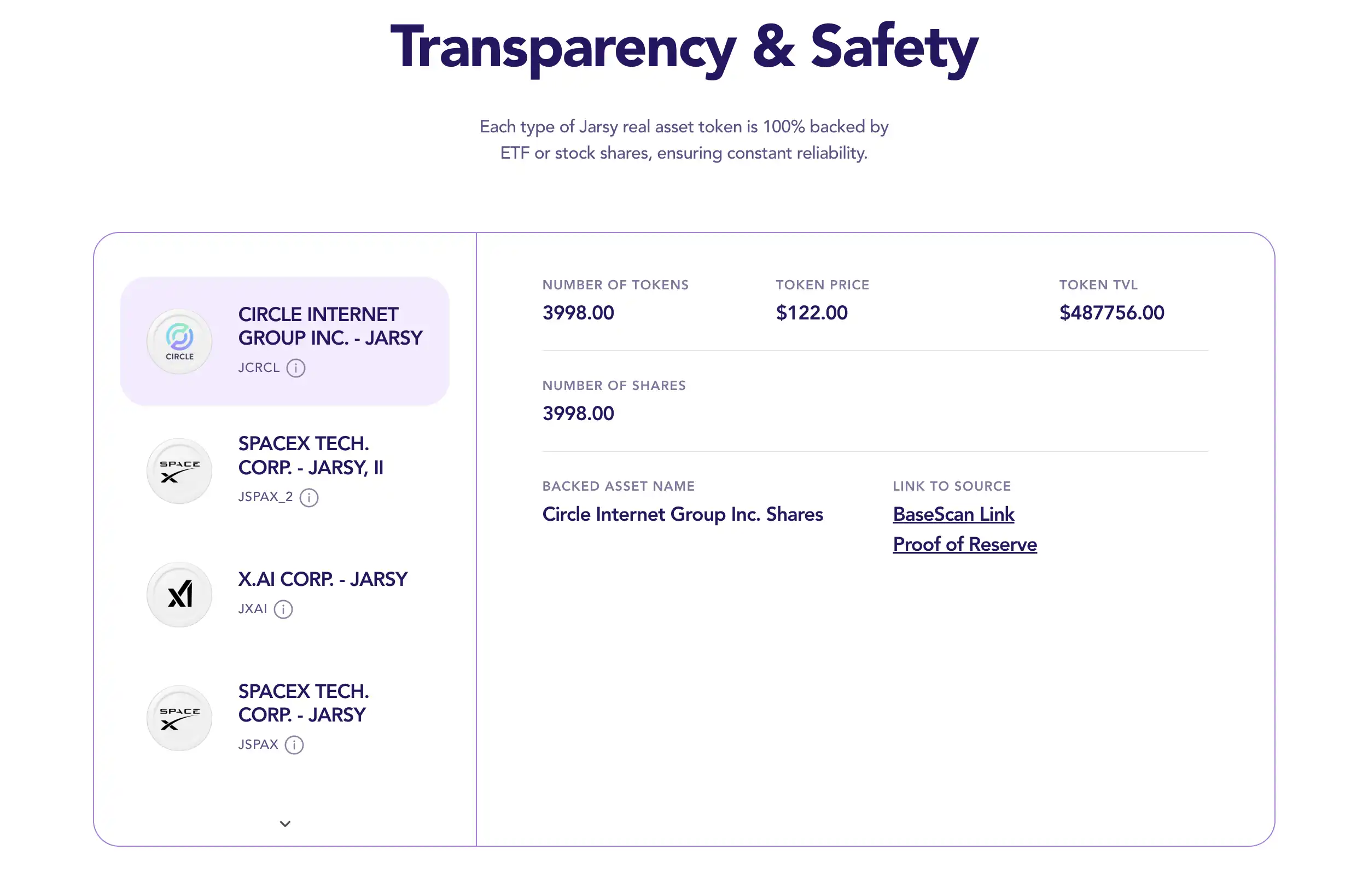
Jarsy also places all held stock assets in a dedicated SPV (special purpose vehicle) for custody and provides a real-time on-chain reserve proof page for inquiries. Each Jarsy token purchased by investors (e.g., JSPACEX representing SpaceX shares) corresponds to a real share as support. Although token holders are not legal shareholders of the company, they enjoy economic rights almost equivalent to holding shares, including realizations during future IPOs, compensation during acquisitions, and even potential dividend income. This makes Jarsy different from the aforementioned projects, resembling a "group buying website" for private equity.

However, Jarsy has significantly lowered the participation threshold, with a minimum investment of only $10. Notably, apart from U.S. investors, users worldwide can participate without needing accredited investor certification. Jarsy has also optimized the Web2 user experience, supporting email registration and fiat payments, creating custodial wallets for users, and making the purchase of tokens feel almost devoid of blockchain complexity. Jarsy focuses on compliance and ease of use, attempting to build a bridge product of "Web2 interface + Web3 backend." Since its launch, Jarsy has already introduced tokenized equity for star companies like Anthropic, Stripe, and Perplexity AI, with many products selling out immediately upon release.

Of course, the Jarsy model still faces two major challenges. First is liquidity; since the supply of each token depends on the actual number of shares acquired, and private equity itself lacks public market pricing, large holders selling a significant number of tokens can lead to price crashes or a lack of buyers. Currently, Jarsy's largest holdings include X.ai (approximately $350,000), Circle ($490,000), and SpaceX ($670,000), all of which are not very large. In such a shallow market, a sell order of several tens of thousands of dollars could easily collapse the price, indicating a clear lack of trading depth.

Secondly, any project involving "real holdings" will encounter expansion bottlenecks. Each new target for Jarsy requires significantly more effort than a "derivatives model platform," and demands high networking and resource requirements. Additionally, although Jarsy claims to prioritize compliance, it still offers unregistered security tokens, which presents uncertainties under the U.S. regulatory environment. However, Jarsy has proactively collaborated with top law firm WSGR (Wilson Sonsini, Goodrich & Rosati) to plan a compliance route, indicating its intention to seek regulatory exemptions or approvals, which may make it more appealing to institutions in the current compliance environment.

As CEO Han Qin stated, "We founded Jarsy to bring private investment opportunities, long monopolized by institutions, to ordinary people." Despite challenges such as liquidity and compliance, Jarsy has taken an important first step and is one of the more compliant "equity tokenization platforms" currently available. With user growth and asset scale expansion, if it can gradually gain regulatory recognition, it is possible that its tokens will circulate in compliant secondary markets, making "Pre-IPO equity" a true asset class for the public.

Opening Bell: A Pioneer in Traditional Stock Chain Transformation

The Opening Bell platform launched by Superstate offers another path, allowing companies to directly move their stocks onto the blockchain. Unlike the aforementioned projects where third parties buy shares and issue tokens, here the company itself becomes the issuer. In May 2025, Superstate (a compliance fintech company founded by Compound founder Robert Leshner and others) announced the launch of Opening Bell, enabling stocks already registered with the SEC or eligible private companies to conduct 24/7 on-chain trading via the Solana blockchain. In simple terms, publicly listed companies or private companies can issue on-chain stock tokens on the Opening Bell platform, ensuring that these tokens represent actual legal equity (not Mirror token synthetic products).

The first practitioners of this model include Nasdaq-listed company Upexi (stock code UPXI) and Canadian company SOL Strategies, with Galaxy Digital, which recently gained attention for its Ethereum coin stock company, also participating (though only the SOL Strategies case has not yet been listed on Nasdaq). This requires a strict legal framework, such as Superstate already registering as a digital transfer agent in the U.S. to ensure that the on-chain shareholder register is synchronized with traditional registrations.

The emergence of Opening Bell marks a further integration of traditional finance and blockchain. Through this platform, company stocks can be traded in real-time 24 hours a day, providing unprecedented flexibility and transparency, making stocks "always on" like cryptocurrencies. Private companies also have the opportunity to use Opening Bell to gain liquidity in advance; some companies that are planning to go public or are not in a hurry for an IPO can completely reach global investors by issuing on-chain stocks for financing or shareholder realization. Superstate clearly states that Opening Bell's target customers include both listed companies and "late-stage private companies" seeking liquidity.

Of course, the advancement of this model still requires regulatory approval. Although the on-chain plans announced by companies like SOL Strategies have submitted SEC application documents, they all note that they are "pending regulatory approval." However, at least in terms of trends, regulatory agencies are showing a more open discussion attitude towards asset tokenization. The U.S. SEC held a special roundtable in 2025 to discuss securities tokenization, with traditional giants like Blackstone CEO and Robinhood CEO publicly expressing support. Superstate itself has already had successful experiences in stablecoins (USTB) and on-chain government bond funds, and now expanding into the stock field is quite timely.

In terms of Pre-IPO, Opening Bell provides a potential path for a disguised IPO, allowing companies to bypass the lengthy traditional IPO process and achieve public trading of stocks during the private placement stage. For example, a unicorn company can first issue a portion of its equity tokens for trading on Opening Bell, and when conditions are ripe, it can formally IPO or directly merge. This is somewhat similar to the past OTC market, but with on-chain technology, transparency and efficiency are greatly enhanced.

From a certain perspective, if this model is recognized, future IPOs may no longer require Wall Street underwriters but could be completed on-chain. From this angle, Superstate resembles the "Binance Alpha" of Nasdaq.

Further Reading: "Superstate Launches 'On-Chain Shares,' SOL Reserve Company Moves the Coin-Stock Battlefield Back On-Chain"

Is the Era of Investment Democratization Here?

Making investment opportunities in unlisted companies more open and efficient is undoubtedly an exciting trend for ordinary investors. From the perspective of wealth opportunities, this helps narrow the gap between the public and institutional investors. However, the on-chain Pre-IPO field still presents both opportunities and risks. "Regulatory compliance" and "the reluctance of target companies" hang like the sword of Damocles over such projects.

Embracing regulation and cooperation should be the main direction for on-chain Pre-IPO trading. More and more traditional financial institutions and investors are showing interest in this field. For example, the Hong Kong Stock Exchange and Nasdaq are researching tokenized securities; well-known VCs may consider collaborating with these platforms to release some shares for on-chain circulation without affecting company control. This new paradigm of LP and GP collaboration, if successful, is expected to greatly accelerate the popularization of private equity tokenization. Undoubtedly, on-chain trading of Pre-IPO is a new blue ocean full of potential. The "Trojan horse" of freely trading unlisted equity could ultimately open the "gates" of the capital market's ultimate form, and perhaps we are just a few steps away from that gate.

免责声明:本文章仅代表作者个人观点,不代表本平台的立场和观点。本文章仅供信息分享,不构成对任何人的任何投资建议。用户与作者之间的任何争议,与本平台无关。如网页中刊载的文章或图片涉及侵权,请提供相关的权利证明和身份证明发送邮件到support@aicoin.com,本平台相关工作人员将会进行核查。

Share To
APP

X

Telegram

Facebook

Reddit

CopyLink