Universities Have Become the "Martial Arts Sects" of the Crypto World
Written by: Yanz, Liam
In August 2025, the price of Bitcoin crossed $120,000, and the once "marginal asset" was once again thrust onto the mainstream stage. This driving force came not only from Wall Street hedge funds but also from the most conservative and astute fund managers in Ivy League campuses.
On August 9, the U.S. Securities and Exchange Commission (SEC) disclosed a detail in its 13F filing that caught the market's attention: **Harvard University's *endowment fund* (approximately $53.2 billion in size) held $116 million in Bitcoin ETF (IBIT) in the second quarter of 2025.** This position ranked as its fifth-largest investment, following Microsoft, Amazon, Booking Holdings, and Meta, even surpassing the positions of Google's parent company Alphabet and Nvidia.
Harvard is not an isolated case.
Brown University, Emory University, and the University of Austin have all publicly disclosed their cryptocurrency positions.
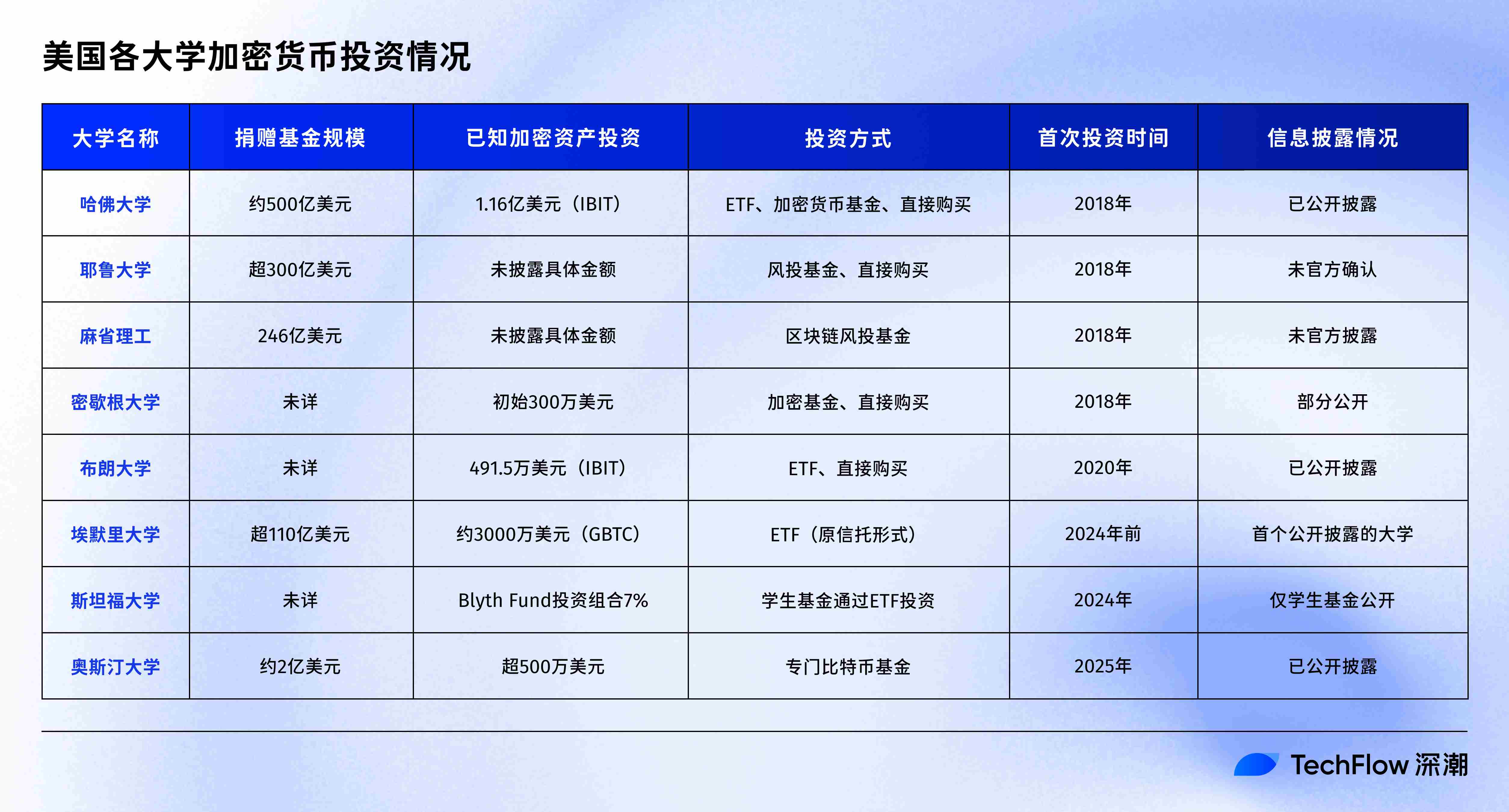
The "guardians of wealth" in these ivory towers embracing cryptocurrency is not a momentary impulse but rather the surface manifestation of years of strategic planning.
The capital, talent, and technology from prestigious universities have long been rooted deep within the crypto industry.
This time, however, they have been pushed to the forefront.
Investing in Crypto Amidst the Bubble Burst
In 2018, the darkest hour for the cryptocurrency industry.
With the collapse of the ICO bubble, the global market value of crypto assets evaporated by over $630 billion, falling to less than $200 billion. Bitcoin dropped to $3,000, Ethereum to $80, and retail investors fled the scene, with cryptocurrencies being labeled as "Ponzi schemes." Even Facebook announced a ban on cryptocurrency-related advertisements.
At this moment, when everyone was avoiding it, Yale University's endowment fund made a decision that seemed to "contradict its founding principles."
Under the leadership of legendary investor David Swensen, in October 2018, Yale joined Harvard, Stanford, and other top institutions to invest in Paradigm's newly established $450 million crypto fund, founded by Coinbase co-founder Fred Ehrsam and former Sequoia Capital partner Matt Huang. At the same time, Yale also participated in a16z's first crypto fund, totaling $400 million.
Looking back, this investment during the downturn not only influenced the development trajectories of Paradigm and a16z but also, to some extent, accelerated the historical progress of the crypto industry.
Originally, Paradigm planned to allocate 60% of its funds to crypto assets and 40% to equity in crypto startups. However, after receiving the funds, Paradigm chose a risky move—massively buying Bitcoin and Ethereum through its trading platform Tagomi, with an entry cost of about $4,000 for Bitcoin. Just a few months later, in the first half of 2019, Bitcoin's price briefly surpassed $10,000.
For university endowment funds, at that time, there was no way to directly purchase Bitcoin, nor were there compliant ETF products. Allowing Paradigm to hold crypto assets on their behalf was a "curved entry" strategy, enabling the foundation to achieve risk isolation in compliance and responsibility even if losses occurred.
How Matt Huang managed to persuade the Yale fund to invest in a newly established crypto fund remains somewhat of a mystery.
Although Matt Huang's mother, Marina Chen, was a professor in Yale's Computer Science Department, there is no information to prove that Marina Chen influenced Yale's investment in Paradigm.
Through an article published by Matt Huang in 2020 titled "Preaching Bitcoin to Open-Minded Skeptics," we may glimpse how he convinced the investment heads of various university funds.
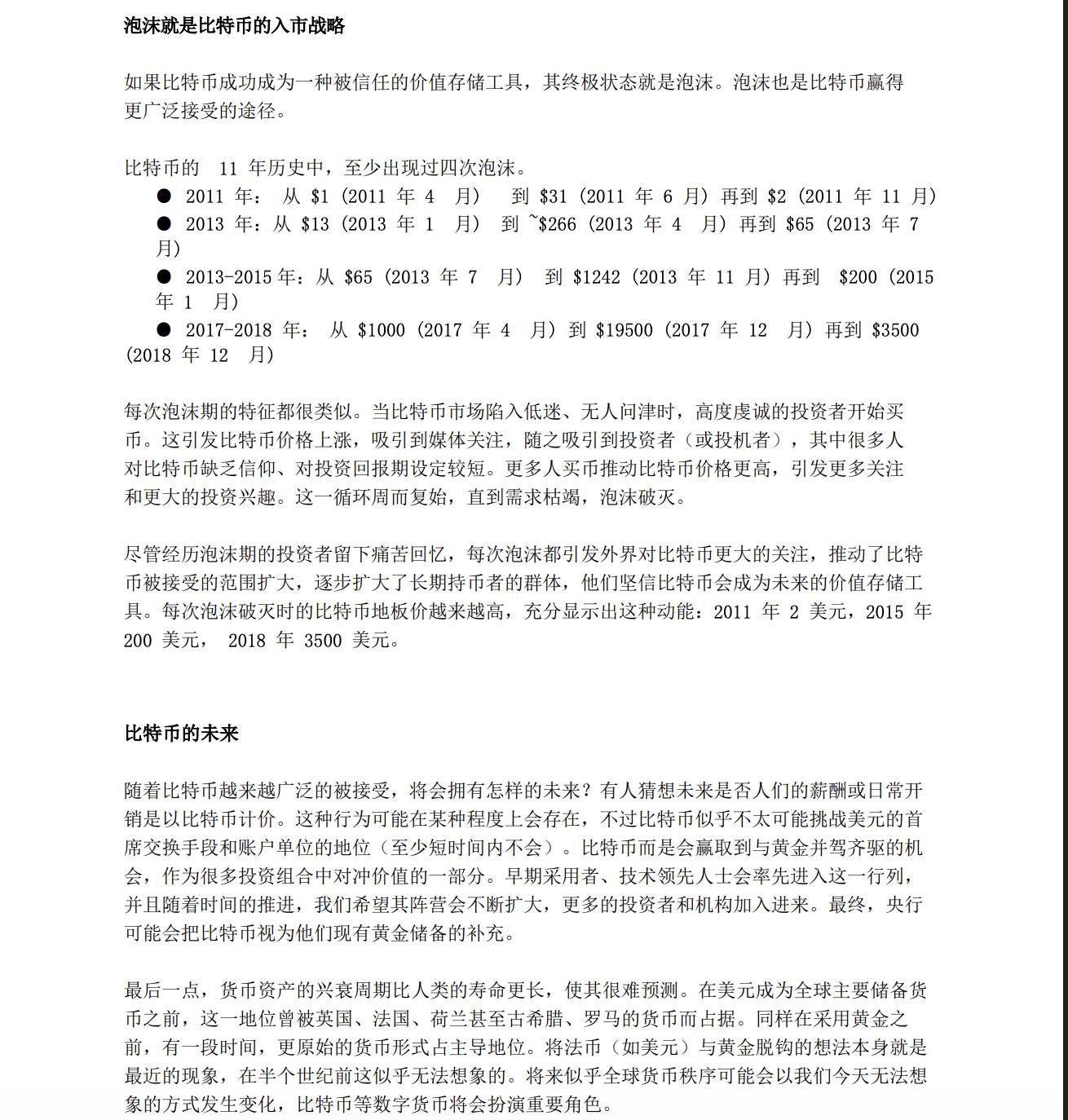
In Matt Huang's view, bubbles are not flaws but rather a necessary path for Bitcoin to gain broader acceptance. Each bubble expands Bitcoin's recognition and acceptance. Bitcoin will not challenge the dollar's status as a medium of exchange in the short term; in the future, it will stand alongside gold as a hedging tool in investment portfolios, held by institutional investors, until central banks may eventually consider Bitcoin as a reserve.
For the crypto industry, Paradigm is not just an investment institution bringing capital but also an important builder.
In April 2019, Paradigm led a seed round investment of $1 million in Uniswap. At that time, Uniswap had not even established a company, and the developer was just its founder, Hayden Adams, a mechanical engineer who had just been laid off by Siemens and had only started self-learning Solidity in 2017.
Not only did they invest, but Paradigm's research team member Dan Robinson was almost daily immersed in Uniswap's Discord, helping to solve liquidity and smart contract issues.
Through their collaboration, the AMM model was born, igniting the DeFi summer.
Paradigm has invested in numerous star projects, including StarkWare, Mina, Uniswap, Compound, MakerDAO, Yield, Optimism, Amber, Fireblocks, Synthetix, Opyn, TaxBit, BlockFi, Chainalysis, Gitcoin, Lido, dYdX, and more.
Another crypto fund that Yale invested in early on, a16z crypto, has also shaped the industry's development, investing in well-known projects like Coinbase, Solana, Aptos, Avalanche, Arweave, etc. In addition to investing, a16z has deeply participated in industry development through its public policy influence, having donated tens of millions of dollars to the super PAC Fairshake that supports crypto issues and betting on Trump's victory to gain a more favorable crypto policy environment.
Returning to the end of 2018, the beginning of all this cannot be separated from the legendary investor David Swensen.
As the highest-paid person at Yale, he has managed billions of dollars in endowment funds for the past 34 years, expanding the fund size from $1 billion to $31.2 billion, achieving an average annual return rate of nearly 17%.
The "Yale Model" he pioneered has become the gold standard for university endowment funds worldwide. Many of the fund managers at top institutions like Princeton, Stanford, MIT, and the University of Pennsylvania are former employees of his, referred to as the "Yale faction."
Yale's entry quickly triggered a chain reaction. Harvard, Stanford, MIT, and other Ivy League schools followed suit around the same time. "The Information" reported at the end of 2018 that Harvard University, Stanford University, Dartmouth College, MIT, and the University of North Carolina all invested in at least one cryptocurrency fund through their respective endowment funds.
In a sense, Yale's investment in 2018 was not only a timely assistance during the industry's winter but also a high-profile vote of confidence in the future of the crypto industry.
The Crypto Gang in Prestigious Universities
Beyond capital and endorsement, the more profound impact of the world's top universities on the crypto industry lies in people.
Where there are people, there is a community, and many of the "leaders" and backbone forces in the crypto community come from prestigious universities, gradually forming an invisible yet powerful "university gang."
In the Chinese-speaking world, the Tsinghua faction is undoubtedly the most influential presence. Li Lin, the former founder of Huobi, graduated from Tsinghua University's Department of Automation; the core team of the high-performance Layer 1 blockchain Conflux comes from Tsinghua's Yao Class; the two co-founders of the blockchain security company CertiK, Gu Ronghui (CEO) and Shao Zhong (CTO), are also Tsinghua graduates.
Tron founder Justin Sun and Bitmain founder Jihan Wu both graduated from Peking University.
The alumni projects from Zhejiang University are spread across Web3 applications, from the NFT trading platform Magic Eden to the NFT data platform NFTGo, and from the popular blockchain game Stepn to the hardware wallet Keystone, covering multiple tracks in C-end applications.
Abroad, a prestigious university background is almost a standard for founders in the crypto industry.
The Stanford faction, leveraging its heart position in Silicon Valley, has a significant influence in the crypto industry, nurturing founders of star projects like OpenSea, Alchemy, Filecoin, Story, and well-known industry leaders like Lily Liu, chair of the Solana Foundation.
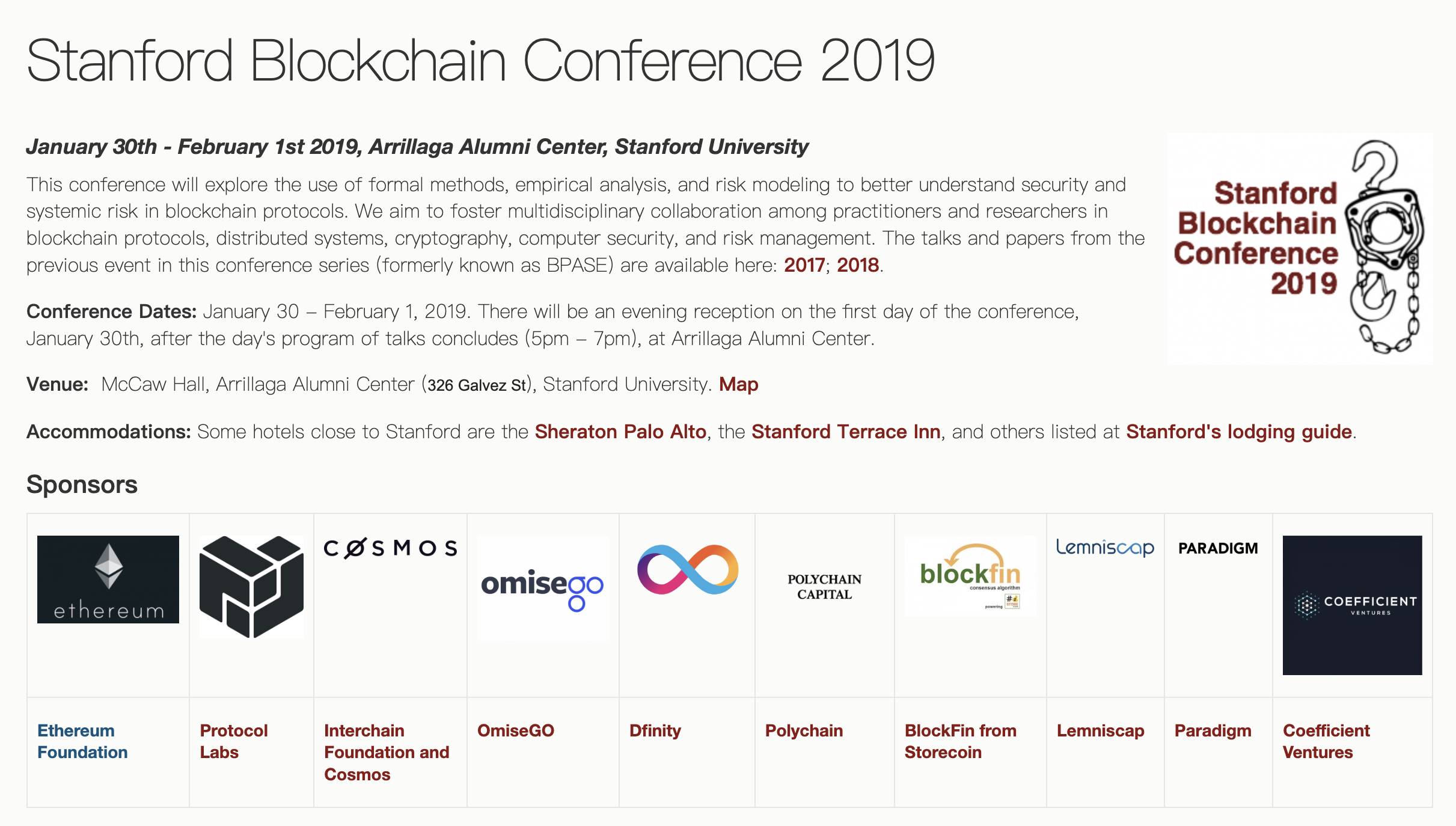
At the Stanford Blockchain Conference in 2019, star sponsors gathered, with well-known projects and institutions like Ethereum, Cosmos, and Polychain prominently featured, rivaling many large crypto conferences.
The MIT faction excels in technical research. The MIT Digital Currency Initiative team participated in the development of Zcash, which was selected by MIT in 2018 as one of the world's top ten breakthrough technologies. After all, zero-knowledge proof (ZK), a milestone technology in cryptography, was proposed by MIT researchers in the 1980s.
MIT professor and Turing Award winner Silvio Micali even personally got involved, creating the high-performance public chain Algorand in 2018.
The lineup of MIT alumni can be described as a "crypto star roster": Paradigm founder Matt Huang, MicroStrategy founder Michael Saylor, StarkWare co-founder Uri Kolodny, Litecoin founder Charlie Lee, and FTX founder SBF all hail from MIT.
UCB (University of California, Berkeley) is extremely active in entrepreneurship and incubation.
In January 2019, Berkeley established the blockchain startup accelerator Berkeley Blockchain Xcelerator, jointly operated by the Berkeley Haas School of Business, Berkeley Engineering SCET, and Berkeley Blockchain. Each year, it incubates a batch of early-stage crypto projects, having accelerated over a hundred companies to date. Computer Science professor Song Xiaodong personally founded the privacy public chain Oasis Network. Other notable UCB projects include Galxe, Osmosis, Sei Network, Opyn, Ampleforth, and Kadena.
The Princeton faction has a profound influence in the investment field.
In 2022, four alumni from the class of 1987—Ethereum co-founder Joseph Lubin, Pantera Capital founder Daniel Morehead, Galaxy Digital founder Michael Novogratz, and Peter Briger of Fortress Investment Group—jointly donated $20 million to their alma mater to launch a blockchain research program.
It is worth mentioning that when Morehead founded Pantera, he received early support from Briger and Novogratz. Today, Pantera has become a top crypto fund managing over $5 billion in assets.
In an industry that emphasizes "Don’t Trust, Verify," trust between individuals is particularly valuable. Alumni relationships serve as this natural trust bond: founders are more inclined to hire alumni, and investors are more willing to invest in alumni, thus forming an invisible barrier of "gang culture."
After Li Lin founded Huobi, he brought in classmates Lan Jianzhong and Zhu Jiawei, with over half of the senior management coming from Tsinghua. Former CEO Qi Ye and CFO Zhang Li also graduated from Tsinghua. Jihan Wu similarly relied on Peking University classmates for support at Bitmain.
Today, blockchain courses have become standard at major universities, with student blockchain clubs and alumni networks intertwining to form an invisible web of talent and capital.
Stanford's CBR conference, Berkeley's Xcelerator, and MIT's DCI hackathon are continuously supplying new blood to the crypto world.
Not just "early investors" in the industry, universities have become the "martial arts sects" of the crypto community.
免责声明:本文章仅代表作者个人观点,不代表本平台的立场和观点。本文章仅供信息分享,不构成对任何人的任何投资建议。用户与作者之间的任何争议,与本平台无关。如网页中刊载的文章或图片涉及侵权,请提供相关的权利证明和身份证明发送邮件到support@aicoin.com,本平台相关工作人员将会进行核查。


