How to Build an Effective On-Chain Governance Mechanism: DoraHacks On-Chain Quadratic Governance and Improvement Examples

CN
1 year ago

DoraHacks, as the world's largest multi-chain developer incentive platform and hackathon platform, needs to allocate millions of dollars in funding to hackathons and open-source developer communities every month. Governance is an important part of this process. Traditionally, there are roughly two types of award methods: one relies on the judgment of professional judges to decide the awards; the other is through community voting, and the prize money is distributed according to the number of votes. However, the former may be disconnected from the community, and community members may lack a sense of participation; the latter may evolve into a simple popularity contest, ignoring the value of the project itself.

In seeking a method that can reflect community wishes and ensure fairness in the selection process, DoraHacks turned its attention to quadratic voting on the chain. This method allows voters to cast more than one vote, but as the number of votes increases, the cost of each vote will also increase, similar to tiered electricity pricing in real life. This means that if a project, although targeting a niche market, is significant to certain community members, they can choose to invest more to increase the project's chances of winning.

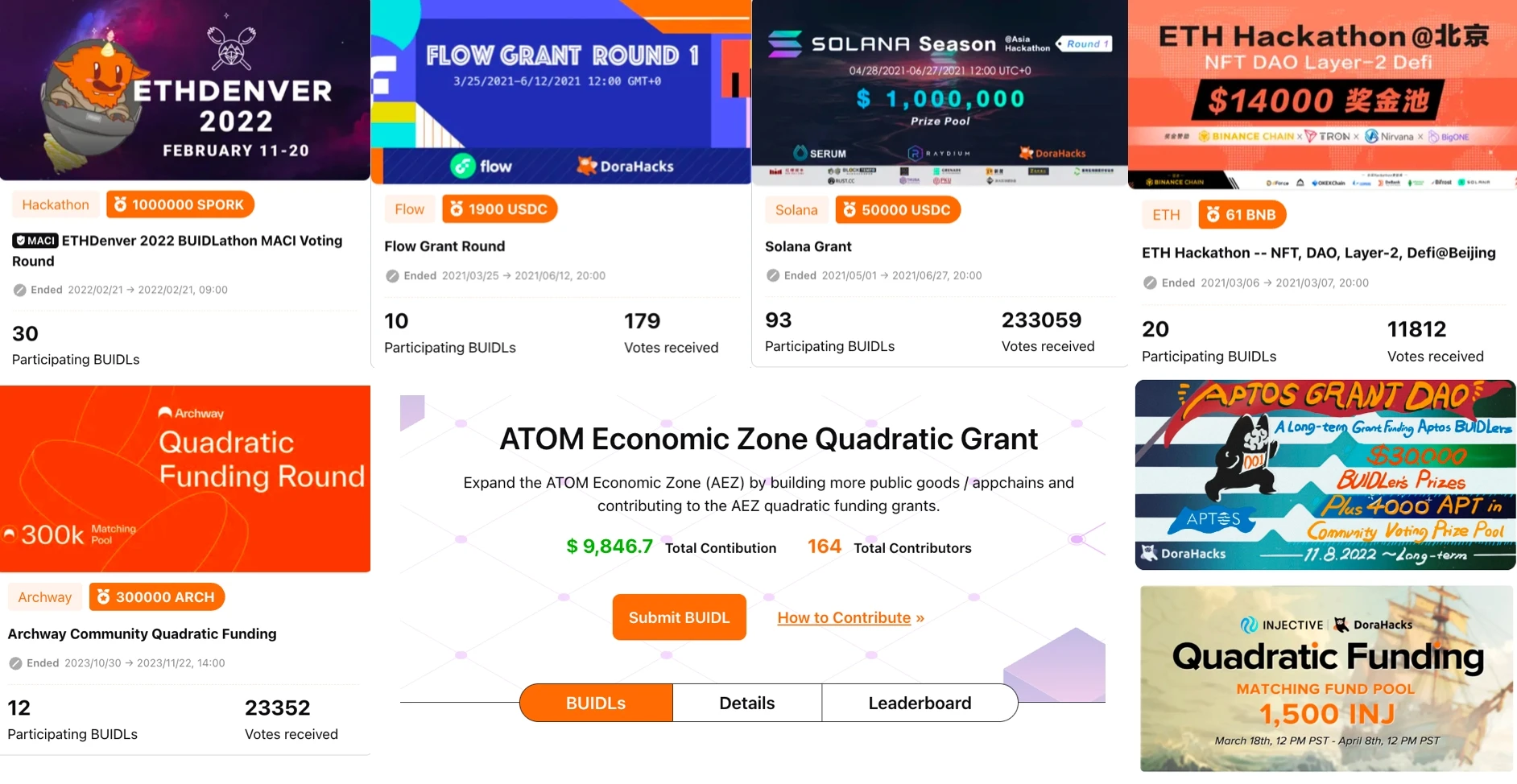
The example at the beginning comes from DoraHacks' quadratic voting instance at the end of 2020 - the distribution of a $14,000 prize pool in the ETH Hackathon@Beijing. This voting method not only takes into account the number of votes, but also includes the tokens used for voting as a direct contribution to the project, ensuring that each outstanding project receives a certain proportion of the prize money, while also receiving additional donations from the community. This vote took place on the BSC chain at the time. This initiative not only marked the first attempt at quadratic voting on the chain, but also the first application of quadratic voting in offline blockchain community activities.

Subsequently, the DoraHacks team continued to promote quadratic governance in the multi-chain world and successfully applied it on mainstream non-EVM chains such as Solana, Aptos, TON, Cosmos Hub, Injective, Archway, and Flow. In 2022, at ETHDenver BUIDLathon, DoraHacks supported an unprecedented scale of offline quadratic voting activities, and continued to expand global community participation in the subsequent online BUIDLathon. Currently, as the platform and infrastructure that supports the most ecosystems, DoraHacks has supported over 32 Web3 ecosystems in on-chain quadratic funding, with a total of over 300,000 community members participating.

How to Build an Effective On-Chain Governance Mechanism: DoraHacks' On-Chain Quadratic Governance and Improvement Examples

Quadratic governance allows a large number of Web3 community members to participate in ecosystem development and provides important seed funding and market opportunities for early public goods development in various ecosystems. In order to help more community members understand the process of quadratic governance and support high-quality projects in the ecosystem, DoraHacks recently launched the "Community Incentive Fund" mechanism (CIF), using well-known Memecoins and NFTs in various ecosystems to incentivize community members to actively participate in voting. Currently, in the Injective Grant DAO and Aptos Grant DAO quadratic voting rounds, voters will receive Injective Quant ($QUNT) and Aptos Gui Inu ($GUI), two popular Memecoins, and lucky voters will also be selected to receive rare NFTs using device-independent quantum random number generators. Through CIF, DoraHacks has turned quadratic funding and on-chain governance into an interesting process, changing the serious nature of on-chain governance and providing a new direction for the development of public goods funding.

Let's turn the topic back to on-chain governance. Even beyond the scope of Web3 hackathons, the blockchain world itself has many governance scenarios that urgently need a more democratic and efficient voting method. In its exploration, DoraHacks found many areas in need of improvement in the early versions of on-chain quadratic voting, some of which are new problems brought about by the characteristics of blockchain, and some are chronic issues of democratic governance mechanisms. After long-term practice and exploration, the DoraHacks team proposed comprehensive solutions to address these issues and launched a new quadratic governance infrastructure.

First, there are problems brought about by the characteristics of the blockchain itself. First, blockchain wallet addresses are easily obtainable, making the cost of a Sybil attack in on-chain voting extremely low. DoraHacks has developed a proprietary anti-Sybil attack check algorithm, and after each on-chain quadratic voting, there is generally a 3-5 day anti-Sybil attack check period, during which addresses detected as "Sybil" will have their weights excluded in the bonus calculation (but the donation amount from Sybil addresses will still be considered as a direct donation to the voted project).

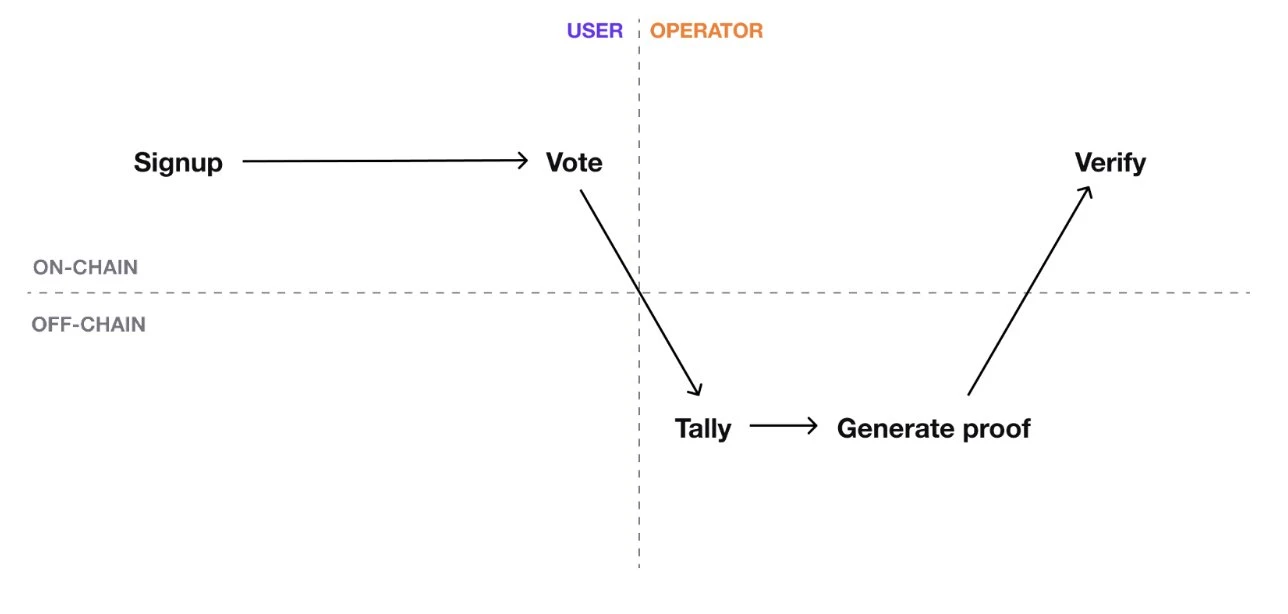
Second, based on the blockchain's broadcast mechanism, on-chain activities are traceable and verifiable. Although higher transparency may mean a higher degree of democracy for the community, it also makes it easier to foster collusion. For example, a candidate project in a hackathon can use certain rewards to incentivize more community members who were originally unfamiliar with the project to vote, and then use the on-chain voting records as a basis to claim rewards afterward; or some projects can also analyze on-chain voting conditions in real-time to calculate the "most cost-effective" number of votes for themselves. The best solution to this problem currently is the "Minimally Anti-Collusion Infrastructure" (MACI), the specific details of which have been introduced and analyzed in a previous article, please see Pioneering Decentralized Governance: A Retrospective on DoraHacks' MACI/aMACI Study and Implementation.

How to Build an Effective On-Chain Governance Mechanism: DoraHacks' On-Chain Quadratic Governance and Improvement Examples

On the other hand, democratic voting itself still has many issues waiting to be resolved, with the most significant being a new form of "winner-takes-all". Taking a hackathon as an example, if the prize pool is distributed based on the number of votes for projects, even with a mechanism like quadratic voting that suppresses "majority tyranny", there is still an extreme situation: if the number of votes for Project A far exceeds that of Project B (say, by 100,000 times), then B will hardly receive any prize money from the pool, while A will take the vast majority of the rewards.

DoraHacks has pioneered the "Quadratic Progressive Tax" mechanism. In simple terms, PT is a bonus distribution coefficient. Although it allows for a certain wealth gap in the distribution of the prize pool, this gap is strictly limited by the PT coefficient. For example, if the PT coefficient of a prize pool is 10, the project with the most votes can receive at most 10 times the prize money of the last place. Conversely, there will no longer be situations where small teams receive nothing, because even the worst-performing project can receive a prize equivalent to 10% of the first place. The quadratic progressive tax significantly improves the highly uneven distribution of early quadratic funding, greatly enhancing the fairness and effectiveness of quadratic funding.

Of course, quadratic governance provides a new choice for multi-chain governance models. DoraHacks is rapidly exploring and optimizing more effective governance models and governance technologies. Through effective governance mechanisms, resource allocation is optimized, and more participation and fairness are brought to the community. DoraHacks' practice has proven that innovative mechanisms such as on-chain quadratic voting and MACI can effectively balance the interests of all parties and ensure the diversity of projects and the voice of small teams, even in complex governance scenarios. These explorations not only pursue technological and governance innovation, but also demonstrate the potential of the future blockchain world: a more democratic, transparent, and inclusive decentralized ecosystem, as well as a more interesting and vibrant development path for Web3.

Related reading:

Quadratic Governance: What’s Working and What’s Not?

Pioneering Decentralized Governance: A Retrospective on DoraHacks' MACI/aMACI Study and Implementation

What Will aMACI Unlock?

Canary: A Post-Quantum Cryptographic Protocol Resistant to Quantum Attacks

How do hash-based post-quantum digital signatures work? (Part 1)

How do hash-based post-quantum digital signatures work? (Part 2)

Original Article Link

免责声明:本文章仅代表作者个人观点,不代表本平台的立场和观点。本文章仅供信息分享,不构成对任何人的任何投资建议。用户与作者之间的任何争议,与本平台无关。如网页中刊载的文章或图片涉及侵权,请提供相关的权利证明和身份证明发送邮件到support@aicoin.com,本平台相关工作人员将会进行核查。

Share To
APP

X

Telegram

Facebook

Reddit

CopyLink