Author: Biteye Core Contributor Wilson Lee
Editor: Biteye Core Contributor Crush
Background
On April 10th, A16z Crypto released the zero-knowledge solution Jolt to accelerate and simplify blockchain expansion operations.
Jolt integrates SNARK (Non-Interactive Zero-Knowledge Proof), allowing developers to quickly create SNARK-based L2 solutions. The team also stated that Jolt is 2 times faster than the current zkVMs.
ZK technology is one of the main threads running through the encryption industry, and ZK-Rollup is referred to by Vitalik as a long-term solution for Ethereum's expansion. A16z's launch of Jolt from August last year to its official release this year indicates that ZK-Rollup is still a long and arduous path.
ZK-Rollup has attracted numerous players and has formed more refined technical categories to distinguish the differences between projects. Compatibility with EVM is the most representative classification standard.
Due to historical reasons, EVM has a large number of ZK-unfriendly designs. However, many existing projects were built on EVM in the early stages, and ZK-Rollup is still considered a future expansion solution. Therefore, the vast majority of ZK-Rollup projects naturally face the trade-off between being more compatible with EVM or more compatible with ZK.
ZKM incubated by Metis DAO takes a more fundamental approach and proposes a universal zkMIPS solution.
zkMIPS achieves the transformation of program execution process to ZKP by using a more fundamental MIPS instruction set. In addition to being compatible with EVM, it can also be compatible with other VMs, such as MoveVM and RustVM, allowing ZK-Rollup to open its doors to a more diverse group of developers.
This article will provide readers with an in-depth understanding of Metis' efforts and progress in ZK and decentralized Sequencer.
ZKM and Hybrid Rollups: Harmonizing OP and ZK
Metis' outstanding performance in the market is attributed to its innovative Hybrid Rollups mechanism, which combines fraud proofs and validity proofs to incorporate the advantages of both.
ZKM's zkMIPS technology provides solid compatibility support for Metis' Hybrid Rollups, enabling Metis to achieve organic integration of ZK and EVM.
Mechanism and Advantages of Hybrid Rollups
Key roles in Hybrid Rollups include:
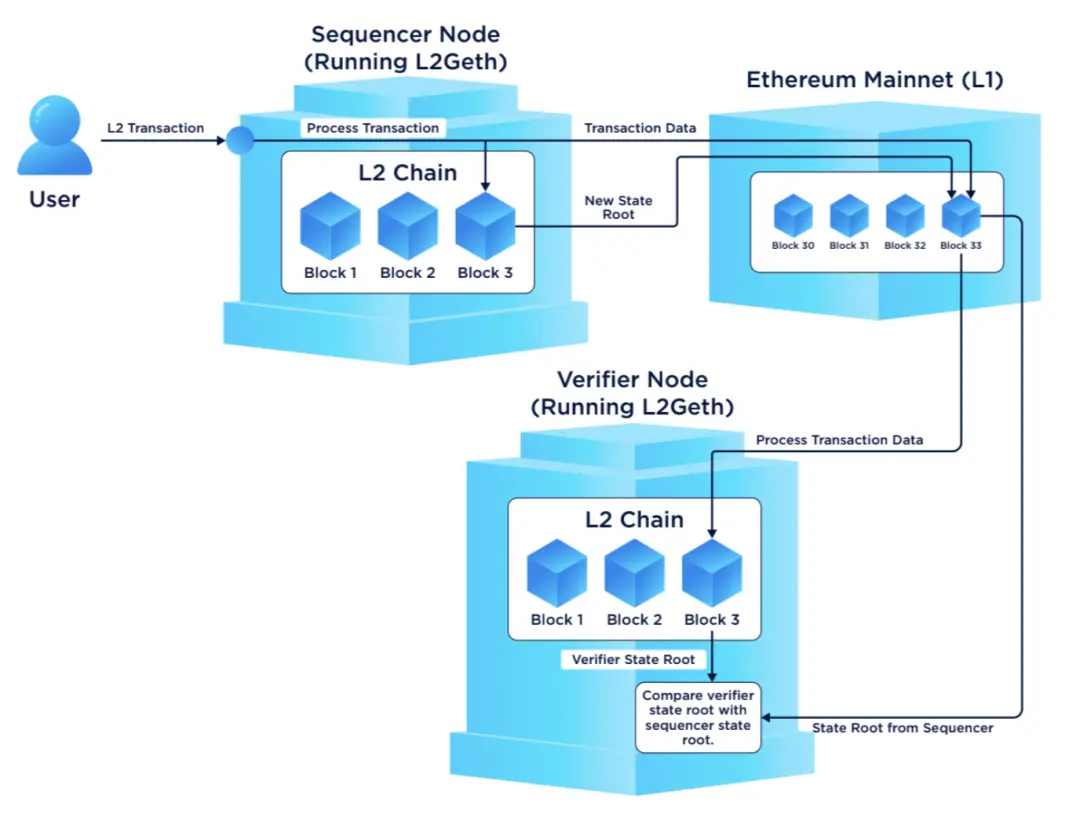
Sequencer: Responsible for receiving and processing user transactions, determining the best order for transactions in the Canonical Transaction Chain (CTC), and packaging and publishing them to the consensus and data availability layer.
Proposers: Evaluate the transactions and state roots submitted by the Sequencer and record them in the State Commitment Chain (SCC).
Verifiers: Verify the state roots on the Rollup chain to ensure the correctness of transactions and prevent fraudulent behavior.
In a standard L2 solution, the Sequencer collects and processes transactions, and then publishes transaction data to the Ethereum mainnet (L1). This process requires L1 to perform final data verification and confirmation to ensure security and consistency.

Hybrid Rollups take a hybrid approach to processing and optimizing L2 transactions, with the specific steps as follows:
1. Transaction initiation and processing:
Users initiate transactions on L2.
The Sequencer receives and processes these transactions, determining their order in the Canonical Transaction Chain (CTC).
2. State submission and verification:
Proposers evaluate the transactions and submit state roots to the SCC.
Verifiers audit the state roots in the SCC to ensure their accuracy.
3. Generation and verification of zero-knowledge proofs:
Provers read data from L1, generate ZK proofs, a key feature of Hybrid Rollups that allows the system to verify the validity of transactions without revealing specific transaction content.
Once ZK proofs are generated, if not submitted on time, Verifiers will initiate the fraud proof process, which may result in penalties for the Sequencer.
4. Final confirmation of data and state:
Once ZK proofs are verified through smart contracts, transactions are finally confirmed.
A smart contract bridge between L1 and L2 ensures the secure transfer of funds and state.
Hybrid Rollups' design offers several significant advantages:
Efficiency and cost-effectiveness: By using ZK proofs, Hybrid Rollups can process more transactions while consuming less gas.
Enhanced security: Combining traditional fraud proofs and ZK proofs ensures the security and correctness of transactions even in the face of potential malicious behavior.
Scalability: Using recursive proofs, Hybrid Rollups can handle large-scale transactions without sacrificing performance, supporting a wider range of blockchain applications.
Compatibility and flexibility: Supporting multiple smart contracts and programming languages allows developers to easily migrate existing applications to Hybrid Rollups.
How zkMIPS Achieves Good ZK Compatibility
The core idea of ZK is to transform the program execution process into a mathematically verifiable proof, allowing anyone to easily verify the correctness of program execution without the need to repeat the program. The challenge lies in how to transform arbitrary program logic into relatively stable mathematical proofs.
Developers typically use high-level languages for program development, and different high-level languages have different "conversations" with hardware.
Therefore, the implementation paths of existing ZK projects are usually incompatible with each other. Scroll directly writes circuits for each opcode of EVM, achieving opcode-level equivalence, which accurately reflects EVM but requires a huge amount of engineering effort; Polygon zkEVM creates a custom VM with optimized performance, directly converting EVM bytecode into VM bytecode, achieving opcode-level equivalence more efficiently, but the introduction of a large amount of custom code may deviate from EVM in the long term; zkSync creates its own VM (SyncVM) and defines its own algebraic intermediate representation (AIR) based on registers, then builds a dedicated compiler to compile Yul (an intermediate language that can be compiled into bytecode for different EVM versions, considered a lower-level Solidity) into LLVM-IR, and then compiles it into instructions for the custom VM, achieving compatibility at the Solidity level, but it cannot directly use existing Ethereum tools, and language conversion may require program re-auditing; StarkNet abandons EVM compatibility and directly uses its low-level language (Cairo) to run a custom smart contract VM (Cairo VM) to achieve ultimate ZK efficiency.
Compared to the solutions of the aforementioned projects, ZKM has chosen a more inclusive path: zkMIPS.
MIPS, short for "Microprocessor without Interlocked Pipeline Stages," is a design-concise microprocessor instruction set that originated in 1985.
The basic principle of MIPS is to simplify complex microprocessor instructions to their most basic form, which not only improves processing speed but also reduces program execution complexity.
In the zkMIPS system, this instruction set is used to implement the conversion of programs to ZK proofs.
The implementation process of zkMIPS is as follows:
Program to MIPS conversion: Firstly, smart contracts or programs written in high-level programming languages (such as Solidity or Rust) are compiled into the MIPS instruction set. This step involves transforming higher-level abstractions into specific operations that can be executed at the hardware level.
ZK proof generation: Subsequently, these MIPS instructions are used to generate corresponding zero-knowledge proofs. Due to the simplified nature of MIPS, this step is more computationally efficient and can generate proofs faster without sacrificing security.
Advantages of zkMIPS
Compatibility: zkMIPS not only supports EVM-compatible Solidity but also other mainstream development languages such as Rust and Move. This enables zkMIPS to serve a broader blockchain development ecosystem, leading to more application possibilities.
Cost-effectiveness: Due to the efficiency of the MIPS instruction set, zkMIPS significantly reduces computational costs when generating zero-knowledge proofs, enhancing the overall sustainability of the system.
Recursive proofs: zkMIPS supports recursive proofs, allowing multiple proofs to be aggregated into a more manageable unit, which is crucial for improving system scalability.
In fact, the advantages of MIPS have already been integrated into projects such as Optimism. Optimism's Cannon mechanism converts executed programs into MIPS, making it easier and more efficient to identify errors and re-execute when challenged.
Metis has also followed this trend by integrating Cannon into its ecosystem, further validating the practicality and efficiency of zkMIPS technology.
Decentralized Sequencer: Decentralization and Sustainability
In addition to leveraging Hybrid Rollups to integrate the advantages of OP and ZK, Metis is actively advancing the implementation of a decentralized Sequencer, setting a decentralized benchmark for Rollup.
In the traditional Rollup model, a single Sequencer, while effective in processing transactions and data, also concentrates significant power, leading to various risks:
Operational risk: If the sequencer fails or is attacked, the entire system's transaction processing will be disrupted.
Censorship risk: The sequencer has the ability to selectively process or reject transactions, which may limit user access to specific decentralized finance (DeFi) protocols or services.
Manipulation risk: In transaction ordering, the sequencer may prioritize its own transactions, gaining undue benefits by increasing transaction fees, known as maximum extractable value (MEV).
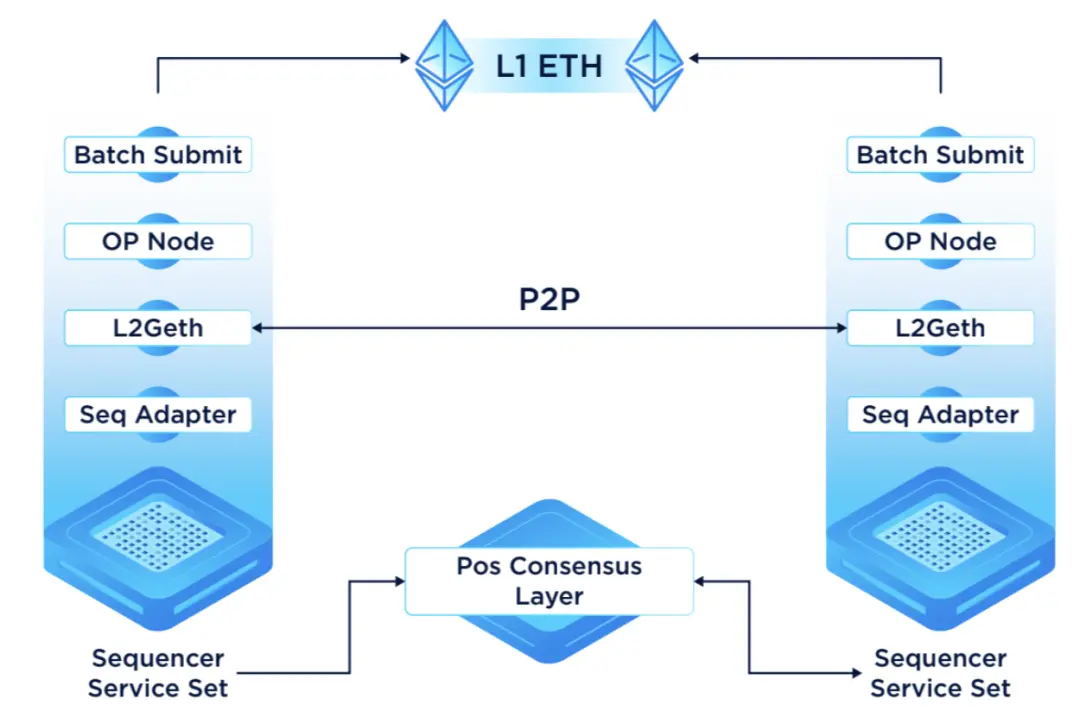
To address these issues, Metis has designed a decentralized Sequencer pool, consisting of multiple Sequencer nodes that collectively aggregate, order, and execute transactions. This design ensures the fairness and transparency of the system:
Consensus mechanism: Over two-thirds of Sequencer nodes must reach consensus on the state of each new block before submitting transaction batches to the Ethereum mainnet (L1).
Multi-party computation (MPC) signatures: Before submitting batches to L1, MPC signatures are used to verify the authenticity of the batches, ensuring the correctness of the data.
Advantages of Decentralized Sequencer:
Enhanced security: By collectively making decisions across multiple nodes, the risk of single-point failure is reduced, increasing the network's robustness and security.
Reduced censorship and manipulation potential: The presence of multiple Sequencers makes it difficult for a single node to manipulate or censor transactions, protecting users' transaction freedom.
Stability and redundancy: The system supports smooth rotation of Sequencers, minimizing the impact of failures or interruptions and improving the overall stability of the network.
In Metis' decentralized Sequencer model, each node consists of several key components:
L2 Geth (including OP-Node): Responsible for transaction ordering and block assembly.
Adapter module: Serves as an intermediary for interacting with other external modules, primarily PoS nodes.
Batch proposer: Responsible for constructing transaction batches and submitting them to L1 after obtaining approval from multiple Sequencers.
PoS nodes: Coordinate between Ethereum, the consensus, and the Metis layer to ensure the secure locking of assets and reward validators.
Consensus layer: Includes a set of Tendermint PoS nodes running in parallel with the Ethereum mainnet, ensuring operational efficiency without impeding the mainnet's processes.

Through this design, Metis' decentralized Sequencer pool not only enhances the fairness and transparency of transaction processing but also strengthens network security and stability by decentralizing power. These are key elements in building a trusted and sustainable blockchain ecosystem.
Conclusion and Outlook
Metis' technological and conceptual advantages have laid a solid foundation for future development. Its Hybrid Rollups based on zkMIPS are expected to address compatibility issues for ZK-Rollup, bringing a more diverse developer ecosystem.
The advancement of decentralized Sequencer demonstrates the team's pursuit of a decentralized vision. As Metis' ecosystem continues to mature, we have reason to believe that Metis will emerge as a strong contender in the future L2 competition, continuously creating value for users and developers.
免责声明:本文章仅代表作者个人观点,不代表本平台的立场和观点。本文章仅供信息分享,不构成对任何人的任何投资建议。用户与作者之间的任何争议,与本平台无关。如网页中刊载的文章或图片涉及侵权,请提供相关的权利证明和身份证明发送邮件到support@aicoin.com,本平台相关工作人员将会进行核查。