Since the emergence of Bitcoin in 2009, blockchain technology has undergone significant evolution, transforming from a simple cryptocurrency ledger to a platform widely used for decentralized applications. Its fundamental attributes - immutability, transparency, and decentralization - have established blockchain as a robust framework for secure data transactions, eliminating the need for traditional intermediaries.
Despite the progress in blockchain technology, concerns about data privacy persist. While blockchain ensures the security of data transmission through encryption, the decryption process for data processing may pose potential security vulnerabilities. This is particularly significant in areas where data confidentiality and integrity are crucial, such as decentralized applications (dApps) and financial systems operating within the Web3 framework.
To mitigate these risks, advanced encryption methods such as Fully Homomorphic Encryption (FHE) and Zero-Knowledge Proofs (ZKP) have become increasingly important. These technologies provide a revolutionary approach to performing computations on data and verifying its confidentiality without revealing the underlying sensitive information.
In this article, we will delve into the key roles of FHE and ZKP in enhancing the privacy of blockchain applications and emphasize the importance of these technologies in the future development of blockchain data privacy.
Introduction
The history of FHE and ZKP can be traced back several decades. Over time, both have undergone significant development and continue to play a crucial role in enhancing data privacy.
Fully Homomorphic Encryption (FHE)
FHE is a complex encryption method that allows direct computation on encrypted data while maintaining its confidentiality throughout the process. Essentially, FHE keeps data encrypted during storage and computation, treating encryption as a secure "black box" with only the key owner able to decrypt the output. The concept of FHE was initially proposed in 1978, aiming to modify computer hardware to achieve secure processing of encrypted data. However, it was not until 2009, with advancements in computing power, that a viable FHE scheme emerged. This breakthrough was largely attributed to Craig Gentry, whose innovative work marked a significant milestone in the field.
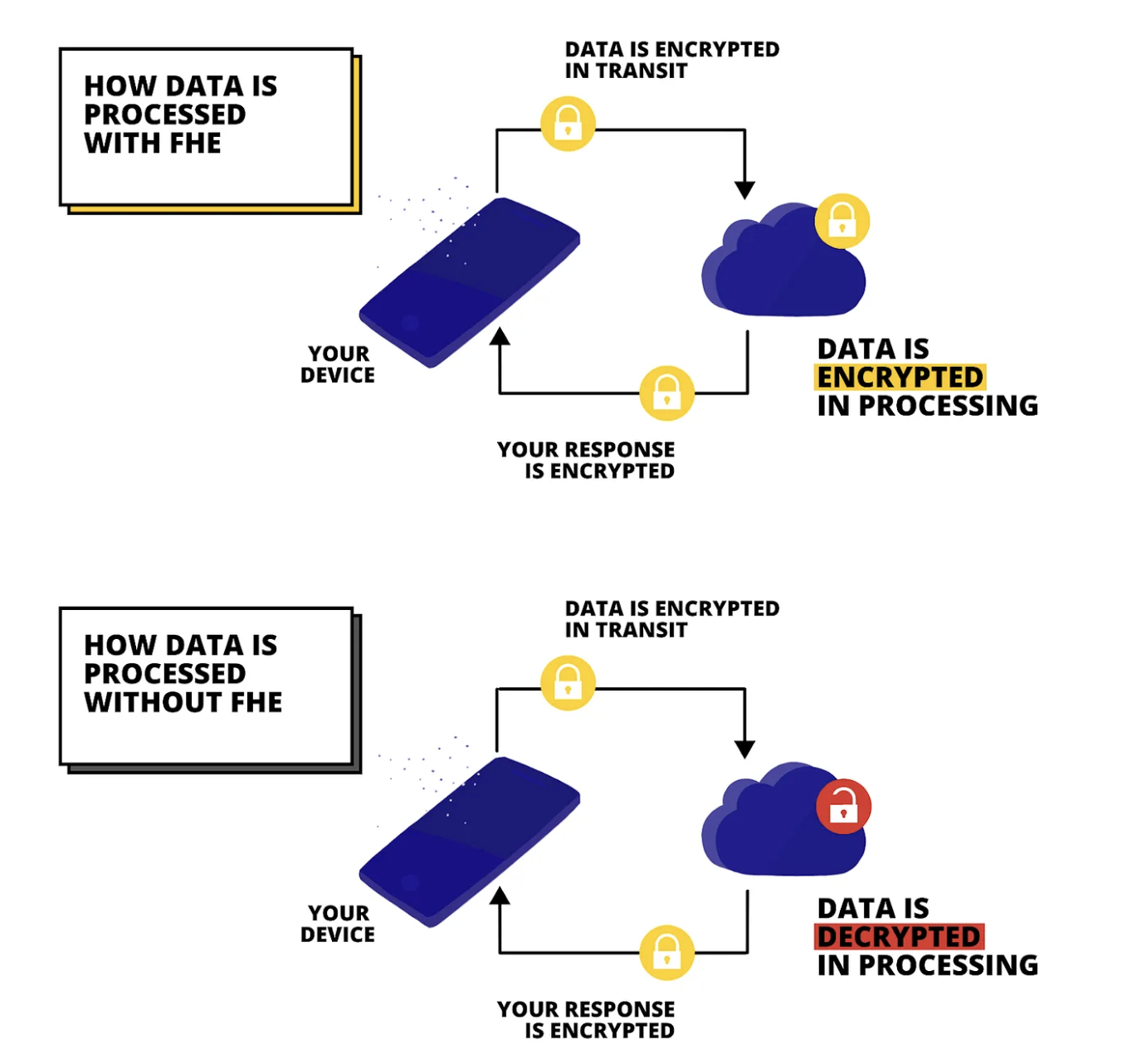 Image source: Zama
Key Terminology:
- Fully: Indicates the ability to perform various operations on encrypted data, such as addition and multiplication.
- Homomorphic: Refers to the ability to perform computations on encrypted data without decryption.
- Encryption: Describes the process of transforming information into a secure format to prevent unauthorized access.
Since 2009, significant progress has been made in the field of FHE, with a major breakthrough occurring in 2013, simplifying the relinearization process and significantly improving the efficiency of FHE. These advancements demonstrate the capability of FHE to perform various arithmetic operations on encrypted data, protecting the security and integrity of data without exposing its content.
Zero-Knowledge Proofs (ZKP)
ZKP first appeared in the groundbreaking paper "The Knowledge Complexity of Interactive Proof Systems" by Shafi Goldwasser, Silvio Micali, and Charles Rackoff in 1985. Initially a theoretical concept, ZKP saw significant development with the introduction of zk-SNARKs in 2012. zk-SNARKs are a type of ZKP that can verify the authenticity of any computation with minimal information leakage.
In a typical ZKP, there are two main roles: the prover and the verifier. The prover's goal is to confirm a specific statement, while the verifier's role is to assess the truth of the statement without learning any additional information. This approach allows the prover to disclose only the necessary evidence required for verifying the statement, thereby protecting data confidentiality and enhancing privacy.
With the rise of blockchain technology and cryptocurrencies, the practical application of ZKP has significantly increased. They are crucial in facilitating private transactions and enhancing the security of smart contracts. The emergence of zk-SNARKs has led to the development of solutions such as zCash, zkRollups, and zkEVMs, transforming academic pursuits into a practical ecosystem. This shift highlights the growing relevance of ZKP in safeguarding the security of decentralized systems like Ethereum and driving robust privacy-centric digital infrastructure.
ZK vs FHE
While FHE and ZKP share some similarities, they have significant differences in functionality. FHE can directly perform computations on encrypted data without revealing or accessing the original data, thereby generating accurate results without exposing underlying information.
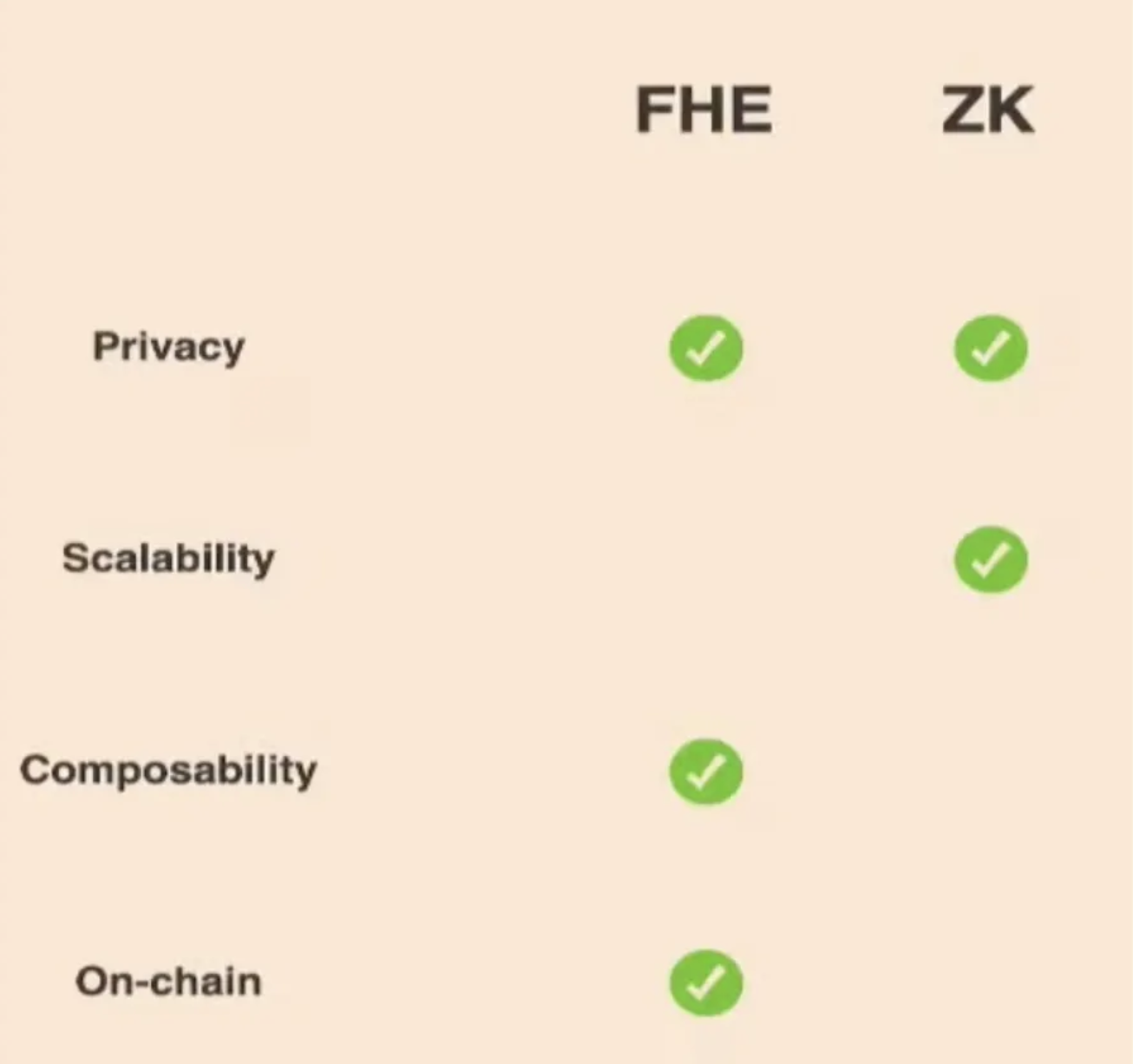
Image source: Workshop by Morten Dahl (Link)
These two technologies differ in the following aspects:
Encrypted Computation
ZKP faces challenges in handling encrypted data from multiple users, such as private ERC-20 tokens, without compromising security. In contrast, FHE excels in this regard, providing greater flexibility and composability for blockchain networks. However, ZKP typically requires customized integration for each new network or asset.
Scalability
Currently, ZKP is widely considered more scalable than FHE. However, with ongoing technological advancements, the scalability of FHE is expected to improve in the coming years.
Complex Computations
FHE is well-suited for complex computations on encrypted data, making it ideal for applications such as machine learning, secure MPC, and fully private computation. In comparison, ZKP is typically used for simpler operations, such as proving specific values without revealing them.
General Applicability
ZKP excels in specific applications such as identity verification, authentication, and scalability. However, FHE can be used in a broader range of applications, including secure cloud computing, privacy-preserving AI, and confidential data processing.
This comparison highlights the unique strengths and limitations of each technology, demonstrating their relevance in different scenarios. Both technologies are essential components of blockchain applications, with ZKP currently having a more mature application record. Nevertheless, FHE is expected to develop in the future and may become a more suitable solution for privacy protection.
Combined Application of ZKP and FHE
Some applications have already explored interesting methods of combining ZKP and FHE. Notably, Craig Gentry and his colleagues have explored using hybrid fully homomorphic encryption techniques to reduce communication overhead. These innovative technologies have been applied in various blockchain scenarios and hold potential for exploration in other fields.
The potential applications of combining ZKP and FHE include:
Secure Cloud Computing: FHE encrypts the data, while ZKP verifies its correctness, enabling secure computation in the cloud without exposing the original data.
Electronic Voting: The combination ensures the confidentiality of the ballots and confirms accurate counting.
Financial Transactions: In the financial sector, this integration maintains the confidentiality of transactions while allowing parties to verify the correctness of transactions without revealing detailed information.
Medical Diagnosis: Medical data encrypted with FHE can be analyzed by healthcare providers, allowing them to confirm diagnostic results without accessing sensitive patient information.
The combined application of ZKP and FHE is expected to enhance identity and data security in applications, and is worth further exploration and research.
Current FHE Projects
Here are some projects dedicated to applying FHE technology in the blockchain field:
Zama: An open-source cryptography company dedicated to developing FHE solutions for blockchain and artificial intelligence.
Secret Network: A blockchain platform launched in 2020, integrating privacy-preserving smart contract functionality.
Sunscreen: A compiler designed for FHE and ZKP.
Fhenix: A confidential Layer 2 blockchain utilizing FHE technology.
Mind Network: A universal restaking rollup solution based on FHE.
Privasea: A data infrastructure platform using FHE technology to facilitate computation on encrypted data.
Conclusion
FHE is rapidly establishing itself as an indispensable part of network security, especially in the field of cloud computing. Industry giants such as Google and Microsoft are adopting this technology to securely process and store customer data without compromising privacy.
This technology promises to redefine data security across platforms, heralding an unprecedented era of privacy. To realize this future, continued advancement of technologies such as FHE and ZKP is essential. Interdisciplinary collaboration is crucial, involving cryptographers, software engineers, hardware experts, and policymakers to address regulatory environments and promote broader adoption.
As we move towards a new era of digital sovereignty, timely awareness of the latest developments in fields such as FHE and ZKP, seamlessly integrating data privacy and security, is crucial. Keeping abreast of information updates will enable us to effectively navigate this evolving landscape and fully harness the potential of these advanced encryption tools.
免责声明:本文章仅代表作者个人观点,不代表本平台的立场和观点。本文章仅供信息分享,不构成对任何人的任何投资建议。用户与作者之间的任何争议,与本平台无关。如网页中刊载的文章或图片涉及侵权,请提供相关的权利证明和身份证明发送邮件到support@aicoin.com,本平台相关工作人员将会进行核查。


