Blast Network: A New Layer 2 Network with Promising Features
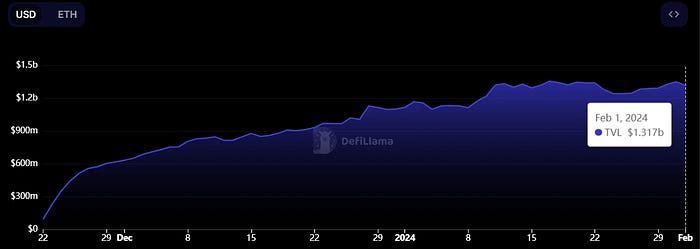
Blast is a Layer 2 network initiated by Pacman, the founder of Blur, and officially launched on November 21, 2023. Within just 48 hours, it attracted a total value locked (TVL) of $230 million. The network, based on Optimistic Rollup technology, is fully compatible with the Ethereum mainnet, supporting EVM and Solidity. According to Pacman, Blast's vision is not limited to serving Blur but aims to support all types of DApps, including DEX, lending, derivative trading, NFTFi, and SocialFi. As of February 1, 2024, Blast's TVL has exceeded $1.3 billion.
I. Mechanism Features of Blast Network
Blast Network is the first blockchain network designed to provide passive income potential for funds within Layer 2 accounts. Its main features include:
- Compound Interest for Users and Developers: Users' and developers' asset balances on Blast Network automatically compound over time, increasing their earnings. Blast Network's revenue comes mainly from two sources: ETH staking rewards and stablecoin interest earnings. Specifically:
- ETH Staking Rewards: After users bridge ETH to Blast Network, Blast locks these ETH on the Layer 1 network and utilizes the Lido protocol for native network staking, yielding ETH staking rewards at a current rate of approximately 4%. Blast automatically converts these rewards into USDB and distributes them to users, developers, and the Blast Foundation.
- Stablecoin Interest Earnings: When users bridge stablecoins (such as USDC, USDT, DAI, etc.) to Blast Network, Blast automatically converts them into an equivalent amount of USDB and deposits them through protocols like MakerDAO, generating stablecoin interest earnings at a current rate of approximately 5%. Blast distributes these earnings to users, developers, and the Blast Foundation. Users' USDB balances on Blast Network also compound over time, increasing their earnings.
Introduction of USDB: Blast Network introduces USDB, an automatic basic stablecoin whose value is always equal to $1. USDB serves as a unified unit of account and a medium for cross-chain transfers and revenue distribution within Blast Network. When users transact on Blast Network, they use USDB as the unit of account, whether buying or selling ETH or other tokens. Upon exiting Blast Network, users can exchange USDB for any supported stablecoin or ETH and bridge back to the Layer 1 network, enabling a seamless cross-chain experience while avoiding exchange rate risks.
Gas Revenue Sharing Mechanism: Blast Network adopts a gas revenue sharing mechanism. When users transact on Blast Network, they need to pay a certain amount of gas fees. These gas fees are collected and distributed to users, developers, and the Blast Foundation at a certain ratio. Specifically, 50% of each transaction's gas fees are allocated to users as an incentive for participating in Blast Network, 25% to developers as an incentive for building the Blast ecosystem, and 25% to the Blast Foundation to support the maintenance and development of Blast Network. This creates a virtuous cycle where more users and transactions lead to more gas fees and revenue, attracting more users and developers to join Blast Network.
BLAST Token Airdrop: In May 2024, Blast plans to airdrop the BLAST token, with 50% allocated to users and 50% to developers. The BLAST token will serve as the governance token of Blast Network, allowing holders to participate in various governance matters such as parameter adjustments, protocol upgrades, and fund allocation. It will also serve as the utility token of Blast Network, enabling holders to enjoy various benefits and privileges such as reduced gas fees, increased yield rates, and priority use of new features.
Blast Points: Blast also implements a scoring mechanism where Blast Points measure the contributions of users and developers to Blast Network, determining the allocation ratio of airdropped tokens. Users and developers can earn Blast Points by participating in various activities on Blast Network, such as asset deposits, transactions, inviting friends, and deploying DApps.
II. Big Bang Competition
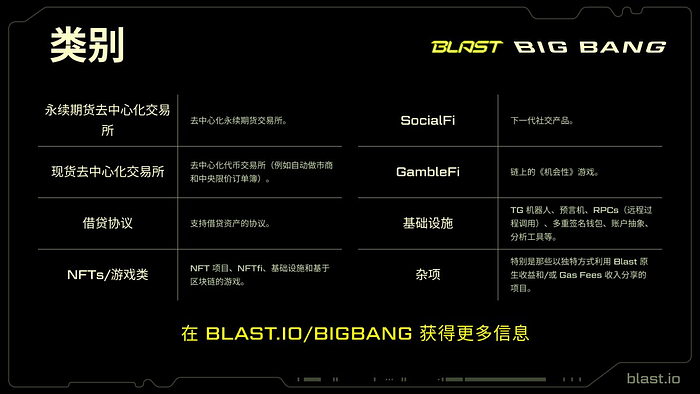
The Big Bang Competition symbolizes Blast Network's entry into the new battlefield of Layer 2. It took place from January 17 to February 17, with three key stages: intention registration, project submission, and winner selection. Through this competition, Blast Network further accelerated the development of its ecosystem, providing a platform for projects to showcase and develop. The competition themes included sustainable contract DEX, spot DEX, lending protocols, NFT/games, SocialFi, GambleFi, infrastructure, and projects that uniquely utilize Blast's native revenue or gas revenue sharing. This reflects Blast's optimism about the development of various sectors.
Blast Network provides multiple opportunities and rewards for DApps participating in the Big Bang Competition. Participating projects not only receive valuable rewards but also have the opportunity to deploy and operate on Blast Network, enjoying the benefits of the ecosystem and incentivizing active participation in Blast's development.
ETH Locking Liquidity Release: In February, Blast will release ETH locking liquidity, and participating projects will have the opportunity to share the released TVL of $140 million and engage with 104,000 users participating in locking.
Personalized Guidance for Investors: All participating projects in the Big Bang Competition will receive one-on-one personalized guidance from investors, providing more support for their development on Blast Network.
Airdrop Rewards: Blast has reserved 50% of the total AirDrop amount to incentivize developers, with over 90% to be distributed to DApps on the Blast mainnet, offering unprecedented airdrop opportunities for developers.
III. Potential Projects in Blast Ecosystem
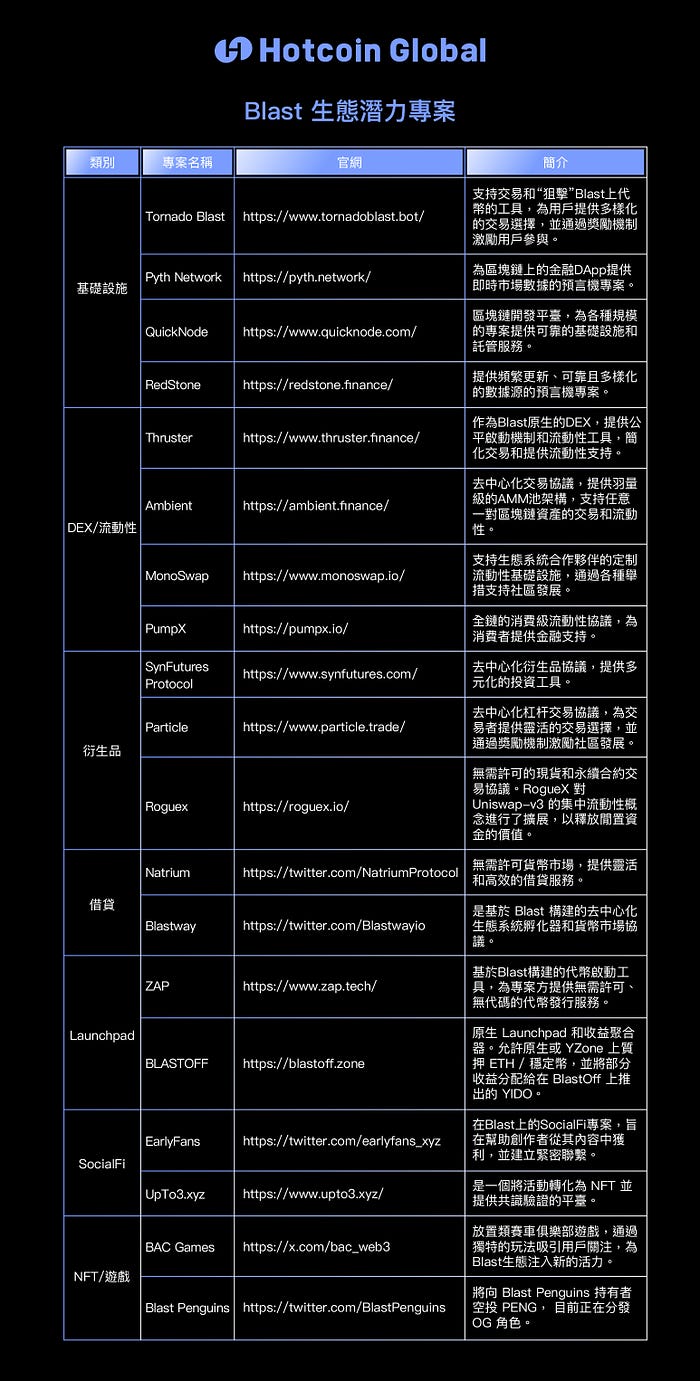
Since the announcement of the Big Bang Competition, Blast Network has already welcomed over 60 projects to collaborate and build on its platform. Here are introductions to some representative projects covering multiple areas, including DEX, infrastructure, lending, NFT, games, demonstrating the diversity and vitality of Blast Network's ecosystem.
IV. Risk Analysis of Blast Network
While the rise of Blast Network has brought new vitality and opportunities to the Layer 2 ecosystem, it also comes with certain risks and challenges.
Decreasing Liquidity Attraction Risk: The high liquidity of Blast Network may attract liquidity from other Layer 2 projects, leading to increased competition. This could result in reduced liquidity for other projects, affecting their performance in the market. Additionally, in order to retain users and investors, other projects may take aggressive measures to capture liquidity, such as increasing rewards or reducing fees, potentially triggering a wave of token stimulation and increasing market uncertainty.
Sustainability of Earnings Risk: While Blast Network addresses the issue of no benchmark interest rates for funds deposited on other Layer 2 chains, it also brings certain risks. With more projects and funds flowing into Blast Network, its inherent revenue model may face pressure, especially in changing market environments or intensified competition. If Blast Network cannot sustain attractive earnings, it may lead to capital outflows and decreased investor confidence, affecting the stability and development of its ecosystem.
Technical Uncertainty Risk: Blast Network is currently in the testing phase, with its mainnet expected to launch in February 2024. During this period, users cannot withdraw their assets. If contract vulnerabilities, hacker attacks, or project abandonment occur, users may face the risk of asset loss.
Market Speculation Risk: The attractiveness of Blast Network mainly comes from its high earnings and expected airdrops, but this could also lead to user speculation and short-term behavior. Once market sentiment changes, or if the airdrop value of Blast Network does not meet user expectations, users may withdraw in large numbers, leading to a significant decrease in Blast Network's TVL and user count.
V. Prospects of Blast Network Ecosystem
The prospects for the development of Blast Network's ecosystem mainly include the following aspects:
Scale Expansion: Blast Network can provide users with native earnings for ETH and stablecoins, as well as a social viral mechanism based on airdrop rewards and invitation systems, which are unique to other L2 networks and are the main reasons for Blast Network's rapid user and fund attraction. Blast Network also has a $20 million investment from well-known institutions such as Paradigm and Standard Crypto, as well as technical support from the Blur team, providing strong guarantees for the future development of Blast Network.
Ecosystem Development Opportunities: Blast Network's strategy of utilizing its native earnings and airdrop rewards to rapidly expand its user and fund base lays a solid foundation for the construction and development of its ecosystem. Additionally, Blast Network can learn from the successful experiences of other L2 networks, such as providing more application scenarios, optimizing user experience, increasing security, and scalability, to enhance its competitiveness and influence.
Challenges in Retaining Users and Funds: The challenge for Blast Network lies in how to maintain the stability and loyalty of its users and funds, as well as how to create its own characteristics and advantages in the fiercely competitive L2 market, attracting more developers and projects to join its ecosystem and form a virtuous network effect.
Impact on the L2 Market: The rise of Blast Network may have an impact on the Layer 2 market, helping to reshuffle the market, but it may also cause a certain degree of market volatility and uncertainty. Some projects may be eliminated or forced to improve, which could affect their underlying VCs and investors.
In conclusion, Blast Network is an innovative and promising L2 network that can provide users with native earnings for ETH and stablecoins, as well as a social viral mechanism based on airdrop rewards and invitation systems, changing the competitive landscape of L2 networks. However, Blast Network still needs to maintain the stability and loyalty of its users and funds, as well as create its own characteristics and advantages in the fiercely competitive L2 market, forming a virtuous network effect, and bringing more value and innovation to the Ethereum ecosystem and the evolving decentralized finance landscape.
Hotcoin Community
Official Chinese Group: https://t.me/hotcoinglobalcn
Official English Group: https://t.me/HotcoinEX
Official Korean Group: https://t.me/hotcoinkorea
Discord: https://discord.gg/NwYqKWkcZn
Facebook: https://www.facebook.com/HotcoinExchange
Twitter: https://twitter.com/HotcoinGlobal
Hotcoin Official Website: https://www.hotcoin.com
免责声明:本文章仅代表作者个人观点,不代表本平台的立场和观点。本文章仅供信息分享,不构成对任何人的任何投资建议。用户与作者之间的任何争议,与本平台无关。如网页中刊载的文章或图片涉及侵权,请提供相关的权利证明和身份证明发送邮件到support@aicoin.com,本平台相关工作人员将会进行核查。


