Headlines
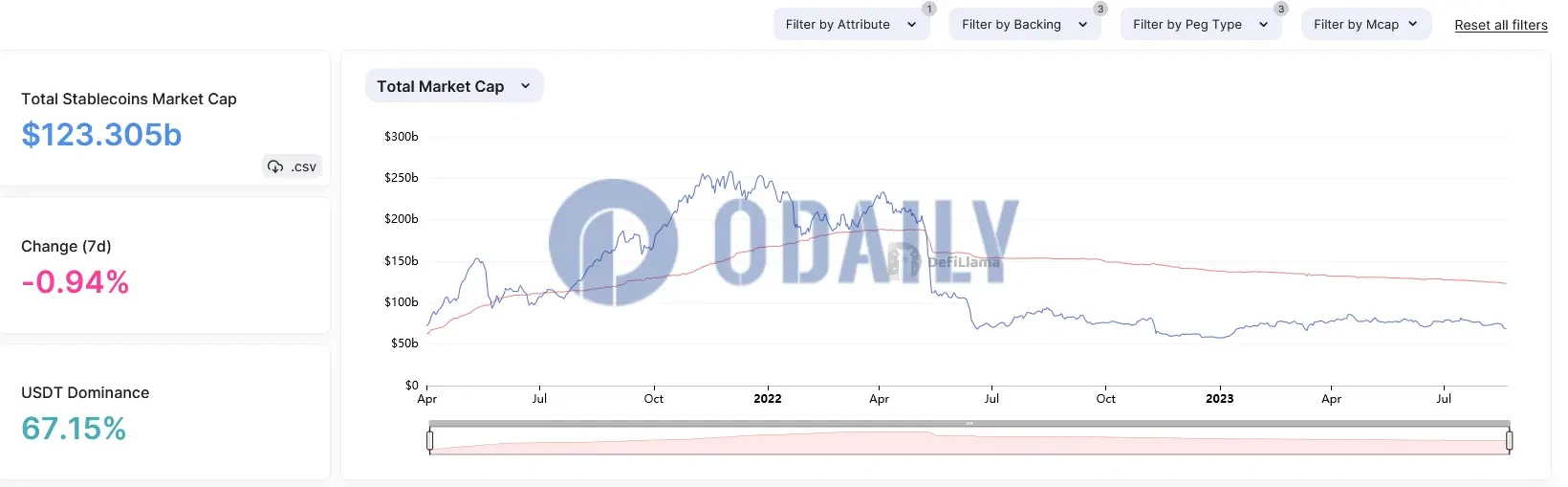
According to DefiLlama data, the current stablecoin total market value is approximately $123.3 billion, hitting the lowest level since September 7, 2021, with a 0.94% decrease on the 7th, and USDT accounting for 67.15% of the market value.

Cryptocurrency
HashKey announced that it will launch a retail trading platform on Monday, the 28th. Livio Weng, Chief Operating Officer of HashKey Group, stated in an interview that initially, retail investors can purchase BTC and ETH, and investment in virtual assets cannot exceed 30% of total assets. Weng mentioned that a tiered system will be established for retail investors, and through the KYC process, investors' investment experience and risk tolerance will be evaluated. A questionnaire will also be used to assess whether investors have a correct understanding of virtual assets. Beginners will have relatively limited investment opportunities, and the first batch of retail investors can only purchase BTC and ETH. Margin and derivative products are not approved by the China Securities Regulatory Commission at present. When regulatory approval is obtained in the future, products will be graded for different types of users. HashKey will collaborate with multiple commercial banks to provide users with fiat currency deposit and withdrawal services, initially supporting USD transactions and not supporting HKD for the time being. Only bank card transactions are accepted temporarily, and credit card transactions are not supported. If a retail investor's investment in virtual assets on the platform exceeds 30% of their total assets, a risk warning will be issued, and investment will be restricted. However, the platform cannot verify users' total assets and can only rely on users' self-provided information. Weng stated that they will actively communicate with regulatory authorities to promote stablecoin regulation and explore the possibility of approving a certain degree of contract trading and pledge products. It is expected that the launch of derivative products will be relatively challenging once they are online. (Sing Tao Daily)
According to Spot On Chain monitoring, the deployer of BALD transferred 1500 ETH from Base to Ethereum, leaving 677 ETH in Base. As reported by Odaily earlier, on August 14, the deployer of BALD transferred 7548 ETH to Ethereum, deposited 2100 ETH into Kraken, and 16 hours ago, the deployer of BALD transferred 5448 ETH to Binance.
Justin Sun redeems 206 million DAI from the DSR pool, earning 257,000 DAI in 9 days
According to on-chain analyst Yu Jin's monitoring, after the Maker DSR was reduced from 8% to 5%, some whales, including Justin Sun, withdrew from the DSR pool. Half an hour ago, Justin Sun redeemed 206 million DAI from the DSR pool, then repaid the DAI to redeem 235,556 wstETH. The 9-day earnings from these DAI amounted to 257,000 DAI, which has been converted into 154 ETH. Earlier on August 18, MakerDAO's proposal to adjust EDSR and stability fees was passed, reducing the DSR from 8% to 5%.
Project News
Multi-chain unified trading infrastructure zkLink introduces a new loyalty points system
Multi-chain unified trading infrastructure zkLink announced the launch of a new loyalty points system. Loyalty points serve as proof of participation in the ecosystem and can be used to obtain future rewards and exclusive benefits. Users can earn loyalty points by interacting with DApps in the zkLink ecosystem, performing on-chain tasks, engaging on social media, and actively participating in community activities. zkLink emphasized that it is collecting data from past activities, including old loyalty points, Loyalty NFT, Zealy Points, Weekly quizes OATs, Sograph OAT, Dunkirk OAT on Galxe, Dunkirk OAT on Aki Network, Community Calls and AMA OATs, and points from other small-scale activities. zkLink will collect, upload, and airdrop points to these users on Galxe in the fourth quarter of 2023. zkLink reminded that strict anti-cheating measures will be implemented to ensure fairness, and first-time offenders will have points deducted and receive a warning. Users who persist in cheating after receiving a warning will be blacklisted and disqualified. In May of this year, zkLink announced the completion of a $10 million financing round, with participation from Coinbase Ventures, Ascensive Assets, SIG DTI, BigBrain Holdings, and Efficient Frontier.
The opBNB testnet PreContract hard fork will take place on August 22
According to official information from BNB Chain, the opBNB testnet PreContract hard fork will take place on August 22. This upgrade includes setting the pre-deployed contract WBNB name to Wrapped BNB, setting the symbol to WBNB, and deleting the pre-deployed GovernanceToken contract, among other changes.
friend.tech trading volume exceeds 30,000 ETH
Dune data shows that the trading volume of friend.tech exceeds 30,000 ETH, with a nearly 50% increase in 15 hours, and the protocol's revenue reaching 1383 ETH, a 42% increase in 15 hours.

Investment and Financing
AI-driven digital human service provider Prins AI announced the completion of a $22 million Series A+ funding round. The new funds will be used to advance deep learning technology, expand the team, strengthen product development capabilities, and optimize marketing and sales efforts. The platform uses blockchain technology and smart contracts to record the training and application records of AI digital humans and employs a cryptocurrency reward mechanism, allowing users to participate in AI digital human training programs. This technology has been applied in various scenarios such as radio and television media, brand marketing, e-commerce live streaming/short videos, education and entertainment, AR/VR/AI, NFTs/metaverse, and more. The company previously completed a $10 million Series A funding round, with investors including Base 10, Kleiner Perkins. (FINSMES)
Global Policies
Russia launches consumer testing for digital ruble
Russia has begun consumer testing for the digital ruble, becoming the 21st country globally to test digital currency. The Russian central bank stated that the testing will be conducted at 30 sales points in 11 cities, with the participation of 13 banks and 600 members of the public. The central bank plans to officially launch the digital ruble around 2025 to 2027, but has pledged not to force people to use it. (Sing Tao Daily)
Gyeonggi Province in South Korea announced that it has completed the revision of the "Gyeonggi Province Public Officials' Code of Conduct," requiring public officials of level 4 or above in the province to report their holdings of virtual assets by September 1, and if necessary, verify the relevance to their duties, and take preventive measures based on the information obtained to prevent them from seeking personal gain in the course of their duties. It is reported that the "Public Officials Ethics Act," which mandates the mandatory declaration of virtual assets by senior public officials, will be implemented on December 14. (News1)
Voices
No content provided.
Mishaboar, a contributor and chief developer of Dogecoin (DOGE), hinted on Twitter while replying to a netizen that he may exit the project's development work if Dogecoin attempts to transition to a PoS consensus. He believes that the PoS mechanism has inherent flaws that may conflict with Dogecoin's core principles. Mishaboar pointed out that many PoS chains have not met expectations, showing a trend towards centralization, encountering disastrous failures, or becoming difficult to use. Additionally, Mishaboar emphasized the potential difficulties brought about by the PoS mechanism, as most token supplies are held by cryptocurrency exchanges, and potential regulatory challenges. He also stated that the praised aspects of PoS, such as energy efficiency and faster transactions, may not be important for Dogecoin's specific use case. Other solutions, such as payment channels and integration with payment providers, can achieve similar effects without transitioning to PoS.
Ho Siu Leung, co-founder and COO of Hong Kong Virtual Asset Exchange (HKVAX), stated that they can obtain the Hong Kong Securities and Futures Commission (SFC) Type 1 and Type 7 licenses in as fast as six months. They plan to launch a platform, over-the-counter (OTC) trading, and other services, but whether to introduce Security Token Offerings (STOs) will depend on the regulations of the Hong Kong SFC. Meanwhile, Wu Wei Leung, CEO of HKVAX, mentioned that Hong Kong supports the development of a global virtual asset center and is continuously helping the industry solve problems. Companies that had previously relocated to Singapore and Dubai have returned to Hong Kong.
Deloitte: Expect More Platforms to Obtain Hong Kong Licenses in the Second Half of the Year
Lü Zhihong, Managing Partner of Deloitte China's Digital Assets in Hong Kong, stated that currently, only two licensed virtual asset trading platforms, OSL and HashKey, have been allowed to open investments to retail investors in Hong Kong. If Hong Kong is to become an international virtual asset center, two licensed platforms are not enough. Attracting overseas platforms to develop in Hong Kong can gather more international Web3 talents and ecosystem-related businesses. It is expected that the Hong Kong SFC will continue to issue more licenses. Earlier, HKVAX also received a preliminary approval notice for the SFC's virtual asset platform license.
免责声明:本文章仅代表作者个人观点,不代表本平台的立场和观点。本文章仅供信息分享,不构成对任何人的任何投资建议。用户与作者之间的任何争议,与本平台无关。如网页中刊载的文章或图片涉及侵权,请提供相关的权利证明和身份证明发送邮件到support@aicoin.com,本平台相关工作人员将会进行核查。