The AI track is gradually becoming more competitive. What new gameplay can old projects offer?
Author: TechFlow of Deep Tide

On May 7th, Bithumb added Korean won trading pairs for two AI projects, AIOZ and NEAR. NEAR, as a well-known L1 project, needs no introduction. AIOZ Network, on the other hand, may be less familiar. Previously focused on storage and streaming, AIOZ Network is now gradually moving towards AI-as-a-Service and shared computing power based on its accumulated advantages in business. Recently, it released the white paper for its decentralized AI project, W3AI.
As the AI track becomes increasingly competitive, what new gameplay can old projects offer to secure a place in a market where liquidity and attention are both scarce?
Due to the complexity of the white paper, TechFlow of Deep Tide has conducted a thorough study of its content to help readers quickly understand the technical features and implementation of the AIOZ W3AI project.
Under the wave, the opportunity for AIOZ to enter the AI market
AIOZ is not a new project, but its transition to AI is a natural progression.
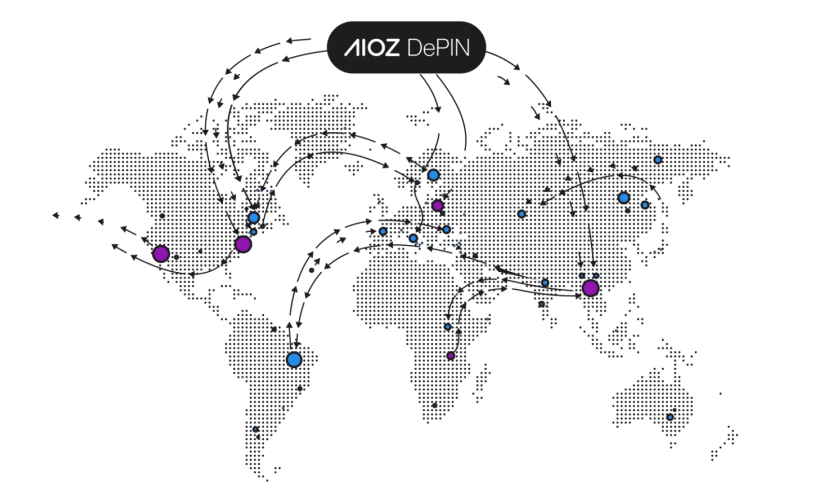
AIOZ Network was previously a Layer-1 network with interoperability with Ethereum and Cosmos, driven by over 120,000 global nodes, and the AIOZ DePIN to provide computing resources. It can support AI in terms of processing speed, rapid iteration, scalability, and network security, and is a resource on which the project can rely to transform its narrative.
Furthermore, from an external perspective, the development of AI also faces challenges with centralized cloud computing solutions being unable to handle large amounts of data, leading to limited scalability and high usage costs. Moreover, due to the ultimate control of data residing with centralized providers rather than users, concerns about data privacy and security are inevitable.
In addition, the barrier to accessing top AI resources may be high, limiting the participation of a considerable number of small businesses and individuals, hindering innovative development. The solution of edge computing provides near-end services for data sources, with applications initiated on the edge side, resulting in faster network service response. As data is processed at local nodes, there is no need for long-distance transmission to central servers, naturally reducing the risk of data leakage. With AIOZ DePIN's globally distributed edge computing nodes, AIOZ has the confidence to make a large-scale entry into the AI field.

W3AI: The "dual-layer architecture" of DePIN+AI as a Service
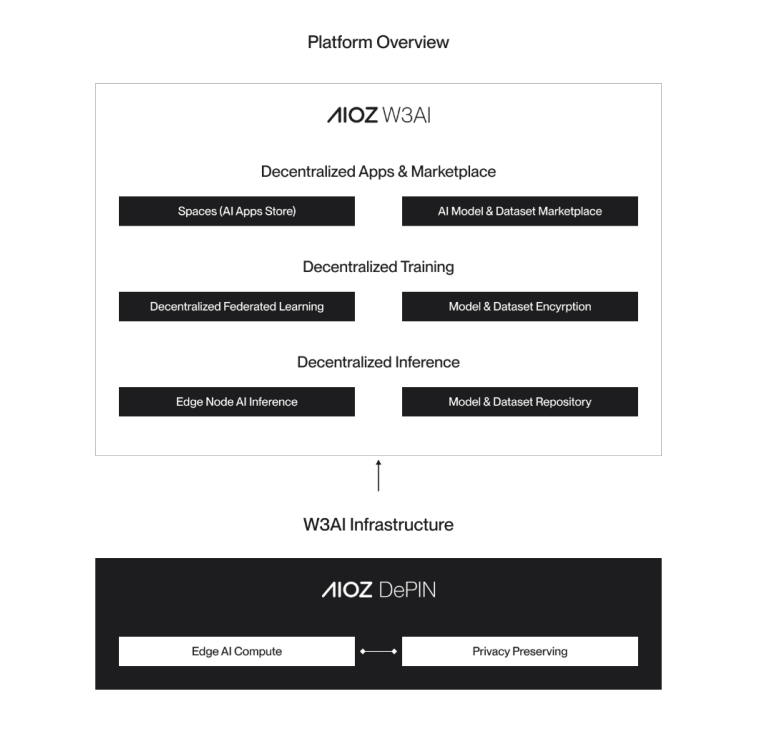
In its move towards the AI track, a key initiative of AIOZ is W3AI --- a dual-layer architecture encompassing infrastructure and applications.
The dual-layer architecture is the core of the AIOZ W3AI project, which adopts an innovative approach to address the fundamental issues of AI computing in terms of scalability, cost efficiency, and user privacy protection.
This architectural design divides the operation of the entire network into two main levels: the W3AI Infrastructure and the W3AI Application, each with its unique functions and roles, collectively supporting the efficient operation of the entire network.
Infrastructure layer (W3AI Infrastructure) as the foundation of the network
- #### AIOZ DePIN's globally distributed artificial nodes
The foundation of AIOZ W3AI lies in its vast distributed artificial edge computing nodes, which globally contribute computing resources including storage, CPU, and GPU, forming a decentralized power source. The multigraph topology ensures efficient communication lines between AIOZ DePINs, minimizing communication costs and improving processing speed. These nodes work collaboratively through distributed computing methods to collectively train and execute AI models. In this way, the AIOZ W3AI platform effectively utilizes dispersed computing resources to reduce costs and enhance data privacy protection. This decentralized approach significantly reduces the risk of server bottlenecks and enhances user privacy by eliminating single-point control.

- #### Data processing and storage
Through AIOZ W3S, data is securely stored on multiple globally dispersed nodes, enhancing data security and improving data processing response times.
The use of distributed file system AIOZ IPFS and encryption technology protects the data stored on nodes, preventing unauthorized access and data leakage.
Flexible application layer (W3AI Application)
- #### Web 3 AI platform provides AI as a Service
AI as a Service (AIaaS) is a model where AI technology is provided as an online service to users, enabling enterprises or individuals to enjoy the convenience of AI technology without incurring high costs.
For example, when an e-commerce merchant wants to understand user purchase history and analyze user consumption behavior to provide personalized shopping recommendations, AI technology can be used to collect and analyze user data to generate corresponding sales strategies. This is an application of AI as a Service in e-commerce.
In terms of product form, W3AI provides a simplified AI training workflow and intuitive UI/UX, offering a user interface and API that allows developers to easily access W3AI services, develop and deploy AI models, and more. This layer's design focuses on user experience and service accessibility. The platform also integrates various AI as a Service offerings, including machine learning, deep learning, and neural networks, allowing users to choose different services and tools as needed.
- #### Model training and inference
The W3AI platform supports model training and inference in a decentralized environment. W3AI Training (AIOZ W3AI Infrastructure) uses technologies such as federated learning and homomorphic encryption to enable numerous edge computing nodes (DePINs) to collaboratively train AI models without the need to share their own data, improving model training performance while also ensuring data privacy. Through running trained models on edge AIOZ DePINs, AI is brought closer to the data source. W3AI Inference (AIOZ W3S Infrastructure), supported by W3S technology, allows users to upload their own datasets for model training or use existing models on the platform for data analysis and prediction.
- #### Decentralized W3AI marketplace and incentive mechanism
The application layer also provides users with a decentralized marketplace, AIOZ AI dApp Store, and AI Model & Dataset Marketplace, where individual users and enterprise organizations can freely contribute, sell AI datasets and models, build and deploy innovative AI applications, and convert their contributions into token rewards.

Navigating the "AI-empowered routing" between the "dual-layer architecture"
With a well-structured architecture, the logic resources and task data that need to be processed between the operation of the dual-layer architecture are not few. Therefore, W3AI introduces AI-empowered routing into the dual-layer architecture to dynamically optimize each task, ensuring higher overall system efficiency.
At the infrastructure layer, AI-empowered routing calculates the demand for computing and the current load of nodes, dynamically allocating tasks to ensure that each node can participate in suitable tasks based on its capabilities and real-time network conditions. It also monitors the health of nodes to promptly identify and address potential node failures or performance bottlenecks, avoiding the impact of single-point failures on overall efficiency.
At the application layer, intelligent routing can quickly respond to user requests, dynamically adjust data flow and processing strategies in real-time. It can also intelligently allocate the most suitable nodes based on the user's specific geographical location and requirements. In the face of large-scale high-concurrency tasks, the AI routing architecture intelligently schedules and optimizes tasks to support the application layer in handling complex AI models and big data analysis.
The white paper also references a large number of complex formula calculations to demonstrate the specific implementation of routing. Interested readers can refer to the white paper document.

Workflow, an example of AI task implementation
With this rich infrastructure architecture, how does W3AI unfold its workflow? From data input to result output, W3AI's workflow embodies a complete decentralized operation mode: encrypted output → task splitting and allocation → execution of computing tasks and storage → collection of results in containers after computation → users obtain decrypted output results.
We can break down the above process into simple steps:
First, the data input and encryption: User-uploaded data is encrypted using homomorphic encryption before entering the platform to ensure data security.
Task splitting and allocation: The encrypted data is split into multiple segments based on task requirements, and each task is allocated to the most suitable node for execution.
Execution of computing and storage: The selected nodes execute specific computing tasks, such as AI model training or data analysis, while also handling related data storage.
Collection and encryption of results: After the tasks are completed, the results are encrypted again and stored in transformed containers, awaiting retrieval by end-users.
Decryption and output of results: Only authorized users can access the final results, which are decrypted before being output.

Through this process, W3AI improves processing efficiency while also considering flexible and scalable features, data security and privacy, optimizing system resource utilization, reducing manual intervention, and lowering operational costs.
Token economy revolving around the entire ecosystem
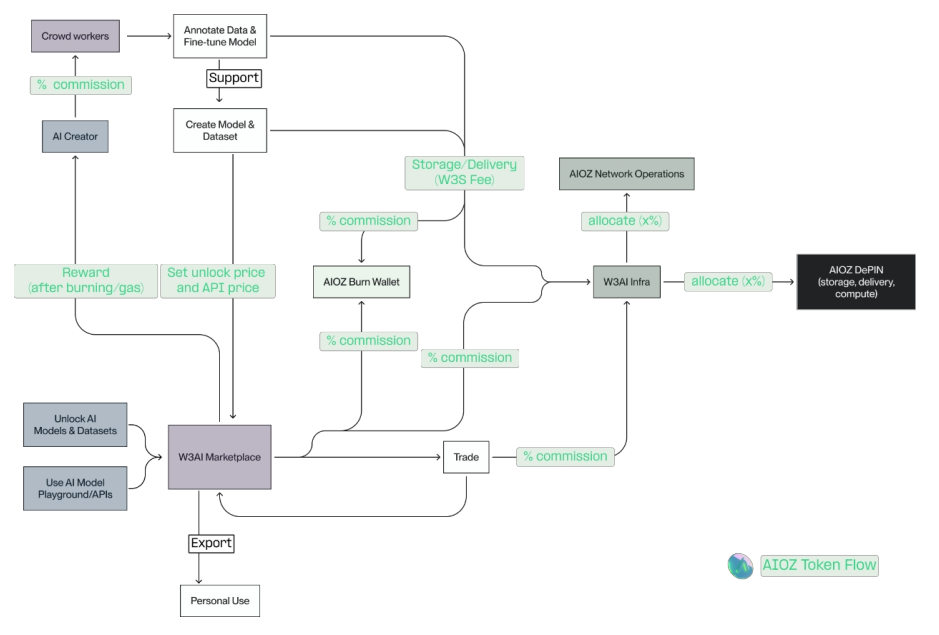
$AIOZ plays a crucial role in the entire AIOZ W3AI ecosystem. With the emergence of AI as a Service and shared computing power businesses, its token has more use cases and value capture.
Data trading and contribution incentives
$AIOZ is used to reward users who provide computing power and storage resources, ensuring the stable operation of the network. In the platform's trading market, users can use $AIOZ to purchase various AI as a Service offerings or buy and sell AI models and datasets. Token holders can also participate in the governance of the network by voting to decide the next steps in the ecosystem's development.
Sustaining ecosystem operation
A portion of the transaction fees using $AIZO is used for AIOZ network operation and financial management, ensuring the platform's continuous maintenance and development. Another portion is burned directly, helping to regulate token supply and alleviate inflation. This carefully designed token circulation cycle incentivizes innovation, rewards participation, and drives the continuous development of the AIOZ W3AI ecosystem.

Conclusion
As a decentralized project transitioning to AI, AIOZ W3AI has natural advantages in terms of technical resources and operational mechanisms. In terms of technology and concepts, W3AI demonstrates considerable potential to provide users with more secure, flexible, and efficient computing services and an engaging ecosystem experience. However, it is important to note that W3AI also faces challenges such as the market's incomplete understanding and trust in centralized AI solutions, as well as the potential high operating costs under a high standard operational mode.
The current white paper is more like a blueprint formulated in the early stages of the project, preparing for the future but not yet implemented and executed. Its actual usage, as well as any other security and technical issues, are subject to market validation.
Nevertheless, actively transitioning the narrative is the correct posture for Web3 projects highly relevant to business. Both old and new projects are actively participating in the AI drama, and whether the players in the crypto space will get their money's worth, time will naturally provide the answer.
免责声明:本文章仅代表作者个人观点,不代表本平台的立场和观点。本文章仅供信息分享,不构成对任何人的任何投资建议。用户与作者之间的任何争议,与本平台无关。如网页中刊载的文章或图片涉及侵权,请提供相关的权利证明和身份证明发送邮件到support@aicoin.com,本平台相关工作人员将会进行核查。