friend.tech's V2 focuses on building the Web3 community, but facing competition from multiple Web2 social giants, its challenges are greater than its opportunities.
By BitpushNews
Recently, friend.tech has successively released positive news, sparking market discussions. On May 3, friend.tech opened the project token FRIEND for airdrop application; on May 4, friend.tech released the v2 version; on May 7, friend.tech announced the launch of new features such as Keydrops, Memeclubs, and Pinned Rooms. Regarding the new version of friend.tech, some are optimistic while others are skeptical, and the market's attitude towards it varies.
From the perspective of token price, when FRIEND was first listed, the opening price was $3.03. As of May 7, the price has dropped by approximately 30%. So, how has friend.tech's v2 version performed since its launch? What innovations does friend.tech's v2 version have? Facing Twitter and many other Web3 social giants, what challenges does friend.tech face at this crossroads?

Friend.tech (FT) is considered one of the most successful Web3 dApps in SocialFi, with revenue exceeding $2 million and net deposits exceeding $33 million in the first month. After the launch of v2, friend.tech has performed well based on its large user base. According to Dune data, as of May 7, since the release of friend.tech v2, the number of Clubs has reached 131,643, with a total transaction volume of 18,019,367 FRIEND tokens and Club fees of 269,495 FRIEND tokens. According to Bitpush terminal data, as of May 7, FRIEND is priced at $2.14, which means that within 5 days of friend.tech's launch, the fee income is approximately $576,000.
From the perspective of whale holdings, most whales still have a positive outlook on friend.tech in the short term. According to DUNE, as of May 7, among the top 20 holders of FRIEND, 4 whales reduced their holdings, 7 whales increased their holdings, with @machibigbrother increasing the most (adding 74,298 FRIEND tokens), and the remaining 9 whales did not change their holdings.
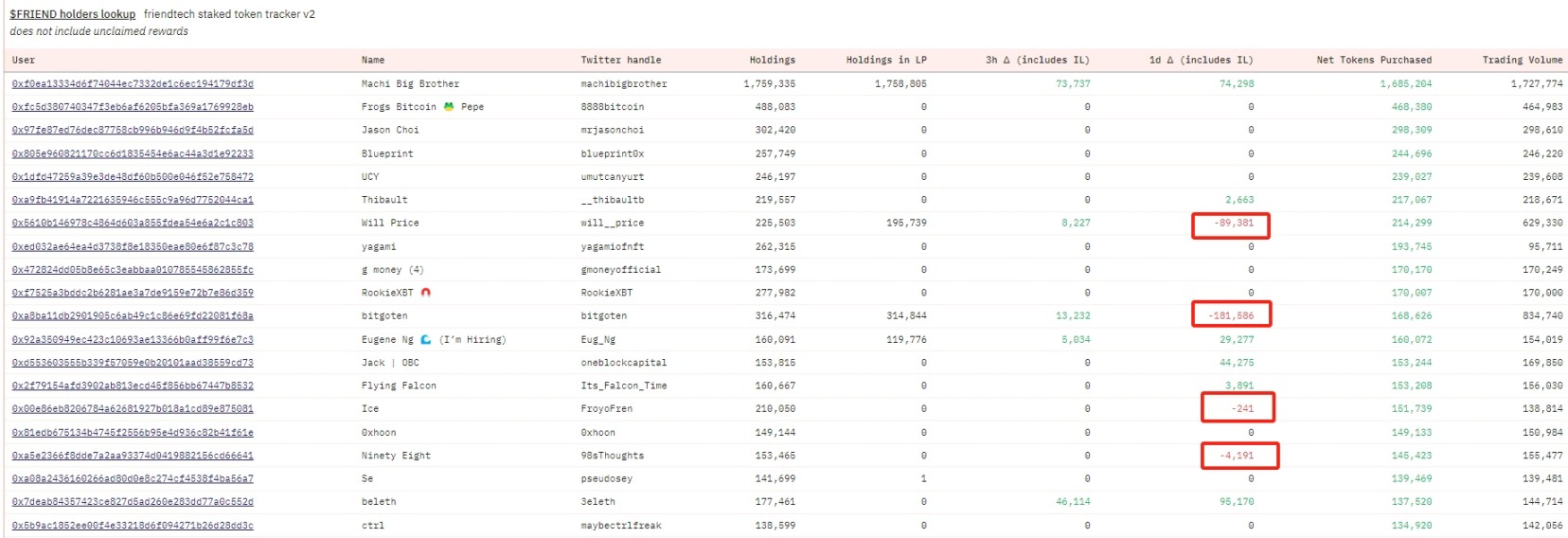
Overall, after the launch of friend.tech v2, there has been a significant increase in fee income in the short term, indicating high short-term activity. From the observation of whale holdings, although some whales have started selling FRIEND tokens, overall, whales still have a positive outlook on FRIEND in the short term.
What Innovations Does friend.tech V2 Have
Before introducing friend.tech's v2 version, let's briefly understand the basic information of its v1 version. friend.tech was launched in August 2023, allowing users to buy and sell "Keys" associated with Twitter accounts. These Keys are essentially passes to private in-app chat rooms and exclusive content, effectively monetizing social interactions. The v2 version of friend.tech attempts to integrate the NFT community, DAO, and meme coin social aspects. Among them, Clubs (chat rooms) are one of the main new features introduced in FT v2.
Anyone can create a new club. Clubs are defined as "group spaces" owned and managed by key holders. Here's how clubs work: 1) Key holders vote to elect the club's chairman; 2) The chairman manages the club and selects moderators; 3) All club keys are traded using $FRIEND; 4) Each club transaction incurs a 1.5% transaction fee, which is distributed to farmers and FT. Chat room members can manage shared finances and mint tradable on-chain collectibles, meme coins, etc., creating additional income for the group. To support this, friend.tech will also have a local decentralized exchange for trading all these assets. The chat rooms will also introduce tagging, enhanced notification systems, pinned messages, lotteries, and referral programs.
In the v2 version, the friend.tech platform will also be improved, including new discovery features, enhanced keyword search, personalized recommendations for key purchases, and other user-specific suggestions. Considering the criticality of security in cryptocurrency, the v2 version also integrates with cold wallets to enhance security and adds two-factor authentication.
Overall, in the v1 version, friend.tech mainly aimed to quickly establish a Web3 social ecosystem through influential crypto celebrities, and then achieve the growth and development of the platform, KOLs, and users through the fan economy. However, with user stagnation, the original model is being challenged. From the v2 version, it can be seen that the FT team is now more focused on the community, hoping to integrate DAO, meme, and NFT under friend.tech through chat rooms (Clubs), providing a better user experience and environment for Web3 users.
Facing Strong Competitors, friend.tech Stands at a Crossroads
For a newcomer in the Web3 arena, friend.tech's v1 version mainly focused on how to quickly attract users, with its product innovation advantage being the monetization of social interactions. This attracted a group of KOLs to join, and a large number of KOL fans and users flocked in with the expectation of airdropped points. However, as the hype around friend.tech waned, its shortcomings became more apparent, with KOLs and the platform making money while fans continued to lose money.

From the current data, after the launch of friend.tech's v2, its performance has been relatively good, once again becoming a market hot spot. However, this is mainly due to the continuous release of positive news and airdropped points. The development of Web3 social interaction dominated by the community is actually quite challenging, unlike the ease of attracting KOLs in the v1 version. For example, the most frequently used social app for Web3 users, Telegram, has various Telegram Bots in the DeFi field with rich and diverse functions, and has already achieved a certain scale. In addition, Telegram is constantly trying to collaborate with its "progeny" Ton public chain, to lay out Web3. Telegram's Chief Investment Officer, John Hyman, stated that in the future, TON will continue to operate as an independent decentralized organization, and Telegram's focus will remain on providing an instant messaging platform. From its application ecosystem, Telegram hopes to develop into a super app similar to WeChat, which naturally includes various essential applications for Web3. In addition to Telegram, traditional applications such as Facebook and Reddit have long been trying to add various Web3 novelties such as NFT to their Web2 social apps.
Overall, although friend.tech has ambitious goals in the v2 version, the reality is that the difficulty is high. In the v2 version, friend.tech attempts to build an encrypted social app centered around the community, friendly to Web3 users. However, this goal is actually being pursued by many projects. Considering the user migration cost, friend.tech's v2 version is difficult to compete with Web2 social app giants. What is truly worth looking forward to may be how friend.tech's monetization of social interactions can be deepened in the community.
Conclusion
friend.tech's v1 version achieved great success in the short term, but from a long-term perspective, the model of the platform and KOLs making money while regular users lose money has become a criticism, which has ultimately led to its development falling into a slump to a large extent. friend.tech's v2 version focuses on building the Web3 community and attempts to build an encrypted social ecosystem centered around community interaction monetization. However, facing competition from multiple Web2 social giants such as Telegram, its challenges are greater than its opportunities. Compared to Web2 social giants like Telegram, friend.tech needs more innovation and accumulation; otherwise, it may ultimately face the fate of being forgotten by the public.
免责声明:本文章仅代表作者个人观点,不代表本平台的立场和观点。本文章仅供信息分享,不构成对任何人的任何投资建议。用户与作者之间的任何争议,与本平台无关。如网页中刊载的文章或图片涉及侵权,请提供相关的权利证明和身份证明发送邮件到support@aicoin.com,本平台相关工作人员将会进行核查。


