Source: Filecoin Network

Key Points
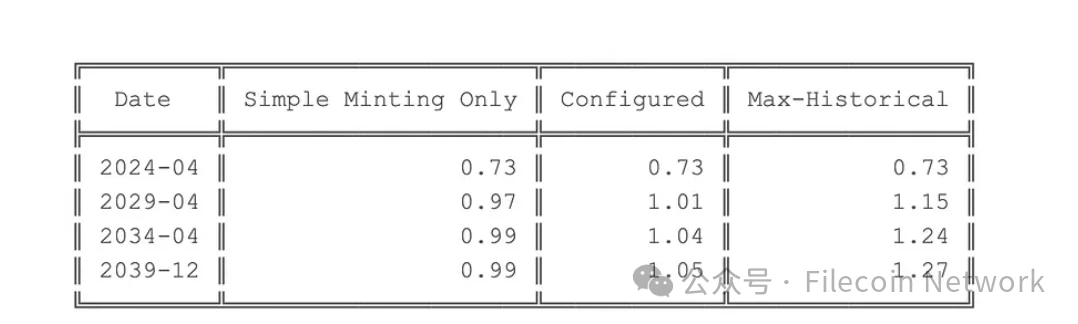
If the historical peak load rate and update rate are maintained (an aggressive scenario of original byte load growth), the total supply of Filecoin expected to enter circulation by 2040 is estimated to be 1.27BFIL.
If the load is lower than the historical daily peak, the total supply will decrease, which is likely to happen, as it is quite difficult to maintain this level for the next 16 years. For example, if the current load rate remains unchanged, the total supply of Filecoin expected to enter circulation by 2040 is estimated to be 1.05BFIL.
In summary, by 2040, the amount of Filecoin entering circulation will be far less than the theoretical maximum token supply of 2B.
Introduction
Filecoin adopts a hybrid minting model to encourage continuous and long-term storage supply. The hybrid minting model combines simple minting and baseline minting to align block reward emissions with storage targets. This allows the Filecoin network to proportionally incentivize storage providers based on the utility (i.e., storage capacity) they provide to the network.
In the hybrid minting model, a portion of minting rewards comes from exponential decay (simple minting), while the remaining portion comes from network baseline minting. When the raw byte power (RBP) is higher than the baseline, the baseline minting will exhibit exponential decay, but when it is lower than the baseline, it will slow down to polynomial decay. This mechanism allows the network to issue the maximum possible rewards when RBP reaches or exceeds the baseline storage target. The target baseline storage capacity aims to double the network's storage capacity annually.
Visual Adaptive Minting
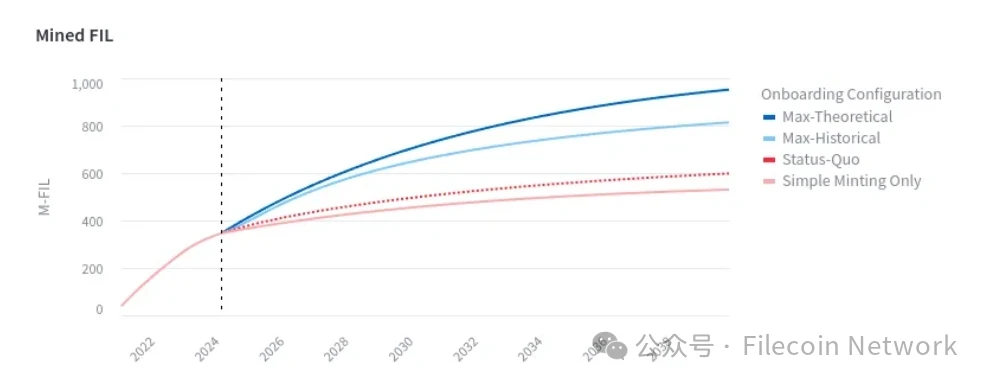
As minting is adaptive, it is helpful to intuitively understand the amount of minted Filecoin and compare it with the mintable upper and lower limits. If RBP reaches or exceeds the baseline function, it will reach the upper limit; if only simple minting is activated, it will reach the lower limit. Figure 1 visually illustrates these boundaries:

Minting trajectories for different load configurations. The pink line represents the amount of FIL that will be minted if only simple minting is activated (lower limit); the dark blue line represents the total amount of FIL that will be minted if RBP matches the future baseline (theoretical upper limit); the light blue line represents the amount of FIL that will be minted if the network's RBP load rate and update rate are maintained at historical peak values (approximately 62PiB/day and 100% update rate) (high growth rate); the scattered red line represents the amount of FIL that will be minted if the current load rate and update rate remain unchanged (4PiB/day and approximately 50% update rate).
Note that as minting is adaptive, the future total minted amount depends on certain assumed loading behaviors (see footnote 1 below). This network calculator can be used to explore different scenarios of future loading and updates, and how this will affect the estimated minted FIL total on the Filecoin network. You can interactively explore different minting scenarios.
Impact on FDV
What does this mean? We can see that, according to the allocated mintable 1.1BFIL tokens, by 2040, the actual mintable token amount will be at most 0.953BFIL tokens. The specific amount will depend on future loading behaviors, but the upper limit is 0.953B. Currently, the RBP load is approximately 4PiB/day, and SP has updated about 50% of sectors. If this trajectory is maintained, by 2040, only 62% of the 0.953B mintable tokens will be minted. Another scenario is that if the load increases to the historical peak value of 62PiB/day and SP updates 100% of its sectors, then by 2040, 85% of the mintable tokens will be minted (see footnote 2 below). When compared with the total mintable 1.1BFIL tokens, this impact becomes more apparent. In this case, if the current loading trajectory is maintained, by 2040, only 54.3% of the allocated tokens for minting will be minted. If the number of loaders grows and maintains the historical peak value, by 2040, 73.9% of the total 1.1B tokens will be minted.
We can also look at this issue from the perspective of total supply. The table below shows the predicted total supply for three scenarios by date, where all future minting is: ① simple minting, ② based on the current loading and updates sustainability, ③ based on the sustainability of historical peak loading and updates. Here, we define the total supply as: Total Supply = Minting + Continued Storage - Consumption. Please note the comparison with the circulating supply, which is defined as: Circulating Supply = Total Supply - Locked Amount.

Predicted total supply of Filecoin under various minting scenarios (in billions of FIL) (as of April 10, 2024).
What does this mean for Filecoin's circulating supply? Filecoin can mint up to 2BFIL, but the actual circulating FIL quantity will be much lower. If the current loading trajectory remains unchanged, by 2040, at most 1.05B tokens will enter the market circulation. If RBP loading and updates grow to their historical peak and maintain this level, then by 2040, at most 1.27BFIL tokens will enter circulation (see footnote 3 below).
Conclusion
In conclusion, we have explored Filecoin's minting mechanism and its impact on circulating supply. By using some boundaries as comparison points, we found that by 2040, the actual upper limit of the total circulating supply of FIL tokens may be between 1.05B and 1.27BFIL, which is lower than the specified 2BFIL. This means that by 2040, in the scenarios of "maintaining the status quo" and "maintaining aggressive" original byte growth, the total token supply will be 47.5% to 36.5% less than the theoretical upper limit.
Footnotes
Whether the network power is above or below the baseline, the total minted amount will asymptotically approach 1.1B in the infinitely distant future. However, when it is below the baseline, the speed at which this asymptotic value is reached is much slower. Therefore, choosing a finite future time as a target will be more valuable, as in our example of 2040, these two predicted values differ greatly. For more detailed information on the importance of focusing on a finite future time, please refer to this explanation.
The amount of mintable tokens by 2040 may be approximately 0.953B tokens. This is less than the specified 1.1B tokens, as the baseline minting mechanism has already taken effect during periods when the network RBP was below the baseline.
These predictions consider gas consumption and are linearly extrapolated in the simulation window. Potential changes in future gas consumption trends or protocol changes will alter these predictions.
免责声明:本文章仅代表作者个人观点,不代表本平台的立场和观点。本文章仅供信息分享,不构成对任何人的任何投资建议。用户与作者之间的任何争议,与本平台无关。如网页中刊载的文章或图片涉及侵权,请提供相关的权利证明和身份证明发送邮件到support@aicoin.com,本平台相关工作人员将会进行核查。