Original | Odaily Planet Daily
Author | How is the husband
On April 30, the long-awaited Hong Kong spot cryptocurrency ETF officially launched on the Hong Kong Stock Exchange, marking the first time that an Ethereum spot ETF has landed on a major exchange. Currently, the Hong Kong spot cryptocurrency ETF is mainly issued synchronously by three local asset management companies, including Huaxia Fund (Hong Kong), Boshi Fund (International), and Jia Shi International. They include Boshi HashKey Bitcoin ETF (03008), Boshi HashKey Ethereum ETF (03009), Huaxia Bitcoin ETF (03042), Huaxia Ethereum ETF (03046), Jia Shi Bitcoin Spot ETF (03439), and Jia Shi Ethereum Spot ETF (03179).
From April 30 to May 6, the Hong Kong spot cryptocurrency ETF has been online for just over a week. How has it performed? How does the Hong Kong spot cryptocurrency ETF differ from the US spot Bitcoin ETF issued earlier this year, and does it have unique competitiveness to attract capital from the Asia-Pacific region and even globally?
To this end, Odaily Planet Daily will review the development of the Hong Kong spot cryptocurrency ETF over the past week and make a comprehensive comparison with the US spot Bitcoin ETF.
The first day's performance was not satisfactory, but the future is promising
In nominal terms, the Hong Kong ETF has been active for a week, but in terms of actual trading days, excluding the May Day holiday and weekends, the Hong Kong ETF has been open for trading for a total of 4 days. During these four days, the initial fundraising scale of the Hong Kong spot cryptocurrency ETF was approximately HK$2 billion, with a net asset value of US$293 million calculated. This is a significant advantage compared to the initial net assets of US$113 million for the US spot Bitcoin ETF on its first day.
However, at the end of the first day of trading, according to SoSoValue data, the total trading volume of the six initial Hong Kong cryptocurrency spot ETFs was approximately HK$87.58 million (approximately US$12.70 million), far lower than the US first-day spot Bitcoin ETF trading volume of US$4.66 billion.
Despite the Hong Kong spot cryptocurrency ETF's fundraising scale being more than twice that of the US spot Bitcoin ETF, why is there such a large disparity in actual trading volume on the first day?
The difference in market size: Compared to the global financial center of the United States, Hong Kong has a relatively smaller market reach, especially since it is not yet open to ordinary investors in the mainland, leading to lower actual trading volume.
Lower acceptance of cryptocurrencies: Traditional financial practitioners (and institutions) in Hong Kong and even Asia still have a certain gap in their understanding of cryptocurrencies compared to those in Europe and the United States.
The high fundraising scale in Hong Kong is attributed to its innovative "physical subscription and redemption" mechanism, which led to a high fundraising amount during the subscription period as many ETF investors used Bitcoin and Ethereum to purchase ETFs.
In the following three trading days, the performance of the Hong Kong spot Bitcoin ETF and Ethereum ETF was relatively ordinary, as shown in the data below.
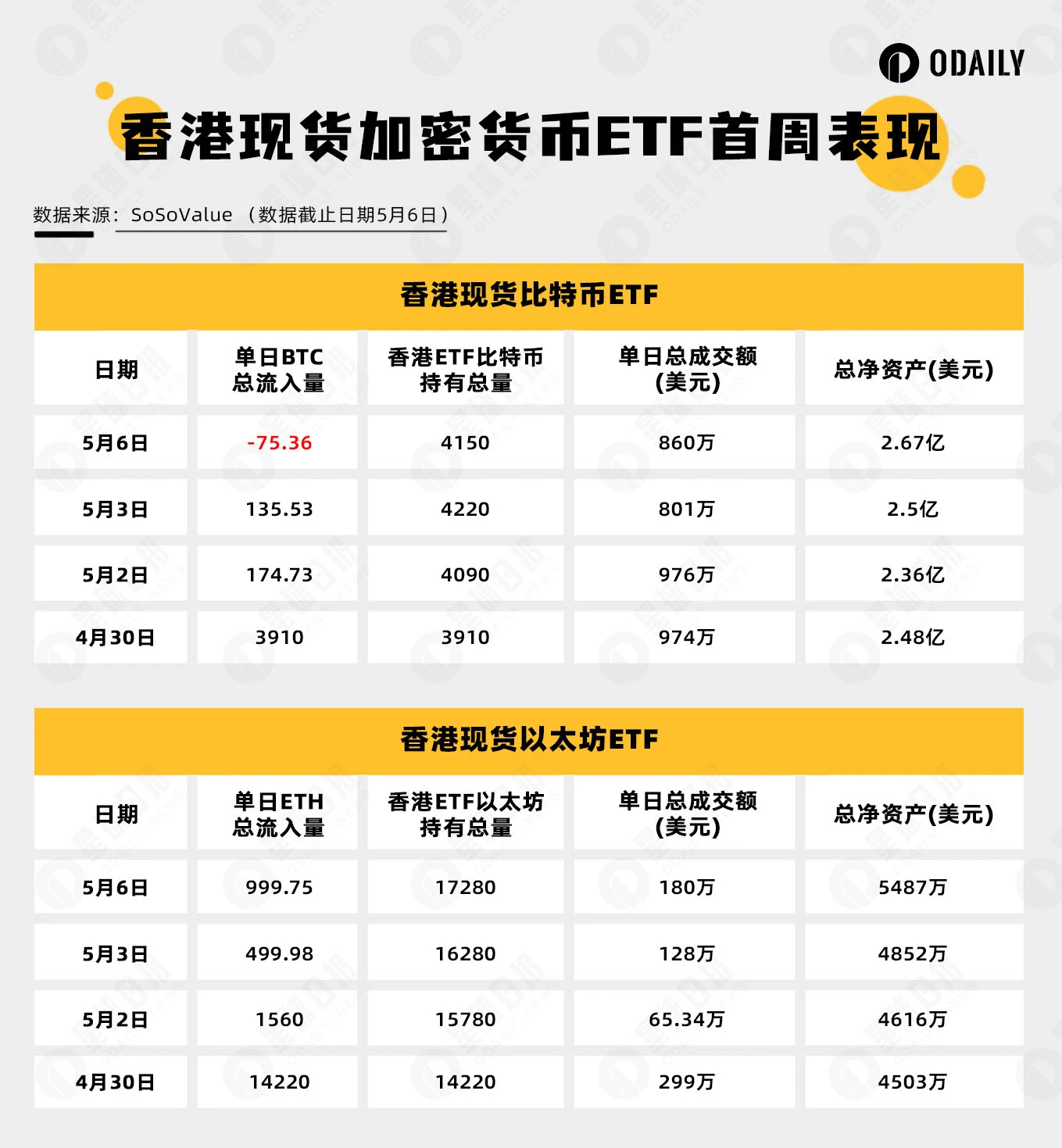
From the chart, it can be seen that the six ETFs in Hong Kong had relatively stable and positive trading volume and fund inflows in the first three days. However, on May 6, the spot Bitcoin ETF experienced its first net outflow (75.36 BTC), worth approximately US$4.75 million.
Although the Hong Kong spot cryptocurrency ETF did not meet expectations in terms of scale and trading volume, many well-known individuals still have a positive outlook on the future of the Hong Kong ETF.
Eric Balchunas, a senior ETF analyst at Bloomberg, had previously predicted that it would take two years for the Hong Kong virtual asset ETF market to reach a level of US$1 billion, but it reached US$292 million on the first day, indicating a need to reassess the Hong Kong virtual asset ETF market. He also stated that although it lags behind the United States in trading volume, in proportion, the US$310 million Hong Kong ETF is equivalent to US$50 billion in the US market. Therefore, the impact of the Hong Kong virtual asset ETF on its local market is as significant as that of the US spot Bitcoin ETF on its local market.
Weng Xiaoqi, Chief Operating Officer of HashKey Group and CEO of HashKey Exchange, stated that the custody assets of HashKey Exchange have increased from HK$2.2 billion before the ETF was issued to HK$3.3 billion, and he believes that a large amount of funds will continue to flow into the market in the future. Weng Xiaoqi also believes that the ETF can attract more traditional investors into the virtual asset market, and the overall scale can reach about 20% of the US market in a year, approximately US$10 billion, indicating that the virtual asset market still has a long way to go before saturation.
Sui Chung, CEO of CF Benchmarks, a subsidiary of Kraken, expects that by the end of 2024, the asset management scale of the Hong Kong Bitcoin ETF will reach US$1 billion.
In addition to the positive outlook expressed by many well-known individuals on the future of the Hong Kong spot cryptocurrency ETF, Tiger Brokers (Hong Kong) has also officially launched virtual asset trading services, becoming one of the first technology brokers in Hong Kong to support a platform for trading and managing traditional securities as well as virtual assets. However, the virtual asset trading services provided by Tiger Brokers are currently only available to professional investors. In the future, under regulatory compliance, Tiger Brokers plans to extend virtual asset trading services to retail investors. Additionally, the company will consider adding virtual asset spot deposit services.
US Spot Bitcoin ETF "VS" Hong Kong Spot Cryptocurrency ETF
Shortly after the launch of the Hong Kong spot cryptocurrency ETF, on May 3, according to Watcher.guru, it was revealed that two Hong Kong asset management companies had purchased a total of US$112 million worth of US spot Bitcoin ETF. The data shows that in addition to Yong Rong Asset Management purchasing US$38 million worth of the BlackRock IBIT ETF, another Ovata Capital Management purchased four US spot Bitcoin ETFs, with a total investment of over US$74 million.
Why did Yong Rong and Ovata choose to purchase the US spot Bitcoin ETF instead of the Hong Kong spot ETF?
Based on the original text disclosed by Watcher.guru, the two companies did not adjust their timing based on the progress of the Hong Kong ETF before making their moves.
From the perspective of these two asset management companies, most asset management companies focus on the future development prospects of the assets they purchase, with a high probability of long-term holding, which requires consideration of related expenses. However, based on the basic information disclosed by the three Hong Kong issuers, Huaxia at 1.99%, Jia Shi at 1.00%, and Boshi at 0.85%, compared to the common 0.25% fee rate of the US spot Bitcoin ETF, the higher fee rates are likely to be a "roadblock" for many long-term investors, even though the three issuers have waived fees to incentivize investment trading.
Furthermore, from the perspective of market size and trading volume, the Hong Kong spot cryptocurrency ETF has only recently started, and its market size is smaller compared to the US spot Bitcoin ETF, which has been active for nearly 4 months. A larger market size often brings better liquidity and trading experience.
Finally, from the perspective of fund custody, the custodian of the US spot Bitcoin ETF is Coinbase, while the custodians of the Hong Kong ETF are HashKey Capital and OSL Asset Management. In terms of custodial scale and past trust foundation, Coinbase is clearly superior.
So, does the Hong Kong spot ETF have no advantages? Not exactly. The current significant differences between the two lie in three points:
Hong Kong's pioneering "physical subscription mechanism": Compared to the US spot Bitcoin ETF, which can only be traded in cash, the physical subscription mechanism can provide investors with a more flexible way of trading, boosting trading enthusiasm. Additionally, the physical subscription mechanism has a significant promoting effect on Web 3, as it can serve as a capital withdrawal channel for Web 3 investors, bridging the gap between traditional finance and Web 3, and facilitating the circulation of capital in the later stages.
Regional coverage: After all, the trading time of the US spot Bitcoin ETF and the time difference and policy barriers in Asian countries are not conducive to the relevant work of Asian companies. However, the launch of the Hong Kong spot cryptocurrency ETF will prompt Asian companies to purchase the Hong Kong spot ETF under more favorable physical conditions.
First launch of Ethereum spot ETF: The most unique advantage is that Hong Kong is ahead of the US in launching the Ethereum spot ETF. Assuming that the US SEC does not approve the application for the spot Ethereum ETF this month, at least in this year, Hong Kong is the only region supporting the spot Ethereum ETF, which will be beneficial in attracting Ethereum-related investors and gaining a competitive edge.
The channel is now open, looking forward to potential expectations
In fact, on the day the Hong Kong spot cryptocurrency ETF was launched, due to the market downturn caused by the lower-than-expected performance and outflow of the US spot Bitcoin ETF, the community's view of it was more negative than positive. However, after a few days of development, the Hong Kong spot cryptocurrency ETF still has a certain promoting effect on the cryptocurrency market.
From the aforementioned pioneering physical subscription mechanism that bridges the traditional finance and Web 3 capital channels to the coverage of the Asian trading range, it all reflects the support of the Hong Kong region for the development of Web 3. Furthermore, compared to Western countries, it will take some time for Hong Kong and even Asia to fully accept cryptocurrencies. Finally, the potential expectations left by the Hong Kong spot cryptocurrency ETF, namely the opening of the mainland trading channel.
As Kaiko's latest report shows, the competition for cryptocurrency spot ETFs is heating up globally. In essence, Hong Kong does not have a competitive edge over the US in terms of the product, and ETFs are not meant to create a confrontational situation. The most important thing is that the issuance of ETFs will strengthen the existing Web 3 liquidity and direct traditional funds to Web 3. Conversely, in a bearish market, ETFs also provide a high-quality channel for the "escape" of Web 3 funds.
免责声明:本文章仅代表作者个人观点,不代表本平台的立场和观点。本文章仅供信息分享,不构成对任何人的任何投资建议。用户与作者之间的任何争议,与本平台无关。如网页中刊载的文章或图片涉及侵权,请提供相关的权利证明和身份证明发送邮件到support@aicoin.com,本平台相关工作人员将会进行核查。


