Understand WeTEE in three minutes: A new decentralized cloud service targeting confidential computing

CN
1 year ago

WeTEE aims to provide a complete set of decentralized confidential cloud computing infrastructure, serving all developers including "Web2+Web3".

Author: River

In the encrypted world, narration is the baton of market trends. Where the expectation lies, there lies the hotspot.

In the current wave of AI+Crypto, have you ever thought about whether there is a core narrative that spans Web2 & Web3 and AI?

The answer may lie in cloud computing. Whether it is the three cornerstones of the digital age, "computation, storage, and communication," mapping from Web2 to Web3, or the fiery AI field's three major elements of "data, algorithms, and computing power," computation/computing power plays an indispensable key role.

This article will focus on a new encrypted project called WeTEE, which is positioned as a DeAI project that cuts across AI and Web3 dual narratives, to explore how it fits into the current AI trend and whether it can bring new variables to the "AI+Crypto" track.

WeTEE: Decentralized Confidential Cloud Computing Infrastructure

As is well known, the traditional cloud service market is dominated by internet giants such as AWS, Alibaba Cloud, and Tencent Cloud. The most obvious problem is the widespread reliance on centralized cloud servers, which means that developers/project parties fundamentally rely on the reputation of one or more giants for the cloud services they use.

This is equivalent to surrendering data autonomy and privacy security to Web2 giants. Because of this, in recent years, cloud service providers have frequently experienced data breaches, causing serious losses to individuals and institutions. Therefore, no matter how developers/project parties view the core issue of "decentralization" in the Crypto world, it is far better to make it "impossible to do evil" through mechanism design than to believe that giants will "not do evil" (Don't Be Evil).

In this context, the advantages of decentralized confidential cloud computing services need no further explanation. It not only ensures the decentralization of cloud computing, maintains data security and privacy, but more importantly, it can also achieve a more extensive DePIN business logic and reduce the cost of cloud computing services through token incentives.

However, the problem is that the current decentralized cloud computing service market is still in a nascent stage. Looking at the prominent AI track projects, Bittensor (TAO) has become the leader in decentralized algorithm track, Masa Network plays the leading role in the decentralized data field, and the competition in the decentralized computing power market is still in its infancy, with new and old players such as io.net and Akash mainly focusing on computing power supply.

In this context, if we carefully analyze the direction of decentralized cloud computing, it is still facing a significant ecological gap with the mature cloud computing service solutions of Web2 at the bottom layer. This means that the transformation of confidential computing technology faces high costs, and there is no particularly good solution for enabling programs to be deployed quickly and securely within the industry, which limits the development momentum by not meeting the series of application functions needed by Web3.

In other words, the second half of the development of the decentralized cloud computing market urgently needs a set of blockchain development toolkits for Web3, in order to provide a comprehensive solution that meets the needs of decentralization, confidentiality, low latency, and low cost. From this perspective, WeTEE has just filled this gap in this niche direction:

Any DePIN/Web2.5/AI application that has a demand for low latency and high computing power can choose to deploy on WeTEE, and obtain a universal cloud computing solution similar to traditional cloud services.

WeTEE combines the container orchestration system Kubernetes, trusted execution environment (TEE), and blockchain architecture, ensuring not only the flexibility of deployment but also the security and reliability of application hosting. In addition, WeTEE has optimized the encapsulation process for applications, allowing users to quickly complete the confidential encapsulation of applications by modifying TEE configuration files and Docker image files, with the process being as fast as 10 minutes or even less!

It is for these reasons that WeTEE provides a set of trustworthy computing solutions without side effects, and this service form is a container service, providing comprehensive support for underlying computing power services and hardware-level security protection:

In simple terms, it is not only aimed at Web3 or Web2 users, but also allows all protocols based on smart contracts, web or mobile clients, and AI enterprises to reliably, securely, and quickly deploy in a decentralized cloud computing environment.

Strong compatibility, security positioning, etc.

So, what are the differences and advantages of WeTEE's technical architecture compared to traditional centralized or decentralized cloud deployment solutions?

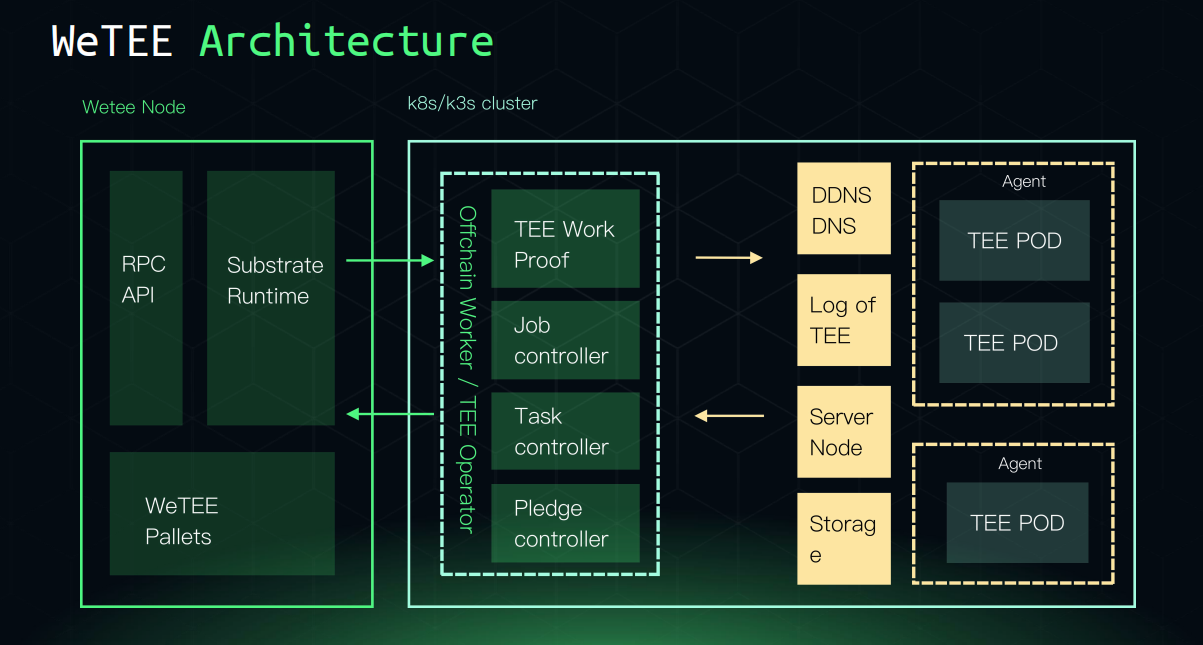
We can briefly summarize the operation mechanism of WeTEE. As mentioned earlier, the comprehensive technical architecture of the entire WeTEE network is based on the container orchestration system Kubernetes, integrating trusted execution environment (TEE) and blockchain solutions as the underlying framework. The biggest feature is the simplification of the entire process of encapsulation and deployment requirements:

WeTEE provides a new way of program deployment, where developers/project parties only need to adapt and modify once, and can almost "foolishly" freely deploy various traditional software services and scripts, compressing the time to the level of minutes, thus enjoying the secure services of decentralized cloud computing.

At the node level of the underlying blockchain, WeTEE adopts Polkadot's Substrate framework, modularizing the basic underlying design of the blockchain. Developers only need to "call once," eliminating the original cumbersome workload, which can significantly improve the efficiency of developers, allowing them to focus more on business logic development.

In the container part, WeTEE uses the container orchestration system Kubernetes, the biggest advantage of this design being to ensure that code execution is not affected by underlying hardware.

At the same time, WeTEE has also developed a TEE Operator specifically for trusted computing to interact with the underlying blockchain. Once the Operator receives operational instructions from the blockchain, it will call the Kubernetes cluster through the Agent and create application containers.

Subsequently, Kubernetes will inject confidentiality into the application containers, ensuring hardware-level security protection, protecting data and computation from external threats, and ensuring the confidentiality and integrity of data even in the face of third-party intrusions.

Based on this, WeTEE can provide a visual UI interface, allowing developers to deploy containers and view the real-time running status of applications, operational conditions, and other information.

In addition, WeTEE's innovative solutions for smart contracts and confidential containers are particularly noteworthy:

  • WeTEE will automatically generate smart contracts based on the resource requirements and deployment requirements of the application, which means that it is transitioning from traditional infrastructure management to smart contract-based autonomous operation. Therefore, compared to other platforms, WeTEE has a clear advantage in node execution;

  • At the same time, WeTEE's confidential containers will also generate proof of work during operation and synchronize it to the blockchain to ensure the confidentiality of data and the integrity of the computation running within it, as well as to achieve the accuracy and verifiability of the computation results, which cannot be tampered with.

In summary, this means enabling more Web2 & Web3 participants to easily access the necessary confidential cloud computing resources, collectively driving the application of blockchain technology in various industries, and taking solid steps towards a truly decentralized, secure, and trustworthy future.

Token Economics and Value Capture Mechanism

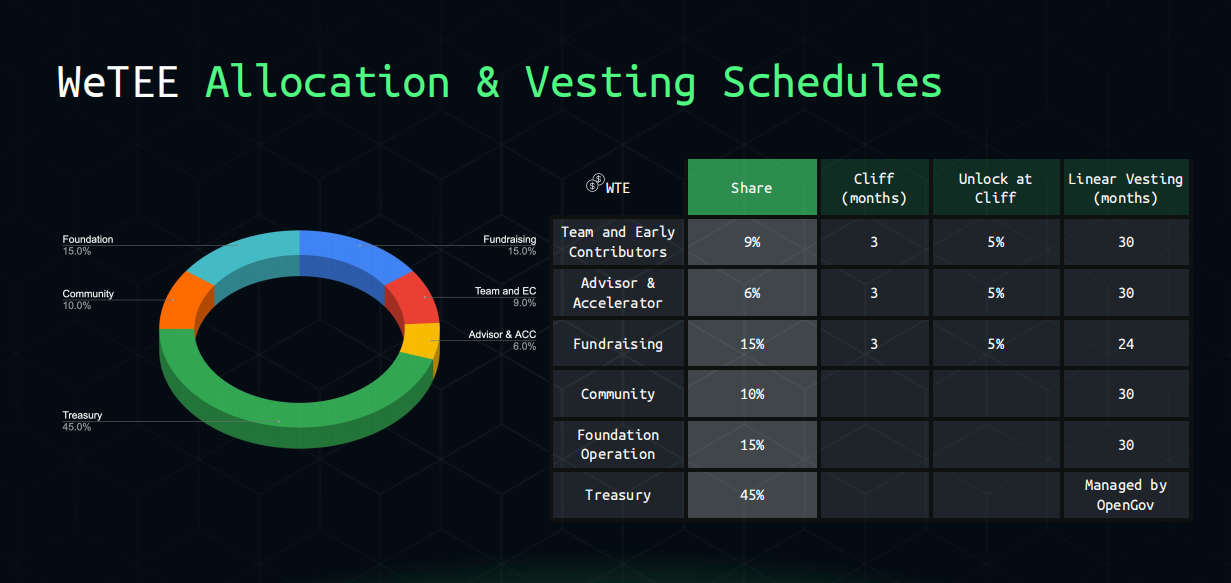
Furthermore, according to official disclosures, in WeTEE's token allocation, 45% is used for the project treasury, 15% for foundation operations, 15% for fundraising, 10% for the community, 9% for the project and early contributors, and 6% for advisors and accelerators. The overall allocation ratio focuses on project operations, with a relatively balanced proportion for the founding team and VCs.

Of particular note is WeTEE's deep-level value capture mechanism in token economics. As WeTEE is based on Polkadot Substrate infrastructure, they have chosen to widely accept various tokens from the Polkadot ecosystem as payment options for computing services.

This means that WeTEE users can use most tokens within the Polkadot ecosystem, such as DOT, KSM, and other tokens, to directly exchange and pay for the consumed computing resource costs, undoubtedly making full use of Polkadot's cross-chain capabilities, enabling asset circulation between different blockchains, breaking down barriers in a single circulation domain, allowing users to mobilize resources in a wider range, lowering the usage threshold, and enhancing overall ecosystem vitality.

More importantly, this "any Polkadot token can be used to pay for services" is expected to make the WeTEE network the settlement layer for the entire confidential cloud computing service ecosystem, maximizing the direct use of the WeTEE token throughout the ecosystem, acting as a settlement token, thereby achieving comprehensive empowerment—directly capturing the growth dividends of the entire WeTEE network ecosystem's computing power and node quantity.

Team and Future Roadmap

The WeTEE founding team is mostly "veterans" in the internet and crypto development fields. The core developers participated in the Polkadot Summer Hackathon in 2023 and won the first prize DTIM, and also received a Level 2 grant from the Web3 Foundation in 2024, to some extent, making them a "designated" potential stock in the Polkadot ecosystem's confidential cloud computing field.

In March 2024, WeTEE just completed the project POC, and besides being the first to support Polkadot, they also plan to further support the Ethereum and TON ecosystems in the future. This means that regardless of the user's or developer's ecosystem on any public chain, they can use WeTEE's confidential cloud computing services, thereby helping WeTEE become a fully chain-driven AI+Crypto underlying computing infrastructure, directly capturing the value of the entire network's computing power demand.

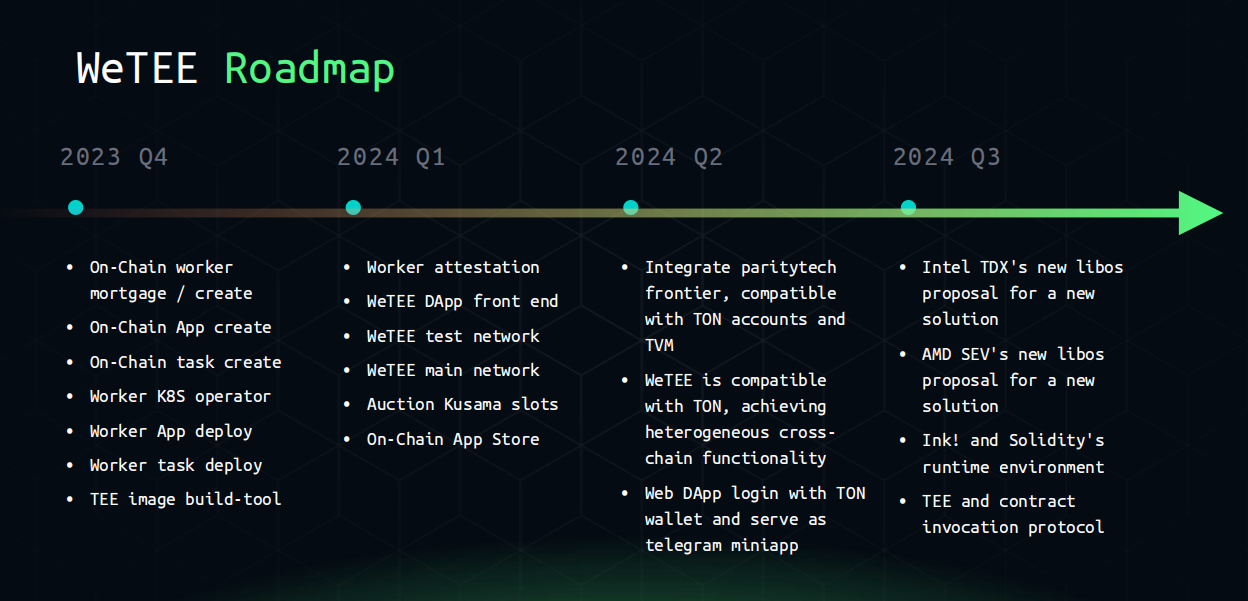
According to the official roadmap, in the second quarter of this year, WeTEE will achieve compatibility with the TONM blockchain, allowing users to log in to the service using a TON wallet, and will be launched in the form of a Telegram MiniAPP. This will help them reach up to 9 billion potential global users, further expanding the scale of the service user base.

In the fourth quarter of this year, WeTEE will also research the integration of Intel TDX's new libos solution, Nvidia SEV's new libos solution, and support for ink! and Solidity runtime environments, while expanding TEE and contract invocation protocols.

Conclusion

Overall, from cloud computing to AI, WeTEE's vision is undoubtedly grand. If successful, it will likely become the most core computing service component covering "Web2+Web3" and the global developer ecosystem, thereby building a cross-"Web2+Web3" computing infrastructure with immense potential for the future, but also undoubtedly full of challenges.

免责声明:本文章仅代表作者个人观点,不代表本平台的立场和观点。本文章仅供信息分享,不构成对任何人的任何投资建议。用户与作者之间的任何争议,与本平台无关。如网页中刊载的文章或图片涉及侵权,请提供相关的权利证明和身份证明发送邮件到support@aicoin.com,本平台相关工作人员将会进行核查。

Share To
APP

X

Telegram

Facebook

Reddit

CopyLink