Author: Liu Zhengyao, Senior Lawyer at Shanghai Mankun Law Firm
The U.S. Federal Court in Seattle issued a judgment on April 30 local time for the founder of Binance, Zhao Changpeng (CZ). Unlike the 36-month sentence pursued by the U.S. Department of Justice (DOJ), the presiding judge, Richard A. Jones, sentenced him to 4 months in prison for CZ's (or Binance's) violation of the U.S. Bank Secrecy Act's anti-money laundering provisions.

Subsequently, CZ stated on social media that he would serve his sentence and then focus on the education sector. At the same time, he emphasized the importance of compliance for cryptocurrency exchanges and the close attention Binance received and the safeguarding of user funds during the (DOJ's prosecution) process, which was crucial for (CZ's lenient sentence). Finally, CZ reiterated his commitment to protecting users.
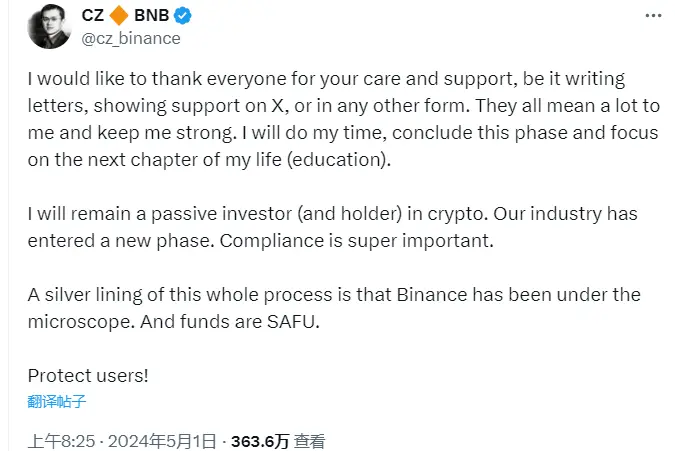
The last sentence "Protect users!" inevitably brings to mind the sentencing of FTX's founder SBF (Sam Bankman-Fried) to 25 years on March 28 this year, for fraud and embezzlement of client funds, resulting in over $8 billion in losses.
From this perspective, CZ's ordeal seems not too bad. However, the story is not over. Lawyer Liu summarized the different demands of various law enforcement agencies in the United States against CZ or Binance, which may help us better understand the legal challenges that cryptocurrency exchanges may face:
 Some friends may feel that CZ's ordeal is somewhat reminiscent of being subjected to a "slaughterhouse" in the United States, and some articles are filled with a sense of schadenfreude. Liu believes that these views are somewhat superficial (of course, this does not necessarily represent my own opinion), the essence of Binance or CZ's ordeal is fundamentally a reactive response of centralized government institutions to the application of decentralized technology in the financial, especially monetary, field.
When facing conservative authoritarian governments, cryptocurrency exchanges have to compromise. However, the awkwardness is that cryptocurrency exchanges themselves are typical centralized institutions, which runs counter to the original intention of decentralization of cryptocurrencies. Although their existence currently has its rationale, such as providing great convenience for virtual currency transactions between users, they fundamentally cannot escape the drawbacks of centralization. CZ is not always blameless, and Binance is not the "protector" of the crypto circle, but CZ has not crossed as many red lines as SBF.
From the perspective of regulators, whether it is the U.S. DOJ, SEC, CFTC, or the territorial jurisdiction, personal jurisdiction, protective jurisdiction, and universal jurisdiction in Chinese criminal law, national legislators and law enforcers can always find a basis to prove the legitimacy of their actions. In other words, at least in the eyes of many politicians, politics is the law, and the law is a tool of politics (but Lawyer Liu still firmly believes in the law!).
The United States accuses Binance of violating its Bank Secrecy Act's anti-money laundering provisions, such as not reporting nearly 100,000 transactions conducted through Binance by organizations including Hamas, "ISIS," and terrorist groups, and not restricting $8.9 billion in transactions between U.S. and Iranian users. In addition, Binance also earned huge fees from millions of transactions between users from "Cuba, Syria, and the Ukrainian regions of Crimea, Donetsk, and Luhansk." (Excerpt from "Judging Zhao Changpeng | Prism," by author Wen Shijun)
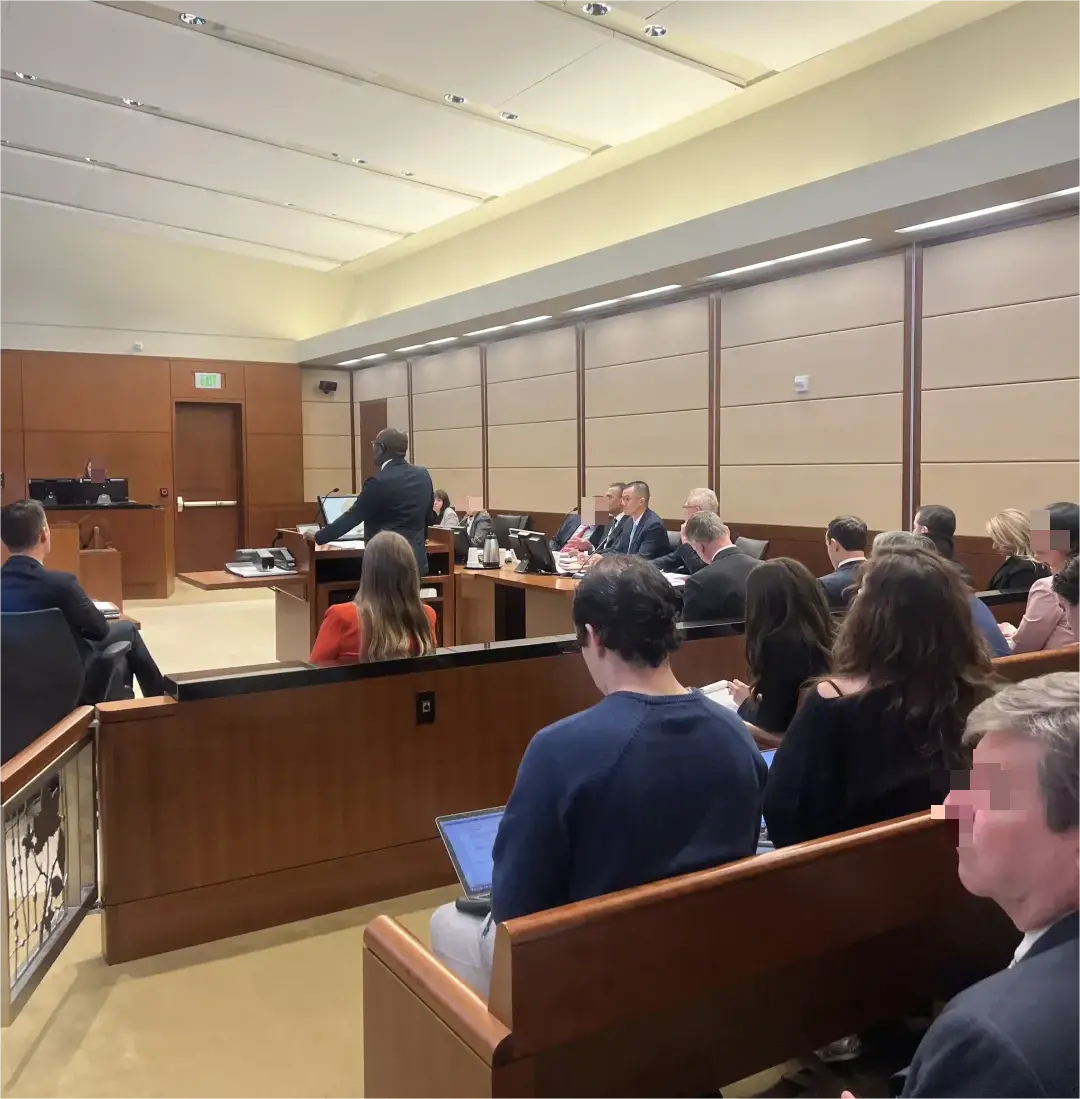
(CZ's trial photo circulating online, deleted upon infringement)
According to some American lawyers, the application of the Bank Secrecy Act in the CZ case is not common in U.S. jurisprudence. Therefore, it cannot be ruled out that the CZ case was fabricated.
However, as mentioned earlier, the focus of the author's speculation is not to blame a particular government, because we cannot guarantee that CZ will necessarily receive a lighter sentence in other countries, and he may even face heavier penalties. What the author wants to say is that it is still difficult for decentralized cryptocurrencies and the cryptocurrency exchanges they represent to be accepted by all governments in the short term. However, some people express optimism—since the United States, as the global financial hegemon, does not seem to have taken a heavy-handed approach to the "hegemony" of the virtual currency world, does this mean that the possibility of virtual currencies being accepted by the "mainstream world" is increasing?
But for true believers in decentralization, what does the "mainstream world" think—Who cares?
免责声明:本文章仅代表作者个人观点,不代表本平台的立场和观点。本文章仅供信息分享,不构成对任何人的任何投资建议。用户与作者之间的任何争议,与本平台无关。如网页中刊载的文章或图片涉及侵权,请提供相关的权利证明和身份证明发送邮件到support@aicoin.com,本平台相关工作人员将会进行核查。


