AICoin
As technology rapidly advances, blockchain technology has expanded from its initial financial applications to various fields. DePIN, as an emerging track, utilizes blockchain technology and token economics principles to redefine the construction and operation modes of physical infrastructure, achieving greatly improved optimization of resource allocation and utilization efficiency. Many investment research institutions believe that 2024 will be a big year for the DePIN track, with enormous development potential.
I. Overview of DePIN
Definition of DePIN
The concept of DePIN (Decentralized Physical Infrastructure Networks), also known as decentralized physical infrastructure networks, was first proposed by the analysis firm Messari, aiming to optimize the deployment and management of physical infrastructure through blockchain technology. According to Messari's classification, DePIN is mainly divided into two categories: Physical Resource Networks (PRN) and Digital Resource Networks (DRN). The physical resource network emphasizes the use of geographically related hardware devices to provide real-world goods and services, such as WIFI, VPN, and energy information sharing, while the digital resource network focuses on using hardware facilities to support the storage and computation of digital resources, such as broadband networks and data centers.
The DePIN project achieves the management and allocation of physical resources such as energy, storage space, and bandwidth through decentralized nodes and a decentralized decision-making process. In the DePIN network, each participant is not only a user of resources but may also become a provider of resources, ensuring the transparency and security of resource transactions through smart contracts and encryption technology.
Characteristics of DePIN
Decentralized Management: The most significant feature of DePIN is its decentralization, reducing reliance on centralized management institutions, lowering management costs, and increasing the system's resistance to attacks.
Resource Optimization: Through the automatic execution of smart contracts, DePIN can more efficiently match resource demand and supply, optimizing resource allocation.
High Transparency and Trustworthiness: The application of blockchain technology makes all transaction records publicly transparent and traceable, greatly enhancing the network's trustworthiness.
Incentive Mechanism: DePIN provides economic incentives for resource providers and consumers through a token economic model, encouraging more participants to join and maintain the network.
Enhanced Security: The decentralized nature of the network makes it less susceptible to single point failures, enhancing the overall system's security.
The DePIN project not only improves the operational efficiency and transparency of traditional infrastructure but also reduces costs and provides space for new business models and innovations.
II. Classification and Principles of DePIN Projects
Projects in the DePIN track can be classified based on the types of physical infrastructure resources they provide, covering various areas such as computing resources, storage resources, bandwidth resources, and Internet of Things (IoT) applications. Each category of projects not only differs in technical principles but also targets specific market demands and application scenarios.
1. Computing Resources
Computing resources typically refer to distributed computing capabilities, including the allocation and utilization of CPU and GPU resources. Blockchain technology enables these resources to be securely shared and traded in a decentralized network. The main technical principles include:
Node-based distributed processing: Every node in the network can provide computing resources, automatically matching demand and supply through smart contracts.
Consensus mechanism: Ensures the correctness and transparency of computing tasks and resource allocation in the network.
Encryption technology: Ensures the security and privacy of data during transmission and processing.
Representative Projects:
io.net: A decentralized computing network that is building the world's largest AI computing cloud, supporting the development, execution, and scaling of ML applications on the Solana blockchain, combining 1 million GPUs to form the world's largest GPU cluster. Recently, io.net announced its token IO's token economic model, which will be launched by the end of April.
Render Network: A provider of decentralized GPU-based rendering solutions, aiming to connect users wishing to perform rendering jobs with individuals possessing idle GPUs to process rendering tasks.
Akash Network: A decentralized cloud computing platform that aims to establish a publicly transparent market by integrating underutilized computing resources globally through a peer-to-peer market.
2. Storage Resources
Storage resources in DePIN refer to the space on decentralized storage devices, which can be personal computers, data centers, or even mobile phones. The technical principles mainly include:
File sharding: Large files are divided into multiple small segments before storage, distributed across multiple nodes to enhance data tampering resistance and availability.
Redundant storage: Data is stored in multiple copies to ensure recoverability and accessibility in case of node failure.
Encryption technology: Data is encrypted before storage to ensure its security and privacy.
Representative Projects:
Filecoin: A decentralized storage network where anyone can store and retrieve data on the internet, with built-in economic incentives to ensure reliable and continuous storage and retrieval of files within the specified time frame.
Arweave: A decentralized data storage protocol that enables data to be permanently stored on its permaweb, a second-layer network that allows data to be accessed through web browsers and other means.
3. Bandwidth Resources
Bandwidth resources in the DePIN track refer to the sharing of data transmission capabilities. Projects in this category typically utilize the following technical principles:
Traffic encryption: Ensures the security of data during transmission.
Dynamic routing algorithms: Automatically select the optimal path to ensure efficient and cost-effective data transmission.
Bandwidth tokens: Use blockchain-issued digital tokens to control the use and allocation of bandwidth.
Representative Projects:
Helium: Provides decentralized wireless network services, allowing users to contribute bandwidth resources and earn tokens by deploying Hotspots.
World Mobile: A mobile network that uses hybrid spectrum, renewable energy, and blockchain technology, transforming into cheaper internet access using unlicensed spectrum such as free space optics and other wireless transmitters.
4. Internet of Things (IoT) Applications
The application of IoT in DePIN involves managing and operating a large number of IoT devices and the data they generate through blockchain technology. Key technical principles include:
Device authentication: Each device has a unique identity through blockchain technology.
Data on-chain: Data generated by devices can be encrypted and stored on the blockchain, ensuring data integrity and traceability.
Smart contracts: Automatically execute specific tasks or transactions based on data, such as automatic payments and data sharing authorization.
Representative Projects:
IoTeX: Provides secure IoT device connectivity services using blockchain technology, focusing on privacy protection and data security in smart devices, creating a trusted IoT platform to deliver better value to end users.
IOTA: Provides efficient microtransactions and data transfer solutions for the IoT environment through its non-blockchain Tangle technology.
III. Current Development Status of the DePIN Track
With the maturity of technology and the increasing number of application cases, DePIN projects have transitioned from the initial concept verification stage to practical application and commercialization. By providing more economical and efficient infrastructure services, they have gradually gained market recognition and user trust. According to DePINscan, as of April 25th, there are over 232 DePIN projects in operation or under development globally, with 31 AI-related projects included. The active devices in DePIN reach 841,861, covering over 175 countries and regions, with a total market value exceeding 11.8 billion USD.
DePIN projects have attracted a lot of attention from venture capital and investors. According to RootData statistics, from 2022 to the end of 2023, DePIN-related projects received over $3 billion in investments. As of April 25th, the announced funding for the DePIN track in 2024 reached $97.7 million, with the funds mainly used for technology development, marketing, and ecosystem construction. According to CoinGecko data, as of April 25th, the market value of DePIN-related tokens has exceeded $26 billion, demonstrating its rapid growth potential.
During the April Hong Kong Web3 Carnival, UWEB and JDI Global released the "2024 DePIN Development Report," forecasting that the market size will reach $35 trillion by 2028, playing an increasingly important role in the global infrastructure network development.
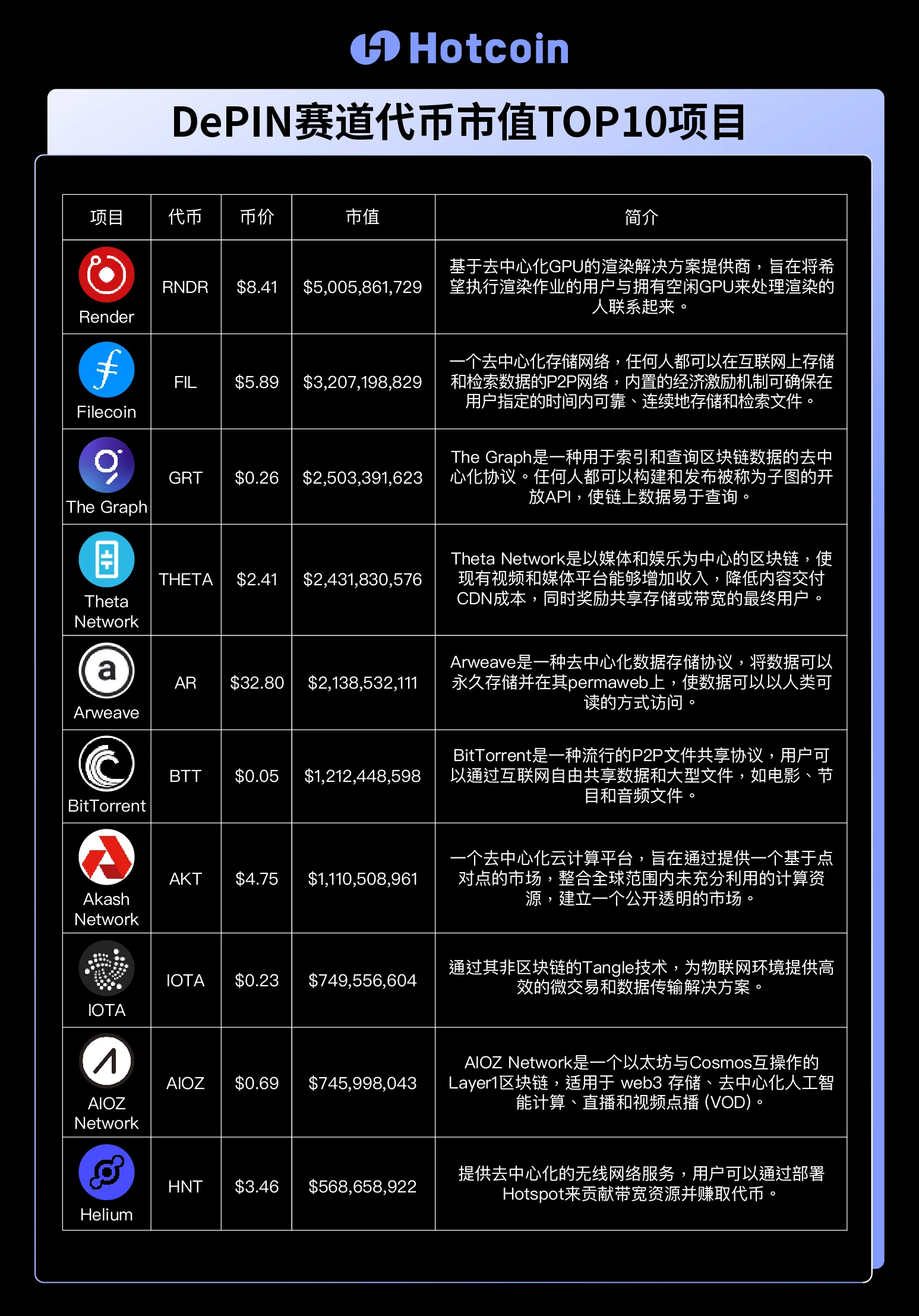
IV. Investment Opportunities and Risks in the DePIN Track
The DePIN track is gradually becoming a focus of investor attention, offering not only innovative technological solutions but also unique business opportunities. However, the DePIN track also comes with both opportunities and risks.
Investment Opportunities
Technological Innovation and Application Expansion: DePIN projects involve technological innovations, particularly in the areas of IoT, 5G communication, cloud computing, AI computing power, etc., optimizing the allocation of data storage, computing power, and bandwidth resources. This has led to increased resource utilization efficiency and security, creating new market demands and bringing disruptive changes to traditional industries.
Environmental Sustainability: With increasing global emphasis on environmental protection and sustainable development, DePIN projects demonstrate significant potential in improving energy efficiency and reducing carbon footprints. By optimizing resource allocation, these projects reduce energy waste, aligning with future development trends.
Ecosystem Construction and Network Effects: From IoT to cloud computing, from content distribution to smart city construction, DePIN technology has broad application prospects. Investing in DePIN projects is not just an investment in a single technology or service but in a rapidly developing ecosystem. With the strengthening of network effects and the maturity of the ecosystem, early investors may see significant returns.
Global Development Characteristics: DePIN projects inherently possess characteristics of global development, as their services and products are not limited by geographical boundaries and can quickly expand to global markets. With the widespread adoption of technologies such as 5G and AI, the practical application and market penetration of DePIN projects will further accelerate.
Regulatory Progress and Market Acceptance: Many countries and regions are gradually introducing policies supporting blockchain technology and decentralized networks, potentially providing broader development space and higher market acceptance for DePIN projects.
Investment Risks
Technological Complexity and Implementation Difficulty: DePIN projects often involve complex technological challenges, including data security, network stability, and cross-platform compatibility. Project execution and operation may face technical obstacles such as security vulnerabilities and performance issues, which could affect the long-term stability of the project.
Uncertainty of Token Economic Models: Many DePIN projects rely on specific token economic models to incentivize participants and maintain network operations. The sustainability and effectiveness of these models are uncertain and may impact the long-term stability and investment returns of the projects.
Market Competition and Technological Iteration: The DePIN track faces intense market competition. Additionally, rapid technological iterations may lead to certain projects quickly becoming outdated. Investors need to consider the competitiveness and continuous innovation capabilities of the projects they invest in.
Market Acceptance and User Growth: The success of DePIN projects largely depends on market acceptance and user base growth. Ineffective attraction of users and partners may make it difficult for the business model to sustain.
Regulatory Risks and Policy Changes: As an emerging technology field, DePIN projects may be affected by uncertain regulatory risks and policy changes. Uncertainty in government policies may lead to sudden changes in the investment environment, affecting investment decisions and project operations.
V. Prospects of the DePIN Track
Continuous Technological Innovation: Technology is the core driving force behind the development of the DePIN track. With the continuous maturity and optimization of blockchain technology, future DePIN projects will be more efficient and secure, better serving complex infrastructure needs.
Stronger Cross-Chain Capabilities: To achieve broader interoperability and resource sharing, DePIN projects need to develop stronger cross-chain technologies, enabling seamless connections and data and resource sharing between different blockchain networks.
Expanded Market Applications: The market applications of DePIN projects will expand from existing areas to a wider range of industries and scenarios, from energy management to smart city construction, from IoT to supply chain management. DePIN technology will be applied to more industries, improving the operational efficiency and cost-effectiveness of infrastructure.
Increased Consumer-Level Applications: In the future, DePIN projects will focus more on consumer experience, developing more applications aimed at ordinary consumers, such as home automation solutions provided through decentralized networks.
Continuous Optimization of Token Economic Models: By optimizing token distribution and incentive mechanisms, ensuring that participants—whether resource providers or service consumers—receive fair returns, exploring more ways to give tokens practical application value, such as paying specific physical infrastructure usage fees through tokens.
Promoting Industry Digital Transformation: DePIN technology will help traditional industries achieve digital transformation, improving industry transparency and efficiency. By optimizing resource allocation and utilization, DePIN projects will help the world achieve more sustainable development goals, such as improving energy efficiency and reducing environmental pollution.
As an innovative track combining blockchain technology and physical infrastructure, DePIN carries tremendous potential and possibilities for continuous development in the future. With the continuous advancement of technology and the gradual expansion of market applications, DePIN is expected to become an important force driving the modernization and digital transformation of global infrastructure.
Hotcoin is closely monitoring the development dynamics of the DePIN track and has listed high-quality assets such as RNDR, FIL, GRT, THETA, BTT, AKT, IOTA, AIOZ, HNT, IOTX, MOBILE, TFUEL, LPT, ANKR, STORJ, BZZ, MXC, OCEAN, and more. For cryptocurrency investments, come to Hotcoin for early access to the hottest high-quality assets!
免责声明:本文章仅代表作者个人观点,不代表本平台的立场和观点。本文章仅供信息分享,不构成对任何人的任何投资建议。用户与作者之间的任何争议,与本平台无关。如网页中刊载的文章或图片涉及侵权,请提供相关的权利证明和身份证明发送邮件到support@aicoin.com,本平台相关工作人员将会进行核查。


