Original Title: A Brief History of Memecoins: Their Past and Future
Author: Jerome
Translation: Block unicorn
What is a Meme?
A "meme" is a unit for spreading cultural ideas and symbols, constantly spreading and propagating in people's consciousness. Like genes, memes also have different spreading abilities. Those that resonate strongly tend to endure, while those with less influence are quickly forgotten.
The internet introduced the concept of "internet memes," which promote the rapid spread of memes and cultural ideas through forms such as images, videos, GIFs, and jokes. A study likened the spread of internet memes to a disease, stating that "memes spread in a manner similar to diseases spread by the SIR model," infecting "individuals."
The spread of internet memes is similar to the spread of infectious diseases.
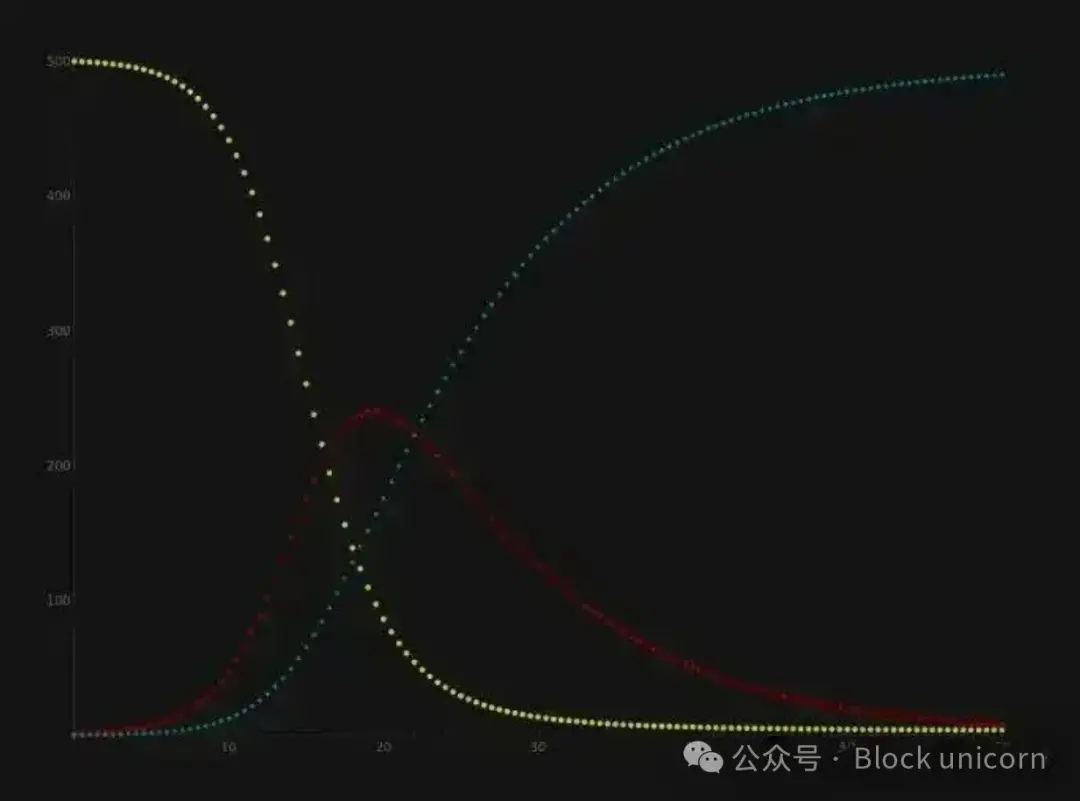
"Meme coins" are a type of cryptocurrency whose value comes entirely from related memes. Essentially, they bring economic value to the concept of memes.
With the emergence of meme coins, cultural ideas, symbols, and their propagation can be traded and speculated upon. Their value is based on the relevance of memes and their ability to capture public opinion, creating a new market that can quantify cultural resonance and has financial value.
A Brief History of Meme Coins
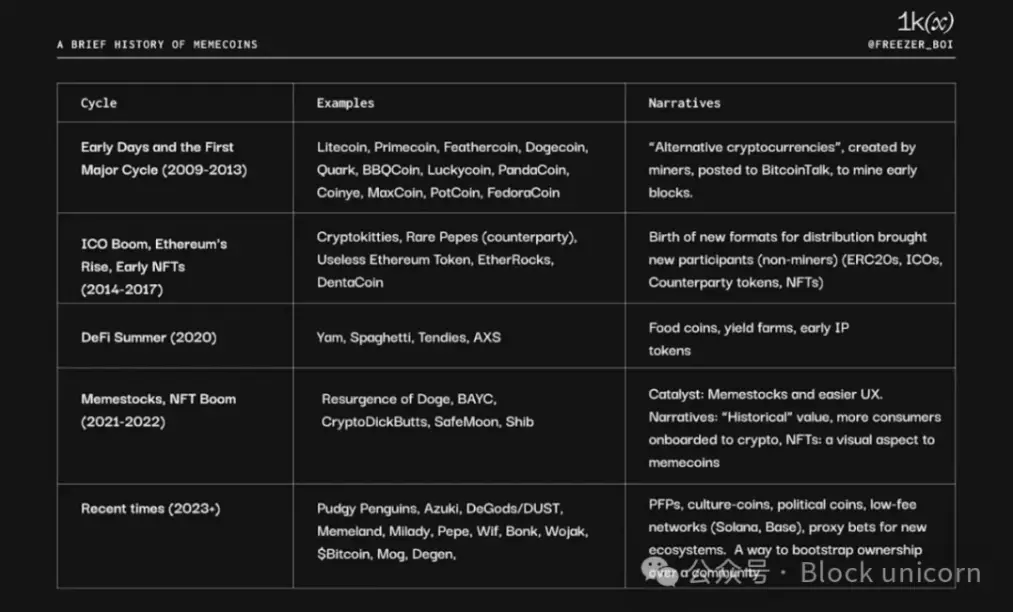
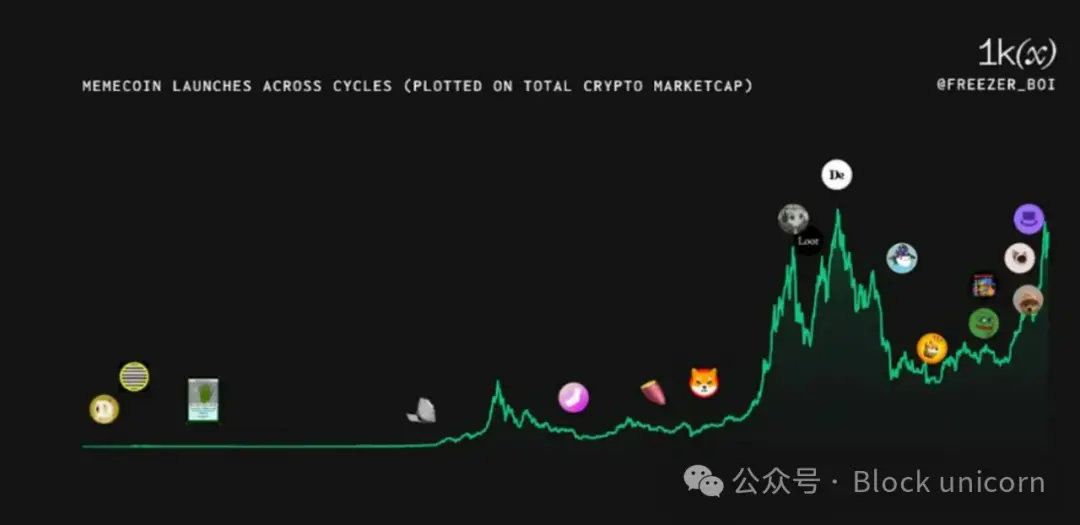
The following table and chart briefly outline the cryptocurrency cycles and the rise of meme coins within these cycles:
POW Meme Coins
Proof of work (POW) meme coins are primarily designed for miners to allocate resources to mine and sell new tokens. Many such meme coins initially appeared on the "Alternate cryptocurrencies" subforum of Bitcointalk. Although many meme coins failed to enter exchanges, those that were successful were traded on platforms such as Cryptsy and BTC-E, which are now closed. Each meme coin is typically distinguished by factors such as name and brand, hash algorithm, block time, and supply, all of which contribute to its overall narrative (or "meme").
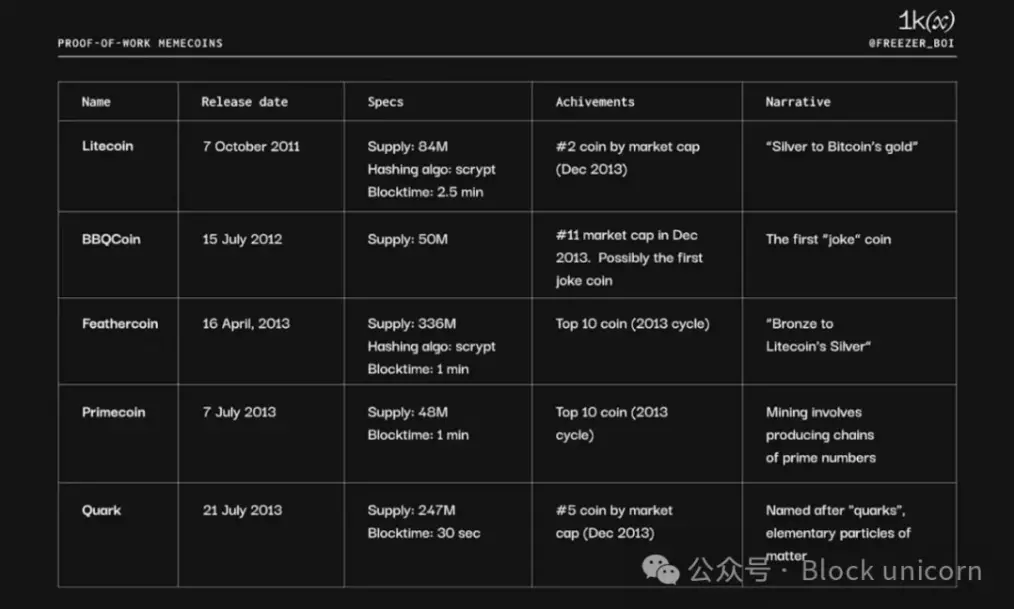
The first wave of tokens in the post-Bitcoin era was "meme coins," which, apart from new ideas, offered almost no intrinsic value. The above image shows some examples:
Except for Litecoin, all of these tokens have disappeared (reasons include low trading volume and market value, lack of exchange support, susceptibility to 51% attacks, etc.). This may be attributed to several factors: weak meme stickiness (lack of cultural longevity) and participation cost issues (each meme coin is a complete blockchain).
Litecoin's enduring popularity may be attributed to the meme value derived from Bitcoin (digital silver), its earlier appearance compared to other meme coins, and continuous support from numerous exchanges.
Dogecoin: The First Meme Coin
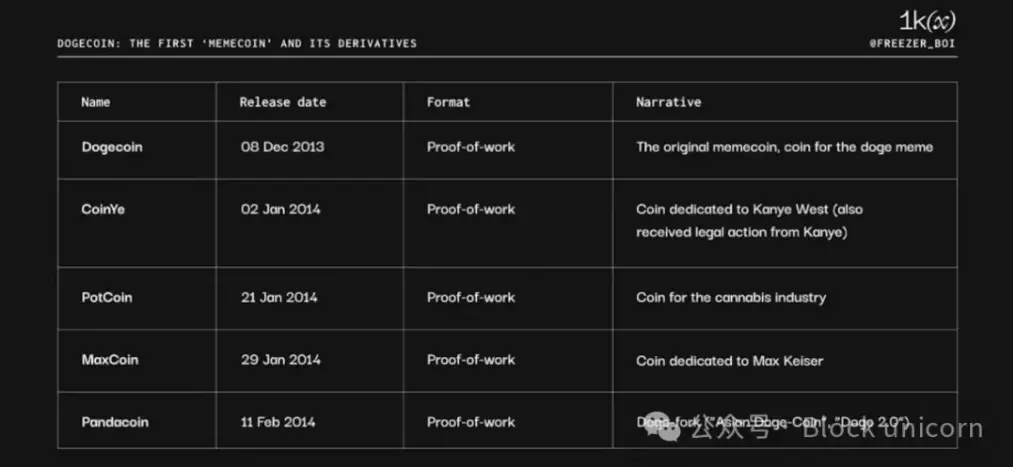
In the summer of 2013, the original Dogecoin ("wow, so applause") began to spread on 4chan and Reddit. On December 8, 2013, Jackson Palmer and Billy Markus capitalized on this cultural trend and launched Dogecoin on Bitcointalk. This was the first cryptocurrency based on internet memes.
The success of Dogecoin gave rise to a new category of cryptocurrencies that are fun, humorous, ironic, and use celebrities (such as Kanye West, Max Keiser), animals (such as Pandacoin), or are designed to attract specific communities. These were launched as proof of work tokens on the "Alternate cryptocurrencies" subforum of Bitcointalk. "Technical details" became less important; everything revolved around "memes." The image below shows some examples:
ICO Craze and the Rise of Ethereum
The rise of Ethereum sparked a wave of innovation, bringing new use cases, better user experiences, and new users.
Some specific improvements include:
Easier token issuance (ERC20 standard)
Attracted new user groups (non-miners)
Token creators could earn more money (unlike zero-premine PoW tokens, ERC20 tokens were sold directly through ICOs)
Introduction of interoperability/unified ecosystem/unified wallet (through ERC20)
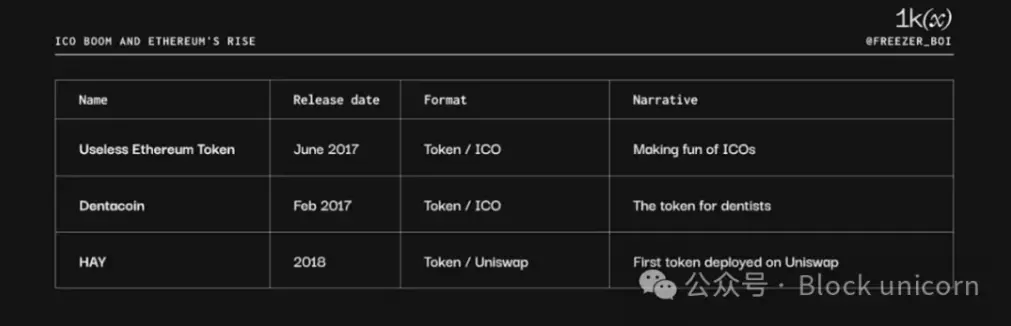
The ICO era gave rise to a wave of more "serious" projects, such as theDAO, Filecoin, Tezos, EOS, Cardano, Tron, and Bancor, which aimed to have utility or purpose beyond meme value. During this period, while some meme coins were not particularly noteworthy, they still attracted some attention.
One example is the launch of the Useless Ethereum Token in June 2017, which mocked the concept of ICOs and raised 310 ETH in its ICO.
Although Dentacoin's initial goal was to be the "cryptocurrency for dentists," it was still considered a meme coin and reached a peak market value of $2 billion in January 2018.
HAYCOIN was the first ERC20 token to be listed on Uniswap and was one of the meme coins created during this era (2018). Created by Uniswap founder Hayden Adams for testing the Uniswap protocol, it initially did not attract much attention or trading volume, but it resurfaced in 2023 due to its historical significance.
Collectible Memes and Early NFTs
In addition to cryptocurrencies, a collection of frog Pepe memes called "Rare Pepes" emerged, which was not publicly released and had a watermark that read "RARE PEPE DO NOT SAVE" if leaked.
Between 2016 and 2018, a group of Counterparty developers and Pepe meme enthusiasts created the Rare Pepe Wallet (Pepe Cash) and planned to trade "Rare Pepe memes" on the Counterparty protocol.
Rare Pepes are often considered the second NFT series in history and still hold value to this day, with some selling for over $500,000.
With the release of CryptoPunks, MoonCats, and CryptoKitties, NFTs entered the era of Ethereum, representing unique tokens pointing to images and media. EtherRocks was initially a joke on Reddit in 2017, centered around collecting a collection of 100 colorful clipart rocks, and became popular in 2021, with a floor price reaching 305 ETH (worth $1 million) in August.
Another example is Unisocks (SOCKS), launched by Hayden Adams in May 2019, offering 500 pairs of physical socks that can be exchanged for SOCK (ERC20) tokens. The price of each pair of socks has soared to $53,000, potentially making them the most expensive socks in the world.
DeFi Summer
In June 2020, Compound Finance introduced a new token distribution method called "liquidity mining" or "yield farming," allowing users to lock assets to provide liquidity and earn token rewards.
This innovation kicked off the "DeFi Summer," reaching its peak with "food coin" yield farms offering 10,000% annualized returns (in meme coins) for locking tokens in Yam or Pickle contracts.

Meme Stocks and Dogecoin
In 2021, stimulus measures, rate cuts, cheap capital, and global lockdowns due to the COVID-19 pandemic created a high-risk environment worldwide.
Retail traders on Reddit popularized the "Gamestock" meme in early 2021, driven by Robinhood's user-friendly experience and zero-commission trading, leading to a rapid surge in its stock price.
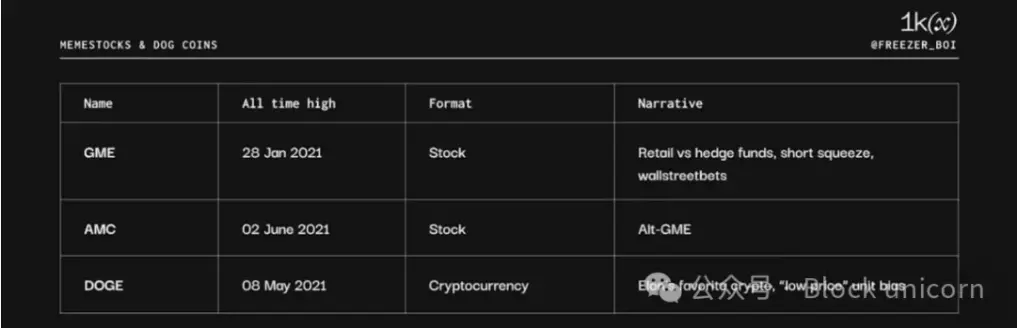
The frenzy around "GME" sparked speculation in other assets, especially those available on Robinhood. DOGE was listed on Robinhood in 2018 at a price of $0.008 and gained attention in 2021 due to Elon Musk's tweets, reaching a peak market value of $90 billion in May 2021.
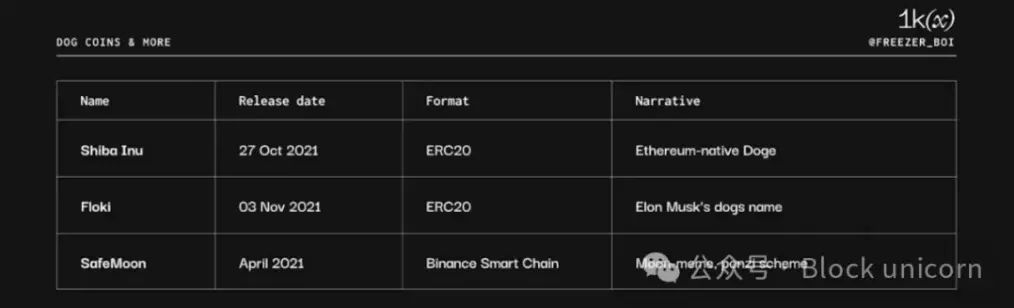
The popularity of DOGE gave rise to more dog-themed meme coins, such as Shiba Inu, Floki, and Safemoon, reaching high valuations within a few months.
NFT Craze: "Meme Coins with Pictures"
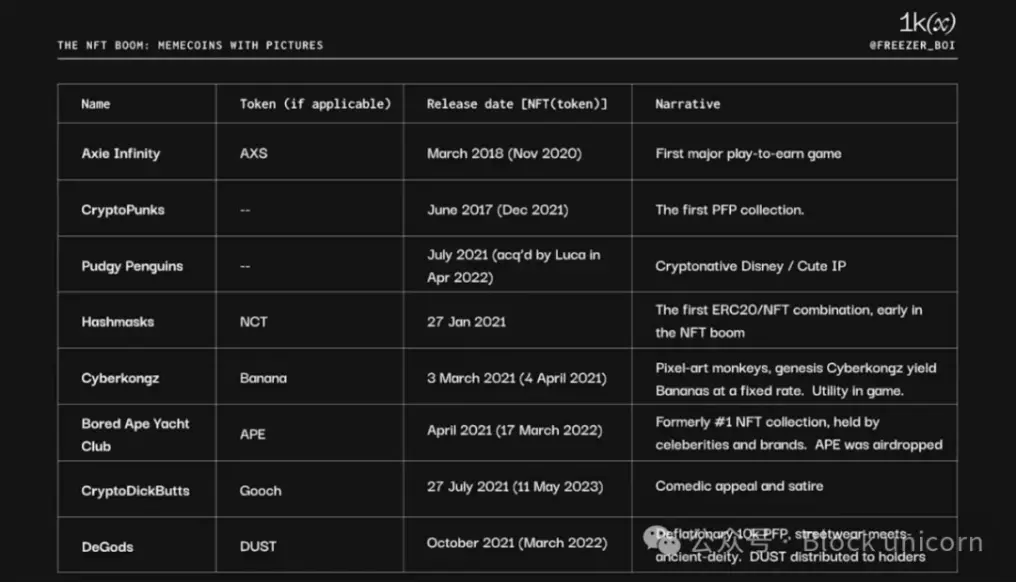
The ERC721 standard and platforms like OpenSea gave rise to NFTs, unique encrypted assets representing "culture" or "meme" expression.
Prominent NFTs include CryptoPunks, Bored Apes, Squiggles, and Pudgy Penguins, used as profile pictures on Twitter and Discord, symbolizing status and "club membership."
Recent Trends (2023+)
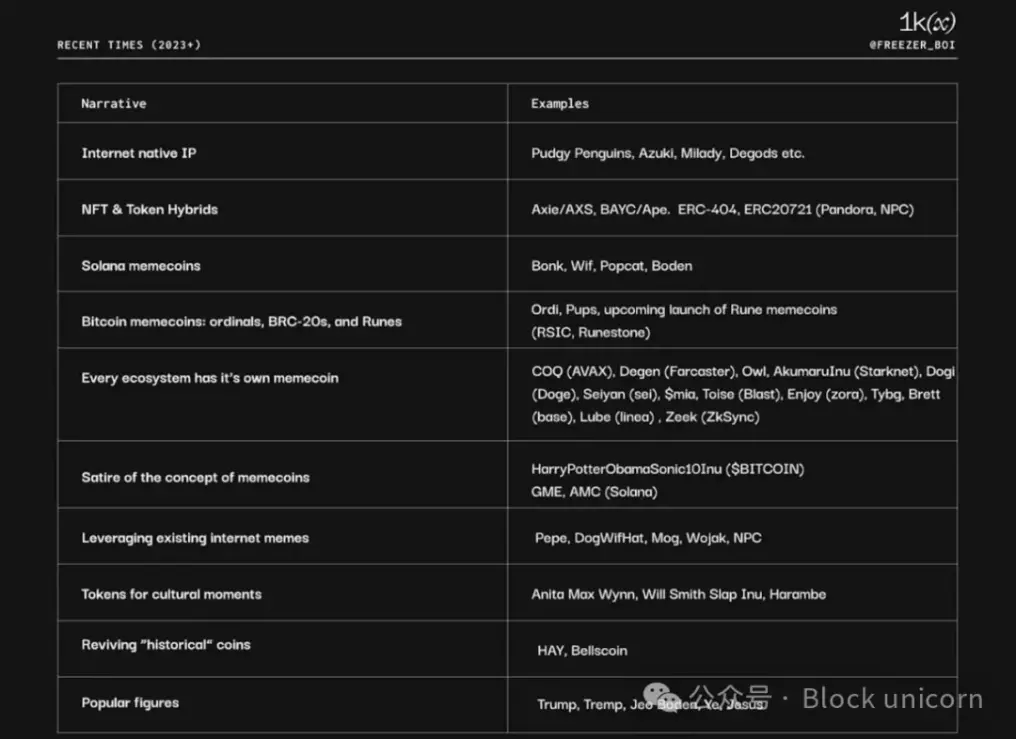
As cryptocurrencies rebound from the bear market, new memes, cultures, ideas, and ecosystems continue to emerge, attracting increasing interest and attention to memes.
Common Patterns
Each cycle sees some form of meme coins presented in various technical forms, such as PoW coins, ERC20 tokens, and NFTs, using attention, narrative, and hype to survive and spread.
Memes precede tokens; the most successful meme coins leverage existing meme popularity for promotion.
Native crypto memes are just beginning to spread beyond the crypto community, such as Pudgy Penguins.
Low prices attract speculation; price itself becomes a meme.
Strong communities and marketing are crucial for the success of meme coins.
From rapid growth to professional operations, meme coins continue to evolve.
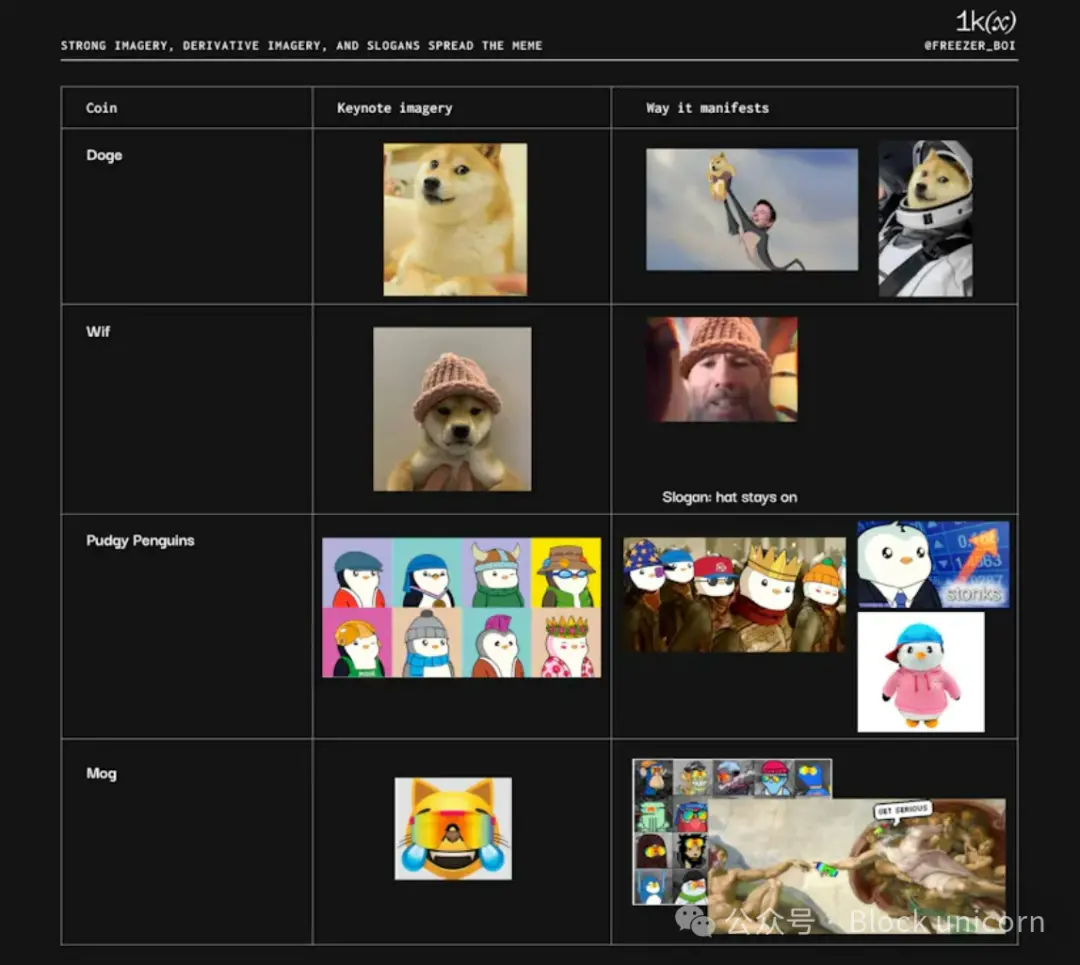
Images and slogans drive the spread of memes.
Opportunities
Meme coins have a market value exceeding $600 billion, with a daily trading volume of $13 billion, offering significant financial value.
Getting in early on the next meme can bring profits for creators and investors, expanding influence and becoming early believers, whether as a ticket to wealth or a choice to follow specific KOLs.
免责声明:本文章仅代表作者个人观点,不代表本平台的立场和观点。本文章仅供信息分享,不构成对任何人的任何投资建议。用户与作者之间的任何争议,与本平台无关。如网页中刊载的文章或图片涉及侵权,请提供相关的权利证明和身份证明发送邮件到support@aicoin.com,本平台相关工作人员将会进行核查。


