Author: Deep Tide TechFlow
Questioning narrative, understanding narrative, and becoming narrative are the classic three steps in the hype of encryption.
However, the generation of a narrative often originates from a high-sounding word, such as "intent," "modularization," and "parallelization" … It sounds concise and powerful, making people seem to understand but not really --- that's the kind of sexy technical aesthetic that is desired.
But if you were to ask where these words come from, the top VC Paradigm must be worthy of the supreme title of "word-coiner."
In July last year, Paradigm introduced its focus on the top ten trends, among which it first mentioned the concept of "intent-centric."
So the concept of intent quickly became popular, and projects flocked to hot words. The ordinary demand of "making user experience better" can be wonderfully packaged with just the word "intent"; and protocols based on intent have also become a necessary footnote in the Twitter profiles of new projects.
Recently, the word-coiner Paradigm once again made a move, and its CTO published an article titled "Reth's path to 1 gigagas per second, and Beyond," in which the key word is naturally "gigagas."
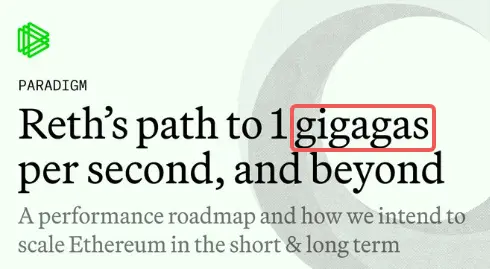
Giga is directly translated as a common unit of quantity, that is, a billion or a gigabyte; and gas is obviously the well-known gas fee.
But when the two words are combined --- a billion gas?
Hmm, it still has that familiar concise and powerful, succinct, seemingly understandable, and mysteriously impressive feeling.
From TPS to GPS, the word-coiner's new standard
In fact, the new concept of gigagas proposed by Paradigm is related to the performance of blockchain.
In conventional thinking, when we talk about how fast a blockchain is, we use TPS (transactions per second) as a measure, that is, the number of transactions it can process per second.
However, Paradigm's CTO believes that "Gas Per Second" (GPS), which measures the amount of gas that can be consumed per second, is a more accurate performance metric. This is because:
- Measurement of computational workload: Gas is the unit of measurement for the computational workload required to execute operations (such as transactions or smart contracts), so GPS can more accurately reflect the amount of computation the network can handle per second.
- Representation of capacity and efficiency: Using GPS as a performance metric can provide a clearer understanding of the capacity and efficiency of the blockchain, helping to evaluate system costs.
- Resisting DOS attacks: Standardizing performance metrics as GPS can better guard against potential Denial of Service (DOS) attacks, which may exploit less accurate measurements.
- Cross-chain performance comparison: Using GPS helps in comparing the performance of different EVM-compatible chains, as different chains may have different computational complexities in transaction processing.
Therefore, using GPS instead of TPS to measure the performance of the blockchain would be better, and Paradigm suggests in the article that the EVM community should adopt the amount of gas per second as a standard metric, combined with other gas pricing dimensions, to create a comprehensive performance standard.
If, according to Paradigm's thinking, the amount of gas consumed per second is used to comprehensively evaluate the performance of EVM networks, while capturing computing and storage costs, then the ranking of GPS for current mainstream L1 and L2 should be as follows:
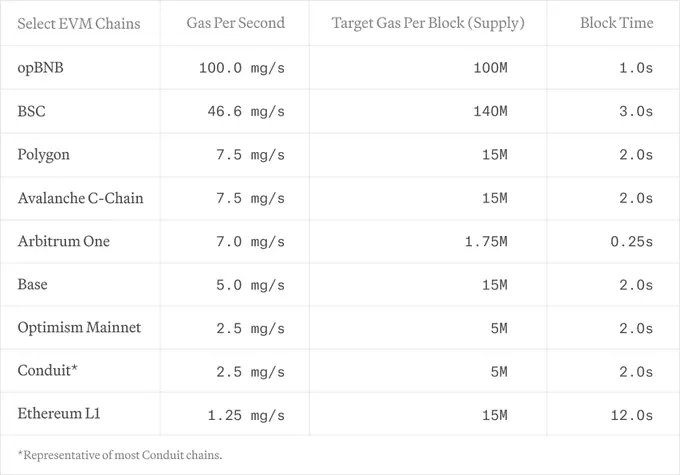
*Deep Tide Note: The data in the table refers to milligas (mg), which means "one thousandth of a gas." The larger the value, the greater the amount of computation the blockchain network can handle per second, indicating better performance. According to the table data, opBNB is the highest among all the listed networks.
This means that compared to other blockchain networks, opBNB can execute more computations in a unit of time, handle more or more complex transactions and smart contracts. However, the evaluation of performance should also consider other factors, such as network security, degree of decentralization, and fee structure.
1 gigagas, VC's own infrastructure construction
However, what Paradigm wants to do goes far beyond the numbers in the table, but to achieve GPS at 1 gigagas, that is, the blockchain can consume 1 billion units of gas per second.
In the early years, Paradigm started developing Reth, an Ethereum execution client, using Rust.
The goal of Reth is to optimize execution performance and increase the number of "gas" units that can be processed per second, thereby enhancing the overall performance of the Ethereum network.

From the publicly available data in the article, Reth can already achieve 100-200MB gas per second (including sender recovery, transaction execution, and computing each block's trie); so to achieve the goal of 1 gigagas per second, it needs to be expanded by another 10 times.
The method proposed by Paradigm is to vertically and horizontally expand its self-developed Reth.
As for how to specifically expand, because this part is too technical and not suitable for ordinary readers, we have simplified it here for a quick understanding of the situation.
The so-called vertical expansion is like replacing a machine with a more powerful engine or adding more memory to it, so that it can handle more workload. The main purpose is to improve the processing capacity of the original single server or node.
Specific methods that Paradigm can think of include:
- JIT/AOTEVM: By using just-in-time compilation (JIT) or ahead-of-time compilation (AOT) for EVM, the overhead of the EVM interpreter is reduced, thereby speeding up the processing speed of single-threaded transactions. It is claimed that this can halve the execution time.
- Parallel EVM: Using multi-core processors to execute EVM, more transactions can be executed simultaneously. This is because historically, up to 80% of EVM transactions have no conflicting dependencies and can be executed in parallel.
- Parallel, pipelined, modified state root: Reducing the overhead of calculating the state root. The calculation of the state root accounts for the majority of the block time, over 75%, so optimizing this is a key step to significantly improve efficiency.
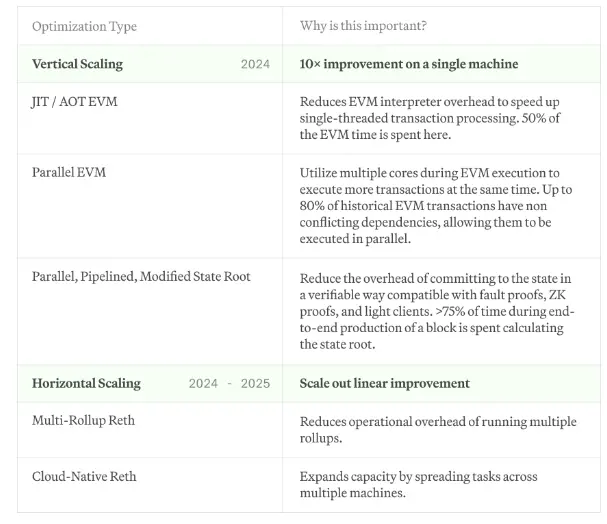
Horizontal expansion, on the other hand, is like adding more processing units to the system, similar to adding more production lines in a large factory. By adding more processing units to share the workload, the overall capacity of the system can be expanded without increasing the pressure on individual nodes.
Specific methods that Paradigm can think of include:
- Multiple Rollup Reth: Reducing the operating overhead when running multiple rollups, meaning that multiple rollups can be started in the same process, thereby minimizing the operating costs of running thousands of rollups.
- Cloud-native Reth: By distributing tasks to multiple machines, the capacity is expanded. This is similar to cloud computing architecture, allowing the system to automatically scale as needed and using cloud object storage to persist data.
If you don't understand these, it doesn't matter. All we need to understand is that the essence of this matter is:
Paradigm has developed its own Ethereum client, proposed a new standard for measuring EVM performance, and aims to elevate this new standard (GPS) to 1 gigagas through various means.
The VC takes the lead in infrastructure construction and performance enhancement, ultimately achieving much faster execution efficiency than existing Ethereum and other EVM public chains, allowing the blockchain to consume more gas and perform more tasks in a unit of time, paving the way for the chain to support large-scale applications.
From this, it can also be seen that Paradigm not only invests in others to develop L1/L2, but also invests its own resources in performance development, making multiple bets to improve infrastructure.
The creation of new terms never stops, but customer acquisition has never begun
Clearly, gigagas is a more hardcore concept, not as accessible as "intent" that anyone can get involved in.
Perhaps in the future, various L1/L2 chains will demonstrate their performance reaching 1 gigagas or even more; however, application layer projects may not be directly related to this concept.
However, in the current lack of narrative, having an additional concept also means an additional possibility of grabbing attention.
Mr. Pan also keenly pointed out that creating terms in encryption requires them to be easy to read, easy to understand, and original. From this perspective, gigagas meets all these conditions and indeed appears novel to people.

However, now that there are so many L1/L2 chains, and so many new stories and concepts about performance, after the back-and-forth competition, where are the standout applications?
Or is it that as long as the infrastructure is strong enough, the applications will eventually emerge, so everyone should focus on infrastructure first?
In the author's view, the importance of gigagas may not be as significant as gigausers (one billion users). Perhaps performance is a prerequisite for achieving user scale, but performance does not necessarily guarantee users.
The real improvement in user experience and user influx for encrypted products is still a long way off.
免责声明:本文章仅代表作者个人观点,不代表本平台的立场和观点。本文章仅供信息分享,不构成对任何人的任何投资建议。用户与作者之间的任何争议,与本平台无关。如网页中刊载的文章或图片涉及侵权,请提供相关的权利证明和身份证明发送邮件到support@aicoin.com,本平台相关工作人员将会进行核查。


