Article: Jeff John Roberts, Fortune Magazine
Translation: Luffy, Foresight News
On April 15th, a Bitcoin wallet that had been dormant for 14 years woke up. The wallet owner sent 50 bitcoins to Coinbase, making a profit of over 3 million dollars from these once-worthless bitcoins. Such transactions are rare but not unique. Almost every week, early Bitcoin wallets wake up, raising the question of how many speculated lost bitcoins can be put back into circulation. A new survey by Fortune and Chainalysis provides some insights.
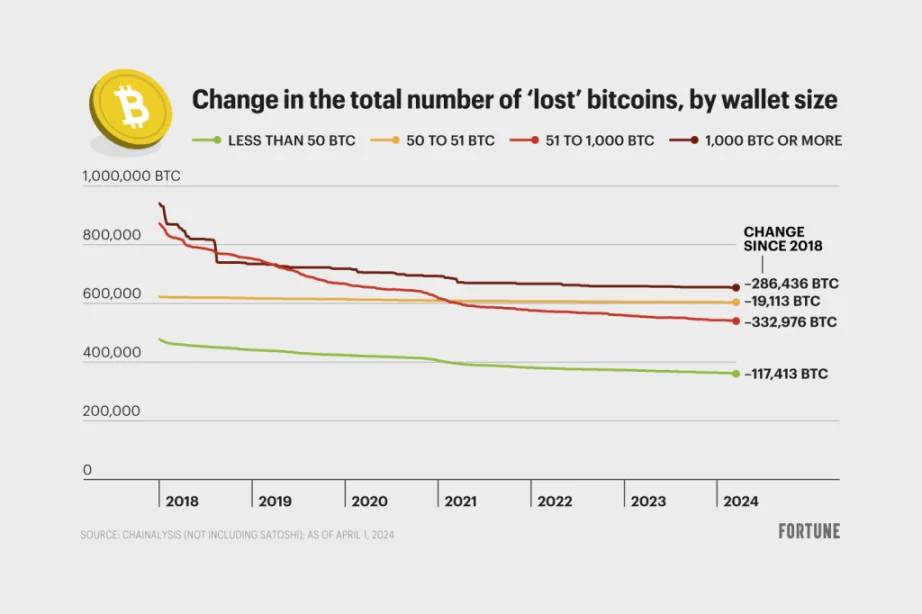
The chart shows the changes in the number of lost bitcoins since 2018.
As shown in the above figure, hundreds of thousands of "lost" bitcoins (defined by Chainalysis as bitcoins that have not moved since 2014) have re-entered circulation in recent years. The chart shows the net change in the total amount of bitcoins in four different-sized wallets, including those holding less than 50 bitcoins and those holding 1,000 bitcoins or more. The "less than 50 bitcoins" category accounts for the vast majority of old Bitcoin wallets, as shown in the figure below.
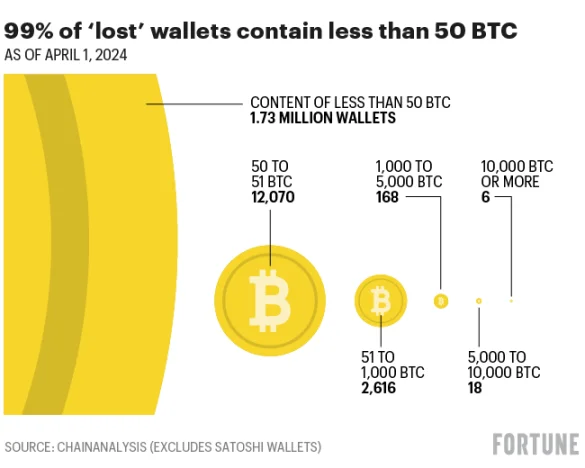
The chart shows details of the lost Bitcoin wallets.
Both charts indicate that the number of old wallets containing 50 bitcoins is disproportionate. This reflects the fact that in the early days of Bitcoin, the block reward was 50. (Subsequently, a series of "halving" events reduced the reward to 25, 12.5, 6.25 bitcoins, and just last week, the reward decreased to 3.25 bitcoins).
Today, the number of bitcoins mined daily is less than 10% of the earliest days, and early wallets (many of which contain substantial wealth) may attract greater interest.
$121 Billion
Those who only occasionally take an interest in cryptocurrency may be surprised to learn that approximately 1.75 million Bitcoin wallets have been completely dormant for a decade or longer, many of which contain substantial funds. As of mid-March, these wallets (excluding about 30,000 wallets associated with Bitcoin's founder, Satoshi Nakamoto) contained 1,798,681 bitcoins, now worth about $121 billion.
These 1.8 million "lost" bitcoins account for about 8.5% of the total supply of 21 million bitcoins (of which 93% have already been mined). In most cases, it is impossible to know for certain the whereabouts of a particular wallet, but it is certain that many wallets indeed have permanently lost bitcoins. In the early days of Bitcoin, this cryptocurrency was almost worthless until its price broke through the $1 mark in 2011. Therefore, many recipients of bitcoins may have completely forgotten about them or not bothered to keep the private keys required to access the wallets. Before 2012, companies like Coinbase that store private keys for users did not exist, making lost keys especially common.
However, not all idle wallets have been lost or abandoned. Bitcoin is known for its large "HODLers," who pledge never to sell their reserves (or at least to hold them long term). It is these individuals (in cryptocurrency terms, they have "diamond hands") who manage the few active wallets since 2018.
So why would they sell? Chainalysis' analysis of the activity in new active wallets found a statistically significant correlation between changes in Bitcoin prices and activity in specific weeks. However, most of the time, the increase in wallet activity seems unrelated to any obvious external events.
Overall, the activation rate of old wallets seems predictable. For example, in the week of March 25th, a typical pattern emerged, with 172 long-dormant wallets becoming active, including 169 wallets with less than 50 bitcoins and one wallet with over 1,000 bitcoins. Many Bitcoin holders have more than one wallet, especially those who owned wallets before 2014, so the number of people activating wallets that week may be much lower than 172.
Variable: Satoshi Nakamoto's 1.1 Million Bitcoins
Chainalysis' survey data suggests that old wallets will continue to be awakened at a steady but slow pace until the number of lost bitcoins stabilizes at around 1.5 million.
However, we can imagine that the pace of wallet awakenings will accelerate in the future. That is, when HODLers from before 2014 grow older and bequeath their long-held bitcoins to their children, who may then sell them. However, such events are still decades away, as most early Bitcoin holders are only in their 20s or 30s.
Finally, the above "lost" bitcoin count does not include the wallets controlled by Satoshi Nakamoto, who is estimated by Chainalysis to own about 1.1 million bitcoins. A recent report by Fortune magazine on Satoshi Nakamoto's wealth (valued at about $75 billion) found that most people who closely follow cryptocurrencies believe that the Bitcoin creator has likely become a myth and is very unlikely to ever touch his wallets.
If this is true, then the current total of lost bitcoins is approximately 2.9 million, accounting for nearly 14% of the total supply. In the long run, the best outcome would be for these bitcoins to become permanently lost treasures.
免责声明:本文章仅代表作者个人观点,不代表本平台的立场和观点。本文章仅供信息分享,不构成对任何人的任何投资建议。用户与作者之间的任何争议,与本平台无关。如网页中刊载的文章或图片涉及侵权,请提供相关的权利证明和身份证明发送邮件到support@aicoin.com,本平台相关工作人员将会进行核查。


