Original | Odaily Planet Daily
Author | Kate

Ethereum's promise to reduce fees faced a new challenge yesterday. Despite the highly praised Dencun upgrade, the introduction of the new Blobs feature suddenly led to a surge in costs. Understanding the impact of this new surge is crucial for cryptocurrency developers. The precious asset of block space is likely to cause a backlash.
Event Review
On March 14th, Middle March, co-founder of Ethscriptions (@dumbnamenumbers), announced on X that they had successfully minted a BlobbedEthscription, referred to as #0, and said "who knows what the world of Blobs will look like in the next three weeks."
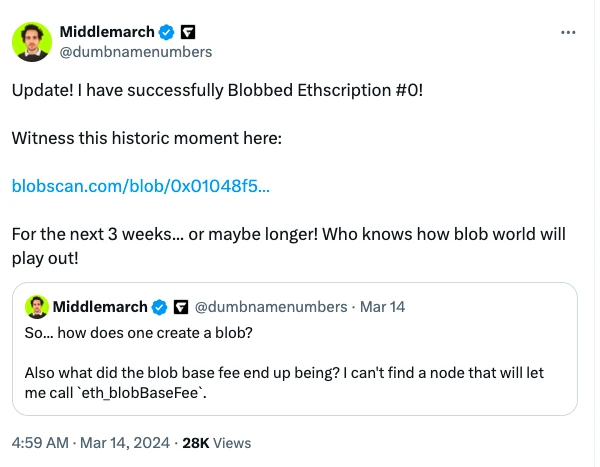
Shortly after, in the early morning of March 28th Beijing time, March posted a tweet announcing the official launch of Blobscriptions.
Just an hour later, Ethereum's Blobbasegas surged to 14,499,530 wei. March admitted on X that Blobscriptions caused this gas increase.
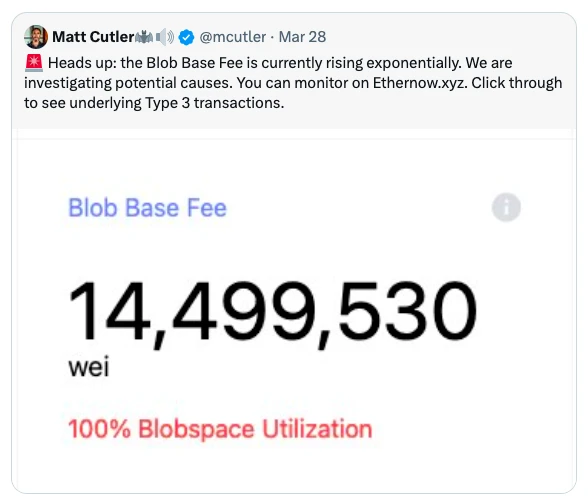
Around 10:30 am Beijing time on the same day, Vitalik Buterin tweeted that "Dencun hard fork has been activated, thanks to Blobscriptions, the Blob fee market has now entered a 'price discovery mode'".
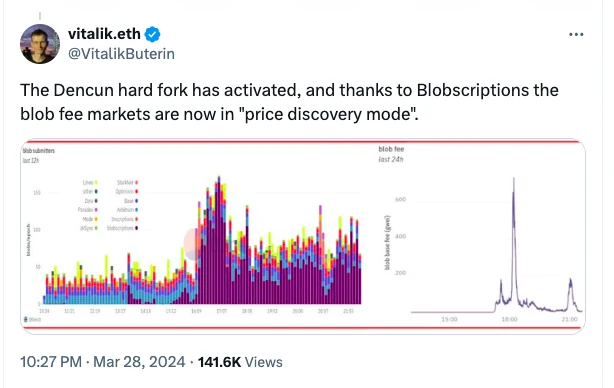
According to data, the gas fee generated by this activity reached as high as 0.1 ETH, about $370. This is far from the average Gas price for data minting on Blobs before.
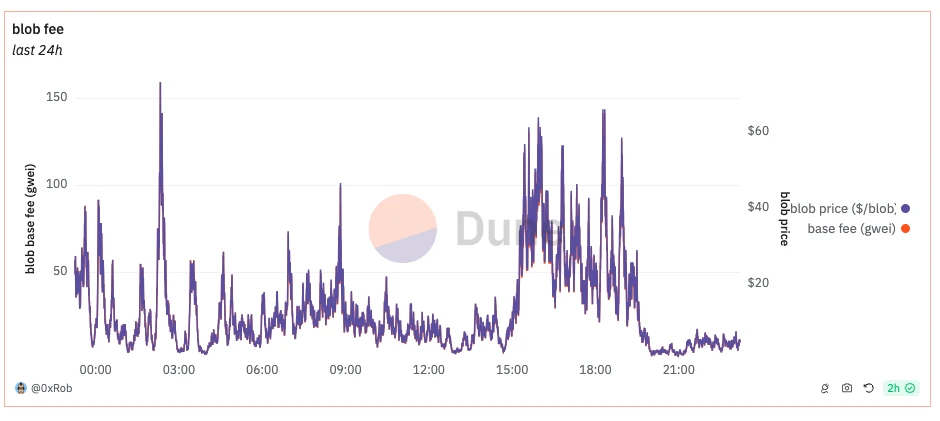
Early on March 29th, according to Ethernow data, Blob gas fee has dropped to around 40 gwei.
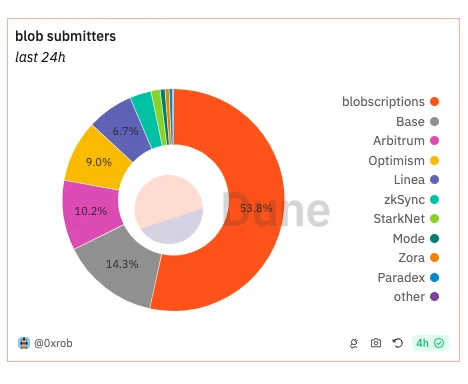
According to Dune data, we can see the submission of Blobs in the past 24 hours:
Blobscription: Joy and Worry
Why Blobscription is So Popular
Ethereum's Dencun upgrade introduced an economic data package called Blobs, originally intended to make transactions smoother. However, users quickly seized this business opportunity, to the extent that what used to be free blobs have now become scarce commodities.
Middle March launched Ethscriptions, a protocol that allows users to embed multimedia content directly into Ethereum's "blobs." Blobscriptions leverage the "Blob" introduced in EIP-4844 to reduce minting costs, allowing anyone to store data on Ethereum at 10 to 100 times cheaper than calldata.
The introduction of inscriptions on Blobs began to stress-test this feature. These inscriptions, inspired by Bitcoin Ordinals, embed unique fungible and non-fungible artifacts in Blob transactions.
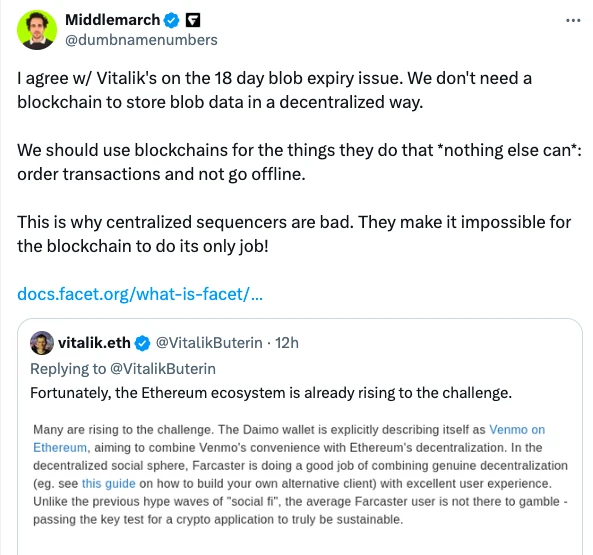
However, Ethereum itself does not guarantee the availability of Blob data beyond 18 days, a feature that raises doubts about whether this "crazy inscription" activity will become a "large-scale social experimental game" on the blockchain. However, addressing this issue, March stated on X that the indexer of Ethereum inscriptions will store this data indefinitely. And admitted that storing data on Blobs goes against the decentralized nature of Ethereum.
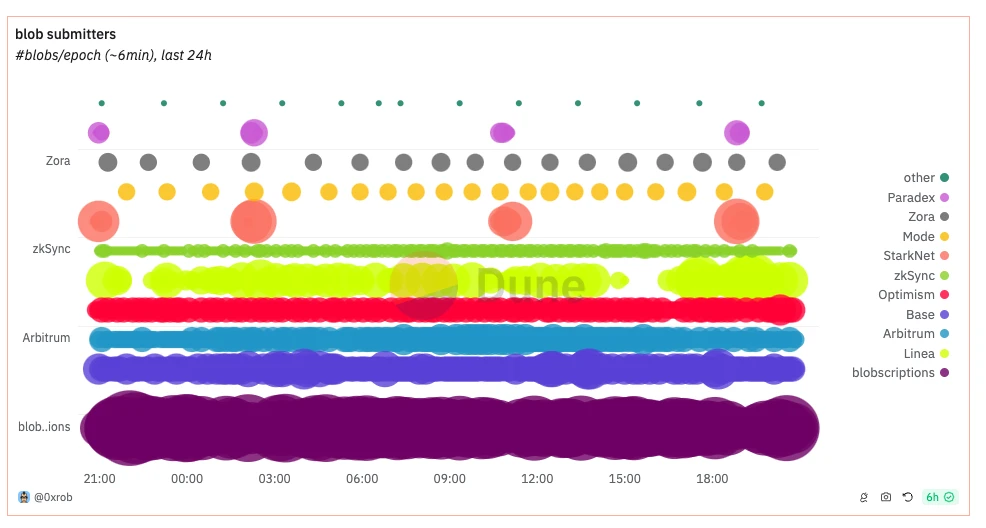
In just a few days since its inception, users have created over 4500 Blobscriptions. Dune data shows that as many as 50% of the newly generated Blobs are for these inscriptions. Cryptocurrency users seem to be fascinated by the idea of permanently storing random text and images on the blockchain, reminiscent of early Bitcoin inscriptions.
A Brief Peak or a Lasting Trend?
Since its release, Dencun has indeed prompted Ethereum users to transition to affordable L2, which is what Ethereum users have been hoping for. However, if Blobscriptions continue to clog the low-cost channels, this benefit may be short-lived. Worse still, this could negate one of the main selling points touted by Ethereum cryptocurrency developers.
If the initial impact is mainly focused on Blobs, then the entire Ethereum cryptocurrency ecosystem may feel the effects of this surge, with concerns that it may affect base layer transactions. If it is the latter, it could undermine one of Dencun's main goals, which is to significantly reduce transaction costs on the second layer (L2) network.
Even if the frenzy of BlobScriptions is proven to be temporary, the damage it has caused is already significant. For example, according to the data from Ehternow, the cost of Blob fluctuates around 40 gwei (approximately $1.35) at the time of writing. Although this number is significantly lower than the peak of 585 gwei, it is still much higher than the symbolic price of 1 gwei (0.01 USD) before the buying frenzy.

In conclusion, the sudden emergence of BlobScriptions has reignited the debate about Ethereum's actual ability to provide low-cost cryptocurrency transactions. If this trend continues, it may challenge the benefits promised by Dencun. However, it will also plunge the blockchain into an uncertain future. A potential era of instability seems to be opening up in the surprised eyes of Ethereum developers. Ethereum may need to demonstrate extreme flexibility to navigate through this delicate period of reassessment.
Simple Tutorial
Finally, Odaily still provides a tutorial for everyone. The potential speculation space of BlobScriptions itself, and whether it can reproduce the glory of Bitcoin inscriptions in the future, will be left for further consideration.
Website: https://blobscriptions.io/
Steps (see the image below):
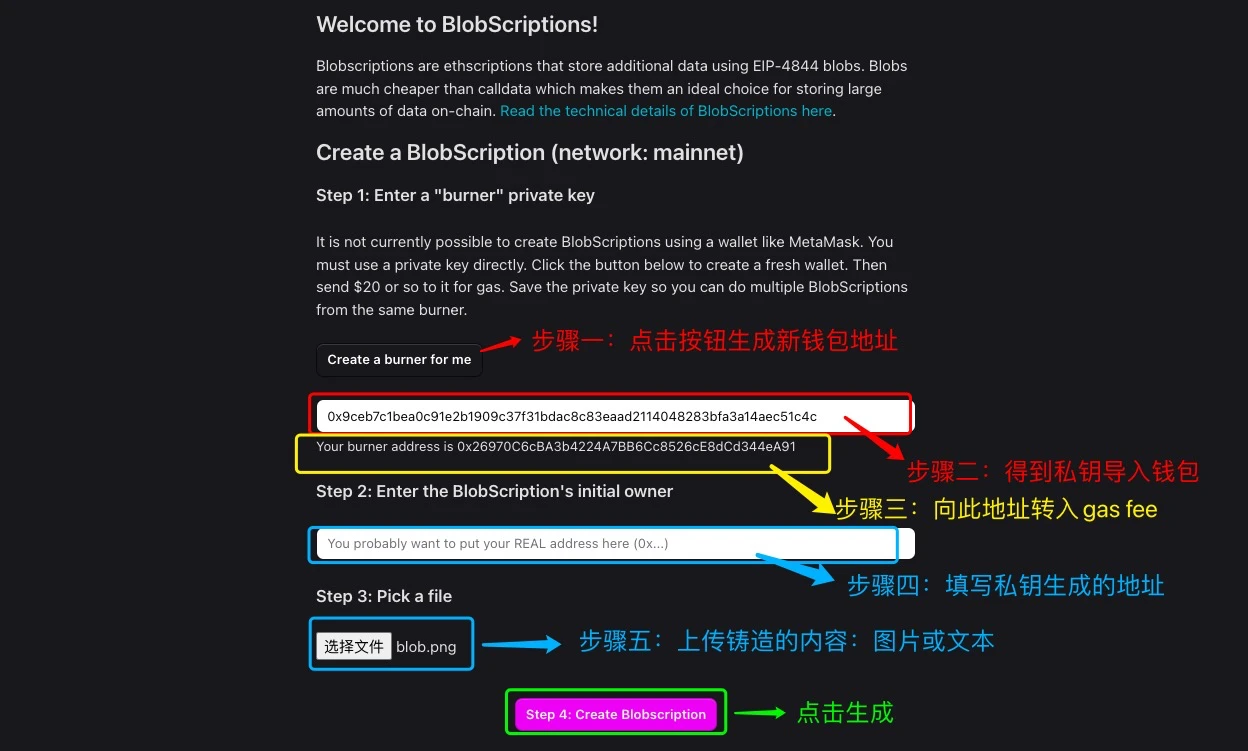
Note: After selecting the button to generate a new wallet, please record the private key for multiple minting uses in the future. Before depositing the gas fee, you can check the current fee to avoid insufficient balance situations.
免责声明:本文章仅代表作者个人观点,不代表本平台的立场和观点。本文章仅供信息分享,不构成对任何人的任何投资建议。用户与作者之间的任何争议,与本平台无关。如网页中刊载的文章或图片涉及侵权,请提供相关的权利证明和身份证明发送邮件到support@aicoin.com,本平台相关工作人员将会进行核查。


