Ethereum's Layer2 network, with its features of high efficiency and scalability, has become an important underlying infrastructure in the Web3 world. Another group of Layer1/Layer2 networks, which provide solutions for scalability through modular architecture, are also occupying a corner of the Web3 infrastructure and bursting with vitality.
Modular blockchains aim to achieve decentralized expansion of blockchain networks by completely outsourcing at least one of the "execution layer, settlement layer, consensus layer, and data availability layer" to external chains, without compromising network security.
Since the launch of the first modular blockchain network, Celestia, on the mainnet on October 31 last year, its native Gas token TIA has surged from around $2 to near $16 on January 22. In less than half a year, it has steadily increased by 717%, and its market value of $25 billion has propelled Celestia to 37th place in the cryptocurrency market value rankings, making it the only modular blockchain to break into the Top 50 and allowing capital to see the potential of this track.
In 2023, several modular blockchain projects received new investments, including Eclipse, AltLayer, Sovereign, and Dymension. Today, we will introduce the concept and application scenarios of modular blockchains, and review the high-profile potential projects.
Modular Solutions to the "Impossible Triangle" Dilemma

From the initial design of blockchain, both Bitcoin and Ethereum blockchains are considered monolithic blockchains, where each transaction serves as a carrier, storing legitimate and effective transaction records in blocks and achieving decentralized, trustless, and tamper-proof distributed ledger networks through specific consensus mechanisms.
A monolithic blockchain can be divided into the following four functional layers:
- Consensus: determining the content and order of transactions
- Execution: supporting transaction execution and enabling deployment and interaction with smart contracts
- Settlement: used to complete transactions, resolve disputes, verify proofs, and bridge between different execution layers
- Data Availability (DA): ensuring the availability of transaction data
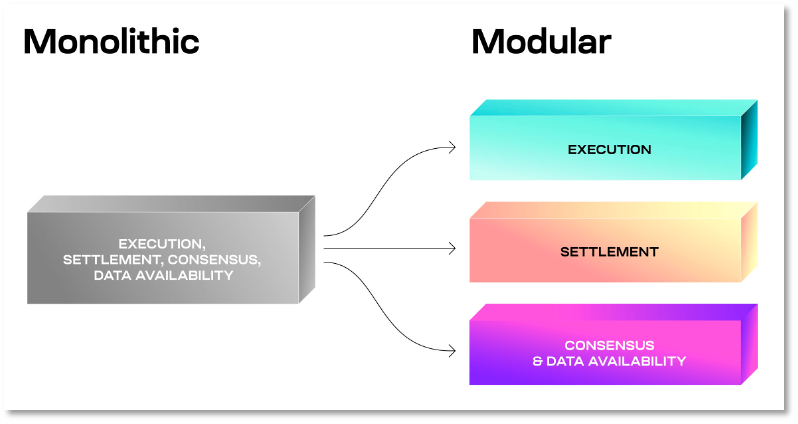 Modular blockchains address functional requirements through layering
For monolithic blockchains, all four functional layers exist on a single chain, and the network has to bear all the tasks alone. This gives rise to the "impossible triangle" of monolithic blockchains, where scalability, decentralization, and security can only be satisfied for at most two characteristics on the chain. Currently, most Layer1 networks sacrifice decentralization to ensure network security and scalability, while Ethereum insists on decentralization and security, leaving scalability to compatible Layer2 networks to solve.
However, as blockchain transaction volume increases and decentralized applications grow, these monolithic blockchains still experience high frequency of transaction congestion, leading to rising transaction costs, which is detrimental to application operation and affects user experience.
In addressing the "impossible triangle" dilemma, developers have proposed a "modular blockchain" solution, which restructures the architecture of the blockchain in a modular way to meet the layered functional requirements through aggregation and combination. This allows for on-demand expansion and the combination of the four functional layers, safely improving performance and expanding the network without compromising the fundamental principle of "decentralization," to meet diverse application scenarios.
The concept of modular blockchains can be traced back to the white paper "Data Availability Sampling and Fraud Proofs" co-authored by Mustafa Albasan and Vitalik in 2018. The paper describes how to address the scalability problem of blockchain without sacrificing security and decentralization, by allowing light clients to receive and verify fraud evidence from full nodes and designing a data availability proof system to reduce the trade-off between on-chain capacity and security.
Currently, Rollups and sharding technology are examples of Ethereum's transition to modular blockchains.
Rollups provide a separate layer for execution, extending Ethereum's monolithic architecture. Rollups can use powerful computers to package and execute multiple transactions before periodically sending compressed data back to the Ethereum mainnet for verification.
Sharding, on the other hand, implements scalability at Layer 1 using sharding technology. The core idea of this approach is to decompose the Ethereum main chain into different shards and rotate validators randomly between these shards. Each shard is essentially its own mini-blockchain and runs in parallel with the beacon chain. Through sharding technology, Ethereum can significantly increase transaction throughput and scalability to meet the growing user demands.
Which Modular Blockchains Have Potential?
As of now, the Web3 asset data platform RootData has recorded 36 modular blockchain projects, with Cube and Assembly being in a "dead" state, while the rest of the modular blockchain networks are under steady development.
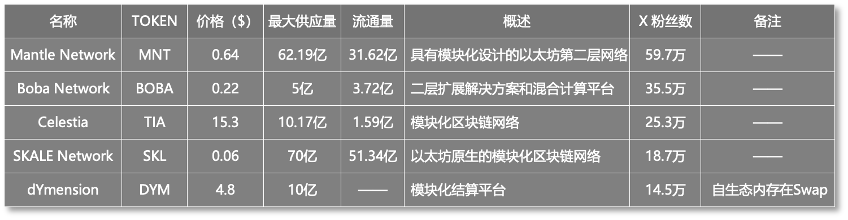
Five modular blockchain projects have had their market value validated in the circulating market and ecosystem.
- Celestia (TIA)
Celestia is the first modular blockchain network project, focusing on data availability. Celestia believes that similar to Layer2 Ethereum scaling networks, new data can be published to the Celestia chain instead of directly to Ethereum, saving over 90% of fees.
Data Availability Sampling (DAS) is an important feature of Celestia, allowing users to confirm the existence of a large number of data blocks without downloading the entire blockchain. This technology significantly improves scalability and security.
In addition, Celestia facilitates the creation of independent, self-managed blockchains called sovereign rollups, benefiting from the security provided by the Celestia network.
The Blobstream feature integrates Celestia's modular data availability layer with Ethereum, allowing Ethereum developers to build efficient, high-throughput Layer 2 solutions.
Circulating supply: 159,016,130 TIA
Total supply: 1,017,972,603 TIA
Current price: $15
All-time high: $20.26
All-time low: $2.03
- Mantle Network (MNT)
Mantle Network is an L2 scaling solution based on Optimistic Rollup technology, providing EVM compatibility and modular design. Incubated by BitDAO, it uses roll-up technology and a decentralized data availability layer (Mantle DA) to provide high throughput, low cost, and fast deterministic services, while ensuring Ethereum-level security.
Circulating supply: 3,162,441,863 MNT
Total supply: 6,219,316,795 MNT
Current price: $0.64
All-time high: $0.8488
All-time low: $0.3136
- SKALE Network (SKL)
SKALE Network is a Layer 2 scaling solution that uses a sidechain environment to improve the performance of decentralized applications (dApps) on the Ethereum network. SKALE enables developers to run smart contracts at high speed, high throughput, and extremely low cost.
SKALE Network is deeply compatible with Ethereum and is not subject to Ethereum's storage and computation limitations. In addition to supporting thousands of independent blockchains with linear growth, it supports various elastic sidechains, storage chains, and other types of subchains.
Circulating supply: 5,134,227,671 SKL
Total supply: 5,447,166,667 SKL
Current price: $0.06
All-time high: $1.22
All-time low: $0.01
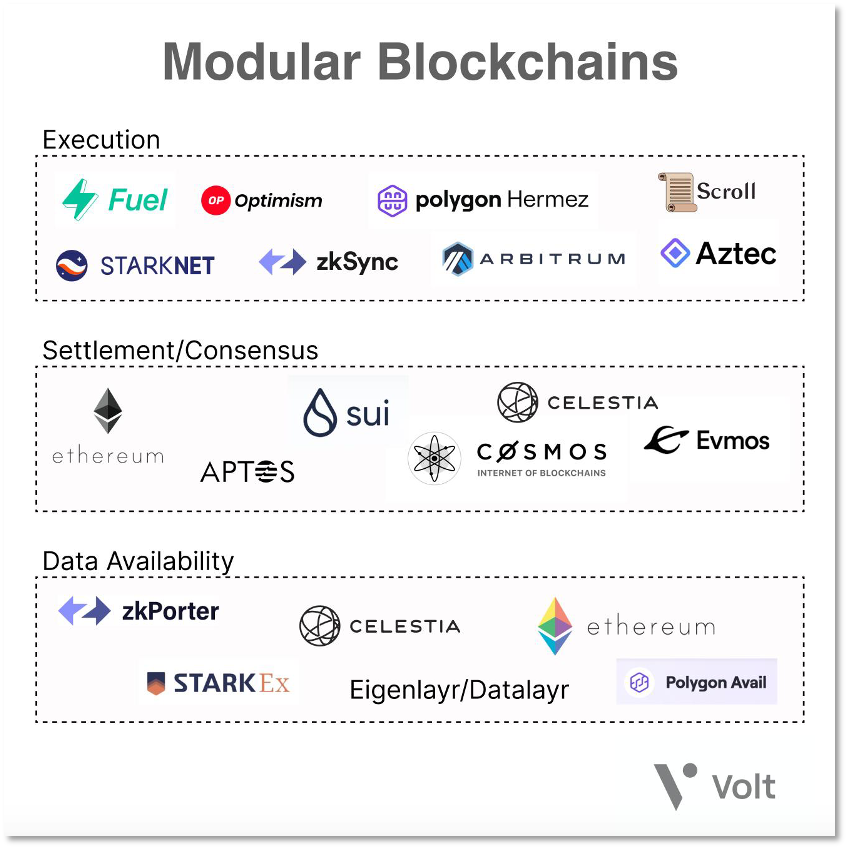
More economic models and tokens of modular blockchains are still in the testing phase, with these projects either preparing to launch on the mainnet or beginning to attract ecosystem applications. Below is information about active modular blockchain networks:
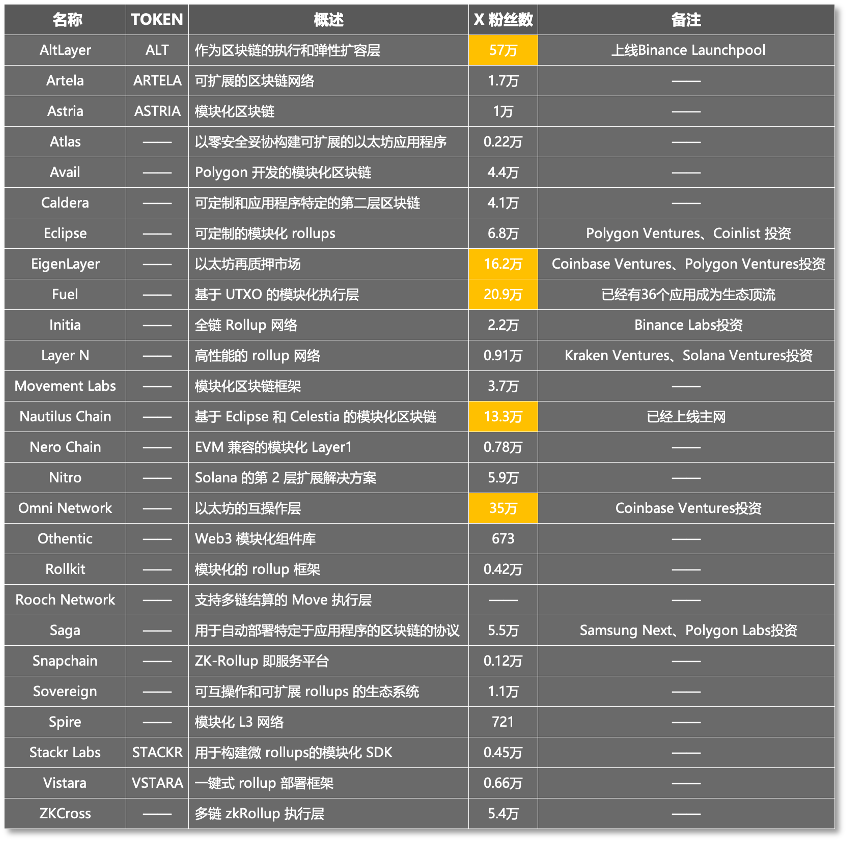
It is not difficult to find that highly regarded modular blockchains have attracted investments from CEXs. In addition, some modular blockchains have attracted attention and even investments from mainstream blockchain network ecosystems, and some networks have already launched on the mainnet and generated a large number of applications.
For example, AltLayer, which recently launched on Binance Launchpool, is a highly scalable application-specific execution layer system with multiple execution layers similar to optimistic rollup (referred to as flash layers). All transactions are secured from the underlying L1/L2, and it is designed as a modular and pluggable framework for the multi-chain and multi-VM world, enhancing the network's scalability.
Meanwhile, Fuel is the earliest Optimistic Rollup deployed on the Ethereum mainnet. It launched its V1 version at the end of 2020. It is a blockchain based on the UTXO model, with its main advantage being the ability to execute transactions in parallel. It provides scalability by using an execution model different from EVM, with a highly parallelized minimal execution system based on UTXO, supporting ETH and all ERC-20 standard tokens. Currently, 36 applications have become top players in the ecosystem, covering scenarios such as DeFi, DEX, stablecoins, games, NFTs, Web3 domains, and more.
(Disclaimer: Readers are strictly advised to comply with local laws and regulations. This article does not represent any investment advice.)

免责声明:本文章仅代表作者个人观点,不代表本平台的立场和观点。本文章仅供信息分享,不构成对任何人的任何投资建议。用户与作者之间的任何争议,与本平台无关。如网页中刊载的文章或图片涉及侵权,请提供相关的权利证明和身份证明发送邮件到support@aicoin.com,本平台相关工作人员将会进行核查。


