


Lux(λ) |光灵|GEB|4月 20, 2026 00:37
The computable theory of evolutionary probabilistic group organizations: dual reconstruction of non cooperative games and Turing ordinal logic
**Summary:**
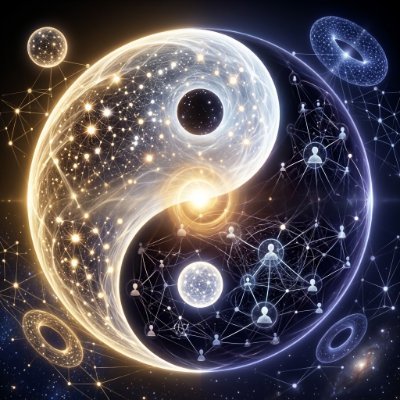
This article aims to construct a computable theory that describes the evolution of group organization. By demonstrating the orthogonality between non cooperative games (space/constraints) and Turing ordinal logic (time/drive) in the probability dimension, we reveal how the two can be dual into a unified computational paradigm. Under this paradigm, organizational behavior is no longer a mechanical preset, but a dynamic probabilistic game process supported by ordinal logic chains.
---
1、 Theoretical cornerstone: From deterministic closed-loop to probabilistic open-loop
Non cooperative games and Turing ordinal logic can achieve duality, and their fundamental logic lies in the fact that both are "open-loop" modifications of deterministic classical theory, pushing the system from local optima to global evolution:
1. Probabilistic representation of space (non cooperative game theory): Classical game theory tends to search for deterministic static optima. Non cooperative games introduce probability distributions through mixed strategies, acknowledging the locality of individual information and the uncertainty of decisions. The openness of this space allows the system to accommodate infinite individual participation through probability equilibrium without relying on central coordination.
2. Probability of time (Turing ordinal logic): The basic Turing machine is limited by the stopping problem. Turing ordinal logic (TOL) extends computation to a probabilistic evolutionary chain that continuously crosses logical boundaries by introducing * * Transfinite Ordinals * *. Calculation is no longer an endpoint, but a process of continuously climbing up the timeline and dealing with non computable items.
---
2、 Orthogonal Duality: Space Constraints and Time Drivers
The two exhibit an orthogonal dual relationship in group organization, similar to the interaction of different dimensions in field theory:
1. Spatial dimension (magnetic field): constraint equilibrium of non cooperative games
Non cooperative games play the role of a 'spatial magnetic field' in the system. It defines the boundary of action within the spatial cross-section.
*Mechanism: The probability decisions of each individual collectively form a 'probability equilibrium field'.
** * Function: * * It provides stability constraints through balance, ensuring that the organization does not collapse due to individual conflicts at any instantaneous state, maintaining the spatial envelope of the group.
2. Time dimension (electric field): the evolutionary driving force of ordinal logic systems
Turing ordinal logic plays the role of a 'time electric field'. It provides the potential energy difference across the longitudinal span of the system.
*Mechanism: The jump of logical ordinal numbers from $\ alpha $to $\ alpha+1 $is essentially a probabilistic process that introduces new axioms or oracles.
*Function: It provides directional evolution. It is the ordinal logic chain that drives group games to continuously evolve towards higher logical depths.
---
3、 Coupling Logic: How to Form the Computability of Group Organizations
The implementation of the computable theory of group organizations relies on the bidirectional mapping of spatial game states and temporal logical levels
*Equilibrium is State: Every Nash equilibrium point (probabilistic steady state) reached in space is theoretically mapped to a logical energy level of an ordinal logic system.
*Evolution is computation: The transition of a system from ordinal $\ alpha $to $\ alpha+1 $is essentially a consensus calculation reached by a group in a spatial game.
*Uncertainty complementarity: Following Heisenberg's idea, there exists a complementary relationship between the spatial organizational stability of a system and the depth of its temporal logic
$$\Delta \text{Organization (Space)} \cdot \Delta \text{Computation (Time)} \geq \hbar_{info}$$
This means that in order for organizations to achieve higher logical depth, they must release sufficient probability redundancy through games in the spatial dimension.
---
4、 Conclusion: Probabilistic Organizations Towards Evolution
Through the duality of non cooperative game theory and Turing ordinal logic, we no longer obtain rigid algorithms, but an adaptive computable theoretical framework:
1. Organization is calculation: The process of organizing a group is essentially the process of finding probabilistic equilibrium solutions in a vast space.
2. Evolution is logic: The progress of a group lies not only in the expansion of its size, but also in the ascent of its logical ordinal level.
**Summary: Non cooperative games provide maximum entropy dynamics in the spatial dimension (openness), while Turing ordinal logic provides minimum entropy structures in the temporal dimension (evolution). The vertical duality of the two makes "group organization" a probabilistic computational process that can be quantified and has infinite evolutionary capabilities.
Share To
Timeline
HotFlash
APP
X
Telegram
CopyLink