Written by: Xiaobing, Chao Xiang Research
As global investors fixate on Nvidia's earnings report, TSMC’s production expansion, and Samsung HBM's yield rates, a quiet surge is taking place on the Tokyo Stock Exchange.
On June 3, 2026, the Nikkei 225 Index broke through 68,000 points for the first time, with an increase of nearly 33% year-to-date, which is three times the rise of the S&P 500 and more than double that of the Nasdaq during the same period.
This cannot be considered a balanced slow bull market; the inflow of funds is extremely concentrated: the AI semiconductor supply chain. Just the stocks of Tokyo Electron and Advantest together pushed the Nikkei index up by about 840 points that day.
An even more astonishing figure belongs to Kioxia Holdings, a NAND flash memory manufacturer that will go public in Tokyo in December 2024. Its stock price skyrocketed from 1,455 yen at IPO to above 78,000 yen. In less than a year and a half, its increase exceeded 3,500%, and its market cap briefly surpassed that of Toyota, becoming the second most valuable company in Japan.
Behind these numbers lies an often-overlooked industrial fact: On the world’s most crowded track of AI, Japan does not design chips or manufacture chips, yet it controls almost everything needed to produce chips.
From equipment, materials, wafers, passive components, power systems, cooling solutions, to optical fiber cables, Japanese companies occupy the most upstream position in the AI industrial chain. To use a clichéd but accurate metaphor: In the AI gold rush, Japan is selling shovels, explosives, and miner's lamps.
We will break down this industrial chain into six levels, scanning the positions, financial performance, and investment logic of Japanese companies layer by layer.
Level One: Semiconductor Manufacturing Equipment
The essence of chip manufacturing is to carve circuits layer by layer on silicon wafers using extremely precise equipment. The more advanced the manufacturing process for AI chips (GPU, ASIC, HBM), the more steps involved, and the higher the precision required for each step. This makes semiconductor equipment the segment with the highest technical barrier, thickest profit margins, and strongest certainty in the entire AI industrial chain.
Japan's position in this field is second only to the Netherlands’ ASML and the United States’ Applied Materials. Six core companies guard different key entry points at various process nodes.
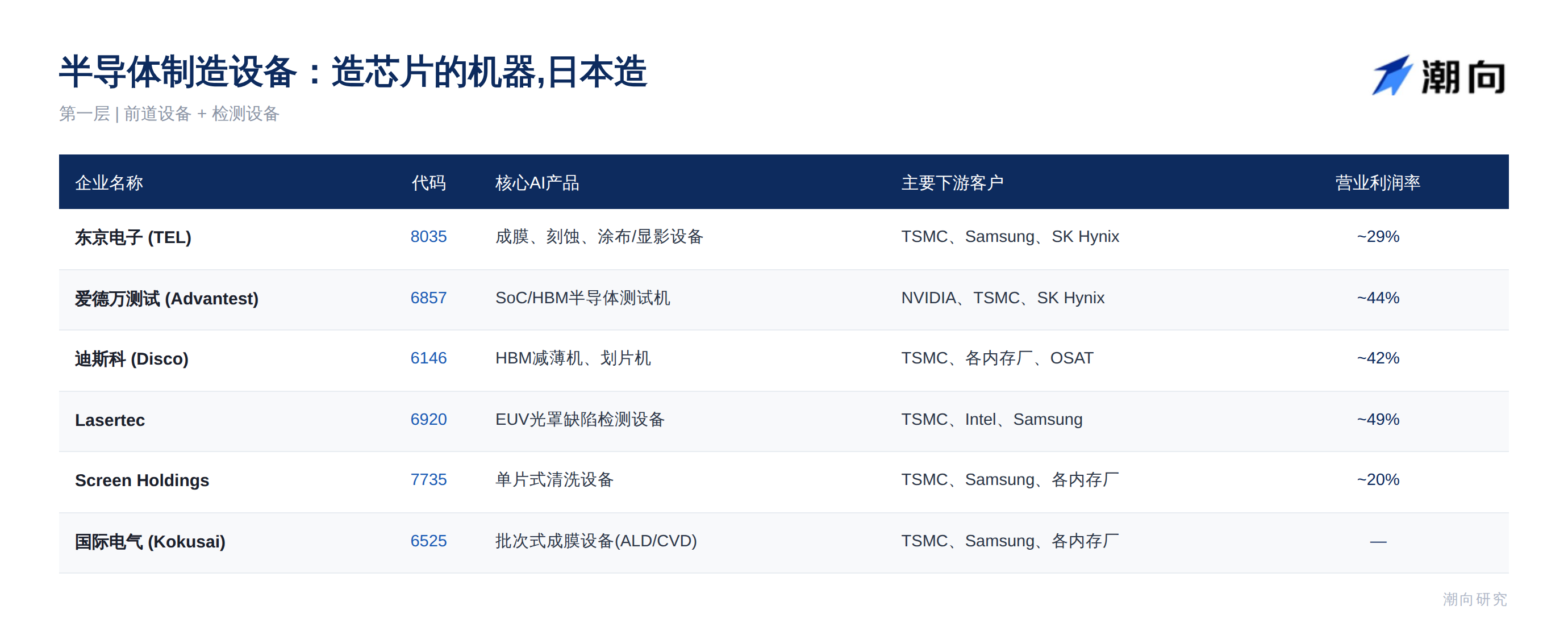
Tokyo Electron (8035): Comprehensive giant in front-end equipment
Tokyo Electron is the third largest semiconductor equipment manufacturer in the world, holding nearly 90% of the global market share in coating/developing, as well as ranking in the top two in etching, cleaning, and film deposition. Whether it’s TSMC, Samsung, or Intel, building advanced process production lines cannot bypass it.
For the fiscal year 2026 (ending March 2026), revenue reached 2.44 trillion yen, and net profit was 574.45 billion yen, both reaching historic highs, with an operating profit margin of about 29%. The 52-week price range was from 19,870 yen to 61,420 yen, with an increase of about 76% over the past year.
The migration of AI chips to 2nm processes and below means that each wafer requires more manufacturing steps and consumes more equipment. This is a "the more advanced the node, the higher the value of the equipment" incremental logic. Out of 22 analysts, 17 issued buy ratings, no one suggested selling.
Advantest (6857): The last checkpoint before each AI chip leaves the factory
The more complex AI chips are, the more critical testing becomes. Advantest holds about 50% of the global market share in SoC testers and shares a monopolistic position in memory testers. Every Nvidia GPU and HBM chip must go through its machines before leaving the factory.
For FY2025 (ending March 2026), revenue reached 1.1286 trillion yen, a year-on-year surge of 44.7%, with operating profit at 499.1 billion yen, and an operating profit margin as high as 44%, while maintaining a gross margin of an extremely high level of 55%-58%. Over the past year, market value increased by over 309%, and the year-to-date stock price increase is about 145%.
The price for a single AI test machine can reach several hundred million yen, the testing takes a long time, and the leverage effect of boosting capacity is extremely strong. The company has further raised its performance forecast for FY2026 to 1.42 trillion yen in revenue and 627.5 billion yen in operating profit.
Disco (6146): Exclusive monopolist of HBM ultra-thin thinning machines
Manufacturing HBM (High Bandwidth Memory) requires stacking multiple layers of DRAM chips, each layer must be ground to extreme thinness. Disco has nearly a complete monopoly in this ultra-thin thinning machine market with a global market share of 70%-80%.
As of the fiscal year ending March 2025, revenue was about 385 billion yen, with a year-on-year growth of about 25%. The operating profit margin exceeded 40%, suggesting an estimated gross margin of around 60%. Its business model has a clever aspect: "equipment sales + high-consumption consumables (cutting blades, grinding wheels)," meaning that every machine sold generates continuous cash flow from follow-up blades and wheels.
Lasertec (6920): 100% global monopoly in EUV mask inspection
To manufacture the most advanced AI chips, EUV (Extreme Ultraviolet) lithography technology must be used. And for EUV mask defect detection, there is only one company worldwide that can perform this operation, which is Lasertec, with a 100% market share.
For FY2025 (ending June 2025), revenue was 251.4 billion yen, with an operating profit of 122.8 billion yen and a profit margin of 48.8%, the ceiling for profits in the global semiconductor equipment industry. Its latest generation product, ACTIS A300, supports High-NA EUV technology and is equipped with its self-developed EUV light source URASHIMA.
This is a pure business model based on disruptive technology monopoly with extremely high entry barriers.
Screen Holdings (7735) and Kokusai Electric (6525)
Screen Holdings is a global leader in single-wafer cleaning equipment. The more complex chip processes become, the exponentially more cleaning steps there are, maintaining an operating profit margin above 20%. Kokusai Electric is highly competitive in batch film deposition (ALD/CVD) equipment, with strong demand for advancements in film processes required for 3D stacking and HBM.
Level Two: Semiconductor Materials and Silicon Wafers
Every chip starts with an ultra-high purity monocrystalline silicon wafer. The requirements for wafer flatness and defect density for AI chips are far higher than for consumer-grade chips. The photoresists, polishing liquids, and packaging materials needed to produce these wafers are almost entirely controlled by Japanese companies.
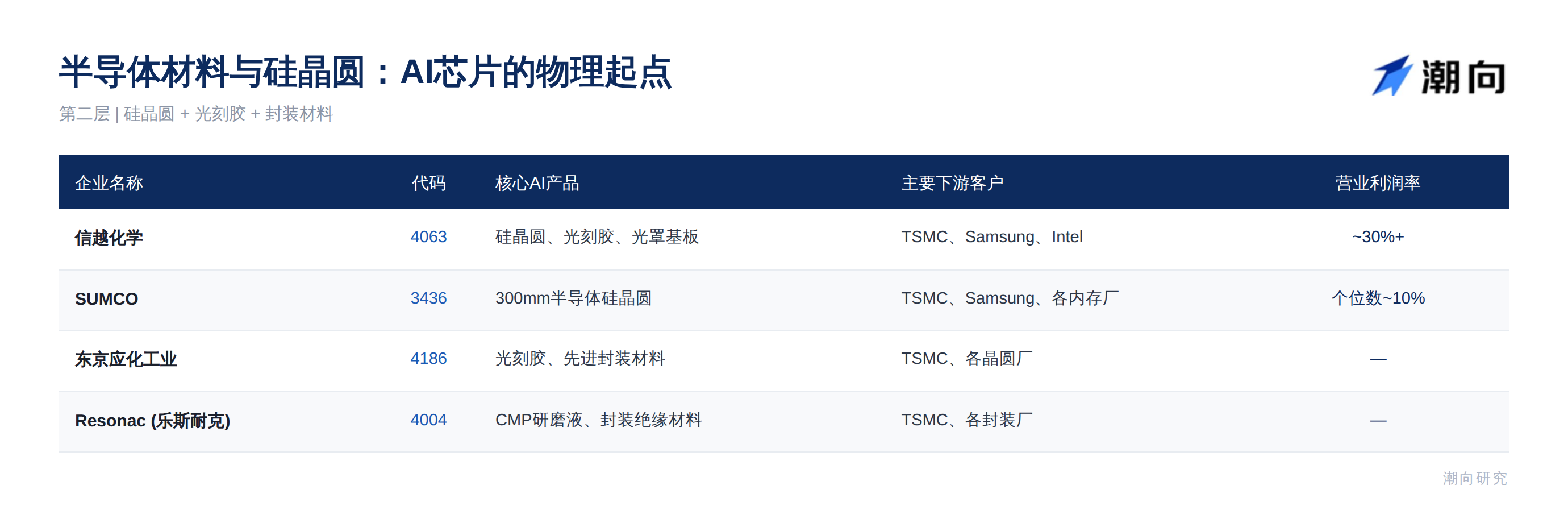
Shin-Etsu Chemical (4063) and SUMCO (3436): The Duopoly of Silicon Wafers
Shin-Etsu Chemical and SUMCO together control over 50% of the global capacity for 300mm silicon wafers. Including Taiwanese GlobalWafers, German Siltronic, and Korean SK Siltron, the top five occupy about 80% of the market, with even higher concentration in the advanced wafer needed for cutting-edge processes.
Shin-Etsu's semiconductor silicon wafer business has maintained an operating profit margin above 30% for many years, with an overall profit margin around 30%. It not only manufactures wafers but is also one of the world's largest suppliers of photoresist raw materials and produces epoxy resin and rare earth magnets for chip packaging. This diversification spans several critical nodes in the semiconductor materials chain while reducing risk from a single economic cycle.
As a pure silicon wafer company, SUMCO is more sensitive to fluctuations in supply and demand in the memory market; its current operating profit margin fluctuates in the single digits to around 10%. However, the premium for advanced silicon wafers driven by AI is set to become the core engine of its profit rebound.
The common strategy of both companies is "prudent expansion." In recent years, the silicon wafer industry has experienced lessons from overcapacity, leading to low willingness for aggressive expansion. Shin-Etsu is pushing for new factory construction both domestically and overseas, with plans to add over 20% to capacity by the end of 2026.
Tokyo Ohka Kogyo (4186) and Resonac (4004): The Invisible Army of Chemical Materials
Besides silicon wafers, AI chip manufacturing also consumes a large amount of chemical materials: photoresists (determining chip linewidth accuracy), CMP polishing liquids (to polish wafer surfaces), advanced packaging materials, and thermal interface materials.
Tokyo Ohka Kogyo (4186) and Resonac (formerly Showa Denko, 4004) are global leaders in these fields. Their products may not be as eye-catching as equipment, but are equally irreplaceable. The increase in process steps for AI chips directly raises the consumption of chemical materials per wafer.
Level Three: Memory Chips
AI training and inference tasks demand a huge amount of data throughput. The weight loading of large language models and the read/write of KV Cache exhibit exponential growth in the need for high-speed storage. NAND flash memory, as the core medium for data center SSDs, is undergoing a supercycle driven by AI.
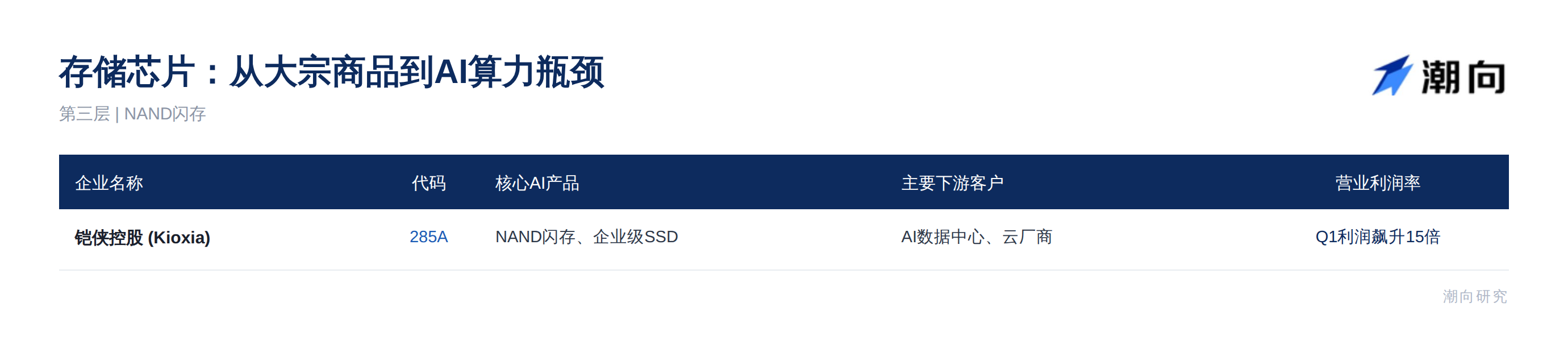
Kioxia Holdings (285A): The King of the NAND Cycle
Kioxia is the most explosive stock in the current Japanese AI market, without a rival.
Since its IPO in December 2024, the stock price has increased by over 3,500%. The 52-week price range has fluctuated from 1,950 yen to 83,140 yen, which is exceptionally rare among developed market stocks. For the 2026 fiscal year (ending March 2026), revenue reached 2.34 trillion yen, a year-on-year increase of 37%, and net profit was 554.49 billion yen, doubling year-on-year. The first quarter of 2026 was even more intense: a single quarter revenue of 1,002.9 billion yen, an annual increase of 189%, with operating profit soaring 15 times to 59.68 billion yen, setting a record for quarterly history. The average price of NAND in dollars doubled in this quarter.
The driving force is a historic supply-demand mismatch: the explosive demand for NAND from AI data centers collides with supply that won’t see new capacity released until the end of 2027. Goldman Sachs upgraded Kioxia from neutral to buy in June 2026, raising its target price from 48,000 yen to 93,000 yen. Kioxia has announced plans to start paying dividends from the 2027 fiscal year and plans to issue ADRs in the United States.
The risks are very clear; the NAND industry is inherently cyclical. The current rolling P/E ratio is close to 77 times, with a forward P/E of about 8.8 times, and this massive discrepancy indicates that the market is betting on the sustainability of explosive profit growth. If AI capital expenditures slow down or new capacity is released in a concentrated manner, price declines could be fierce.
Level Four: Passive Components and Packaging Substrates
An AI server's hardware architecture is fundamentally different from that of traditional servers. The GPU motherboard requires a massive number of passive components (especially MLCCs) to stabilize current, as well as ultra-high specification multilayer packaging substrates to carry GPU chips. The number of MLCCs mounted on a single AI GPU accelerator card can often reach several thousand or even twenty thousand, representing a significant leap compared to mobile phones and PCs.
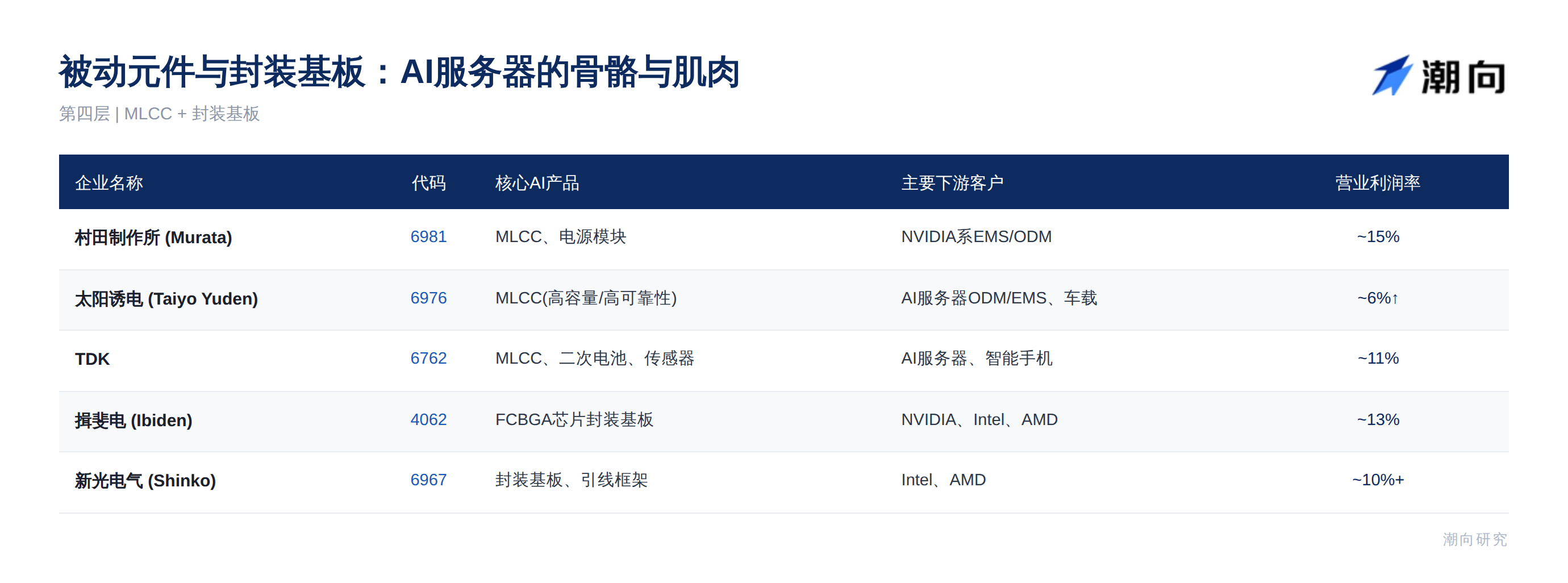
Murata Manufacturing (6981): The Absolute Leader in MLCCs
Murata holds about 40% of the global market share for MLCCs, making it the absolute dominant player. AI servers have extremely stringent requirements for high voltage, large capacity, and ultra-high reliability MLCCs, where Murata has the deepest technological moat in this high-end segment.
For FY2025 (ending March 2026), revenue reached 1.8309 trillion yen, setting a new historical high, with operating profit of 281.8 billion yen and a profit margin of 15.4%. Sales to data centers surged about 70% year-on-year. Murata has clearly stated: currently, the order demand for high-end capacitors in data centers has reached twice the existing capacity, and this extreme supply-demand tightness is expected to last 1-2 years.
On May 29, 2026, Murata’s stock price increased by over 96% in the past month.
Taiyo Yuden (6976): The Most Elastic MLCC Stock for AI
Taiyo Yuden ranks third in the global MLCC market, with MLCCs accounting for 64% of its revenue, and the elasticity of AI server demand is much greater than that of Murata.
For FY2025, net profit surged 5.4 times to 14.8 billion yen, with orders from January to March exceeding 100 billion yen for the first time, and a BB Ratio maintained above 1.25. Taiyo Yuden has already taken the lead in raising prices for medium to low-capacity MLCCs by 6%-13%. In an interview with Bloomberg, CEO Katsuya Sase described the current demand as "scary."
Goldman Sachs predicts that demand for MLCCs from AI servers will at least quadruple by 2030, while industry-wide capacity grows at around 10% annually. Taiyo Yuden's stock price has risen by 163% in the past month, and they anticipate that operating profit in FY2027 will increase significantly by 50% to 30 billion yen.
TDK (6762): A Multifaceted Player Beyond Just MLCCs
TDK is involved in aluminum electrolytic capacitors, thin film inductors, optical transceiver components, HDD magnetic heads, and secondary batteries for AI data centers.
For FY2026, expected revenue is 2.5048 trillion yen, with operating profit at 272.4 billion yen and a profit margin of about 11%. The company plans to expand its AI market sales at an annual rate of 25%-30% by the fiscal year 2031, with plans to expand sales of passive components for AI data centers by tenfold. As the overall revenue still mainly comes from energy applications (lithium battery business), the profit elasticity brought by AI is relatively moderate among the three major component manufacturers.
Ibiden (4062): The Monopolistic Leader in GPU Packaging Substrates
Ibiden produces FC-BGA (Flip Chip Ball Grid Array) packaging substrates, which are core carriers for Nvidia GPUs and data center CPUs. Its estimated market share in the high-end packaging substrate area for AI servers is as high as 70%-80%. There is a saying in the industry: "Without Ibiden and Shin-Etsu, the world cannot produce high-performance server processors."
For FY2026, expected revenue is 415 billion yen, with operating profit at 61 billion yen and a profit margin of about 13%. The company plans to implement a 500 billion yen massive capital expenditure over the next three years, focusing on the construction of the Ohno Factory and the Kaken Factory, aiming to permanently secure its global leadership position in high-end AI packaging substrates.
In April 2026, it briefly emerged as the best-performing stock among foreign IT shares this year. In February, it completed a fundraising of 52.47 billion yen through a new share issuance, with all funds directed toward capacity expansion.
Shin-Etsu Chemical (6967): The Other Half of the Japanese Duo in Packaging Substrates
Shin-Etsu and Ibiden are referred to as the "Japanese Duo" in high-end packaging substrates, together monopolizing 70%-80% of the global high-end substrate market. Core customers include Intel and AMD. The operating profit margin remains stable above 10%. It should be noted that the parent company Fujitsu is promoting its privatization via TOB (Tender Offer Bid), and market operations need to pay attention to relevant announcements.
Level Five: Power and Cooling
AI data center power consumption per rack is several times that of traditional data centers. This brings three new bottlenecks: ultra-large capacity power distribution and UPS, power semiconductors responsible for high-frequency power conversion, and liquid cooling systems and precision air conditioning for cooling servers and chips. Approximately 30%-40% of the power consumed by data centers goes towards cooling, making power and cooling the ultimate bottleneck for the implementation and expansion of AI computing.
This level is often overlooked, but it is another area where Japanese companies deeply benefit.
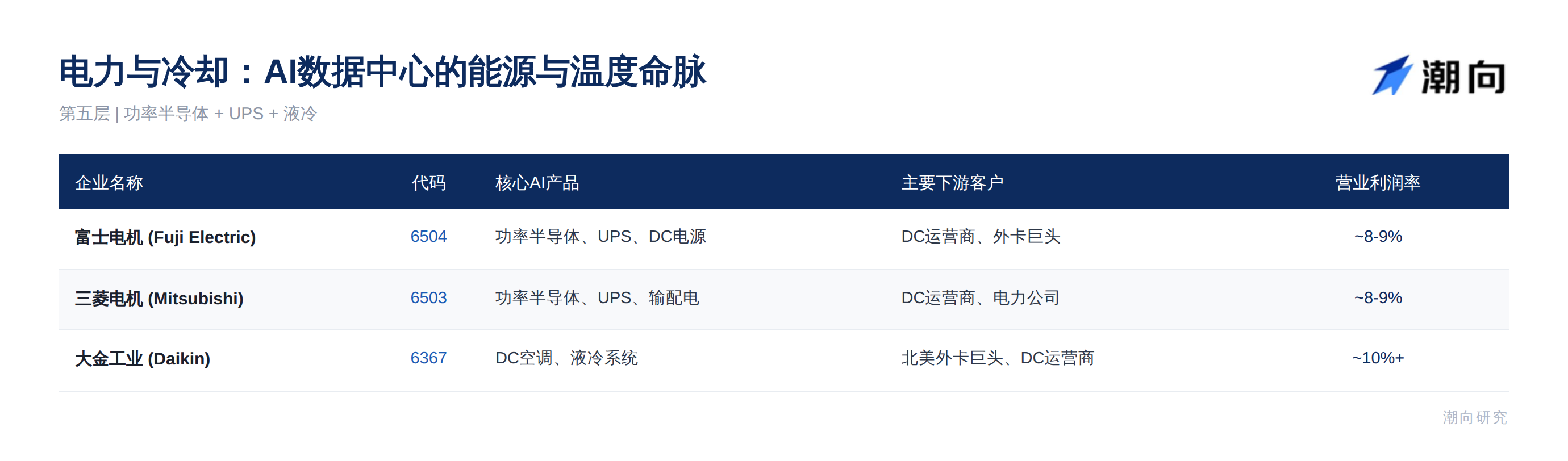
Fuji Electric (6504): A Comprehensive Player in DC Power, UPS, and Power Semiconductors
Fuji Electric’s products cover large power UPS, dedicated high and low voltage power distribution systems for data centers, and core power semiconductors (IGBT, SiC modules). The latest financial report shows that from April to December 2025, operating profit rose by 8% year-on-year, reaching a historic high for five consecutive years. The infrastructure and power systems segment achieved revenue and profit growth due to a surge in data center orders. The company is expanding data center power production capacity to 1.7 times the original, with an overall operating profit margin maintained at 8%-9%.
Mitsubishi Electric (6503): The National Team in Heavy Electric Fields
Mitsubishi Electric has absolute strength in high voltage power semiconductors (IGBT/SiC) and industrial-grade UPS. The UPS business aimed at overseas markets is enjoying a long-cycle dividend, with products fully penetrating the entire power supply chain of AI data centers. The company's total merged revenue scale is 5.5 trillion yen, with a combined operating profit margin of 8%-9%.
DaiKin Industries (6367): Global Air Conditioning Giant Enters Data Center Liquid Cooling
DaiKin is the world’s largest air conditioning company, successfully transferring its core technology into the data center cooling field. Its chip-level direct liquid cooling systems utilize a unique negative pressure circulation technology, which makes leaking extremely difficult even if the hoses are damaged, providing strong protection for server hardware. It acquired American DDC Solutions and Chil-Dyne in 2025, thoroughly integrating cooling technology for North American AI data centers.
Data center cooling specialized business is projected to soar from 23 billion yen in 2023 to about 100 billion yen in 2025, aiming to break through 300 billion yen by 2030. The North American data center cooling market is expected to grow from about 1.1 trillion yen in 2025 to 2.7 trillion yen in 2030, with DaiKin already securing about 12% of the market share, ranking third in the United States. The company's overall profit margin is above 10%.
Level Six: Fiber Optics and Connectivity
AI data centers need to achieve ultra-high speed, low-latency data interconnection between tens of thousands of servers, leading to explosive growth in demand for high-spec optical fibers, high-density optical distribution systems, and optical communication devices. Japan's "Big Three in Wires and Cables" (Fujikura, Furukawa Electric, and Sumitomo Electric) have successfully shifted resources from low-margin traditional harness businesses to high-value-added optical communications and data center operations in the past few years, becoming the most noteworthy star sector in this round of AI market.
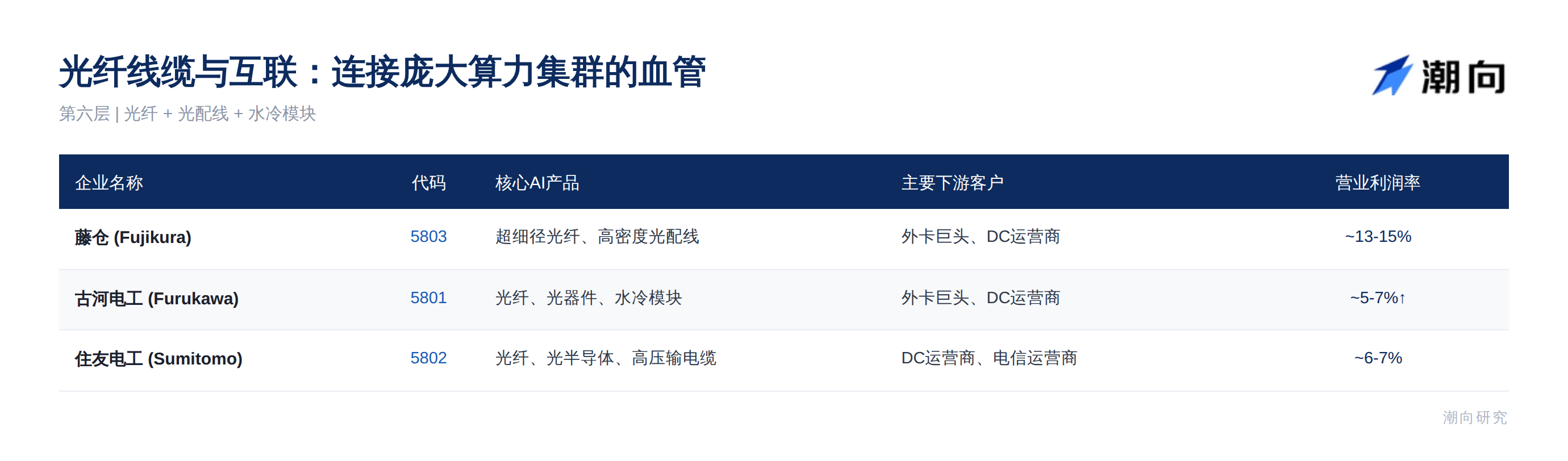
Fujikura (5803): A Super Star in Nikkei 225
With a history of 139 years, its stock price has increased by 1,400% over the past two years. Fujikura’s ultra-fine high-density optical fiber cables (Spider Web Ribbon technology) perfectly meet the AI data center's rigorous spatial and wiring requirements, with Apple as one of its core clients.
For FY2026 (ending March 2026), it achieved its highest ever performance, with sales to data centers reaching 2.3 times that of the previous year, while the company frequently raised its performance expectations. The company has a ROE as high as approximately 32.5%, and an aggregate operating profit margin rising to 13%-15%.
Demand growth far exceeds production capacity, with CEO Naoki Okada openly admitting to a "supply shortfall." The company is investing 40 billion yen to construct a new production line at the Sakura Factory, while concurrently establishing a wholly-owned subsidiary in the United States, Fujikura Optical Cable Systems LLC. On May 12, 2026, the stock price surged 11.6% to an all-time high of 7,624 yen.
Furukawa Electric (5801): A Three-in-One of Fiber Optics, Optical Devices, and Liquid Cooling Modules
Furukawa Electric’s uniqueness lies in that it benefits from two cutting-edge tracks: high-density optical wiring for optical communications and chip-level liquid cooling modules for data centers.
The performance has experienced explosive growth. In FY2025, revenue reached 1.1459 trillion yen, and for FY2026, official expectations have been significantly raised to 1.3 trillion yen in revenue and 65 billion yen in operating profit. The liquid cooling module business is planned to grow from 6 billion yen in FY2026 to 25 billion yen in FY2027. The company proposes to raise the operating profit of its specialized data center business to 200 billion yen by FY2031, which is 8.5 times the previous period. The current operating profit margin is 5%-7%, and it is in a sharp profit margin increase channel.
Sumitomo Electric Industries (5802): A Comprehensive Giant in Fiber Optics, Optical Semiconductors, and Power Network Cables
Sumitomo Electric’s product line covers ultra-large core fiber optic cables, ultra-high-speed optical transceiver semiconductor devices, ultra-high voltage transmission cables (for data center cross-region power supply), and third-generation compound semiconductor substrates (GaN/InP).
The overall profit margin of the company is 6%-7%, and as the absolute leader in Japan's wire and cable sector, its stock price has seen over 90% excess returns driven by dual demand from data centers and optical communications.
When the Japanese Stock Market is Booming
Japanese semiconductor companies were not just strong today. Tokyo Electron, Shin-Etsu Chemical, and Murata Manufacturing have been recognized for decades in the industry. However, the Nikkei 225 has been trapped in the shadow of the bubble economy collapse for more than 30 years, and only broke through the historical high from 1989 in 2024. Why right now, is capital flooding into Japan so fiercely?
A resonance of three forces.
First, the certainty of AI capital expenditures. In 2026, global tech giants are expected to invest about $800 billion in AI-related capital expenditures. Alphabet, Google's parent company, announced on June 2 that it would issue $80 billion in stocks to finance $180 to $190 billion in capital expenditures for 2026. Ultimately, this money will transform into orders for chip manufacturing equipment, purchases of silicon wafers, consumption of MLCCs, laying of optical fibers, and installation of UPS and cooling systems, with a significant proportion of these orders going into the pockets of Japanese companies.
Second, the amplifying effect of yen depreciation. In June 2026, the dollar briefly exceeded 160 yen. The income of Japanese semiconductor equipment and material companies is largely denominated in dollars, while costs are denominated in yen, so a weak yen effectively gives export companies a hidden subsidy voucher.
Third, the release of dividends from corporate governance reforms. One of the legacies of Abenomics is to encourage Japanese companies to improve shareholder returns. Kioxia announced dividends, and Fujikura launched restricted stock incentives, which were unimaginable for Japanese companies in the past. The Tokyo Stock Exchange continues to pressure listed companies to improve ROE, resulting in structural recovery in foreign interest in the Japanese market.
The Japanese government is also boosting the momentum. In March 2026, the semiconductor industry strategy was released, aiming to increase the domestic chip output value to 40 trillion yen (about $250 billion) by 2040, which is eight times the 5 trillion yen in 2020. Rapidus is constructing a 2nm manufacturing plant with plans for mass production in 2027. TSMC is also expanding advanced production lines in Japan.
Risks That Cannot Be Overlooked
The Nikkei Index's 33% gain this year has far exceeded the most optimistic predictions at the beginning of the year. UBS's target for the end of 2026 was 54,000, which has now been surpassed by over 20%.
Concentration risk. On the day it hit a record high on June 3, only Tokyo Electron and Advantest contributed about 1,100 points of gains, accounting for two-thirds of the total increase. Any cracks in the AI narrative could lead to a direct pullback of these high-weight stocks, dragging the index down.
Valuation stretch. Tokyo Electron's P/E is around 48 times, Advantest exceeds 60 times, Kioxia's rolling P/E is close to 77 times, and Fujikura and Taiyo Yuden's stock prices have overreached in the short term due to extremely optimistic expectations. If any flaws arise in performance delivery periods, they may face severe valuation corrections due to expectation gaps.
Yen reversal. The Bank of Japan is anticipated to further raise interest rates in 2026, with real wages experiencing positive growth for four consecutive months. If the yen appreciates rapidly, it would compress the profit elasticity of export companies.
AI capital expenditure cyclicality. Once capital expenditures for global tech giants enter a phase adjustment, the more elastic orders for semiconductor equipment and upstream components will face severe cyclical downtrends. Historically, every massive IT infrastructure investment, from the internet bubble period's optical fibers to cloud computing's early servers, has gone through cycles of enthusiasm to digestion.
Tide Interpretation
The nature of Japan's AI semiconductor market is a "deep infrastructure" value reassessment.
In the past two years, the market has concentrated pricing on the most eye-catching links: Nvidia, which designs chips, TSMC, which manufactures chips, and ASML, which sells shovels. However, the industrial chain of AI is much longer and deeper than this. From silicon wafers to photoresists, from testing equipment to MLCCs, from UPS power supplies to liquid cooling systems, and from optical fibers to packaging substrates, each link has bottlenecks, and each bottleneck represents pricing power. Japanese companies happen to sit at the very top of this chain, occupying the most irreplaceable position.
From the perspective of investment certainty, the highest level belongs to "technological monopoly types," with typical representatives including Lasertec (100% monopoly in EUV inspection), Disco (near monopoly in HBM thinning machines), Advantest (extremely high market share in AI test machines), and Ibiden/Shin-Etsu (the duopoly in high-end packaging substrates). These companies are virtually irreplaceable in the value chain and possess genuine global pricing power. While the demand for MLCCs, wires, and precision air conditioning is also explosive, they face industry competition and are more susceptible to supply-demand relations and expansion rhythms.
Kioxia's 3,500% increase is superficially a reflection of soaring NAND prices. More fundamentally, the market has finally realized: storage has become one of the supply bottlenecks for AI computing power. The surges seen in Murata and Taiyo Yuden reflect a stark reality: the number of MLCCs required for a single AI server is several times that of traditional servers, and the growth rate of global capacity far lags behind demand.
For investors, the Japanese AI semiconductor sector offers a markedly different mode of participation compared to U.S. technology stocks. You don't need to bet on which AI company will emerge; you just need to believe one thing: whoever wins the AI race will need to use Japanese equipment, materials, and components to compete.
A 33% annual increase will not happen every year. But from the perspective of the industrial cycle, the construction of AI infrastructure is far from over, and Japan's structural position in the global semiconductor supply chain won't be shaken in the short term.
Whoever controls the "means of production" in the AI era, Japan remains at the table.
Disclaimer: This article is for information sharing and investment research reference only and does not constitute any investment advice. The stock market has risks, and investments should be made with caution. The individual stocks mentioned are for industry analysis needs only and do not represent a recommendation to buy or sell. Data sources include the latest financial reports from various companies, Yahoo Finance, Investing.com, StockAnalysis, Bloomberg, and other public information. Chao Xiang Research strives for accuracy but does not guarantee completeness; please refer to the official data from respective exchanges.
免责声明:本文章仅代表作者个人观点,不代表本平台的立场和观点。本文章仅供信息分享,不构成对任何人的任何投资建议。用户与作者之间的任何争议,与本平台无关。如网页中刊载的文章或图片涉及侵权,请提供相关的权利证明和身份证明发送邮件到support@aicoin.com,本平台相关工作人员将会进行核查。


