Author: Ada, Deep Tide TechFlow
Recently, the popular "new stock god" Serenity publicly shared a systematic view on the AI industry chain in Taiwan. He named 9 stocks covering CPO (Chip Packaged Optical), ASIC (Application-Specific Integrated Circuit), and compound semiconductors as the three main lines, among which he characterized CPO as "the biggest industrial theme of the next stage." Goldman Sachs predicts that the global Optical TAM will explode from $15 billion in 2026 to $154 billion in 2028, with CPO's share rising from $164 million to $91 billion. He also made it clear: the AI industry chain in the Taiwan stock market does not face a bubble, and the real risk is not across the strait but in the capital expenditures of super-large-scale cloud service providers.
TSMC COUPE Countdown to Mass Production in 2026, 5 Taiwan Stocks Each Representing a Link
The solid time anchor supporting Serenity's CPO main line judgment is TSMC's COUPE (Compact Universal Photonic Engine) platform entering mass production in 2026.
According to TrendForce's report on April 1, TSMC's Director of Advanced Packaging Integration, Hou Shang-yu, stated at SEMICON Taiwan that COUPE will enter mass production as planned in 2026, based on SoIC technology for heterogeneous integration of electronic integrated circuits and photonic integrated circuits. Hou also pointed out the three major bottlenecks for the scaling up of CPO: wafer-level testing, fiber array unit (FAU) integration, and high-speed optical packaging assembly. The 5 CPO Taiwan stocks identified by Serenity correspond to these three bottleneck issues and their peripheral support.
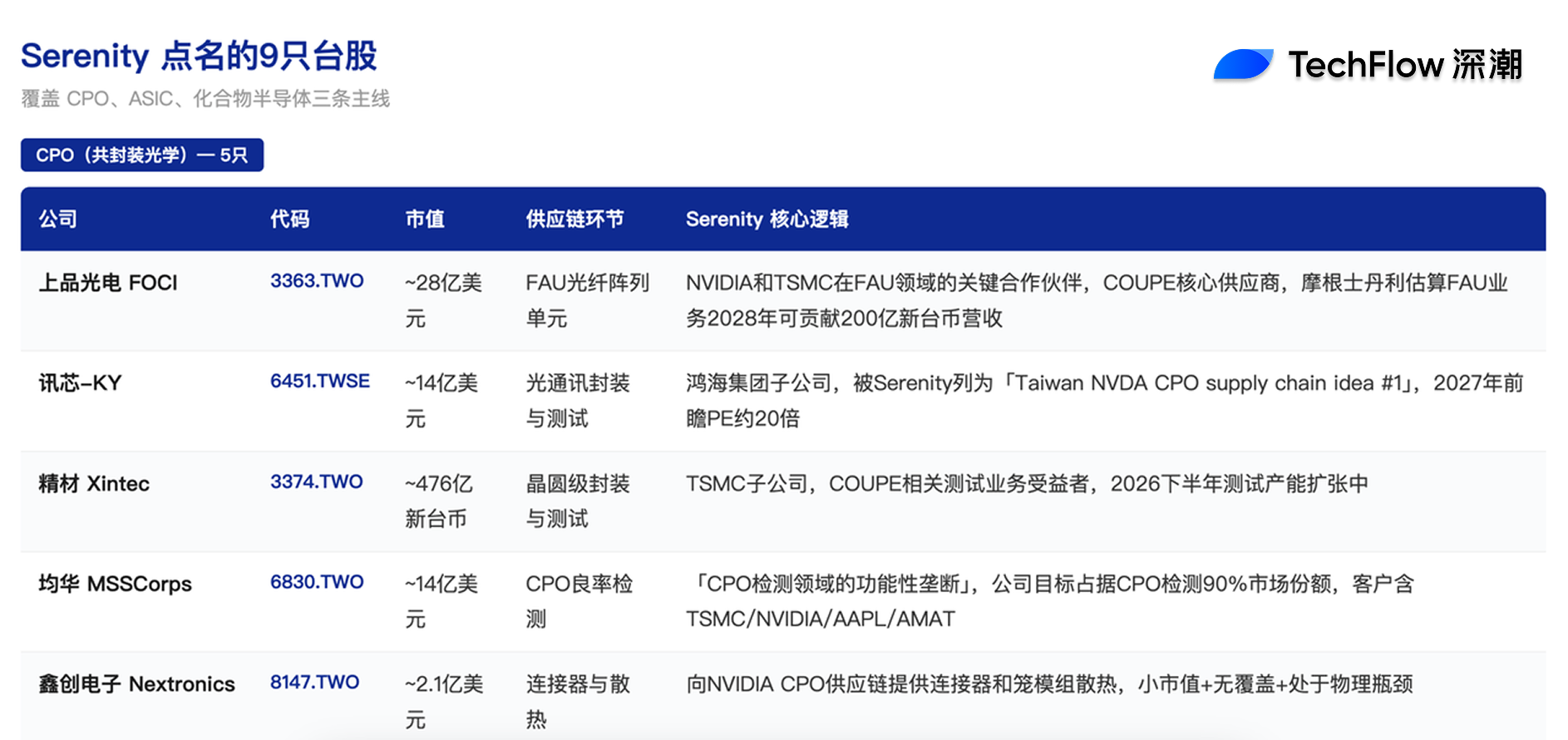
The first is FOCI (Shangpin Photonics, 3363.TWO), with a market capitalization of about $2.8 billion. FOCI is a key partner of NVIDIA and TSMC in the FAU field and a core supplier within the COUPE architecture. Serenity stated on X that FOCI’s current market value of approximately $2.8 billion "has not fully reflected its strategic position in the industry chain." Morgan Stanley estimates that FOCI's FAU business could contribute about NT$20 billion in revenue for a single business line by 2028, while current revenues are almost zero. Hunterbrook Media and Citrini Research confirmed in March through a cross-patent comparison of FOCI, Himax, and TSMC that the three have a "fingerprint-level" correspondence on 22-channel FAU, representing the strongest external evidence of FOCI’s entry into the COUPE core supply chain.
The second is Xunxin-KY (Shunsin Technology, 6451.TWSE), with a market capitalization of about $1.4 billion. Xunxin is a subsidiary of Hon Hai Group for optical communication packaging and testing. Serenity once listed Xunxin on X as "Taiwan NVDA CPO supply chain idea #1," arguing that "Hon Hai is NVIDIA's ODM, equivalent to Celestial being listed on MRVL's coattails for free." His personal estimate is a forward P/E of approximately 20 times for Xunxin before 2027.
The third is Jingcai (Xintec, 3374.TWO), with a market capitalization of about NT$47.6 billion. Jingcai is a wafer-level packaging and testing subsidiary of TSMC, chaired by CH Chen, primarily focusing on wafer-level chip size packaging and wafer testing. According to a DIGITIMES report on May 29, 2026, Jingcai is preparing for capacity expansion for testing business in the second half of 2026. Serenity recently categorized Jingcai as a "beneficiary of COUPE related testing businesses" in an interview.
The fourth is Junhua (MSSCorps, 6830.TWO), with a market capitalization of about $1.4 billion. Serenity clearly stated on X that he is building a position in Junhua and made a strong judgment: "It appears to be a functional monopoly in the CPO testing field. The market might confuse it with the oligopoly of MA-tek and iST in material/failure analysis." He then quoted Junhua's statement "the company aims to occupy 90% of the CPO testing market share" as verification. Junhua's customer mapping includes TSMC, NVIDIA, AAPL, AMAT, etc. Among the three major CPO bottlenecks pointed out by TSMC, "wafer-level testing" is precisely the segment where Junhua has a direct foothold.
The fifth is Xinchuan Electronics (Nextronics, 8147.TWO), with a market capitalization of about $210 million. Serenity's reason for building a position in Xinchuan is for its supply of "CPO connectors and Cage Thermal Modules (cage module cooling)" to NVIDIA’s CPO supply chain. Xinchuan is the smallest by market value among the 5 CPO Taiwan stocks, corresponding with Serenity's consistent "small cap + no coverage + within physical bottlenecks" stock selection profile.
The 5 Taiwan stocks can be roughly ordered by supply chain links: FAU access (FOCI), optical communication packaging testing (Xunxin-KY, Jingcai), yield testing (Junhua), connectors and cooling (Xinchuan). The entire chain corresponds to a highly concentrated downstream customer base in NVIDIA and TSMC.
Three ASIC Taiwanese Manufacturers Bound to Three Major Hyperscalers' Self-Developed Chips
Apart from NVIDIA GPUs, the continuous release of self-developed ASICs by super-large-scale cloud service providers such as AWS Trainium, Google TPU, and Microsoft Maia constitutes the second main line of Serenity's Taiwan stock list.
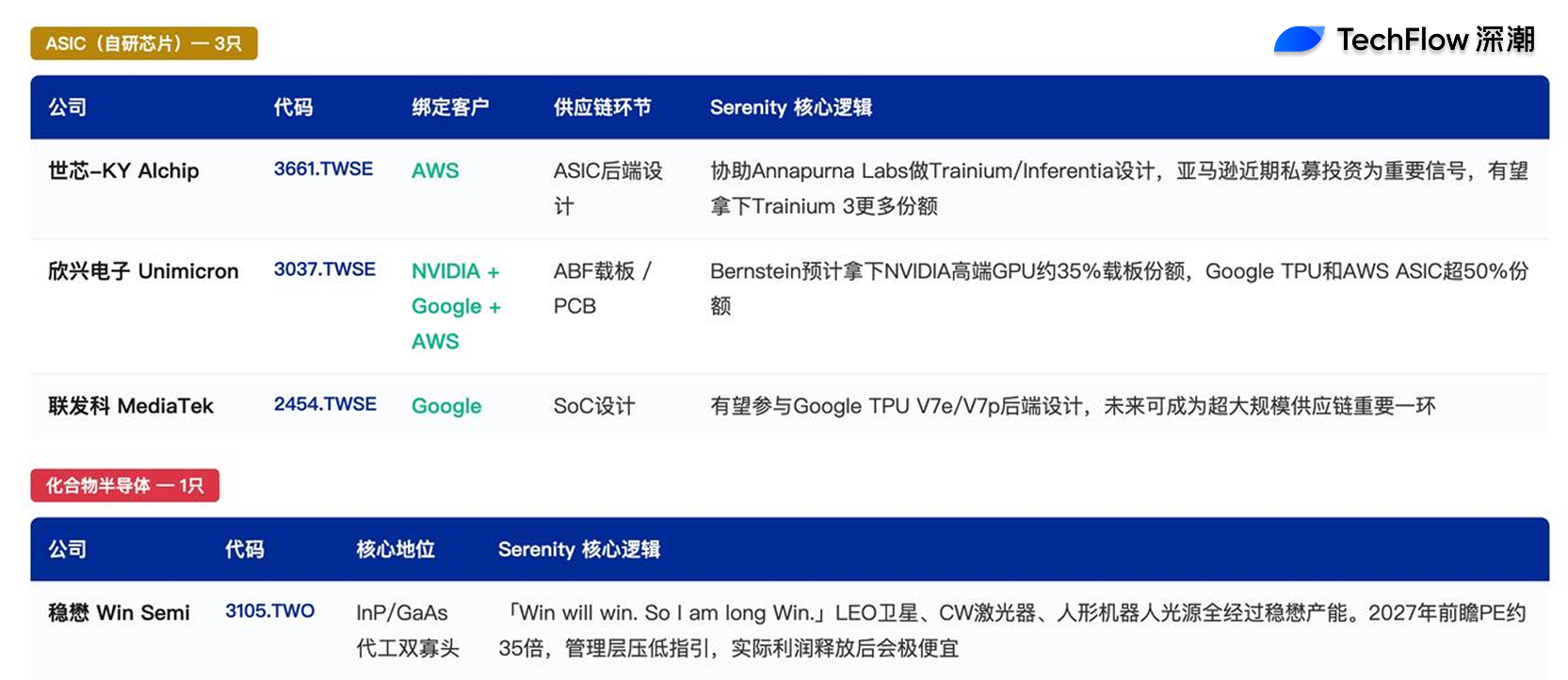
Worldchip-KY (Alchip, 3661.TWSE) is the most representative target on this line. Founded in 2003 and headquartered in Taipei, Worldchip specializes in the design and manufacturing of advanced CMOS ASICs. According to industry chain data compiled by Global Tech Research, Worldchip mainly assists Amazon's Annapurna Labs with the backend design of AWS Trainium and Inferentia series chips, currently working on projects including Trainium 1 and Inferentia 2. Serenity recently stated that Worldchip is expected to gain more market share in the design of AWS Trainium 3, especially since Amazon’s recent private investment in Worldchip was interpreted by the market as an important signal. Worldchip's collaboration with Ayar Labs in the CPO field also represents further expansion of its potential market space.
Unimicron (3037.TWSE) emerges as an ASIC beneficiary from the perspective of ABF substrates and PCBs. According to a Bernstein research report cited by Gotrade News on May 4, Unimicron is expected to secure about 35% of the ABF substrate share for NVIDIA's high-end GPUs, as well as over 50% of share for ASIC chips such as Google TPU and AWS Trainium. Bernstein listed TSMC and Unimicron as "the most representative Taiwan stocks in the AI Capex cycle in the Asian market." Unimicron reported an 8% quarter-over-quarter revenue growth and an 18% gross margin in Q1 2026.
MediaTek (2454.TWSE)'s collaboration news on Google TPU has been widely circulated in the market. According to Global Tech Research analysis, MediaTek is expected to participate in backend design support for Google TPU V7e/V7p in the future. Serenity recently mentioned that although this positive news is partially reflected in the stock price, he believes MediaTek's future ASIC business growth should still be monitored closely. In the coming years, MediaTek has the opportunity to become a crucial part of the super-large-scale supply chain of major U.S. cloud vendors.
The three Taiwanese companies each tie into the core segments of the self-developed chips of the super-large-scale cloud service providers from three different dimensions: design service, substrate packaging, and SoC design.
Win Semiconductor: The Underestimated InP/GaAs Double Oligopoly in the Market
Serenity's most steadfast and direct position in the Taiwan stock market is in Win Semiconductor (3105.TWO).
Win is one of the world's leading compound semiconductor foundries, alongside GlobalFoundries, as a double oligopoly in InP (Indium Phosphide) and GaAs (Gallium Arsenide) foundry services. The market's traditional impression of Win comes from its relationship with SpaceX Starlink and Broadcom (AVGO) supply chains.
Recently, Serenity stated on X: "Win will win. So I am long Win." Serenity's central judgment is that Win is one of the double oligopolists in InP and GaAs foundry, as future low Earth orbit (LEO) satellites from SpaceX Starlink, continuous wave lasers (CW laser), and the visual and radar light sources of humanoid robots will all pass through Win's foundry capacity.
He provided a valuation of approximately 35 times forward P/E for Win in 2027. Although it may appear expensive, he believes "the management intends to keep guidance low, and actual profit release in the future will make the P/E appear very cheap." Win's assistance in expanding the laser production capacity for silicon photonic companies is seen by Serenity as the future core growth engine, and this portion has not been fully priced by the market.
InP is the sector where Serenity established his earliest position in U.S. stocks with "Hormuz Strait" target AXTI, likening InP substrates to "the oil of the future AI optical communication era." Win's position in the Taiwan stock market is at the downstream foundry node of this industry chain.
Segments Not Mentioned by Serenity but Necessary for the Complete Picture: Upstream Materials, Energy, and Liquid Cooling
The 9 Taiwan stocks identified by Serenity are concentrated in the midstream segments of CPO and ASIC, making upstream materials, and downstream energy/liquid cooling sectors equally indispensable for the complete picture of the Taiwan stock AI industry chain. Although Serenity did not directly cover this part in his public statements, it is crucial for fully understanding the AI industry chain in Taiwan.
On the upstream materials side, TSMC itself (TSMC, 2330.TWSE) is the central node of the entire picture. According to Bernstein's predictions, TSMC's earnings are expected to grow by about 40% in 2026, with a compound growth rate of about 20% in 2027-2028; the company has locked in its 2026 capital expenditure guidance in the high range of $52 to $56 billion. In the upstream transmission chain of AI Capex, TSMC acts both as an amplifier and a throttle, as its capital expenditure direction will directly determine the order rhythm for downstream packaging, substrates, testing, connectors, and all Taiwan stocks.
In terms of energy and liquid cooling, Taiwan's AI data centers are facing substantial electricity supply pressure. According to a statement cited by Reccessary in December 2025 by Taipower's Planning Department Director Yi Xuquan, global critical power grid equipment such as transformers and gas turbines are in a state of shortage, with gas turbine delivery cycles extending from 2-3 years to 7-8 years and prices doubling, "the pace of grid construction simply cannot keep up." This supply-side bottleneck has created structural opportunities for three key Taiwan stocks.
First, Delta Electronics (2308.TWSE), as a leader in power management and liquid cooling integration solutions, has penetrated dual scenarios of AI data centers in both the white zone (IT computing) and gray zone (power cooling). Second, AVC (3017.TWSE) is a global leader in cooling solutions, covering all-stack technologies for cold plate liquid cooling and immersion liquid cooling. Finally, Auras Technology (3324.TWSE) focuses on liquid cooling module manufacturing and is a primary supplier to NVIDIA. According to Goldman Sachs predictions, the global server cooling total market size is expected to grow by 111%, 77%, and 26% respectively from 2025 to 2027, reaching $17.6 billion by 2027; this growth curve is synchronous with the growth curve of CPO during the AI capital expenditure cycle.
The Real Risk Does Not Lie Across the Strait, but in the Capital Expenditures of Super-Large-Scale Cloud Service Providers
Serenity's overall risk judgment on the Taiwan stock AI industry chain is contrary to the mainstream narrative in the market.
He recently stated that there currently is no bubble in the Taiwan AI supply chain, and many Taiwanese companies' valuations are still relatively low compared to similar companies on the U.S. Nasdaq; geopolitical risks have been overemphasized by the market, as Taiwan has already become an indispensable part of the global technology supply chain, "no country would choose to destroy a massive supply chain using a zero-sum game". Looking at the long term over 7-10 years, the U.S. is establishing a domestic supply chain through companies like Intel, but there are no particularly significant systemic risks anticipated in the next 2-3 years.
He pointed out that the real risk worth tracking is the capital expenditures of super-large-scale cloud service providers. The continuous expansion of investments by large cloud vendors like Microsoft, Amazon, Google, Meta, and Oracle is the core driving force behind the current AI industry boom, "as long as these companies continue to increase AI infrastructure construction, the Taiwan supply chain will continue to benefit; but if super-large-scale cloud service providers begin to cut capital expenditures, the Taiwan AI supply chain may face a significant valuation adjustment."
This judgment's "stress test" is beginning to show initial signs.
Recent marginal changes in the market are worth tracking. On June 3, Broadcom announced its Q2 FY2026 earnings, with a Q3 FY2026 AI chip revenue guidance of $16 billion, which is about $1.2 billion lower than the consensus expectation of $17.2 billion from LSEG; Broadcom CEO Hock Tan also maintained the full-year AI semiconductor revenue guidance of $56 billion unchanged during the earnings call, without any upward revision. The market interpreted the "no upward revision" as negative, and on June 5, the Philadelphia Semiconductor Index (SOX) plummeted 10.26% in a single day, marking the largest single-day decline since March 2020; the South Korean KOSPI dropped 5.54%, and on June 8, the KOSPI opened 8.37% lower, triggering a circuit breaker.
However, the key reference observed so far indicates that TSMC's capital expenditures for 2026 are locked in the high range of $52 billion to $56 billion, showing no substantial downward adjustment yet. The capital expenditure guidance from super-large-scale cloud service providers is also still in the upward adjustment channel. To see if Serenity's judgment on the "real risk" is triggered, it is essential to watch the capital expenditure guidance in the Q2 and Q3 2026 earnings reports from Microsoft, Amazon, Google, Meta, and Oracle; this is the core premise for forming Serenity's Taiwan stock list and the marginal variable most worthy of tracking in the upcoming quarter.
免责声明:本文章仅代表作者个人观点,不代表本平台的立场和观点。本文章仅供信息分享,不构成对任何人的任何投资建议。用户与作者之间的任何争议,与本平台无关。如网页中刊载的文章或图片涉及侵权,请提供相关的权利证明和身份证明发送邮件到support@aicoin.com,本平台相关工作人员将会进行核查。


