Key Takeaways:
The recent selloff has dragged bitcoin back to a price band that has historically marked long-term value. In an X post, Edwards, the founder of Capriole Investments, wrote that bitcoin is “trading back at its Production cost” and that “miners are now just breaking even on average.” He added that the best long-term opportunities have historically sat between the current zone and the network’s electrical cost, which he placed at $50,000.
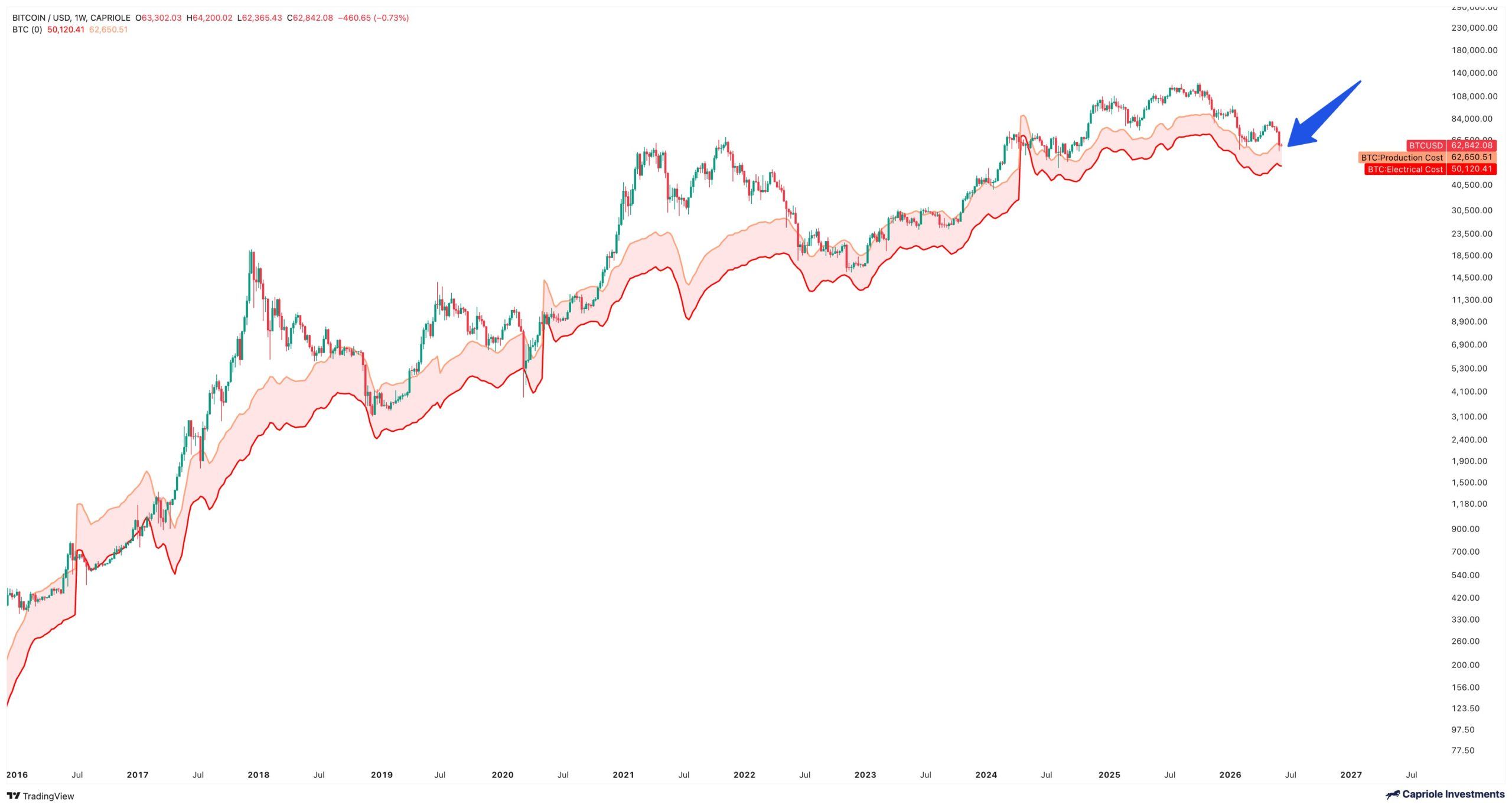
Bitcoin’s current price stands at its production cost, meaning miners are now just breaking even on average, per Capriole.
Production cost is the all-in expense of mining a single coin, including hardware, electricity and other overheads. When the market price falls to meet that figure, the least efficient operations start running in the red and face a choice of either absorbing losses or switching off their machines.
Edwards argues that over the past five years, electrical cost in particular has acted as a hard floor for bitcoin’s traded price, an observation he ties to Satoshi Nakamoto’s original theory that price gravitates toward the cost of production.
The break-even call lands at time when bitcoin has been on shaky ground, slipping to a 2026 low of $59,100 on Friday as more than 351,000 traders were liquidated across crypto markets in a single 24-hour window. The drop widened bitcoin’s year-to-date losses to roughly 30% and briefly pushed its market capitalization below $1.2 trillion, a level last seen in October 2024.
And, while the asset has since clawed back toward $64,000, momentum remains fragile. The pressure has not been confined to spot prices alone as U.S. spot bitcoin exchange-traded funds (ETFs) bled an estimated $2.8 billion to $3.5 billion over a 10-to-11-session stretch in late May and early June, with one week alone logging around $3.4 billion in redemptions, the largest single-week outflow since the funds launched in early 2024.
Strategy’s first bitcoin sale since 2022 added to the gloom, even as the company insisted it remains committed to growing its holdings, adding 1,550 BTC to its kitty yesterday.
For miners, a price at production cost is more than a talking point; it is an operating crisis. Mining profitability has slumped to a 14-month low, with several rigs now flirting with so-called shutdown prices, the point at which keeping a machine powered on costs more than the bitcoin it earns. The 2024 halving cut block rewards to 3.125 BTC per block while network difficulty kept climbing, squeezing margins from both directions.
Bitcoin.com News has tracked the same dynamic in prior cycles, examining the miner capitulation number that marks when the price slips beneath the cost of production. A few years ago, the gap ran the other way, with production cost sitting well above spot value and forcing weaker operators to sell reserves. Research has also flagged how rising energy and hardware expenses have pushed all-in mining costs to record highs, narrowing the cushion miners have when prices fall.
The strain helps explain why a growing share of public miners has pivoted toward artificial intelligence (AI) and high-performance computing, leasing data-center capacity to AI tenants whose revenue is far steadier than block rewards. For some operators, that shift has become a larger growth driver than mining itself.
In all of this, Capriole’s framing is ultimately a bullish one over a long horizon, given that in the 2019 and 2022 bear markets, bitcoin traded below production cost before gradually converging back toward it, rewarding buyers who stepped in near the floor. Whether that pattern repeats depends on variables outside the mining math, including the trajectory of U.S. interest rates, the pace of ETF flows, and broader geopolitical tensions.
免责声明:本文章仅代表作者个人观点,不代表本平台的立场和观点。本文章仅供信息分享,不构成对任何人的任何投资建议。用户与作者之间的任何争议,与本平台无关。如网页中刊载的文章或图片涉及侵权,请提供相关的权利证明和身份证明发送邮件到support@aicoin.com,本平台相关工作人员将会进行核查。


