Author: Martin talk

The boundaries of global financial markets are melting at an unprecedented speed. For leading cryptocurrency trading platforms, competition is no longer limited to the mere speed of "listing crypto assets," but has shifted to a comprehensive layout of global multi-assets. During this grand transformation, how to eliminate barriers to cross-market trading and achieve "frictionless" and "scenario-based" product experiences has become the new focus of competition among major platforms.
In this context, "UEX panoramic exchange," which allows investment in global assets through one account, has become the core proposition for breaking the deadlock. Users are no longer satisfied with the fragmented experience of buying gold and U.S. stocks from traditional brokers, and Bitcoin from crypto exchanges; what they truly need is a one-stop platform that crosses regions and asset classes. Especially recently, as some traditional internet brokers are restricted by regional compliance policies, frequently facing service adjustments, account limitations, or even blockages in fund channels, traders' desire for "absolute control over assets" has reached its peak.
The advantages of UEX's architecture are fully highlighted at this time. It breaks the physical shackles of traditional brokers, giving users the ability to freely navigate different categories of assets. With U.S. stocks as its core advantage, the UEX ecosystem not only supports the launch of real U.S. stocks 2.0 (Reality), enabling users to directly grasp the technological dividend of Wall Street; it also allows traders to swiftly capture opportunities when macro commodity cycles come. If you want to hedge against inflation risks or are highly sensitive to global monetary policy, you can seamlessly trade gold and forex at any time.
The trading vehicle that achieves this seamless crossover and the most efficient grasp of macro cycles is the CFD (Contracts for Difference) business. As the core driver for the realization of UEX's vision, CFDs allow users to use crypto assets directly as margin, eliminating the cumbersome traditional forex or futures account opening processes. With flexible long and short mechanisms and leverage tools, CFDs have naturally become the sharpest tool connecting the Crypto circle and traditional financial assets, as well as a battleground for major platforms advancing into full-blown assets.
1. The "frictionless" 0 fee rate model: No single-choice questions, returning "trading choice" to the market
In traditional CFD brokerage, most retail investors typically use the STP (Straight Through Processing) model. The core advantage of this model lies in "0 commission"—the platform consolidates all trading costs into the spreads, so users do not need to pay an additional fixed commission fee when opening or closing positions, making profit and loss calculations extremely intuitive. However, when cryptocurrency trading platforms cross over into the derivatives arena, they often bring with them a native Crypto gene, promoting the ECN model (emphasizing ultra-low raw spreads + charging a fixed commission based on trading volume) more to users.
As competition intensified, leading platforms began to recognize the habits of traditional CFD players. They started to introduce the 0 fee rate STP model of CFD business, gaining a certain market share.
So, why has this feature received recognition from a large number of users?
The reason hits human nature: for the vast majority of ordinary retail investors and swing traders, the upfront commission based on volume often brings significant "psychological friction." With the opening of a position, the account balance instantly decreases due to the deduction of commissions, easily disturbing the trading mindset; moreover, merging costs into spreads greatly lowers the threshold for users to calculate the "break-even point," making the trading experience more pure and transparent.
As a platform that always places "user experience" as its guiding principle, Bitget did not simply follow the trend, but deeply listened to needs firsthand before taking action. By engaging in multiple face-to-face deep discussions with traders at different stages and strategies, the team confirmed users' strong desire for "see what you get" and quickly landed this with strong execution.
In this industry trend, Bitget's response strategy provides a good product observation sample.
Observing Bitget's version update at the end of May, it is evident that it did not simply stop at "following the trend" of launching 0 fees, but based on intensive communication with traders at different stages, it proposed a more mature underlying solution. Research shows that while ordinary retail investors prefer STP, professional institutions and high-frequency players still have rigid demands for the ECN's raw spreads.
In this version update, it officially launched a dual-track engine with "standard ECN accounts" and "0 fee accounts (STP model)."
It is worth noting that while most crossover platforms have provided new account models, they often come with "heavy friction" capital barriers—where competing products generally set harsh initial deposit thresholds for special accounts (such as extreme spreads or 0 fee accounts), treating them as "VIP privileges" for large clients.
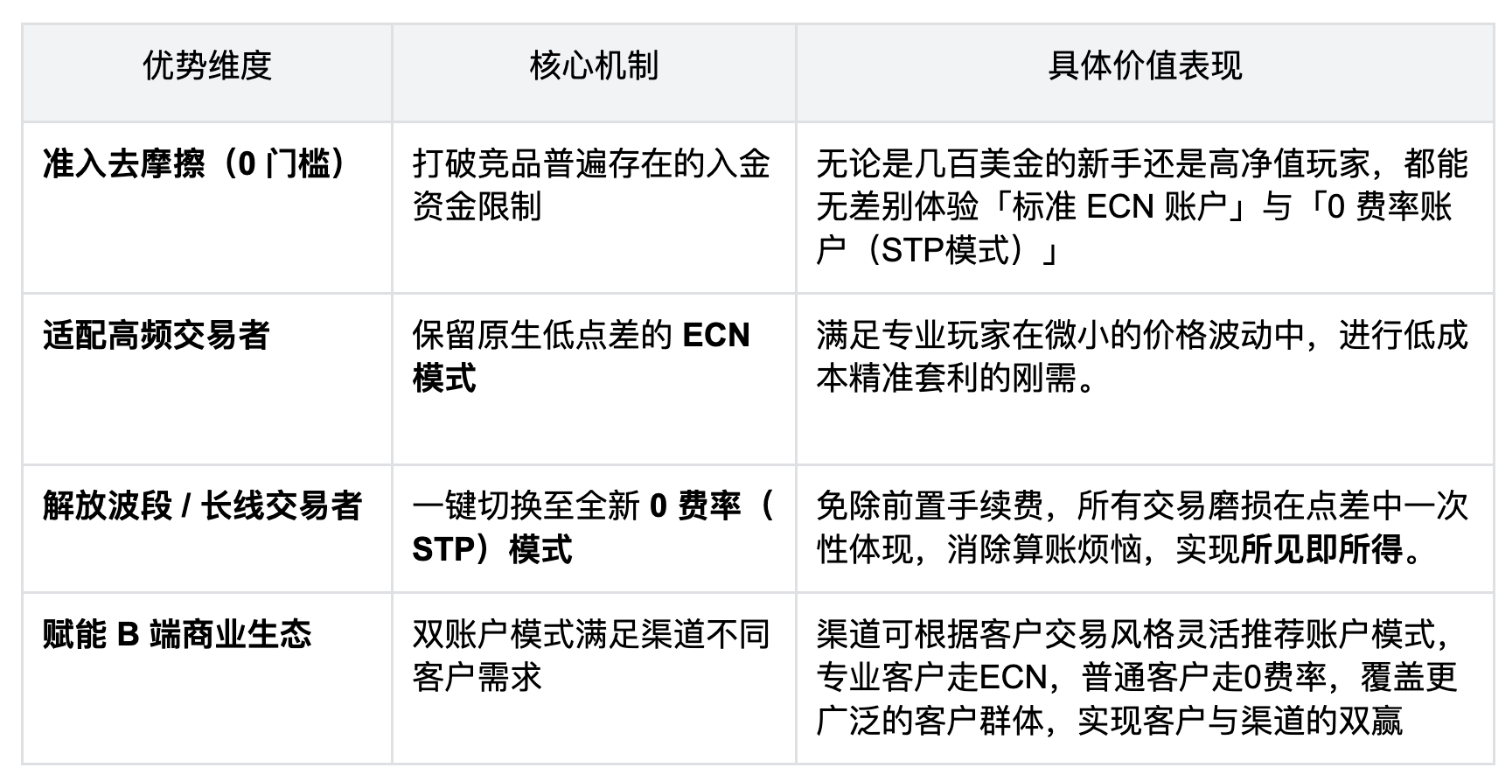
Addressing this pain point, Bitget CFD also announced a highly impactful rule: full accounts with a 0 initial deposit threshold.
The platform no longer makes single-choice questions for users, nor does it tier users based on capital size, but rather returns true choice back to the market. The advantages of this design are specifically reflected in the following four dimensions:
2. The ecological reconstruction of social trading: From "modular copy trading" to full-end "scenario-based" integration
Social trading (Copy Trading) has long been a "standard configuration" for leading trading platforms. The core logic of the copy trading function is to achieve a win-win in the ecosystem: on one hand, it greatly lowers the decision-making and trading thresholds for ordinary users; on the other hand, it provides elite traders with mature strategies an excellent channel for monetizing traffic.
However, as the trading targets extend from pure crypto to forex, commodities, and other CFD fields, the rough model of traditional crypto copy trading begins to reveal its shortcomings: high data latency, slow profit-sharing settlement, inconsistent experiences across multiple ends, and the expert data from different business lines (spot/contract/CFD) often being fragmented.
Observing the iteration path of Bitget CFD's copy trading, it did not simply replicate the inherent template of pure crypto platforms, but deeply restructured from the two dimensions of "scenario-based experience" and "core interest distribution."
First, breaking the physical friction between terminals and operations. Bitget has completed the CFD copy trading function on the web front. The comprehensive coverage of bidirectional communication thoroughly meets the rigid need of professional traders for large-screen reviews and refined operations, greatly enhancing user experience. In the next step, the App side will add a "copy trading entry" directly embedded in the CFD K-line market scenario (users can copy trades accurately with one click based on the current variety when analyzing the market).
A deeper moat lies in the hard-core underlying chain and profit distribution mechanism.
Breaking away from the superficial accumulation of functions and comparing the CFD copy trading configurations of current mainstream platforms, Bitget, with its optimized underlying architecture, demonstrates extremely aggressive data advantages:
- Crushing infrastructure and data efficiency: On traditional platforms, creating an MT5 account and withdrawal often requires about 10 seconds of waiting; whereas Bitget, with its powerful technical framework, achieves account creation and withdrawal in under 3 seconds. Additionally, while industry-leading data statistics for following trades generally exhibit T+1 delays, Bitget updates data hourly, enabling copy traders to track the most accurate real-time win rates, rejecting information lag.
- Reshaping profit-sharing (attracting the gravity field of leading influencers): High-quality following experts are the core assets of the copy trading ecosystem. Compared to the industry's general limit of 15% on profit-sharing and slow weekly settlements, Bitget has directly increased the profit-sharing upper limit to 30% (the future respected model will reach a maximum sharing of 50%), adopting a daily settlement mechanism. This extreme concession and capital turnover rate directly addresses the profit pain points of leading influencers.
- Full ecological integration and UI cost reduction: In terms of interface design, Bitget does not impose unfamiliar operational logic but uses a native MT5 panel design that is more in line with forex traders' habits. More importantly, unlike competitors' independent fragmentation across different business lines, Bitget integrates traffic conversion across multiple lines, presenting the data of leading traders in contracts, spot, and CFDs in a unified manner to maximize the traffic value.
- Eliminating new user trial-and-error friction: Supported by the rare "first order compensation" and ongoing following subsidies in the industry, it eliminates the psychological barriers for existing crypto users to cross over and try macro asset copy trading.
Bitget CFD's "combination punch" in the copy trading module is clearly not just adding functions but aims to retain the top traders, providing the smoothest copy trading tools.
3. Information transparency and investor protection: Standard upgrades in data disclosure
While lowering trading thresholds and optimizing operational processes, solving "information asymmetry" is an important part of trading platforms. In the past, the industry often used high return rates (ROI) as the sole promotion indicator, neglecting potential risk management.
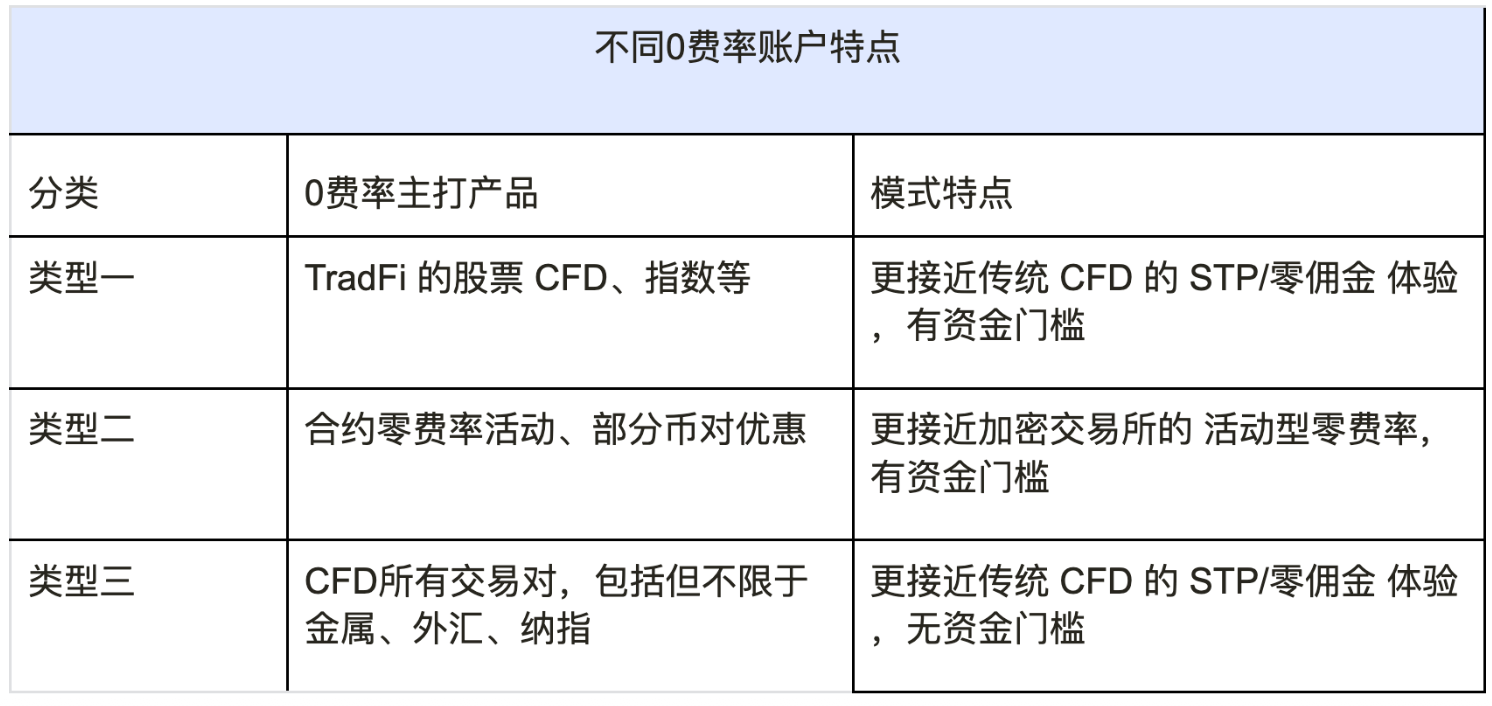
There are generally several forms in which trading platforms build data and content related to trades: some traders in recent years emphasize the zero-commission model of TradFi, copy trading risk control tools, and learning rewards and protection plans for novices, highlighting "lowering trial and error costs." Others more commonly attract users through zero-fee contract activities, trading pair discounts, and low-cost positioning, with core selling points leaning towards "trading efficiency and fee competitiveness." In this context, if Bitget wants to highlight its value, it must focus not only on matching the foundational setups of other competitors but also on truly integrating educational content, risk disclosures, copy trading tools, and product experiences into a sustainable investor protection system.
In Bitget's new version of the CFD trader interface, a more objective data sorting has been implemented:
1. Bi-directional transparent disclosure of data and risks
In the new trader interface, the platform has carried out a more objective sorting of data, mandating the presentation of "average profit statistics" for following experts and significantly enhancing the visual weight of the risk warning for copy trading. This effectively aids followers in escaping the blind spot of a single ROI, allowing for a comprehensive assessment of a trader's actual risk management capabilities.
2. Building a "one-stop trader support" educational ecosystem
To ensure that new users have a complete foundational understanding before entering the derivatives market, Bitget utilizes its help center, Bitget Academy, market information, and analyst live streams to integrate operational guidance, entry, and advanced trading knowledge into the same educational framework, forming a supportive learning path from account opening, operations to strategy understanding.
This approach contrasts with competitors' novice guarantees, community learning, and educational incentive mechanisms, which tend to focus more on trading products and activity-based traffic generation: the former emphasizes a closed loop of "learning – practical application – protection," while the latter leans more towards low fee rates and product-driven user conversions.
In conclusion
As real traders navigating various platforms, we can clearly feel that whether it is the industry's continuous exploration of commission-free models in traditional finance, the extreme pursuit of fee competition, or the frictionless innovations centered around "dual-track fee rates" and "scenario-based copy trading," the entire industry is collectively bidding farewell to the rough era of function stacking.
Ultimately, the evolution of financial tools must return to the essence of being "user-centered"—in this UEX era that spans crypto and macro assets, what traders need is no longer cold parameters and cumbersome thresholds. The true winners in the future will undoubtedly be those long-term platforms that can continuously listen to market demands, minimize operational and capital frictions in details, and truly achieve a seamless global asset trading experience.
免责声明:本文章仅代表作者个人观点,不代表本平台的立场和观点。本文章仅供信息分享,不构成对任何人的任何投资建议。用户与作者之间的任何争议,与本平台无关。如网页中刊载的文章或图片涉及侵权,请提供相关的权利证明和身份证明发送邮件到support@aicoin.com,本平台相关工作人员将会进行核查。


