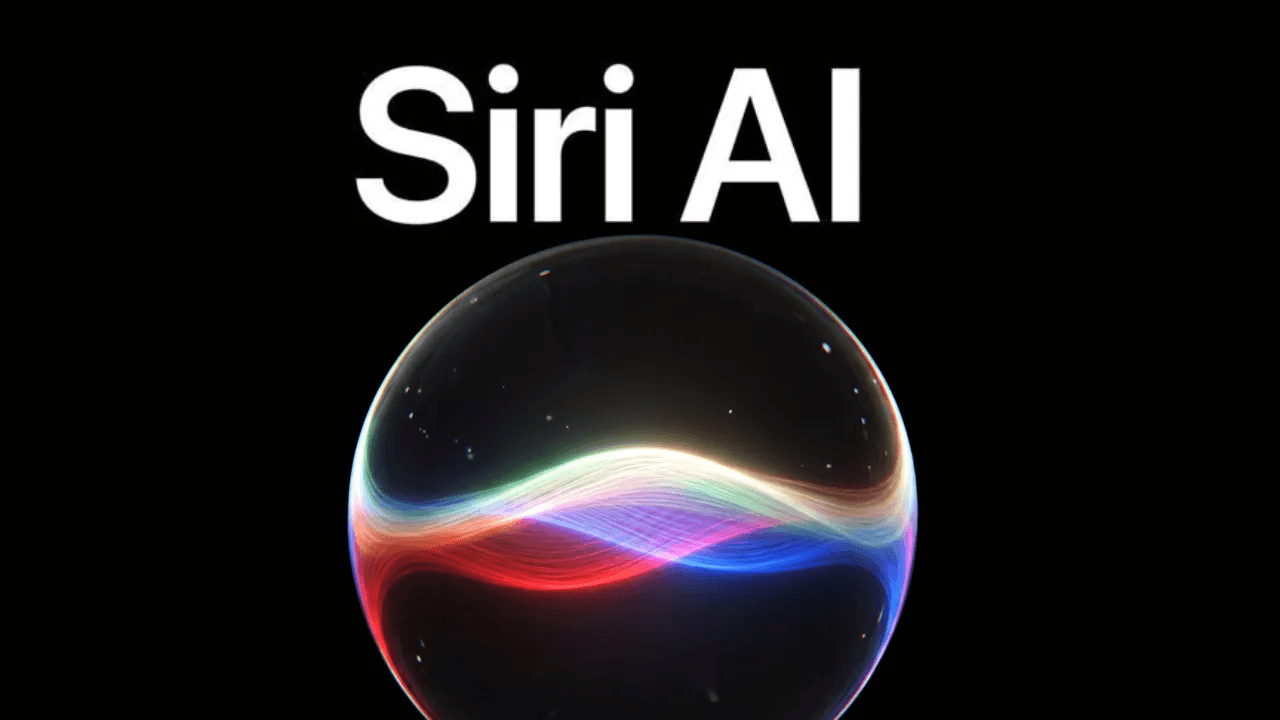
Ten years later, Siri finally stepped out of the system overlay.
At WWDC on June 8, Apple previewed new generation operating systems such as iOS 27 and macOS 27, with almost all software updates pointing to one thing: AI is evolving from a supportive feature to a system-level interaction entry point. The most noticeable change is that Siri has transformed from a voice pop-up that can be summoned at will into an independent app with its own icon, supporting iCloud synchronization of conversation history, and is for the first time aligning in form with independent AI applications like ChatGPT.
The previous generation of Apple Intelligence limited Siri to passive responses at the system level. It could help you polish text, summarize notifications, but it couldn’t perform tasks across applications nor remember what you had asked last time. This time, Apple is attempting to upgrade Siri from a "listener" assistant to an "agent that can take action on your behalf." The impact of this AI update extends far beyond Siri itself. From reconstructing photo albums to having Safari automatically monitor for price drops on products, to password management apps logging you into websites and changing weak passwords for you, new AI capabilities are practically everywhere in the system’s corners.
Siri has an independent entry point, conversation can finally remember context
With Siri becoming an independent app, the first issue to solve is the question of "where can users find AI?"
In the past, Siri’s entry was scattered between voice wake-ups, side buttons, and long presses on the lock screen, lacking a fixed visual anchor. After ChatGPT and Gemini occupied user desktops as independent apps, Siri's intangible status became a disadvantage: users were unsure of what it could do, nor were they accustomed to repeatedly opening a tool without an interface.
With the independent app and iCloud synchronized conversation history, the experience is completely different. Users can ask Siri to analyze key terms of a contract on their iPhone and continue to ask for details on their Mac at noon, with Siri able to remember the context. This establishes a long conversation asset and brings Siri closer in functionality to "an AI capable of ongoing conversation," rather than "a voice tool that answers single questions."
The underlying driving engine has also changed. Wired and several tech media confirmed on site that Apple has launched the third generation of Apple Foundation Models, and established a multi-year deep cooperation with Google Gemini, utilizing Gemini technology to customize the next generation models. At the 2024 WWDC, Apple’s partner was still OpenAI, allowing Siri to call ChatGPT in specific scenarios. Two years later, Google joined the partner list. Apple is no longer solely relying on a single third-party foundational model, opting for a more flexible multi-party customization path.
From "help you look it up" to "help you take care of it"
The core capability of the previous generation of Apple Intelligence was understanding and generating content. It could summarize long messages, rewrite the tone of emails, pull specific images from the photo library. But it couldn’t perform tasks across applications. This is the most fundamental dividing line between the two generations of products.
The new Siri AI achieves cross-application context understanding and task execution through the App Intents framework and Spotlight personal data indexing. Apple's official website provides several typical scenarios: Siri can extract hotel booking confirmation numbers from emails, find restaurants recommended by friends in the Messages app, and even automatically pull verification codes from emails to display in the Phone app interface during a call.
This feature, called Call Context, allows users to avoid switching screens or manually searching; Siri can pop up the needed sequence of numbers directly within the call interface. It addresses a specific and frequent pain point: the need to check information from messages or emails while on a call, often leading to flustered situations.
The upgrade of password management apps similarly points to this. The new version of Passwords can not only detect weak and duplicate passwords but also navigate users to the corresponding websites automatically, complete login, and then generate a strong password and save it. The tedious nature of changing passwords is well known, and many users opt not to change them. By delegating this task to an AI agent, Apple reduces the user's security maintenance costs.
Safari has also integrated similar capabilities. The new Notify Me feature can monitor changes on specified web pages, such as a product going on sale or a page being restocked, and proactively push notifications. Users can simply wait in the background without having to manually refresh every now and then. Another more thorough feature is allowing users to describe their needs in natural language and have the AI directly generate a custom browser plugin. If a user says, "Help me automatically highlight all rows in this webpage where the amount exceeds 500," Safari will generate the corresponding plugin to accomplish this. This essentially opens a path for ordinary users to create browser customizations without coding.
The Shortcuts app has also undergone the same natural language transformation. "Describe a Shortcut" allows users to write just one sentence, like "automatically report today's calendar schedule and weather at 8 AM every morning," and the AI can automatically assemble the corresponding shortcut steps. These changes point towards the same goal: to lower the threshold for system functions that originally only advanced users or developers could use to a point where ordinary users can accomplish them by simply saying a sentence.
The camera installed with Siri, expanded imagery and perspective reconstruction enter the photo album
Visual Intelligence has significantly expanded its coverage in this update. The camera app has introduced a "Siri mode," where users can point at a restaurant bill and have Siri calculate how much each person owes, after which Siri, upon recognizing the image content, can directly initiate a payment request via Apple Cash. Pointing at a book can retrieve reviews, and pointing at food can display nutritional information; these scenarios closely overlap with Google Lens' functionality over the years.
The difference is that Apple has extended this visual understanding capability across more devices. On iPads, users can analyze directly using Siri after taking a screenshot, and on Macs, they can invoke it via shortcut keys; Vision Pro can also utilize it. The camera is no longer the only entry point; Apple is building a universal visual understanding layer that covers all devices.
The Photos app has also received two new AI-based features: Spatial Reframing and Extend. Extend refers to AI automatically generating extended content at the edges of photos. Spatial Reframing, however, has substantive differences; it uses spatial computing models to alter the perspective relationships in photographs, not just simple cropping or stretching, but recalculating the foreground and background relationships of objects in the image. Apple demonstrated this with a side-view photo of a building, which, after processing, transformed into a frontal view. The official announcement has yet to disclose how this feature performs in non-architectural scenarios, but from a technical path perspective, it involves an additional step of spatial understanding in comparison to ordinary generative extensions.
The upgrade of Image Playground represents another dimension. The first generation could only generate cartoon-style or illustration-style images, while this iteration directly supports photo-realistic image generation. Due to high computational requirements, Apple runs it on Private Cloud Compute rather than on-device. Each generated image is forced to embed SynthID invisible watermarks for identifying AI-generated content. Additionally, this feature has set daily usage limits, with specific allocations varying in the official version based on iCloud+ subscription plans, though exact figures have not yet been disclosed.
Hardware thresholds and regional restrictions are unavoidable realities
The range of AI feature support is much narrower than that of system updates.
The compatible devices for iOS 27 start from iPhone 11, but the core functions of Apple Intelligence and Siri AI are limited to iPhone 15 Pro and above, iPads and Macs with M1 and above chips. Some more advanced functionalities, like more expressive voices and higher-order dictation, also require updated hardware: iPhone Air, iPhone 17 Pro series, or M4 iPad and M3 Mac with over 12GB of unified memory.
Regional restrictions are equally stringent. Due to the EU's Digital Markets Act, Siri AI is currently unavailable on iOS and iPadOS in EU regions. In mainland China, Apple Intelligence is temporarily unsupported due to regulatory requirements. AI features like photo-realistic image generation that are based on PCC cloud computing are also locked in regions with restrictions. For users who are accustomed to Apple's globally uniform experience, this dual splitting of features by region and device may cause confusion.
Apple AI this year: a delayed payment for lessons learned, and a change in the list of collaborators
At the 2024 WWDC, when Apple first introduced the concept of Apple Intelligence, Siri was portrayed as a smart assistant capable of deeply understanding personal data and performing tasks across applications. However, these features were subsequently delayed multiple times, leading users to initiate a collective lawsuit for false advertising, with Apple ultimately paying a $250 million settlement.
This experience directly influenced the density of content and the cautiousness of commitments in this release. The expectations drawn a year ago must now be delivered.
Throughout 2025, Apple notably slowed down the pace of consumer-grade AI feature releases, leading to it being referred to as Apple's "Gap Year." During this period, Apple restructured its AI department for internal preparation for the intensive overhaul in 2026. According to Yahoo Finance, Apple's capital expenditure plan for 2026 is $14 billion. Compared to Amazon and Microsoft's thousands of billions in AI infrastructure spending, this number seems restrained. Apple is not participating in the computational arms race, instead relying on its own chip ecosystem and edge computing for differentiation.
The most noteworthy change is the shift in partners. The external model integrated by Siri in 2024 was OpenAI's ChatGPT; by 2026, Apple established a multi-year deep cooperation with Google Gemini, utilizing Gemini technology to customize and develop the next generation of Apple Foundation Models. This shift from a single collaboration to a multi-party parallel approach, from direct invocation to deep customization, reflects Apple's unwillingness to tie its foundational models to a single third party. For users, this means that the sources of model capabilities behind Siri are more diverse and may switch strengths of different models for specific tasks.
免责声明:本文章仅代表作者个人观点,不代表本平台的立场和观点。本文章仅供信息分享,不构成对任何人的任何投资建议。用户与作者之间的任何争议,与本平台无关。如网页中刊载的文章或图片涉及侵权,请提供相关的权利证明和身份证明发送邮件到support@aicoin.com,本平台相关工作人员将会进行核查。


