Original | Odaily Planet Daily (@OdailyChina)
Author | Wenser (@wenser2010)
In August last year, propelled by Trump, the U.S. government transformed funding through the CHIPS Act by directly purchasing nearly 10% of Intel's newly issued shares (about 433.3 million shares) at a price of $20.47 per share, which was worth less than $9 billion at the time; just under a year later, by early May, with Intel's stock price reaching a historic high, the total value of this stake had risen to $54.1 billion, increasing by over $45 billion in just seven months.
Regarding this matter, Trump couldn't hide his pride in a post stating: “I made America $45 billion in the past 8 months.”
As a capital giant who can "post to manipulate the U.S. stock market" at any disagreement, Trump plays an extraordinary role in the fluctuations of U.S. stocks, and recently, he has started his performance again—providing a total of $2 billion in funding to 9 quantum computing companies through the U.S. Department of Commerce in exchange for equity. Odaily Planet Daily will briefly analyze this in this article.
U.S. Government Takes Action, Splashing $2 Billion into Quantum Computing
On May 21, the Trump administration announced that it will provide a total of $2 billion in funding to 9 quantum computing companies through the U.S. Department of Commerce in exchange for partial equity. The specific funding allocation is as follows:
- $1 billion will be granted to IBM (IBM) for the operation and development of its independent subsidiary Anderon;
- $375 million will be allocated to chip manufacturer GlobalFoundries (GFS);
- Public companies such as D-Wave (QBTS), Infleqtion (INFQ), and Rigetti (RGTI) will each receive $100 million;
- Private companies such as Atom Computing, PsiQuantum, and Quantinuum (Honeywell-HON, its independent subsidiary) will each receive $100 million;
- The startup Diraq is expected to receive $38 million.
According to official document information, this is part of the Trump administration's "active investor" industrial policy, with funding sourced from the R&D appropriations of the 2022 CHIPS and Science Act. The Department of Commerce emphasizes that this is a “portfolio” strategy, covering two quantum wafer foundries and seven quantum computing companies, addressing various quantum modalities such as neutral atoms, silicon spin, superconductors, photons, and trapped ions, solving critical engineering bottlenecks such as equipment repeatability, error rates, optical complexity, and refrigeration system integration.
On the day the news was released, U.S. stocksin the quantum computing sector surged sharply, with D-Wave Quantum rising 16%, Rigetti Computing increasing 14%, Infleqtion shares climbing 25%, quantum computing up 9%, and IonQ up 3.1%.
It is worth noting that among these companies receiving funding, only GlobalFoundries Inc. (GFS) disclosed that the equity exchange ratio is about 1%, while other companies, regardless of public status, hold minority non-controlling equity, and specific ratios have not yet been made public; the final ratios will require formal agreement and SEC disclosure.
Capital Operations under the "America First" Strategy
Looking closely at this “investment for equity” operation, it still operates under the Trump administration’s "America First" strategy.
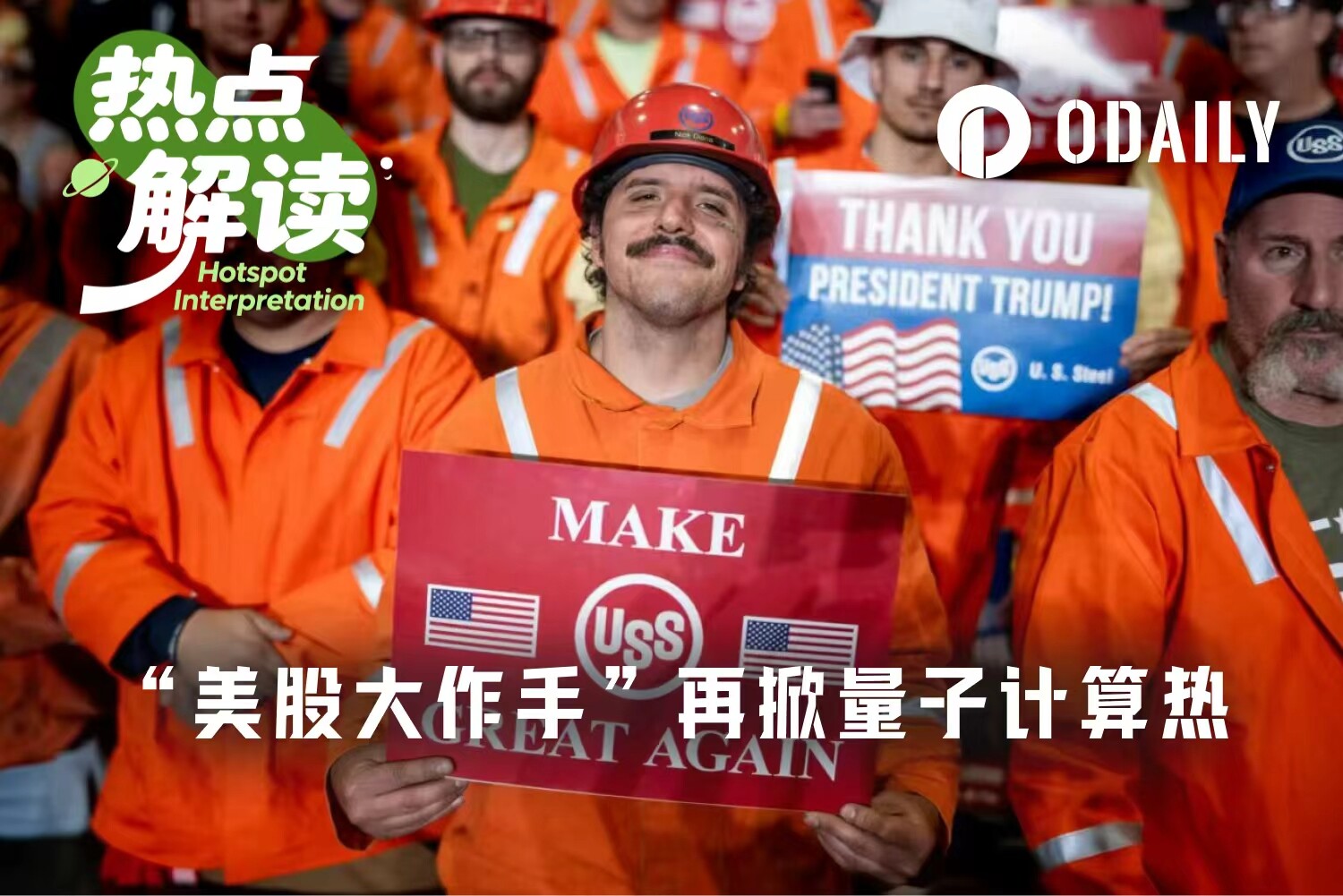
Previously, the U.S. government invested in Intel (INTC), the only full-industry rare earth producer MP Materials (MP), Trilogy Metals (TMQ), Lithium Americas (LAC), U.S. Steel, and other operations to maintain the strategic position of its semiconductor industry chain.
Especially regarding the nearly $9 billion investment in Intel, the Trump administration explicitly stated that this move was aimed at supporting advanced semiconductor manufacturing in the U.S. and reducing reliance on Taiwan Semiconductor Manufacturing Company (TSMC); thus, the U.S. government's related holdings represent passive shares, without board seats, and do not participate in the company's daily operations and management, with most matters following board votes.
However, the U.S. government's "equity investment" provides not just financial support, but also a credibility endorsement and multiple policy supports (such as export licenses and tariff protections). Previously, Intel, after receiving U.S. government funding, was significantly aided by U.S. Secretary of Commerce Gina Raimondo, who met with Apple CEO Tim Cook, Tesla CEO Elon Musk, and NVIDIA CEO Jensen Huang multiple times over the past year, persuading them to cooperate with Intel. With Apple's involvement, Intel has now established relevant cooperation with all three aforementioned companies.
Shift in Operational Approach under the CHIPS and Science Act: From Financial Subsidies to Equity Exchange
The $2 billion funding directed toward quantum computing companies is backed by the CHIPS and Science Act, a bipartisan landmark legislation introduced by the U.S. government in 2022, formally known as the “CHIPS and Science Act of 2022,” which authorizes a cumulative investment of about $280 billion over 10 years, aimed at supporting the semiconductor industry's development and fundamental science and technology research and development, with the main goal of revitalizing the U.S. semiconductor manufacturing industry through large-scale investments, enhancing scientific research and innovation capabilities, and addressing foreign competition in high-tech fields.
However, unlike the financial assistance or pure subsidy models during the Biden administration, the Trump administration's operational model is the aforementioned "active investor" approach—shifting to funding in exchange for minority non-controlling equity. As of May this year, the act has attracted over $645 billion in private investment in the semiconductor manufacturing sector, over 140 projects, and created 525,000 new jobs.
It must be said that while operating and promoting stocks like Dell (DELL), Micron (MU), and Palantir (PLTR) in his personal capacity, Trump is also advancing the prosperity of the U.S. stock market in the name of the U.S. government and other departments, no wonder he often boasts “the new highs in U.S. stocks are mainly due to me”.

Additionally, it is worth noting that the U.S. Department of Commerce's previous investment announcement stated, “The Office of Chip Research and Development continues to solicit proposals from qualified applicants regarding microelectronics technology research, prototype design, and commercial solutions in the U.S. Qualified applicants should submit applications through announcement 2025-NIST-CHIPS-CRDO-01 on the www.grants.gov website.” In other words, the U.S. government's "investment door" remains open, with more information and funding announcements available at official sources.
Of course, the U.S. government's investments cover a wide range of fields, also including critical minerals such as electrical and rare earth, new energy such as lithium batteries, medical supplies, and communication infrastructure, such as Westinghouse, Lithium Americas, Trilogy Metals, USA Rare Earth, Vulcan Elements, XLight, L3 Harris Technologies, and others.
Furthermore, U.S. Secretary of Commerce Gina Raimondo has previously revealed to the media that this U.S. government may take stakes in major defense suppliers like Lockheed Martin (LMT).
In summary, many of the publicly listed companies and key mineral/rare earth/battery materials supply chains, nuclear energy/small modular reactors (SMR), and advanced nuclear fuels, as well as other targets in quantum computing mentioned above, may become the focus of the Trump administration's continued investment in the second half of the year.
免责声明:本文章仅代表作者个人观点,不代表本平台的立场和观点。本文章仅供信息分享,不构成对任何人的任何投资建议。用户与作者之间的任何争议,与本平台无关。如网页中刊载的文章或图片涉及侵权,请提供相关的权利证明和身份证明发送邮件到support@aicoin.com,本平台相关工作人员将会进行核查。


