Keyrock's industry report released on May 24, 2026, systematically lays out the machine payment trajectories that were originally scattered across the blockchain over the past year: from May 2025 to April 2026, AI Agents have completed more than 176 million transactions on the blockchain, corresponding to an amount exceeding 73 million dollars, with machines paying fees for data purchases, cloud computing power, and APIs, significantly shifting towards on-chain settlement as the default path. According to the report, about 76% of the transaction amounts are below the common range of traditional credit card payments, showcasing strong micro-payment characteristics. In terms of asset selection for settlement, 98.6% of the transactions were completed using price-pegged assets like USDC, indicating that the entire machine payment infrastructure heavily relies on a few on-chain networks and price-pegged assets as its settlement foundation. However, behind this seemingly smooth upward curve, researchers simultaneously warn that the synergistic evolution of AI and quantum computing is rewriting security boundaries, with quantum computing seen as a potential threat that may undermine the security of the existing public key cryptography systems. Project Eleven CEO Alex Pruden even bluntly stated that people will no longer be able to rely on traditional security assumptions as they did in the past, which starkly juxtaposes the "prosperity of machine payments on-chain" with the "approaching shadow of quantum threats" on the same page of the report.
176 Million Machine Payments Shift to On-Chain
On the timeline put forth by Keyrock, the period from May 2025 to April 2026 is merely 12 months, yet the AI Agent has already executed over 176 million payments on-chain, accumulating an amount exceeding 73 million dollars. The meaning behind these figures is direct: settlements between machines are no longer just a concept validation in labs but are being repeatedly executed on public chains in a predictable, auditable manner, with on-chain channels pushed into the “default option” position for machine payments. Compared to one-time large remittances, these transactions resemble countless invisible API calls, where each completion of a task, data retrieval, or allocation of computing power leaves a record on the chain.
The report further breaks down these figures: about 76% of the transaction amounts of AI Agents are below the common payment ranges in traditional credit card systems, reflecting a pronounced micro-payment characteristic. For frequent, small expenditures—such as purchasing a segment of training data, pay-per-second billing for cloud computing power, or a single API call—the manual processes of opening, reconciling, and risk controlling required by traditional credit cards are generally viewed as unsuitable for full automation; on the other hand, scripts and contracts on-chain allow Agents to directly initiate payment and confirm receipt upon meeting predefined conditions, without the need for human intervention transaction by transaction. Thus, resources like data, cloud computing power, and APIs are naturally broken down into a massive number of small, high-frequency transactions, progressively driving machine-to-machine payments toward automation and programmability, making the 176 million on-chain payments a clear footnote in the evolution of new payment infrastructure.
USDC Accounts for 98.6% of Machine Settlements
If we zoom out from the 176 million micro-payments themselves to see who is truly underwriting these machine settlements on-chain, there is a startling number in Keyrock's report: between May 2025 and April 2026, 98.6% of AI Agent-related on-chain transactions were completed using USDC and other price-pegged assets. The report does not specify the exact proportions of other assets (such as USDT, DAI, etc.) aside from USDC, but in the machine-to-machine payment network, the default settlement layer has almost become synonymous with the "USDC track."
For Agents, this is an almost "lazy" rational choice: the smaller the price fluctuations, the easier it is to firm up budgets and risk controls into code; the better the cross-chain compatibility, the more freely Agents can allocate computing power and data across different public chains; and the clearer the compliance expectations, the more likely they are to be whitelisted by more APIs and service providers. Consequently, the price-pegged, cross-chain usable, and widely circulated USDC naturally became the default settlement asset in machine wallets. The benefits are equally evident—high concentration leads to simplified settlement paths, aggregated liquidity, and smoother connections between protocols; but the costs are also magnified on the same level: once this primary settlement backbone encounters compliance, technical, or infrastructure shocks, the entire payment network of the machine economy will be forced to adjust or even come to a halt.
Quantum Acceleration Approaches, Eroding Cryptographic Security Assumptions
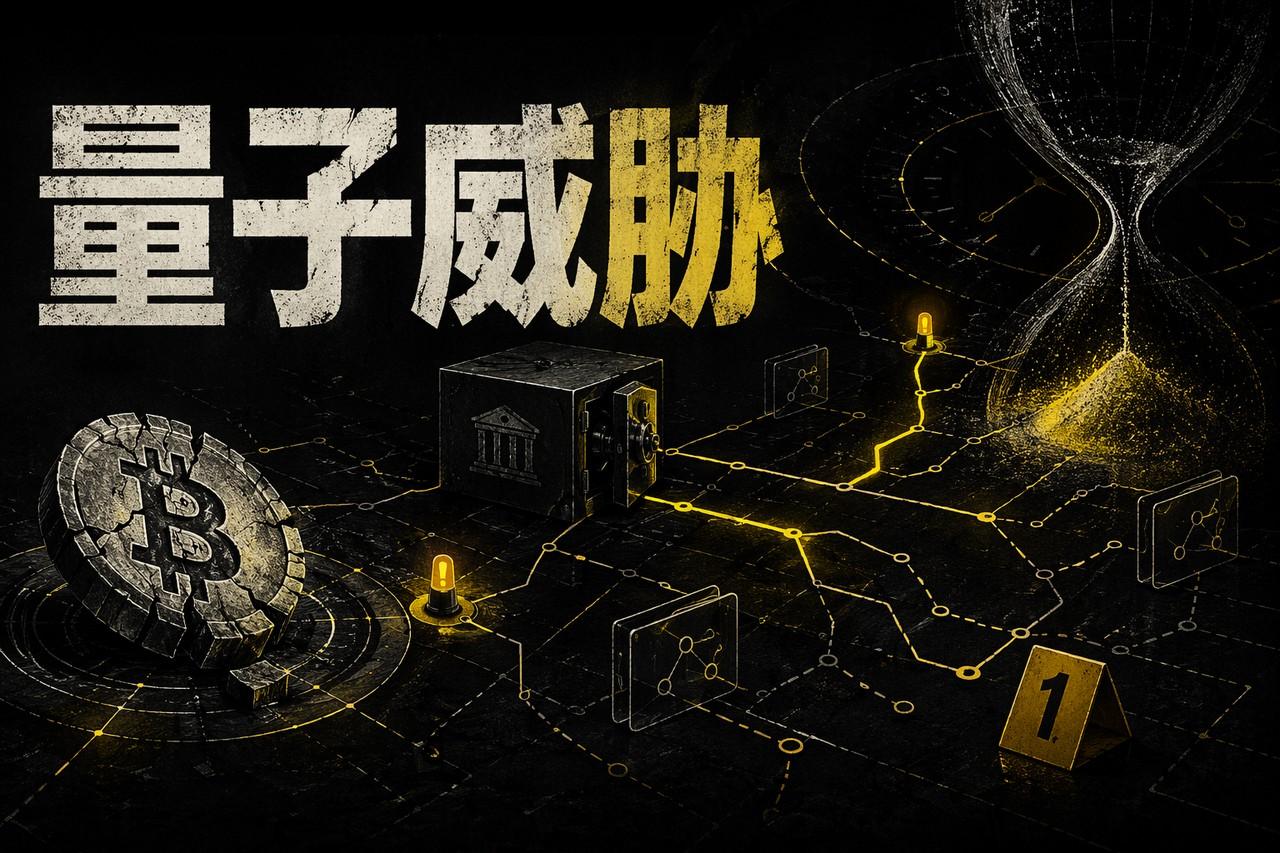
As AI Agents consolidate a majority of payment traffic on a few core settlement backbones, another invisible timeline is advancing simultaneously—AI itself is driving the accelerated evolution of quantum computing. Keyrock notes in the report that the synergistic development of AI and quantum computing is believed to be rewriting the future security landscape, indicating that the foundational assumptions regarded as "sufficiently secure" may soon be prematurely rendered ineffective. Project Eleven CEO Alex Pruden's judgment is even more direct: under such a technological combination, people will no longer be able to rely on traditional security assumptions as they did in the past, a statement that for machine wallets viewing public chains as the default settlement layer is almost tantamount to a system-level alarm bell issued ahead of time.
The reality is that mainstream networks like Bitcoin and Ethereum, which currently support the payment pathways of AI Agents, are still built on public key cryptography, while quantum computing is precisely viewed as a potential threat that may undermine the security of this system. Even though everything remains at the level of "the theoretical existence of being vulnerable to hacking," the Keyrock report does not provide any timelines or previously occurred incidents regarding quantum attacks, but the center of gravity in the security game has quietly shifted south: from "whether it will be breached" to "whether the machine economy can bear the infrastructure rewrite costs under the premise of potential breaches."
Prosperity and Concerns: Quantum Testing for Machine Payments
When AI Agents have already completed over 176 million automated transactions on-chain, generating a settlement record of 73 million dollars for data and cloud computing power, the entire machine payment system appears to operate like a smoothly running engine. About 76% of the transactions remain in the small micro-payment range, while 98.6% concentrate on a few price-pegged assets like USDC, with the current infrastructure essentially scripted as “default scripts”: chain = settlement layer, few assets = universal currency, Agents only need to continuously sign, broadcast, and execute payments according to preset strategies. However, the Keyrock report and the researchers' reminders pull this prosperity back to the cryptographic foundational premise—these signatures, these addresses, and the security boundaries of these assets are still built on a public key system that may be undermined by quantum computing.
Once the scenario is rewritten under the hypothesis of “the basic algorithm losing reliability,” automated on-chain payments immediately expose systemic vulnerabilities: countless Agents continuously sign, hold keys, and invoke contracts in an unattended state; once the underlying assumptions are overturned, the cost will no longer be just the loss of a single wallet but the reset cost of the entire machine economy's settlement layer. The Keyrock report did not document any public cases of mainstream chains encountering quantum attacks, and Project Eleven CEO Alex Pruden merely reminds that people will no longer be able to rely on traditional security assumptions as they did in the past, but this already sufficiently points to the directional needs of the next step: while continuing to expand the machine payment landscape brought by AI Agents, it is essential to reserve technology and governance upgrade spaces for post-quantum security, rather than being forced to rewrite the rules on the ruins when a real attack occurs.
The Next Step for AI Agent Machine Economy
According to the set of data disclosed by Keyrock, on-chain encrypted payments have become the "base water supply" of AI Agent machine economy: from May 2025 to April 2026, AI Agents completed over 176 million transactions on-chain, with an amount exceeding 73 million dollars, where about 76% are small payments below the common range for traditional credit cards, and 98.6% of settlements concentrated on a few price-pegged assets like USDC. This means that the current machine payment infrastructure not only heavily relies on the blockchain network itself but is also locked into very few price-pegged assets as the default settlement layer. Looking ahead along this chain, the truly worth monitoring variables are not complicated: firstly, whether the scale and structure of on-chain transactions will see larger volumes and higher frequency of machine settlements in the future; secondly, the degree of diversification of settlement assets—whether the 98.6% concentration will be gradually diluted by more assets and more tiered settlement schemes; and lastly, how soon post-quantum security solutions addressing quantum threats will move from paper discussions to gradual pilot implementations. What Project Eleven CEO Alex Pruden highlighted is, in fact, a question of temporal dimensions: while continuing to embrace the incremental machine economy brought by AI Agents, the industry needs to reserve space for technological and governance upgrades in security from a longer cycle perspective, binding together the evolution of transaction scale, asset diversification, and post-quantum security pathways, rather than waiting until one day when security assumptions are utterly shattered by reality before taking corrective action.
Join our community to discuss and grow stronger together!
On-chain Telegram Group: https://t.me/AiCoinWhaleData
On-chain Community: https://www.aicoin.com/link/chat?cid=N6OVMor5g
AiCoin On-chain Twitter: https://x.com/aicoinwhaledata
AiCoin Exclusive Hyperliquid Benefits: https://app.hyperliquid.xyz/join/AICOIN88
AiCoin Exclusive Aster Benefits: https://www.asterdex.com/zh-CN/referral/9C50e2
免责声明:本文章仅代表作者个人观点,不代表本平台的立场和观点。本文章仅供信息分享,不构成对任何人的任何投资建议。用户与作者之间的任何争议,与本平台无关。如网页中刊载的文章或图片涉及侵权,请提供相关的权利证明和身份证明发送邮件到support@aicoin.com,本平台相关工作人员将会进行核查。