WLFI Finance Company AI Financial warns of survival crisis.
Written by: Oluwapelumi Adejumo
Translated by: Luffy, Foresight News
The cryptocurrency project World Liberty Financial, supported by the Trump family, is trying to rebuild market demand and confidence after its governance token WLFI fell to an all-time low.
Facing ongoing pressures from governance disputes, unlock concerns, and doubts about liquidity for several months, World Liberty Financial has taken multiple measures to respond: burning WLFI tokens, connecting with exchanges, and launching a rewards program pegged to the stablecoin USD1, aiming to revitalize the overall activity of the WLFI ecosystem.
These measures have boosted market sentiment but have also created a new liquidity window for long-term "sleeping" holders, allowing them to cash out. This precisely reflects the core dilemma faced by the token: the price rebound still highly depends on incentive policies, exchange channels, and market confidence in the project governance.
After hitting an all-time low, World Liberty Financial launched WLFI burns and the USD1 reward program.
This round of ecological self-rescue stems from a brutal market crash. This crypto project linked to Trump has seen its price drop nearly 88% from its historical peak.
To restore market confidence, World Liberty Financial is accelerating the WLFI token burn. On-chain data from blockchain analytics platform Arkham Intelligence shows that the project has permanently destroyed 3 billion WLFI, wiping out approximately $180.8 million in market value from circulation.

WLFI burn records
Previously, the community passed a governance proposal: to permanently destroy 10% of the total number of tokens held by founders, teams, advisors, and partners, amounting to about 4.5 billion tokens.
Besides the burns, the project is positioning the stablecoin USD1 as the core value carrier of the ecosystem. World Liberty Financial no longer relies solely on the demand for its native token but is leveraging mainstream crypto exchange infrastructure to promote the commercial adoption of USD1:
Binance launched the USD1/BTC trading pair, allowing market participants to use USD1 as collateral for Bitcoin futures contracts for the first time.
Bybit simultaneously integrated USD1, listing it as a qualified collateral asset for margin trading, crypto lending, institutional credit lines, and buy-now-pay-later services.
To accelerate adoption, Bybit and World Liberty Financial jointly launched the USD1 rewards program, contributing a reward pool of 45 million WLFI, where users staking or holding USD1 can enjoy up to 20% annualized returns, directly tying WLFI demand to the widespread use of the stablecoin.
WLFI's rebound creates exit opportunities for holders
The structural burn by World Liberty Financial and high-yield activities on exchanges triggered a rebound in WLFI trading, but the sudden market liquidity also brought unexpected consequences.
Data from blockchain analysis platform Santiment shows that on May 18, World Liberty Financial set a record for the highest realized profit and "token sleep consumption," far exceeding previous records.
On that day, the market net sold 1.8 billion WLFI, all for profit taking.
The "token sleep consumption" metric (moving token quantity × holding sleep duration) soared to 17.4 trillion.
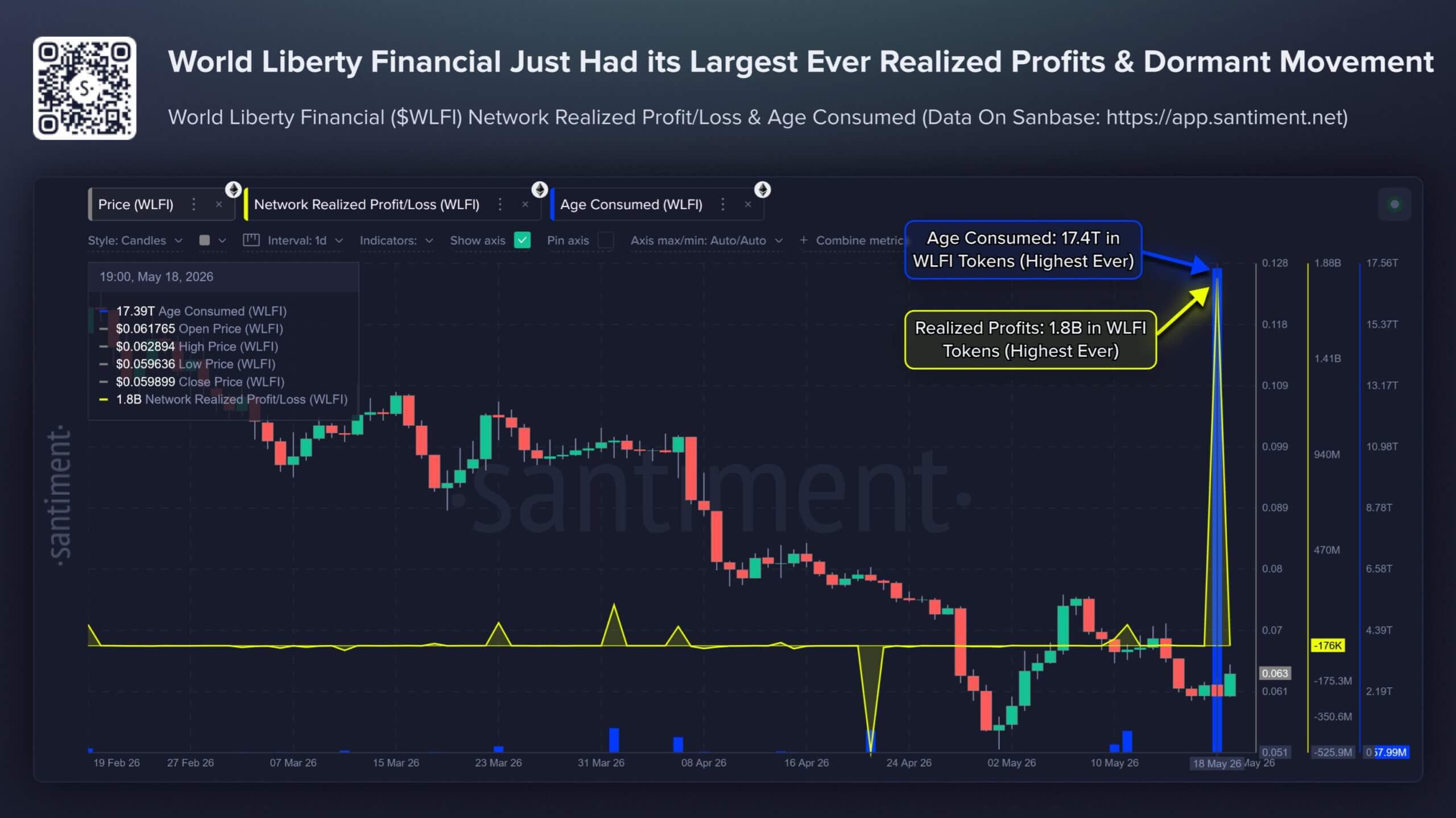
Large amounts of WLFI profit taking
Santiment points out that this wave of trading peak closely followed Binance's opening of USD1 futures collateral functionality. Data indicates that although the new exchange channels successfully activated a sluggish market, they essentially became tools for long-term sleeping holders to liquidate their positions.
Fortunately, the market absorbed most of the selling pressure. After the dual indicators soared, WLFI still rose by 5.5%, indicating that the new demand from exchanges buffered the impact of profit taking. However, the large transfer of dormant tokens also means that for a sustained rebound, the market still needs to digest the massive selling pressure built up by early participants.
AI Financial warns: Risks spread to public markets
The financial pressure of the World Liberty Financial ecosystem has breached the on-chain token market and transmitted to the balance sheets of publicly listed companies.
Fintech company AI Financial (formerly ALT5 Sigma) regulatory filings for Q1 2026 show that the volatility of digital assets has severely impacted corporate financial structures.
AI Financial's corporate treasury is entirely centered around the World Liberty Financial ecosystem: completing $1.5 billion in financing (private placement + private sale, token settlement) in August 2025, purchasing 7.28 billion WLFI at a cost of $0.20 each.
As of March 28, 2026, AI Financial's latest financial report shows:
- The market price drop of WLFI led to an unrealized loss of $348.3 million, with asset book value falling to $706.4 million, less than half of the purchase cost.
- Impairments dragged down overall performance: the net loss from continuing operations for the quarter was $271.3 million, compared to only $2.4 million loss in the same period last year.
More fatal is that contract lockup renders $706 million in assets entirely unusable for daily operations.
Under the token purchase agreement, 3.53 billion tokens cannot be transferred within 12 months.
The remaining 3.75 billion tokens are bound by the Securities Purchase Agreement, requiring shareholder approval, amendments to corporate bylaws, and submission of valid resale registration statements to regulators before they can be sold.
Therefore, at the end of this quarter, AI Financial had cash of $10.5 million, total assets of $32.2 million, and total liabilities of $39.1 million, resulting in a working capital gap of $5.5 million for the company.
The cash crisis forced management to issue a clear warning, casting significant doubt on the company's ability to continue operations within the next year.
To maintain operations, AI Financial added related party debt. In January 2026, it borrowed nearly $15 million directly from World Liberty Financial. Management disclosed that this cash might be used for stock buybacks and increasing WLFI holdings, utilizing project debt while supporting its public equity and underlying ecosystem assets.
Governance lawsuits entangle, ecological disputes continue
The ecological crisis of World Liberty Financial goes beyond price fluctuations, cash shortages, and accounting adjustments; governance lawsuits are subjecting the project to more stringent scrutiny.
The project is embroiled in a defamation lawsuit with crypto entrepreneur Sun Yuchen. Sun publicly accused World Liberty Financial developers of hiding undisclosed blacklist functions in the smart contract.
His legal documents state that the backdoor allows the core team to unilaterally freeze user wallets and restrict individual participation in governance. World Liberty Financial denies the allegations and countersues, stating that Sun deliberately shorted the token and manipulated governance token flows to Binance to influence project decision-making during the project's public launch in September 2025.
In addition to legal disputes, on-chain records show that World Liberty Financial used 5 billion WLFI as collateral to borrow over $75 million USDC. This move has attracted significant attention from the crypto industry and U.S. Congress members, with Senator Elizabeth Warren leading efforts to investigate World Liberty Financial and its ties to the Trump family.
She wrote to the SEC requesting an investigation: "World Liberty Financial's actions seem to benefit the Trump family while harming the interests of investors, who face difficulties in redeeming their tokens normally. 80% of early investors' holdings are locked in, preventing them from selling after the price drop."
免责声明:本文章仅代表作者个人观点,不代表本平台的立场和观点。本文章仅供信息分享,不构成对任何人的任何投资建议。用户与作者之间的任何争议,与本平台无关。如网页中刊载的文章或图片涉及侵权,请提供相关的权利证明和身份证明发送邮件到support@aicoin.com,本平台相关工作人员将会进行核查。


