What AWARP aims to create is not a single product, but a set of infrastructure frameworks.
Source: AWARP
As stablecoins, cross-border payments, and RWA gradually shift from concept to implementation, the market begins to face a more realistic question: the true scarcity is not a single product, but a systemic infrastructure that can simultaneously support payment, clearing, asset issuance, and on-chain liquidity.
Recently, the Lao National Digital Technology Group (LADT), initiated by AWARP, announced that its parent company AWARP has received a strategic investment from Animoca Brands. Future collaboration between the two parties will focus on compliant stablecoins, cross-border payment networks, and on-chain asset systems. Viewing this merely as a routine financing might be somewhat limited; it is more akin to a cutting-edge market digital financial infrastructure solution that begins to connect with a more mature global Web3 ecosystem and compliant stablecoin practices.
Animoca Brands has accumulated substantial experience in the field of stablecoin compliance and has participated in related practices under Hong Kong's licensed framework. This means that its collaboration with AWARP is not just a logic of an investment project, but is closer to the synergy of experience and the connection between cutting-edge market financial infrastructure deployment.
What AWARP aims to create is not a single product, but a set of infrastructure frameworks
Most stablecoin, payment, or RWA projects currently on the market typically cover only one link in the chain: some address issuance issues, some tackle payment issues, and some focus on on-chain asset mapping, but very few can truly connect the "assets - funds - scenarios" into a closed loop. The problem is not that the sector is not hot, but that standalone capabilities are difficult to sustain a long-term financial network independently.
According to project disclosures, AWARP's positioning is not a single stablecoin project but a digital economic infrastructure solution aimed at cutting-edge markets. Its architecture encompasses multiple modules such as national public chains, digital IDs, industrial parks, compliant payments, stablecoins, and RWAs, attempting to incorporate asset issuance, on-chain circulation, real-world payments, and revenue distribution into the same framework. The focus of this idea is not on the "number of sectors," but on whether these sectors can form interdependent, mutually amplification infrastructure relationships.
This is also why AWARP is worth discussing independently. Many projects like to talk about ecosystems, but the so-called ecosystems are often just a stacking of multiple business terms; true infrastructure must answer a more solid question: can these modules jointly serve real economic activities, rather than merely echoing each other in pitch materials?
"Issuance - Circulation - Revenue," is the most critical structure in AWARP's current narrative
If one were to summarize AWARP's current business framework in one sentence, "Issuance - Circulation - Revenue" would probably be the closest expression to its essence. What it tries to solve is not a single scenario, but the complete chain from asset generation to fund usage to liquidity accumulation.
At the issuance level, according to project disclosures, AWARP is not only laying out a single US dollar stablecoin but also covering the US dollar stablecoin USDA, non-US dollar stablecoin solutions, and fully reserved RWA assets represented by clean energy like solar power, gold, and computing power. Such design means that AWARP does not simply view stablecoins as payment tools but understands them within a larger digital asset structure: stablecoins are responsible for value transfer and settlement, while RWAs are responsible for asset anchoring and supply expansion. For cutting-edge markets, this diversified asset framework is clearly closer to actual demand than a single US dollar path.
Specifically, LADT has signed nearly 500 megawatts of solar projects, involving five new energy projects, with partners including leading global photovoltaic companies and mining giants, achieving a first-mover advantage in Laos' five-year new energy plan. Additionally, while providing new energy alternative solutions for enterprises in gold mining, potash mining, and antimony mining, it has established a flywheel model of "asset formation - packaging onto the chain - revenue distribution - asset enlargement."
At the circulation level, AWARP's focus is not on "issuing assets," but rather on providing assets with a pathway into the real economy. According to project disclosures, its circulation layer is centered around its licensed third-party payment institution NewPay, collaborating with local payment networks and on-chain infrastructure to provide access for stablecoin integration, on-chain clearing and settlement, as well as cross-border payment applications. Public reports show that LADT and NewPay have officially launched operations in Laos, with NewPay integrating international payment platforms including Alipay, Alipay+, and WeChat Pay, and being included in the policy context of promoting digital finance and blockchain development in Laos.
This part is particularly important. If stablecoins lack a payment network, they are prone to circulate solely among on-chain accounts; without clearing and settlement channels, RWAs find it difficult to enter broader trading and liquidity scenarios. To put it bluntly, the on-chain narrative most fears being "suspended," and the payment network is precisely one of the few levers to pull on-chain value back into the real economy.
At the revenue level, according to project disclosures, AWARP hopes to further introduce DeFi and structured financial instruments and, in combination with assets like credit, interest rates, foreign exchange, and commodities, build a more scalable liquidity and revenue system. Whether this layer can truly be implemented still depends on subsequent product and institutional design, but structurally, it at least indicates that AWARP has not relegated stablecoins to the level of "payment medium," but is attempting to further integrate them into revenue distribution and capital efficiency management frameworks. For any financial infrastructure, payment can only bring flow, while revenue mechanisms have the chance to bring retention.
AWARP's variables include not just on-chain capabilities but also sovereign collaboration capabilities
Another difference between AWARP and general Web3 projects is that it attempts to embed technical modules into sovereign scenarios rather than merely outputting a set of on-chain tools. According to project disclosures, LADT is positioned as an important executive entity for promoting national-level digital technology and financial infrastructure construction in Laos, undertaking collaborative construction tasks across several sectors such as national public chains, digital payments, and asset issuance.
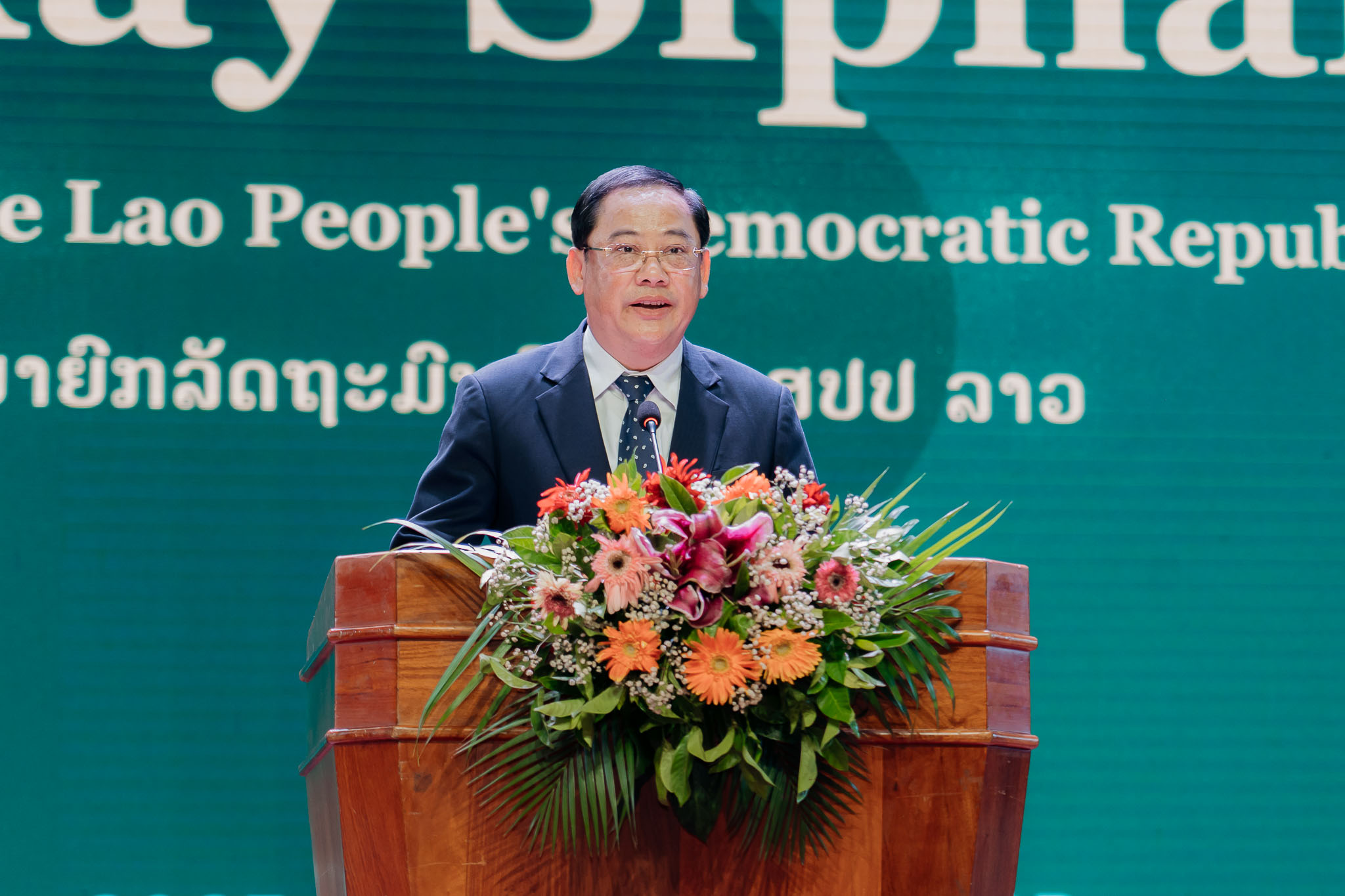
Public reports also show that the launch ceremony of LADT and NewPay was attended by the Prime Minister of Laos and officials from multiple departments, with discussions framed within the policy context of "promoting Laos' integration into the global digital economy and enhancing local digital financial capabilities."
This means that what AWARP truly intends to establish is not just an on-chain network, but a composite system that includes sovereign interfaces, real scenarios, and financial modules. Digital IDs determine compliant access, payment networks dictate circulation efficiency, RWAs determine asset supply, public chains dictate clearing and settlement, and policy collaboration determines whether the entire system can enter a genuine institutional environment. Many projects will use the term "infrastructure," but true infrastructure is never merely a technical term; it is whether it can enter the very logic of economic operation.
The significance of Laos lies not in scale but in its potential as an observable deployment sample
If viewed solely from the market size perspective, Laos is clearly not the destination that international capital would prioritize; however, from the perspective of infrastructure deployment, Laos holds a practical advantage: a relatively concentrated policy path, easier coordination for pilot ranges, and more suitable as the first observational sample for systematic solutions.
AWARP's current narrative does not position Laos as an end-market but rather as a leading deployment site for a set of digital financial infrastructure solutions. According to project disclosures, its subsequent goal is to replicate this model in more countries and regions that are open to digital assets and on-chain financial infrastructure.
Whether this logic holds true is not fundamentally about vision but hinges on four pragmatic issues: whether the policy adaptation pathways can be replicated, whether technical modules can be standardized, whether payment and asset networks can close the loop, and whether local operational mechanisms can be sustainable. If these links are gradually validated, then Laos' value to AWARP would not be an ordinary landing country but a regional deployment template with spillover effects.
The value of Animoca Brands transcends mere branding, encompassing cross-regional collaboration and compliance experience
Animoca Brands positions itself on its official website as a global leader in digital assets, prominently showcasing platforms like Moca Network, Open Campus, Anichess, and The Sandbox, while disclosing its investment portfolio covers over 600 companies and digital asset projects.
However, viewed within the context of AWARP’s business structure, Animoca's significance clearly extends beyond brand exposure. First is its ability to connect global Web3 ecosystems. If AWARP aims to drive stablecoins, RWAs, and on-chain payment networks into more regions in the future, it will require stronger project collaboration, asset distribution, and international user outreach capabilities, which is precisely what Animoca has long accumulated.
Secondly, there is the ability to expand on-chain asset scenarios. One of AWARP's business focuses is to integrate resource-based assets, stablecoins, and payment networks within the same financial framework, while Animoca has long been at the center of the digital asset ecosystem, able to provide more direct connections between assets, applications, and users.
Thirdly, and perhaps the most pragmatic layer, is the spillover value of experience with compliant stablecoins. Animoca Brands is already one of the significant players under Hong Kong's Monetary Authority's stablecoin regulatory framework, which has clearly defined the important use cases of stablecoins to include cross-border payments, tokenized asset settlements, and innovative financial scenarios. This suggests that the collaboration between Animoca and AWARP is not merely a traditional capital support narrative but is closer to the connection between compliant stablecoin practice experience and cutting-edge market financial infrastructure deployment.
Conclusion: AWARP's focus is not on the financing itself but on whether it can truly connect the lines
AWARP can certainly be labeled in multiple ways: stablecoin project, RWA project, payment project, ASEAN digital economy project. However, these labels only tell half the story. What it is more worthy of observation lies in its attempt to incorporate payment, assets, revenue, regulatory interfaces, and sovereign collaboration into a single system.
If it ultimately only establishes a payment network, it remains merely a regional payment project; if it only becomes a stablecoin, it remains just an on-chain tool; but if it truly connects issuance, circulation, revenue, and institutional interfaces, then what it competes for is not a particular niche sector but the entrance to the next generation of digital financial infrastructure in cutting-edge markets.
It is too early to draw conclusions now, but at least one thing is already clear: this should not be treated merely as another piece of financing news. It resembles a cutting-edge market infrastructure sample that is worthy of continued tracking.
About Animoca Brands
Animoca Brands focuses on building and investing in impactful digital asset technologies and ecosystems, owning platforms such as Moca Network, Open Campus, Anichess, and The Sandbox, while also providing institutional-level digital asset services. Its investment portfolio spans over 600 Web3 companies and projects globally and has received recognition from publications like Fortune's "Crypto 40", Financial Times' Asia-Pacific High Growth Companies, and Deloitte Tech Fast.
About AWARP
AWARP is dedicated to laying out the next generation of digital economic infrastructure for cutting-edge markets, systematically constructing a national industrial structure centered around public chains, digital IDs, industrial parks, compliant payments, and RWAs. This system has formed a closed loop of "Issuance - Circulation - Revenue" and uses Laos as a replicable sample for exporting the next generation of on-chain financial infrastructure to the global south.
About Lao National Digital Technology Group (LADT)
LADT is a national-level digital technology group in Laos, initiated by AWARP, and under the guidance of the Ministry of Science and Technology and the central bank, serves as the national主体公司 (main company) to systematically construct five major infrastructure sectors. Its subsidiary NewPay has already covered over 1.3 million users, with a transaction volume exceeding 180 million US dollars by Q4 2025.
免责声明:本文章仅代表作者个人观点,不代表本平台的立场和观点。本文章仅供信息分享,不构成对任何人的任何投资建议。用户与作者之间的任何争议,与本平台无关。如网页中刊载的文章或图片涉及侵权,请提供相关的权利证明和身份证明发送邮件到support@aicoin.com,本平台相关工作人员将会进行核查。


