Written by: Aman Narain
Translated by: Luffy, Foresight News
Imagine this: in 1985, an executive sitting behind a mahogany desk wants to make a transfer. He calls his broker, the broker calls the trading floor, and a note is passed around among people. A day goes by, and another day passes, and the trade is settled, the whole process is complete.
Fast forward to 2026. Your phone can translate seventeen languages in real-time, generate legal contracts, and transfer ten thousand dollars across continents before your coffee cools down.
However, if you want to buy Apple stock at 11 PM on a Sunday night during breaking news in Asia? You can only wait. If you want to use Tesla stock as collateral on another platform? You're stuck within a broker's system, limited by their business hours, constrained by their system outages, and there's nothing you can do about it.
In the age of artificial intelligence, stock trading is still as backward as writing checks by hand. And this has recently changed.
The era misalignment at the core of global finance
Let's first recognize the absurdity of this situation, because it deserves to be pointed out.
We live in a world where, in 2024, the trading settlement volume of stablecoins reaches $27.6 trillion, surpassing Visa's approximately $15.7 trillion, yet the New York Stock Exchange still closes at 4 PM. This trading session has not changed since 1985. The same year, fax machines were still considered cutting-edge technology.
Today, if you buy stocks at any traditional broker, such as Charles Schwab, Fidelity, or Robinhood, your trades are settled on a T+1 basis. A trade you place this morning will not officially complete until tomorrow. Stocks only become fully yours after clearinghouses, custodians, counterparties, and brokers sequentially complete their tasks. This settlement infrastructure has been in place for decades, aside from some minor upgrades.
The reason it hasn't changed is not due to technical issues, but complexity. The infrastructure of the global stock market is like a cathedral built from many interwoven legacy systems, each part bearing significant responsibility. You wouldn’t renovate a cathedral while people are praying. Or, as I mentioned in this week's podcast: you can't renovate an operational airport while a plane is landing.
Until now, every attempt has failed in the same way.
Years of accumulation finally erupted
On March 9, 2026, Nasdaq announced a partnership with Kraken's parent company Payward to build the so-called "stock transformation gateway," operating on Kraken's xStocks infrastructure.
In simple terms: your Apple stock, your Tesla stock, your S&P 500 ETF, all tokenized on the blockchain, traded 24/7, settled in seconds. They hold exactly the same voting rights and dividends as original stocks, not synthetic assets, not derivatives, but real stocks operating on a completely new track.
Just four days earlier, on March 5, the parent company of the New York Stock Exchange, Intercontinental Exchange (ICE), made a significant investment in the crypto exchange OKX, valued at $25 billion, with the explicit strategic intention of tokenizing NYSE-listed stocks on OKX.
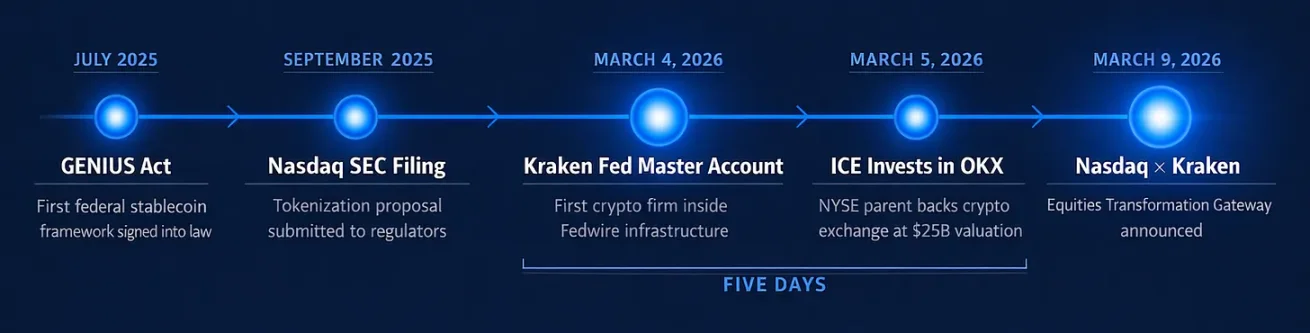
GENIUS Act, Nasdaq's submission to the SEC, Kraken obtaining a Federal Reserve master account, ICE investing in OKX, Nasdaq and Kraken's stock transformation gateway, five major events occurred in eight months.
The two most influential financial exchanges globally are betting in the same direction in the same week. This is not a trend, not an experiment, but a definitive conclusion.
But what most financial reporters overlooked is that these are not sudden announcements. Nasdaq submitted the proposal for tokenization to the SEC in September 2025. The xStocks framework had processed over $25 billion in transactions before the Nasdaq partnership announcement. The first federal regulatory framework for stablecoins, the GENIUS Act, was signed into effect in July 2025. These initiatives had already laid the groundwork; what is happening now is simply the natural progression.
All previous attempts at all-weather trading have failed, but this time it won't
It's not that no one has attempted all-weather trading before, but all have ended in failure.
The Australian Securities Exchange (ASX) announced in 2015 that it would replace its entire settlement infrastructure with blockchain technology. The project attracted global attention, significant funding, and institutional credibility that only a national exchange could provide. Seven years later, A$250 million was wasted. In November 2022, the project was completely canceled.
ASX is not the only ambitious case that faced failure; several exchanges achieved instant settlement on specific products, while others tried to extend trading hours. However, there has never been a single exchange globally that managed to achieve both instant settlement and all-weather trading simultaneously.
ASX made what I call the "cathedral mistake": trying to replace an operational system. All brokers, custodians, clearinghouses, and regulators had to migrate at the same time. This complexity is simply unmanageable.
What sets Nasdaq apart is the simplicity of the concept and the sophistication of the execution. They didn't tear down the airport; they built a second runway next to it.
The traditional market continues to operate as usual, while the tokenization layer runs in parallel. Assets are seamlessly transferred between the two worlds through designated bridges. The old infrastructure remains for institutions, pensions, and compliant custodians, while the new layer serves crowds that the old system can never cover.
This is not a technical upgrade. This is a design principle: to build in parallel, not replace. This is the first true triple jump in the history of global markets—instant settlement, fragmented ownership, and all-weather simultaneous realization, whereas all previous attempts could only barely keep pace.
One less obvious insight is that ASX required existing participants to relinquish control over a system that would benefit them. The Nasdaq model does not demand this; clearinghouses still handle clearing, and custodians still manage custody. The new channel aims to enlarge the cake rather than redistribute it. This is why regulators will get involved and why existing participants will not crush it.
This is not Robinhood: the difference is in the architecture
I know some of you are thinking, "Can't I already fragment my ownership of Apple stock on my phone? Isn't this just Robinhood in a new package?"
No, and the distinction is more important than you think.
Robinhood gives you access, tokenized stocks give you the right to dispose of them; the two are fundamentally different.
At Robinhood and all traditional brokers, without exception, your stocks exist within their system, just a number in their database. You cannot transfer it, you cannot use it as collateral on other protocols, you cannot trade it at 11 PM on a Sunday. You are merely a guest in their building, abiding by their rules and operating within their business hours.
In January 2021, Robinhood halted trading on GameStop stock. This was not a conspiracy but a vulnerability of a centralized system disguised as democratization. This chain, although forged from gold, is still a chain.
Tokenized stocks settle instantly on the blockchain, trade continuously around the clock, and can simultaneously be used as collateral on multiple platforms. They are programmable, meaning they can interact with financial applications that have yet to be invented.
Retail traders in Manila, pension managers in Oslo, and family offices in Singapore all operate on the exact same infrastructure as NYSE floor institutions. Fees are not lower, and there are no streamers falling when you click the buy button; everything is equal.
Stablecoins: the hidden layer of infrastructure
The underlying layer beneath all this is what makes everything else possible.
Tokenized stocks require a settlement layer. Something capable of transferring value between blockchains, across jurisdictions, and between the institutional world and the open decentralized world. An asset stable enough to earn institutional trust while being programmable enough for developers to build upon.
That asset is stablecoins.
The GENIUS Act signed in July 2025 marks the formal acknowledgment of this reality by the U.S. government. It provides the first federal regulatory framework for stablecoins, reserve requirements, auditing standards, and legal definitions. This is not the endpoint; it is the starting gun. When implemented in early 2027, stablecoins will qualify to settle stocks, bonds, and any asset that can be tokenized. T+1 will become a footnote in history, and the clearinghouse model will lose its monopoly.
Moreover, on March 4, Nasdaq announced that just five days earlier, Kraken Financial became the first crypto company in history to obtain a Federal Reserve master account. Direct access to the Federal Reserve's interbank settlement system, Fedwire, utilizing the same rails as those used by JPMorgan's clearinghouse. Kraken is now inside the infrastructure, not on the periphery.
Connect these three points. Tokenized stocks settled through xStocks, companies with direct access to the Federal Reserve, and the NYSE parent company building the same capability through another partner.
This is not a product launch; this is the fusion of infrastructure. A blend that has been simmering for a decade, announced in just one week.
This is not cryptocurrency going mainstream; it is the infrastructure of crypto becoming mainstream. There is a difference, and that difference is permanent.
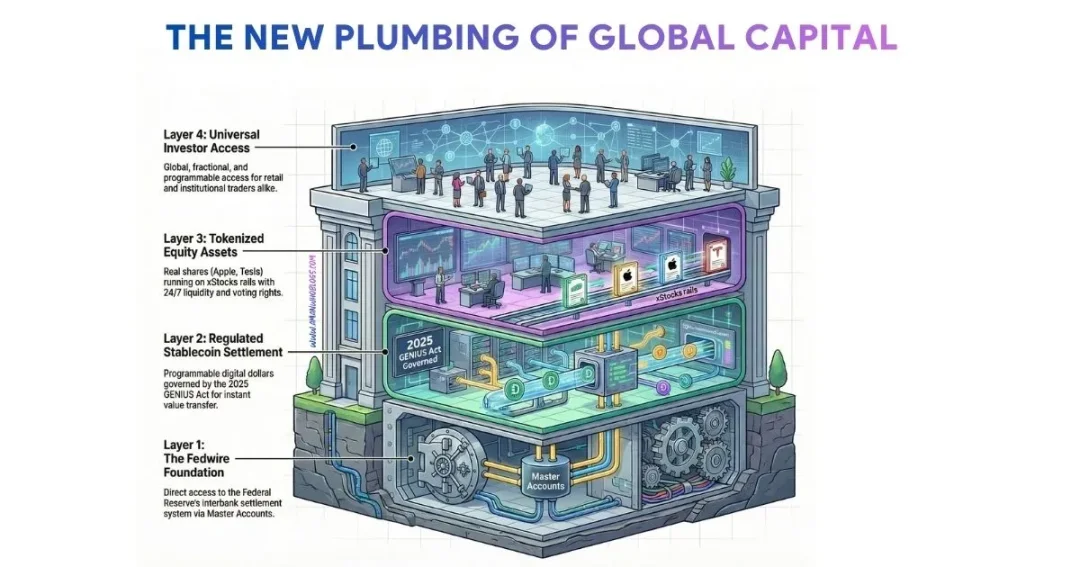
An overview of the new architecture of the global capital landscape. Layer One: Fedwire, now accessible to cryptocurrencies through Kraken's Federal Reserve master account. Layer Two: regulated stablecoin settlements under the GENIUS Act. Layer Three: tokenized stocks, real Apple and Tesla stocks traded 24/7 on the xStocks platform, with full voting rights. Layer Four: a universal channel for all investors.
Three significant events to watch
The infrastructure of global finance is being rebuilt in real-time. Most people won’t realize it until 2030 and will think it happened overnight. It hasn’t; it has just recently occurred.
First, the SEC's ruling on Nasdaq's tokenization proposal (submitted in September 2025). If the proposal is approved in mid-2027, it will open this ecosystem to U.S. retail investors for the first time and mark the inflow of institutional funds. Important note: Before approval, xStocks will remain closed to U.S. investors. Keep a close watch on this time window.
Second, the countdown to implementing the GENIUS Act. The law has been signed. It will count down to January 2027 or 120 days after the regulators issue final rules, whichever comes first. When these rules are in place, stablecoins will settle stocks, and T+1 will become history. This is not an uncertain deadline; it is a definitive timeline.
Third, signals from asset management institutions. BlackRock has tokenized treasury bond funds on Ethereum through its BUIDL product. Fidelity is building its own digital asset infrastructure. If either of these announces tokenized stock products in the next six months, this competition will no longer be about building infrastructure but about product competition. When the two largest asset management companies globally (managing over $20 trillion combined) start to act, the entire industry will no longer sit on the sidelines; it will follow.
Any one of these events is significant. The combination of all three will bring about a generational transformation.
The mailroom moment
In the article "Pipes, Protocols, and Paradoxes", I wrote about how Stripe profits from the system it intends to replace while building the future of money. And this week, this paradox unravels in another manner.
Nasdaq and the NYSE have not been disrupted from the outside; they chose to build alternatives themselves. This is not a story of disruptors versus incumbents; it is like the railroad companies in 1905 deciding to invest in automobiles.
The mailroom did not disappear overnight with the rise of email. It vanished as each executive quietly stopped using it, one by one, without announcements, without fanfare, without a press release.
All of this is happening right now, occurring within your brokerage.
A retail trader in Singapore can buy tokenized Apple stock at 11 PM on a Sunday night; she will not think about which clearinghouse she bypassed; she will only think about completing this trade. Brokers that use access as a moat will not receive any press releases; they will lose customers little by little each quarter until they eventually vanish.
Then on some Thursday, like Schroders, someone will read a statement (Note: On February 12, 2026, Schroders, a century-old asset management giant, officially announced its acceptance of a takeover by U.S. Nuveen, ending its independent operation).
免责声明:本文章仅代表作者个人观点,不代表本平台的立场和观点。本文章仅供信息分享,不构成对任何人的任何投资建议。用户与作者之间的任何争议,与本平台无关。如网页中刊载的文章或图片涉及侵权,请提供相关的权利证明和身份证明发送邮件到support@aicoin.com,本平台相关工作人员将会进行核查。


