🧵 I started using 10,000 USDG to do LP on Robinhood Chain last month, and I earned 20,000 USD in a month. Later, I gradually increased my position, and now I earn stable rent daily. I will talk about the complete tutorial and thoughts on this, as well as the pitfalls I encountered. (This is not a call to action, not an advertisement, but my most authentic workflow)
1️⃣📌 First, let's clarify: LP is not just throwing in money and earning passively.
Many people see "annualized 5000%+ APR" and get excited, going all in. I paid a lot of tuition in my first week; the money earned from LP wasn’t enough to cover impermanent loss!
LP earnings = fee income - impermanent loss - gas fees - cost of wrong range selection.
If a meme coin drops 90% directly, no APR can save you. Understanding this is essential to continue reading!
2️⃣📊 Basic concepts: You must first understand these three things
① What is an LP liquidity provider?
Simply put: You deposit two types of tokens (for example, USDG + some meme coin) into a pool, helping others increase trading depth. Every time someone trades in this pool, you earn a portion of the fees.
You're not "buying coins"; you are acting as a "market maker".
② What are the different types of pools?
1% + pool: High fees, suitable for highly volatile new coins, but has more dispersed liquidity.
0.3% pool: Medium, commonly used for mainstream pairs.
0.05% pool: Ultra-low fees, suitable for stablecoin pairs.
The meme coins on the Robinhood Chain primarily battle in the 1% pool, where the fees are the highest, but the risk is also the greatest.
③ What are Bid Ask / Spot / Curve strategies?
These three are the "shapes" of liquidity:
Spot: Concentrate liquidity near the current price, like a peak.
Bid Ask: Distribute liquidity on both sides of the current price, like a U shape, suitable for sideways trends.
Curve: Smooth curve distribution, more conservative, suitable for somewhat predictable market conditions.
In the early stages of new meme coin eruptions, I primarily deployed using Spot + multiple segment overlaps.
3️⃣💡 My discovery process: Being 10 minutes ahead of others is enough
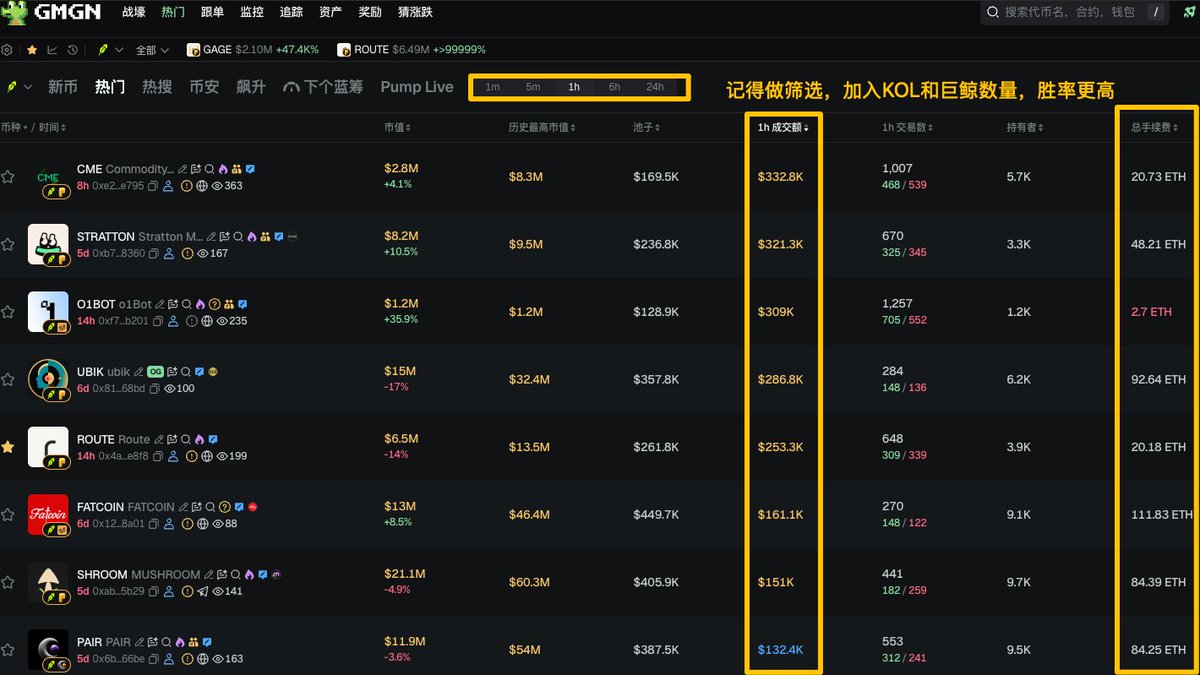
I use #GMGN to monitor newly released Robinhood tokens.
The metric I focus on is not the trading volume itself but rather the ratio of "trading volume to active liquidity".
A pool with only $50k liquidity but generates $200k trading volume in 5 minutes represents an opportunity window. @gmgnai has this monitoring logic for popularity, as shown in 👇 picture 1.
Once I find such a pool, I immediately move on to do the following four things:
· Go to @fomo to check on-chain data: holder distribution, whether big players are accumulating, and if there are any wallets being targeted for dumping.
· Go to X to search for narratives: Are real KOLs discussing it naturally or are there just bots inflating the volume? Are there websites, what business do they primarily engage in, and is there any integration with the RWA narrative? What KOLs are being watched, etc.
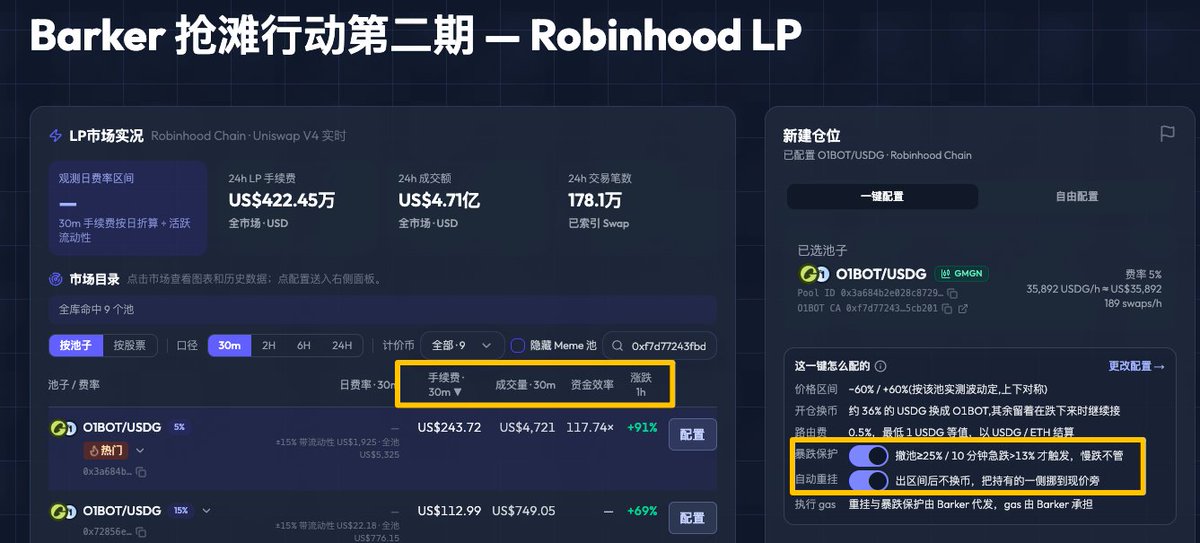
· Go to @BarkerMoneyX to check its LP data: fees over 30 minutes, capital efficiency, etc. You can also configure it with one click; it has "crash protection" and "automatic re-list" features that are quite useful (as seen in 👇 picture 2).
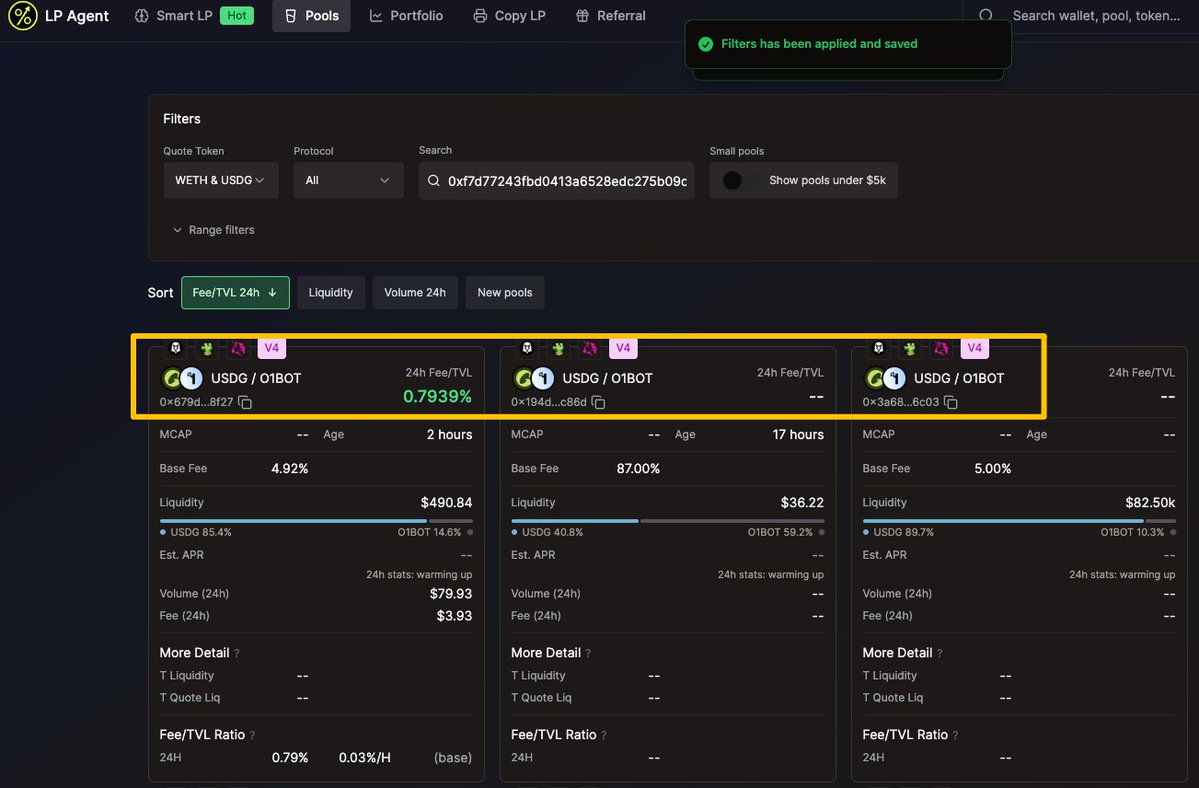
· Go to @lpagent_io and take a look at the smart LPs, their strategies, and build your own strategies. They also make it easy to follow LPs with a single click, a perk for lazy ones (as seen in 👇 picture 3).
If the holders are concentrated in 3-5 wallets, or no real accounts on X are discussing this coin, I will pass regardless of how high the APR is.
4️⃣ 🛠 Execution: How I open positions
The execution tool I use is Uniswap, directly adding liquidity to the pool on the official page.
Why not use third-party tools to create LP? Firstly, for security considerations; secondly, my LP strategy mostly uses Claude to create pairing schemes, which is relatively more flexible.
Here I divide the LP strategy corresponding to the different states of a meme coin's lifecycle into three parts: the rising phase, the sideways phase, and the crashing phase. Each phase employs completely different configuration ideas and strategic plans.
📌 First, remember a basic logic
As an LP, you need to constantly ask yourself two questions:
① Where is the price likely to go next?
② Is my liquidity on the path that the price will take?
Only when the price moves within the range you set can you earn fees. If the price moves out of your range, you turn into a one-sided position, either entirely holding that meme coin (if the price drops below) or entirely holding U or ETH (if the price climbs above).
Understanding this, you will immediately grasp the following three approaches.
🚀 Status One: Rising Phase (new coin just exploded, price rises rapidly)
Characteristics: Trading volume surges in 5 minutes, price rises in steps, narrative on X just starts, target wallets are in profit.
This is the stage with the richest fees, but it’s also the most prone to losses.
My approach: Bid Ask + positioning above
Why? Because the price is rising, I want to place more liquidity above the current price, so that as the price ascends, it continually passes through my position, generating fees.
Specific layout (assuming the current price is $0.01):
Price range $0.010 - $0.013, 40% position, main fee earning range.
Price range $0.013 - $0.020, 35% position, chasing the rising range, can also earn if the price continues to climb.
Price range $0.005 - $0.010, 25% position, lower buffer, in case of a sharp drop to provide a cushion.
Personal advice: During the rising phase, definitely use narrow ranges with multiple segments. The narrower the range, the higher the density of the same amount of money in the unit price interval, thus earning more fees. But this also means that once the price reverses and drops below, you will suddenly find yourself holding a bunch of meme coins. Hence, in the rising phase, what matters most to me is not how much I earn but staying alert for retreat signals (see the last tip 🔔).
⚖️ Status Two: Sideways Phase (price fluctuates back and forth within a range)
Characteristics: Price repeatedly oscillates but does not break, trading volume remains moderate, the target wallets have exited, leaving real traders buying and selling each other. Generally, these meme coins have been issued for over 24 hours and have gone through the most severe PVP stage, making them relatively stable.
This is actually the most comfortable and cost-effective stage. The risk is smaller than in the rising phase, but fees continue to come in.
My approach: Spot concentration + narrow range
Sideways means the price is likely to fluctuate within a range, so I concentrate liquidity highly within this box range, maximizing fees with every oscillation.
Specific layout (assuming oscillating between $0.009 - $0.012):
Price range $0.0095 - $0.0115, 70% position, concentrated in the core oscillation zone with maximum density.
Price range $0.009 - $0.0095, 15% position, lower boundary defense.
Price range $0.0115 - $0.012, 15% position, upper boundary defense.
Why use Spot concentration in the sideways phase? Because you already know that the price is unlikely to stray far, there's no need to spread liquidity too thinly. Concentration = high density = earning more fees during the same oscillation.
During the sideways phase, I can often hold a position for several days, relying on repeated oscillations for stable fees, which is the state closest to "passive income."
💀 Status Three: Crashing Phase (narrative ends, price declines unidirectionally)
Characteristics: Trading volume plummets sharply in 5 minutes, holders begin to collectively withdraw, discussions on X fade, price declines in steps. This is where novices lose their principal. Many people still fixate on the inflated APR on their dashboard at this point.
My approach: Do not do LP, withdraw. Doing LP during the crashing phase is purely a death sentence because:
Volume is gone → fees are almost zero.
Price is declining → your liquidity will all turn into that meme coin that is heading to zero.
The only correct action now is: withdraw your position.
If you still want to take a gamble during a crash (I generally do not recommend this for novices), there is only one extreme play:
Bid Ask + all positioned below + extremely wide range, betting on a dead cat bounce. But this is speculation, not an LP strategy, and the risk is extremely high.
My principle: once the narrative is over, withdraw your principal immediately to save your life. If you keep your green mountains, you can play the next meme coin.
🔔 Universal retreat signals for the three states
No matter what stage I’m in, I’ll immediately be alert if I see these signals:
· Continuous decline in 5-minute trading volume (most important)
· Significant outflow from large wallets
· Discussion heat on X falls sharply
· Price drops below my lowest liquidity range
If I observe two of these, I begin to reduce my position; if I observe three, I exit completely.
Remember, as an LP, you earn from the "frictional fees while money flows." If no money is flowing, you are left with risks without revenues in the pool.
📈 Managing positions: APR is a facade, capital flow is the reality
The APR displayed on various LP tools’ dashboards is a historical snapshot, not a predictor of the future.
The only metric I truly pay attention to is: Is the 5-minute trading volume still there? When a pool’s 5-minute trading volume starts to decline, fees are rapidly disappearing.
At that point, I have a few options:
Move to a new fee tier: Sometimes capital migrates from a 1% pool to a 0.3% pool; I prepare the layout before this migration happens.
Withdraw directly: If the narrative has ended and there are no new catalysts, take the fees and exit.
I do not look at "how high the APR still is"; I look at "if capital is still flowing in this direction."
🔍 Additional advantage: Researching the positions of other excellent LPs
This is something many don’t think of, but it's one of my important sources of profit.
I use @lpagent_io to track the wallets of excellent LP traders. For example, I found some notable wallets in the early days not by copying their positions directly but by studying their logic:
· When did they enter the market?
· How did they set their ranges?
· When would they withdraw?
If you copy someone else's position, the best outcome is that you match them. But if you understand their thought framework, you can do better than them because you can enter earlier and exit more precisely.
💰 Capital management: Why I have survived until now
This part accounts for over 70% of whether you can make a profit, but most people completely overlook it.
My rules:
① Do not exceed 20% of total capital in a single pool at one time
No matter how attractive the opportunity looks, it’s not worth going all in. A meme coin can rise five times in 10 minutes and can also drop to zero in the same timeframe.
② Withdraw part of the principal once fees are earned
Once I have recouped 30%-50% of my initial position in fees, I will withdraw a portion of my principal. Continuing to play with "earned money" feels completely different.
③ Be clear about what you are gambling on
As an LP, you are betting that this coin won't drop too much during your holding period and that there is enough trading volume. It's not about betting it will rise; it's about betting there are friction costs to harvest.
🚀 Summary: What is my real advantage? I have no magical alpha, no insider information.
My advantages boil down to three words: Fast, Accurate, Exit.
Fast: Discovering meaningful trading volume earlier than others.
Accurate: Using multi-segment ranges to make capital work in the right price intervals.
Exit: Leaving before the capital flow disappears, not being greedy for the last profit.
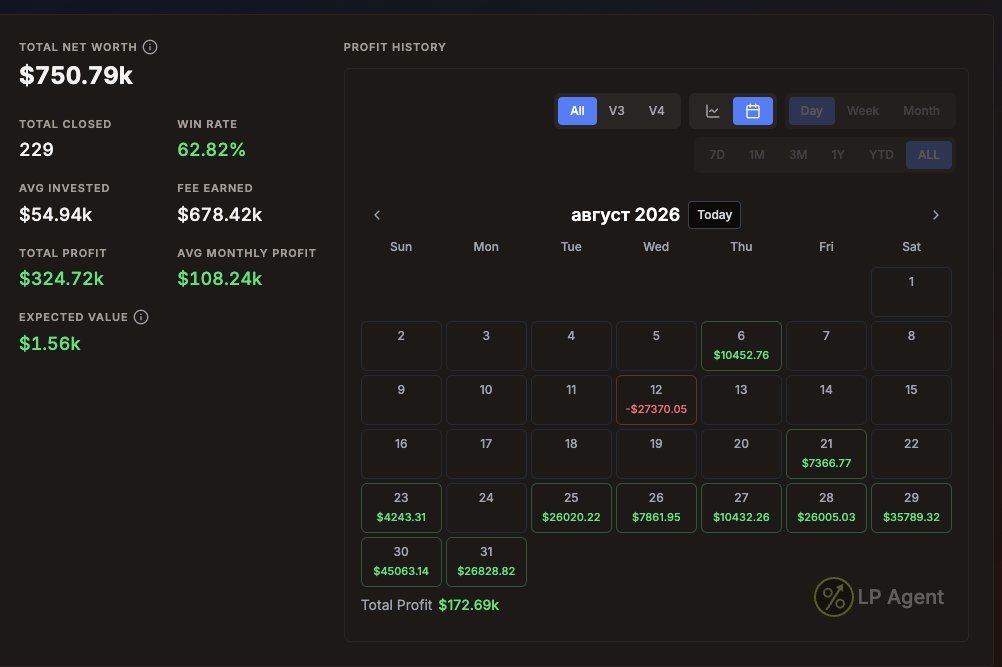
Today I took a quick look; in the past month, I completed a total of 1,281 trades with an 82.2% win rate, all accumulated through continuous practice. The market is never a myth; it’s all about hard work and diligent research. 🧐
免责声明:本文章仅代表作者个人观点,不代表本平台的立场和观点。本文章仅供信息分享,不构成对任何人的任何投资建议。用户与作者之间的任何争议,与本平台无关。如网页中刊载的文章或图片涉及侵权,请提供相关的权利证明和身份证明发送邮件到support@aicoin.com,本平台相关工作人员将会进行核查。


