Japan's 10-Year Government Bond Breaks 3% and Its Impact on the U.S. Stock Market and Cryptocurrency
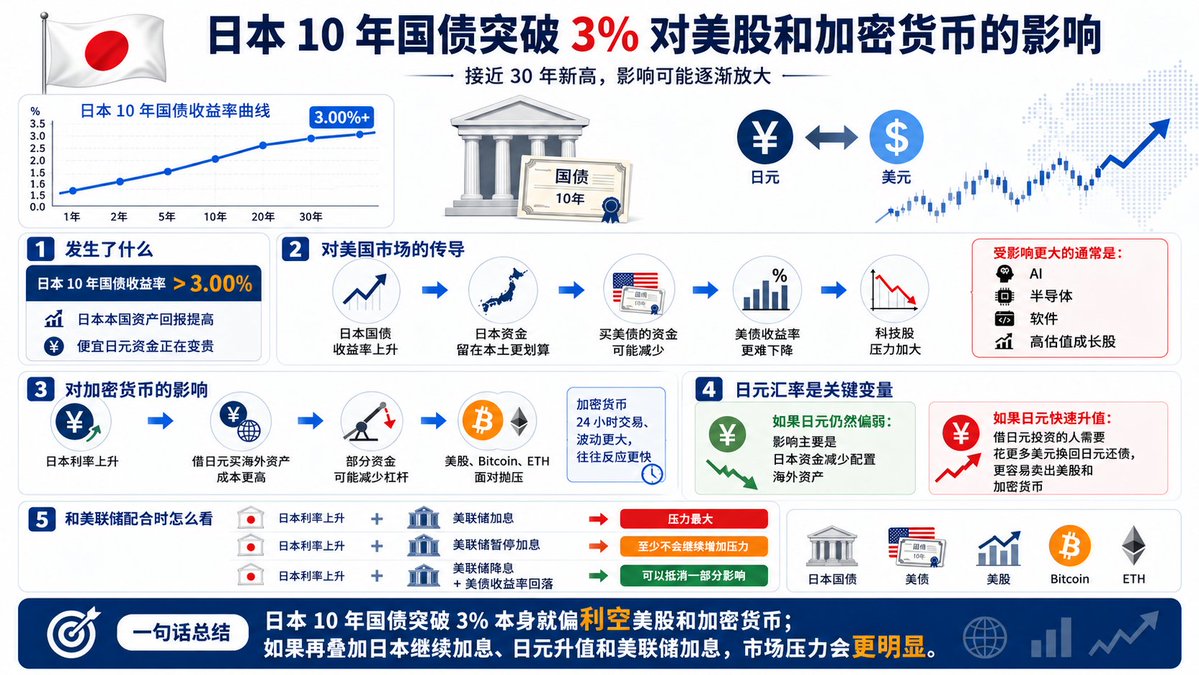
The yield on Japan's 10-year government bonds has officially surpassed 3%, a level not seen for nearly 30 years. I believe this situation will gradually amplify its impact on the U.S. market and cryptocurrencies.
Previously, Japanese interest rates were very low, making it hardly profitable to keep money in Japan. As a result, many Japanese banks, insurance companies, and large investment institutions would convert their money into dollars to buy U.S. government bonds. Now that Japan's own 10-year bonds can yield 3%, many funds will start considering whether it is more advantageous to keep their money in Japan directly.
Japan is also one of the largest foreign buyers of U.S. government bonds. If Japanese institutions reduce their purchases of U.S. bonds, or even bring back some of the money already held in the U.S., the number of long-term buyers of U.S. bonds will decrease. The price of U.S. bonds may fall, and yields will be harder to decline. The cost of borrowing for U.S. companies will remain high, and expensive technology stocks in the stock market will face greater pressure.
In the past, many funds would borrow yen at very low interest rates and then use that money to buy U.S. stocks, U.S. government bonds, Bitcoin, and other assets. As long as Japanese interest rates were low enough, this practice was very profitable. Now that Japan's 10-year bonds have reached 3%, and the Bank of Japan continues to raise interest rates, the cost of borrowing yen is becoming increasingly high.
If Japan continues to raise interest rates, the problem will get even bigger. Those who borrowed yen to buy overseas assets will need to spend more dollars to exchange for the same amount of yen when repaying. This could lead investors to sell some U.S. stocks, bonds, and cryptocurrencies to convert money back into yen for loan repayment.
Additionally, the yen's exchange rate must be considered. If Japanese interest rates rise but the yen remains weak, the impact will primarily be that Japan's funds will reduce purchases of overseas assets. However, if the yen begins to appreciate rapidly, the situation will become more complicated. Not only will the cost of borrowing increase, but one will also need to spend more dollars to convert back to yen to repay debts, making it easier to choose to sell assets.
In other words, Japan's current financial changes are bearish for U.S. stocks and cryptocurrencies. Coupled with potential interest rate hikes by the Federal Reserve, it would mean both Japan and the U.S. are simultaneously raising the cost of funds, leading to a more direct impact on the market. If the Federal Reserve halts its rate hikes, at least it won't add more pressure. Only if it enters a rate-cutting phase, and U.S. bond yields also decline, is there a possibility of offsetting some of the impacts brought on by Japan's rising interest rates.
@Gate Crypto, U.S. stocks, Hong Kong stocks, Korean stocks, gold, CFD, one-stop trading for prediction markets
免责声明:本文章仅代表作者个人观点,不代表本平台的立场和观点。本文章仅供信息分享,不构成对任何人的任何投资建议。用户与作者之间的任何争议,与本平台无关。如网页中刊载的文章或图片涉及侵权,请提供相关的权利证明和身份证明发送邮件到support@aicoin.com,本平台相关工作人员将会进行核查。


