When I first started looking at BTC, the question I was always most concerned about was:
“Can it still go up now?”
When I saw BTC drop, I was afraid it would keep falling; when I saw BTC suddenly rise, I was afraid I would miss out.
After finally judging the direction correctly, I discovered a more troublesome question:
Why can I clearly see the right direction but still possibly lose money in the end?
After watching the livestream of 【Ant AT Club】, I found a relatively simple answer to this question:
Trading is not just about guessing ups and downs.
01 My biggest misconception before: only focusing on “up or down”
Before this livestream, I could easily be swayed by a big green candle.
If BTC suddenly rose, I would think, “Is the bull market coming?”
If I had no position, I would start to struggle: “Is it too late to chase now?”
But during the livestream, as they broke down this round of market from weekly, daily, and 4-hour cycles, I realized:
The market might have changed long before the actual rally started.
This round of BTC had gone through a period of consolidation, and then the trends in different cycles gradually strengthened.
This made me realize more intuitively for the first time: A big rise is not the starting point of the market; many times it is just the moment the trend is seen by everyone.
In the past, when I saw a rise, I would only look at “how much it has risen.”
Now at least I look one step further: Why did it start to rise? Was there any accumulation before the rise?
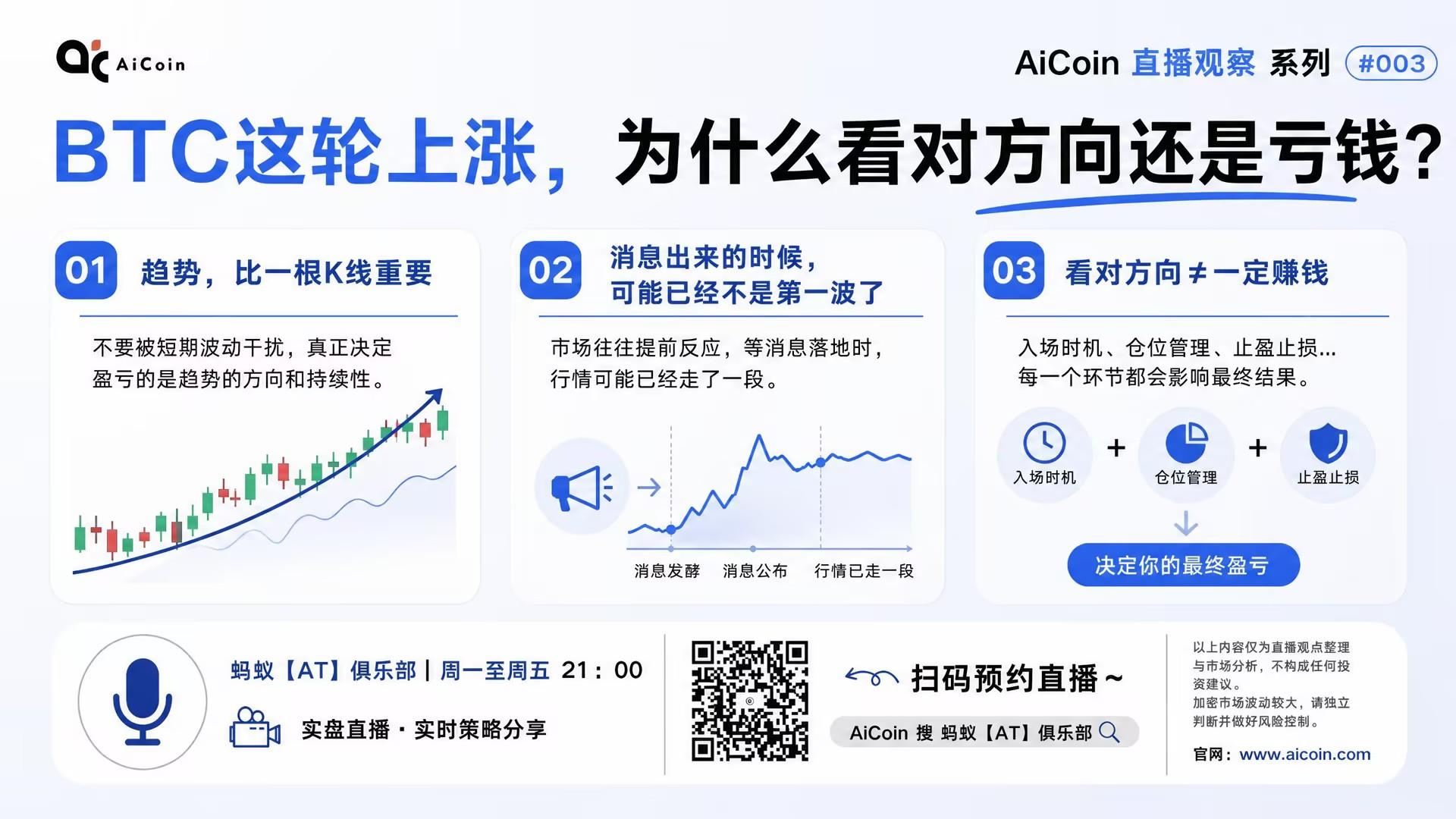
02 First point of knowledge: Trend is more important than a single candlestick
The livestream covered a lot about MACD, weekly, daily, and 4-hour charts.
If I remembered everything, a beginner might easily give up.
So I ultimately left myself a simple version:
Look at the direction on a larger cycle, find changes on a smaller cycle.
For example:
The weekly chart is still strong, indicating that the big direction has not changed significantly;
The daily chart turns strong, indicating that there is potential for further upward movement;
When there is a pullback on the 4-hour chart, it doesn’t necessarily mean that the big trend has ended; it could just be a short-term adjustment.
Looking at BTC this way will prevent me from changing my judgment immediately due to a single red candle.
This is also a mistake I used to make very easily:
When it’s rising, I think it will always rise; when it’s falling, I think the market has ended.
Now I at least know: Short-term pullbacks and trend reversals are not the same thing.
03 Second point of knowledge: When news comes out, it may not be the first wave
This round of market has another very typical aspect.
After the interest rate results were released, BTC rose again.
In the past, upon seeing such news, I would roughly understand it as:
Positive news → BTC rises.
But the “anticipatory trading” mentioned in the livestream made me suddenly understand something: The market may have been trading this news long before.
For example, if the market anticipates a certain result in advance, funds might have already entered the market before the results are announced. When the news actually hits, the price has already responded to part of it.
So in the future, when encountering important news like CPI, interest rate decisions, or employment data, I will remind myself: Don’t just look at the results, but also see what the market was expecting beforehand.
Because what really affects the price is often not “what happened,” but rather: “Did this result exceed market expectations?”
04 Third point of knowledge, and the most important: Knowing the right direction ≠ guaranteed to make money
What impressed me the most in this livestream was not technical indicators, but numerous cases of “being stuck.”
Short-selling at high positions, heavily investing in altcoins, using high leverage, averaging down after losses... Each person's issue seemed different,
but in the end, all pointed to the same thing: The risks were not controlled well.
Assuming you judged that BTC would eventually go up.
You were indeed correct. But if there was a pullback in between, and your leverage happened to not hold up, you would get liquidated.
Then even if BTC did rise later on, it would have nothing to do with you.
So I now believe: The first hurdle in trading is not making accurate predictions, but giving yourself the qualification to wait until those predictions come true.
This is especially important for beginners.
Because the market does not reward “the most confident people.”
Often, it’s those who last the longest who get the chance to wait for the next market move.
05 Why does everyone know to set stop-losses, but it’s really hard to do so?
Because setting a stop-loss means acknowledging: “This time, I might be wrong.”
Just lost a little: “Let’s wait a bit.”
Falling further: “It should just be a pullback.”
Continuing to fall: “I’ve already lost so much; won’t selling now just make it worse?”
In the end, a small loss turns into a big loss.
So my understanding of stop-loss now is not: “Sell quickly once it starts to drop.”
But rather to think in advance: If I'm wrong, where do I exit?
If this isn’t thought through beforehand, when the actual drop comes, people are easily overtaken by their emotions.
06 After watching this livestream, I plan to leave myself a “beginner’s trading checklist”
When encountering a similar market in the future, I won’t immediately ask: “Can BTC still rise?”
Instead, I will first check these five things.
① How is the trend?
Is there any change in the big direction of the weekly and daily charts?
② Where are we now?
Are we near support or have we already rushed to resistance?
Even if the outlook is bullish, different entry points carry completely different risks.
③ What is the market trading?
Is there any important data available?
Has the market already pre-traded any expectations?
④ Can this position be sustained?
Don't suddenly increase your position just because you feel “this time is quite certain.”
Especially for beginners, it's okay not to trade when you don’t understand.
⑤ What to do if I’m wrong?
Think of a stop-loss before entering.
Don’t wait until you've lost before thinking about how to handle it.
07 The biggest cognitive shift this time: from “predicting the market” to “preparing to respond to the market”
I used to think that traders who were good could accurately predict: Whether BTC will go up or down next.
Now my thoughts have changed.
What beginners truly need to learn may not be “how accurate their guesses are,” but rather:
When the trend comes, knowing how to interpret it;
When there is a market pullback, knowing how to judge it;
When the judgment is wrong, knowing when to exit;
When things are unclear, knowing when to stay inactive.
So after watching this livestream, I did not memorize a lot of prices.
Instead, I remembered a simpler logic: First look at the trend, then look at the position; first think about risk, then think about profit.
This may be the place where a trading beginner truly starts to learn.
【Ant AT Club】livestream: Monday to Friday at 21:00 this week
The above content is organized from the current livestream of Ant AT Club, mainly summarizing the core content regarding the BTC trend, technical signals, market expectations, and trading risks from the livestream, and re-organizing it from the perspective of a trading beginner.
If you want to continuously track the latest market conditions, changes in the market, and market analysis, you can follow AiCoin's official website for the 【Ant AT Club】livestream from Monday to Friday at 21:00.
One-click reservation:https://www.aicoin.com/zh-Hans/live
Ant AT Club | Monday to Friday at 21:00
🎙️ Livestream Room:https://meeting.tencent.com/p/7860443965
The above content is only a collation of livestream opinions and market analysis, and does not constitute any investment advice. The cryptocurrency market is highly volatile, please make independent judgments and control your risks.
免责声明:本文章仅代表作者个人观点,不代表本平台的立场和观点。本文章仅供信息分享,不构成对任何人的任何投资建议。用户与作者之间的任何争议,与本平台无关。如网页中刊载的文章或图片涉及侵权,请提供相关的权利证明和身份证明发送邮件到support@aicoin.com,本平台相关工作人员将会进行核查。