Hotcoin Research | The AI revolution continues, why is the AI stock market starting to squeeze out the bubble?

CN
Hotcoin
Follow
3 hours ago

By the end of July 2026, the prolonged global AI investment boom suddenly encountered a chill, revealing cracks in the market structure supported by high valuations and high leverage. The KOSPI index in South Korea dropped more than 10% in a single day on July 28, with core companies in the AI supply chain such as Samsung Electronics and SK Hynix becoming centers of sell-offs; during the same period, the hedge fund Situational Awareness, which focuses on AI stocks, sold off its publicly held stock portfolio after suffering losses. Notably, this round of decline did not occur against the backdrop of stagnant AI demand, collapsed chip revenues, or a regression in model capabilities. On the contrary, Microsoft's Azure, Google Cloud, and AWS still maintained strong growth, and Nvidia's data center revenues continued to hit new highs.

This seemingly contradictory phenomenon is the starting point for understanding the AI bubble: technological revolutions and asset bubbles are not mutually exclusive. AI can continuously improve productivity, create new product entry points, while at the same time there can be excessive capital expenditure, imbalanced financing structures, and asset prices being overshot. The real question that needs to be answered is not "Is AI valuable at all?" but whether industrial revenues, capital investments, and financial pricing are still aligned. When technological progress occurs on a monthly basis, industrial returns on an annual basis, and market pricing changes on a second-by-second basis, the risk of a bubble accumulates in the misalignment of these three speeds.

1. AI Capital Risks are Accumulating: Simultaneous Amplification of Industrial Growth and Asset Bubbles

To determine whether an AI bubble exists, one must first distinguish between industrial realities and financial pricing. The number of AI users, model capabilities, cloud computing demand, and chip revenues are all increasing, enough to negate the claim that "there is absolutely no real demand for AI"; however, industrial reality does not equal valuation rationality, nor does it imply that every capital expenditure will yield sufficient returns.

1.1 AI Demand is Still Growing, Industrial Prosperity is Not Fabricated

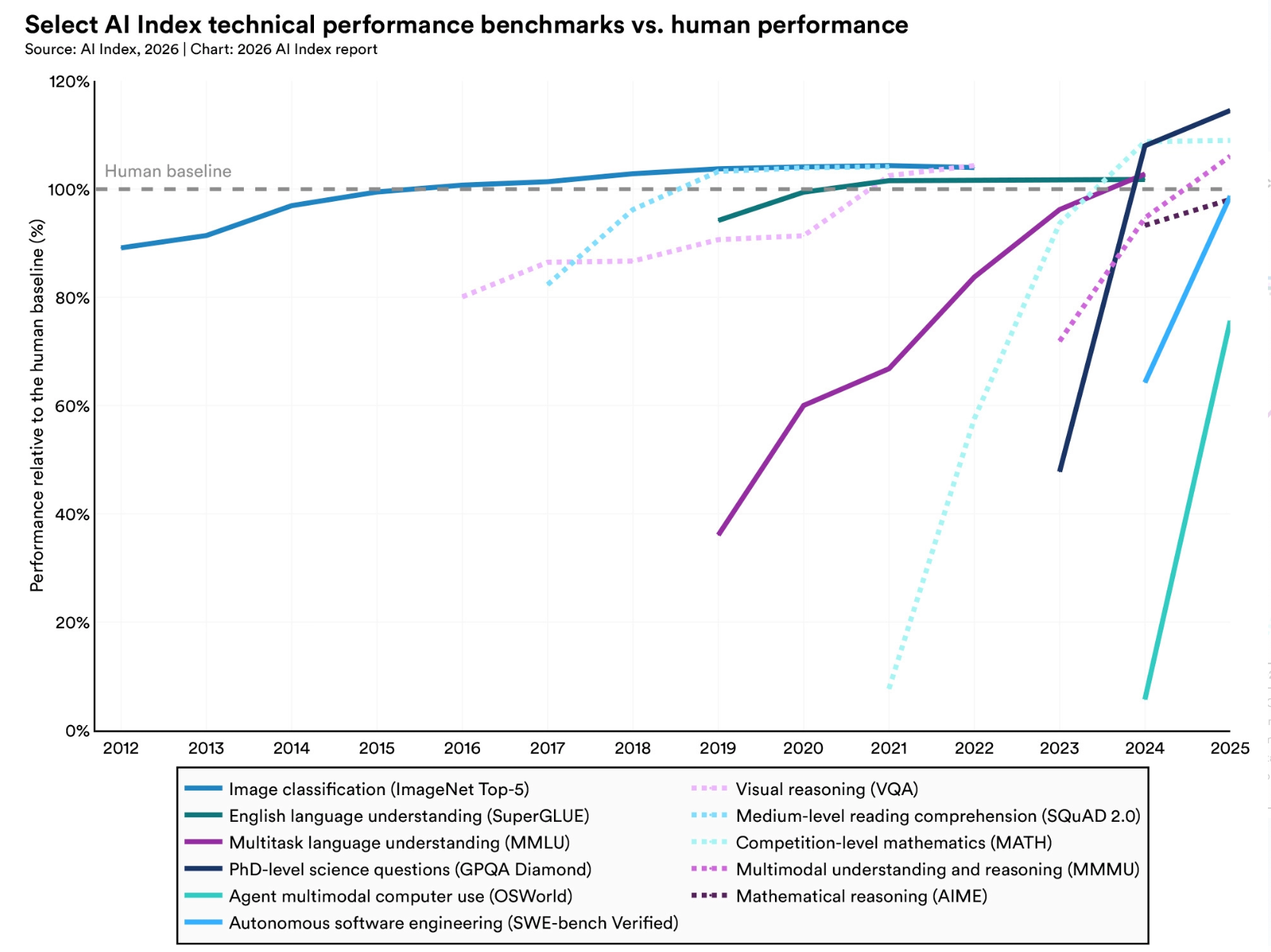
The Stanford University AI Index Report 2026 shows that the adoption rate of AI among surveyed institutions has reached 88%, and generative AI has reached approximately 53% of the global population within three years. Model capabilities are also not stagnant: several cutting-edge models have approached or exceeded human benchmarks in tests like PhD-level scientific questioning, multimodal reasoning, and competitive mathematics.

Source: https://hai.stanford.edu/ai-index/2026-ai-index-report

Commercial data is also improving. By the second quarter of 2026, Microsoft's Azure annual revenue exceeded $100 billion for the first time, Microsoft 365 Copilot paid seats surpassed 30 million; Amazon's AWS second quarter revenue grew by 37% year-on-year, reaching an annualized revenue level of $169 billion; Google Cloud's revenue grew by 82% year-on-year, with backlogs reaching $514 billion. Nvidia's data center revenue reached $193.7 billion in fiscal year 2026, an increase of 68%. These data demonstrate that companies are indeed paying for computing power, cloud services, and AI tools, and AI is not just an empty shell with valuation but no revenue.

1.2 The Bubble Comes from “Investment Outpacing Returns”

A more accurate definition of the AI bubble is not an increase supported by false technology but an excessive capitalization of real technology by the market. According to MSCI statistics, as of May 2026, U.S. AI-related companies' capital expenditures rose nearly 60% year-on-year, about ten times that of non-AI companies, but the revenue growth rate was significantly lower than the capital expenditure growth. Meanwhile, AI-related companies enjoyed valuation premiums in most markets, with AI-related enterprises in the U.S., South Korea, and Taiwan trading at about three times the price-to-book ratio of local non-AI companies.

Market concentration further magnifies this pricing. Data from S&P Dow Jones indices show that as of June 30, 2026, the top ten components of the S&P 500 index collectively weighted about 36.4%; depending on different dates and index adjustments, this ratio was once close to 40%. With the exception of JPMorgan Chase, the remaining positions are occupied by large technology or semiconductor companies. When tech giants simultaneously bear the triple roles of index weight, AI capital expenditure, and profit growth, AI no longer merely represents an industrial sector, but becomes a core risk factor jointly held by global passive funds, pension funds, and index products. When the market rises, concentration can amplify profits; when the market turns, the same structure can also amplify downturns.

1.3 The Decline of Tech Stocks Exposes the Fragility of Market Structure

The adjustment of AI stocks in July 2026 shows that market pricing has shifted from “revenue growth” to “can growth cover investments.” After Samsung Electronics and SK Hynix reported strong earnings, their stock prices still fell significantly; by the end of July, the KOSPI index dropped more than 10% in a single day. This indicates that when market expectations are high enough, merely achieving growth is insufficient to support prices; companies must consistently exceed expectations and prove that the new production capacity will not turn into inventory, depreciation, and price competition in the future.

According to Axios, Situational Awareness, the AI hedge fund founded by former OpenAI researcher Leopold Aschenbrenner, has sold off all public stock portfolios. While this certainly cannot prove that the AI bubble has burst, it reveals a more realistic side of the capital market: Even if long-term directional judgments are correct, high concentration and high leverage may still prevent investors from waiting for long-term logic to materialize. Often, what first strikes investors is not the fundamental performance of companies but the cash chain and liquidity.

Industrial growth in AI and asset bubbles can coexist. The growth in demand affirms that the AI revolution is ongoing, but capital expenditure, market concentration, and valuation premiums have escalated the question of whether “the technology is effective” into whether “capital returns can be realized.” The recent decline is not a confirmation of the end of an industrial cycle, but a clear signal that financial structures are beginning to feel the strain.

2. How the AI Bubble Formed: Simultaneous Expansion of Capital Expenditures, Depreciation Pressure, and Financial Leverage

The AI bubble is not caused by a single company or a single valuation metric, but is a continuous process: insufficient computing power drives capital expenditure, capital expenditure supports upstream revenues, upstream revenues reinforce market narratives, rising stock prices reduce financing costs, ultimately attracting more capital. When this cycle operates fast enough, the market can easily mistake short-term supply constraints for the belief that long-term profits can grow indefinitely.

2.1 The Four Major Tech Giants' Capital Expenditures Approaching Historical Extremes

According to the latest guidance for 2026, the total annual capital expenditures of Microsoft, Alphabet, Amazon, and Meta are approximately $720 billion to $745 billion. If we reclassify the portion of Microsoft that was moved out of capital expenditures due to lease accounting changes back into economic investment, the actual AI infrastructure investment scale for the four companies is approximately $735 billion to $760 billion.

Company

2026 Capital Expenditure Guidance

Latest Changes

Main Investment Directions

Microsoft

About $175 billion

Original guidance around $190 billion, adjusted down after lease classification changes, but economic investment plan unchanged

GPU, CPU, data centers, and networks

Alphabet

$195 billion–$205 billion

Increased by about $15 billion from previous guidance

Servers, data centers, networks, and AI R&D

Amazon

About $220 billion

Increased by $20 billion from the initial plan

AWS, AI chips, robotics, and satellites

Meta

$130 billion–$145 billion

Lower limit of guidance raised from $125 billion

AI training, inference clusters, and data centers

Data Source: Each company's 2026 financial reports and management guidance. Each company has different statistical standards for capital expenditures, financing leases, and other infrastructure investments; the aggregate value is used to observe investment intensity and does not represent fully comparable accounting standards.

The International Energy Agency (IEA) reports that, driven by data center construction, capital expenditures of Microsoft, Amazon, Google’s parent company Alphabet, Meta, and Oracle exceeded $400 billion in 2025, even higher than investments in global oil and gas production; by 2026, it is expected to grow by about 75%, nearing $700 billion. The enormous investment is beginning to translate into real energy pressures: global data center electricity demand grew by 17% in 2025, significantly higher than the 3% growth rate of global electricity demand, with AI data centers growing even faster. According to IEA's predictions, by 2030, global data center electricity consumption will double from the current level, with AI data centers' electricity consumption potentially increasing to three times the current level.

However, capital expenditures have a significant time lag: the GPUs, land, and power purchased today require several years of user growth to recover. A slight deviation in demand judgment could quickly shift from “insufficient computing power” to “excess capital.”

2.2 The Return Threshold for New Investments is Rising

Meta's second quarter revenues reached $60.8 billion, up 28% year-on-year, but capital expenditures for the quarter amounted to $31.08 billion, with free cash flow remaining at $784 million. Amazon's operating cash flow over the past 12 months reached $161.4 billion, but net spending on property and equipment rose to $169 billion, turning free cash flow from an inflow of $18.2 billion in the same period last year to an outflow of $7.6 billion. Alphabet’s second quarter capital expenditures were about $44.9 billion, and they raised their annual guidance to $195 billion–$205 billion.

Microsoft's situation is relatively stable. Its capital expenditures for the fourth quarter of fiscal year 2026 were $41 billion, with free cash flow remaining at $19.6 billion, and Azure revenue grew by 43%. This indicates that enormous AI investments have not placed all tech giants in simultaneous cash flow crises. What deserves attention is not whether these companies will run out of money immediately, but rather how much new revenue and free cash flow each additional dollar of capital expenditure can bring in the future.

This is also a significant distinction between the current AI bubble and the 2000 internet bubble. Companies currently bearing the majority of capital expenditures generally have established cash flow sources from advertising, cloud computing, software subscriptions, and e-commerce, making them more resilient to risk. However, a giant not going bankrupt does not mean its stock price will not be reevaluated, nor does it imply that supply chains and highly valued startups can withstand a slowdown in capital expenditures.

2.3 Rapid Iteration of GPUs Creates Depreciation Pressure

Microsoft disclosed that about two-thirds of its capital expenditures for the fourth quarter of fiscal year 2026 were allocated to short-cycle assets such as GPUs and CPUs. Alphabet also stated that about 60% of its technology infrastructure investment went to servers, with the remainder mainly for data centers and networks. Land and buildings can be used for decades, but GPUs, servers, and network equipment require continuous updates, and the actual economic lifespan is much shorter than that of data center buildings.

This creates an easily overlooked paradox: the faster AI technology advances, the quicker the economic value of previous-generation equipment declines. New chips can significantly reduce unit inference costs and promote industry adoption, but they may force cloud vendors to update their equipment ahead of schedule. Technological progress serves as a deflationary force for users, but it may become a depreciation accelerant for equipment holders.

Therefore, to determine whether AI capital expenditures are excessive, one should not only look at the number of data centers but also consider equipment utilization rates, unit computing power revenues, and the replacement speed between new and old chips. If new production capacity cannot quickly convert into stable loads, GPU inventories could transform from “scarce assets” into surplus equipment that needs to be depreciated.

2.4 Circular Financing Likely Overstates Demand Independence

The AI industry exhibits a unique capital cycle: cloud vendors invest in model companies, which after receiving financing purchase cloud computing power, and cloud vendors then incorporate these contracts into backlogs and future revenues. Microsoft disclosed that OpenAI's new Azure service commitments have reached $250 billion; as of the fourth quarter of fiscal year 2026, Microsoft's commercial remaining performance obligations reached $678 billion, an increase of 84% year-on-year, excluding OpenAI, the growth was 25%.

This does not equate to revenue fraud. Model training indeed consumes computing power, and cloud vendors also genuinely deliver servers, power, and network services. However, it implies that some demand does not entirely originate from terminal clients that have already realized positive cash flow but relies on the financing capabilities of model companies. When the capital market is willing to continuously provide funding for model companies, the cycle can expand; once financing costs rise, computing power demand may decline even faster than apparent orders.

It is noteworthy that Microsoft’s latest financial report also shows that its commercial order growth is mainly coming from clients outside leading model companies, with nearly 90% of annual cloud revenue derived from outside model companies. This indicates that AI demand is spreading to the enterprise market and must not be simplified as solely reliant on circular financing. What needs to be closely observed is whether external enterprise demand can gradually replace financing-driven demand and emerge as the long-term payer for AI infrastructure.

3. The AI Supply Chain Diverges: Real Revenue Exists, but Profit Distribution is Uneven

The AI supply chain is not a whole with completely aligned interests. Chip manufacturers, cloud platforms, model companies, and application developers are at different cash flow stages and bear different risks. The segment currently experiencing the fastest revenue growth may not be the segment with the most stable long-term profits; conversely, the most heavily invested segment may not ultimately receive the largest value distribution.

3.1 Chip and Equipment Manufacturers are First to Realize Revenue but are Most Susceptible to Order Reversal Shocks

AI capital expenditure has begun to translate into actual revenue for upstream companies. Nvidia's fiscal year 2026 revenues reached $215.9 billion, an increase of 65% year-on-year, with data center revenues at $193.7 billion, up 68%. Chip and infrastructure software company Broadcom also maintained rapid growth, with quarterly revenues of $22.2 billion as of May 3, 2026, a 48% year-on-year increase. This demonstrates that true procurement demand has emerged in AI infrastructure construction; however, whether rapid revenue growth can be sustainably converted into stable profits still depends on customer capital expenditures, product pricing, and supply chain health.

However, the high boom upstream stems from concentrated customer investment. When Microsoft, Amazon, Meta, and Alphabet simultaneously expand data centers, chips, HBM, advanced packaging, optical modules, and power equipment all benefit; if two or three of those companies cut capital expenditures, the order changes for supply chain enterprises will be simultaneously magnified. Chip companies face not only demand cycles but also technological iterations, inventory, and competition from self-researched chips by customers.

Thus, the primary risk of current AI hardware lies in the market extrapolating temporary high profit margins into a long-term norm. Hardware companies may continue to grow but will struggle to maintain a state of simultaneous supply shortages, rising prices, and continued repeat purchases from customers permanently.

3.2 Cloud Vendors Control Access to Computing Power but Bear the Heaviest Capital Expenditures

Cloud vendors are the segment in the AI supply chain closest to a “toll road.” Microsoft, Google, and Amazon not only lease GPUs but also provide databases, storage, security, identity, model deployment, and enterprise software. Once customers migrate their data and business processes to cloud platforms, the cost of migration increases, enabling cloud vendors to extend beyond just selling computing power to encompass a complete AI technology stack.

Latest data demonstrates this capability: Azure's annual revenue has surpassed $100 billion, AWS's second quarter operating profit reached $16.6 billion, increasing the operating profit margin to 39.4%; Google Cloud's revenue grew by 82% with backlog orders reaching $514 billion. Compared to standalone model companies, cloud vendors have broader customer bases and more revenue sources.

However, cloud vendors face the problem of needing to pre-purchase equipment and power for future demand. When application demand is insufficient, model companies can reduce their call volume, and enterprise clients can scale back trial projects, but cloud vendors still bear the costs of data center leasing, depreciation, and energy. Therefore, cloud platforms have stronger long-term bargaining power but also bear larger balance sheet risks.

3.3 Model Capabilities are Continuously Improving, but Models are Becoming Easier to Replace

OpenAI disclosed that its enterprise business has contributed to over 40% of revenues, processing over 15 billion tokens per minute through its API; the Stanford AI Index also shows that the gap in comprehensive capability rankings has clearly narrowed among several top models. Model demand continues to grow, but the competition between leading models is transitioning from “can it complete tasks?” to “who is cheaper, more stable, and fits specific scenarios better?”

This will have a bidirectional impact. The decline in model prices and improvements in inference efficiency are favorable for expanding the scale of AI usage, but they will compress the unit revenue of model companies. Open models, self-developed models by cloud vendors, and vertical models are continuously entering the competition, and enterprise clients are beginning to adopt multi-model architectures to avoid being locked into a single supplier. Microsoft disclosed that since 2026, the number of clients using multiple model suppliers has increased fivefold, indicating that model substitution has shifted from a technical possibility to an enterprise procurement strategy.

Model companies can still build strong brands, data, and user networks, but establishing a long-term monopoly based solely on leading model parameters is becoming increasingly difficult. The real barriers in the future may stem from corporate data, distribution channels, user workflows, and unit inference costs rather than a single benchmark test lead.

3.4 The Application Layer Determines Final Demand but Has Yet to Prove Profit Contribution Universally

AI truly creates value when companies redesign processes rather than merely adding an AI tool for employees. Customer service, programming, financial analysis, medical records, and supply chain management have already produced quantifiable cases, but bridging the gap from single-point efficiency improvements to overall company profit growth involves data governance, system integration, employee training, and accountability separation.

The capital expenditure on the application layer is relatively low but has the greatest opportunity to benefit from declining model costs; however, the competitive threshold may also decrease. A multitude of AI applications rely on the same foundational models, making functionalities easy to replicate, ultimately leading profits back to traditional software companies that hold client relationships and business data. The long-term winners in the AI industry are unlikely to be the companies with the strongest models but rather those that best integrate models into paid processes.

The AI supply chain has generated real revenue, but profit distribution is unstable. Hardware benefits first but also faces order cycles; cloud vendors control access but bear capital expenditures; model companies grow rapidly but are affected by price competition; the application layer is closest to the ultimate value but still needs to prove scalable profits.

4. The Crypto Market Becomes a 24/7 Leverage Transmission Layer for AI Risks

The traditional stock market primarily trades within fixed hours, but crypto platforms are converting expectations for Nvidia, Microsoft, AI indices, leveraged ETFs, and AI startups into round-the-clock contracts, allowing users to conveniently participate in global AI asset trading through platforms like Binance and Hotcoin. The crypto market has not created an AI bubble but has altered the way risk is traded, amplified, and transmitted. It extends AI risk from the trading hours of stocks to an all-day market, adding more layers of risk through perpetual contracts, leveraged ETFs, and AI-related tokens. This increases global participation and price discovery speed while also facilitating oracle biases, funding rates, and forced liquidations in asset pricing more quickly.

4.1 Stock Perpetuals are Extending AI Trading Beyond Traditional Market Closures

CoinGecko data shows that the monthly trading volume of RWA perpetual contracts has grown from $230 million in early 2025 to $34.717 billion in May 2026, accumulating a total trade volume of $1.32 trillion in the first five months of 2026. The monthly trading volume of stock perpetuals has increased from $83.1 million in July 2025 to $3.4 billion in May 2026, a nearly 40-fold increase.

The AI supply chain has been a significant driver of perpetual stock growth. In May 2026, the trading volume of Micron-related stock perpetuals skyrocketed from $736 million the previous month to $13.16 billion, an increase of about 17 times; Nvidia, Tesla, and Circle similarly rank among high trading volume targets. By June 2026, the monthly trading volume of RWA perpetuals further approached $470 billion.

Most of these products are not stock tokens and do not imply that users hold corresponding company stocks. They are typically synthetic contracts referencing oracle prices, maintained via margins and funding rates. Users trade stock price fluctuations rather than voting rights, dividends, or residual equity in a company.

4.2 Leveraged ETFs Perpetually Compound Double Leverage, Turning Path Loss into Liquidation Risk

Stock perpetuals already encompass margin leverage. If the contract targets two-fold or three-fold leveraged ETFs, the risk structure further complicates itself: the first layer comes from the daily leverage resets within the ETFs, and the second from the margins and forced liquidations of perpetual contract accounts.

Leveraged ETFs do not guarantee achieving a fixed multiple of the cumulative returns of the underlying assets within a week or a month. The U.S. SEC has provided real-life cases: an index that increased by 2% over four months resulted in a double-leveraged ETF actually declining by 6%; another index that rose by about 8% saw its triple-levered ETF fall by 53%. This is due to daily resets, compounding, and path losses.

If users further leverage ETFs through perpetual contracts, the underlying asset's path loss, perpetual funding rates, and account liquidation thresholds act concurrently. During market downturns, leveraged ETFs need to reduce risk exposure, while perpetual accounts may also face forced liquidations, forming a feedback chain of “underlying stock falls—ETF reduces position—perpetual liquidation—liquidity continues to decline.”

4.3 AI Tokens Adopt Tech Narratives but Usually Don’t Capture Similar Cash Flows

In addition to stock perpetuals, the crypto market also engages tech stock narratives through AI tokens, AI Agents, and DePIN projects. However, these tokens differ in rights structure from publicly traded AI companies. Holding Nvidia shares represents rights to the company's profits and residual assets, but holding a certain AI token does not necessarily confer rights to protocol revenues, computing power equipment, or legal claims to model companies.

This means that the same "AI growth" narrative may become more abstract once it enters the crypto market. Ownership of users by a project does not equate to tokens capturing revenue, and generating revenue on a network does not guarantee it will be distributed to token holders. The valuations of some projects are more reliant on expectations of future adoption, token liquidity, and market sentiment rather than verifiable cash flows.

What truly matters is not whether a project uses the concept of AI, but the role of the token in the system: is it used to pay for actual computational power, obtain service discounts, bear network security, or share verifiable revenue? If a token merely serves as a narrative vehicle, then during adjustments in tech stocks, it often bears larger downturns than publicly traded companies with mature cash flows.

4.4 Oracles and Continuous Liquidation Shorten Risk Transmission Times

In March 2026, S&P Dow Jones indices officially authorized Trade[XYZ] to launch perpetual contracts based on the S&P 500 on Hyperliquid, indicating that traditional index providers have started to acknowledge the commercial value of crypto perpetuals as new distribution channels.

However, 24/7 trading also introduces new pricing issues. After U.S. market closures, underlying stocks do not have continuous trading, so stock perpetuals can only price based on index futures, related assets, market maker quotes, and changes in market expectations. At this time, contract prices reflect the expectations for the next opening rather than immediately arbitrageable spot prices. When significant events occur over the weekend, contracts may deviate substantially from the previous trading day's closing prices.

When traditional markets reopen, spot prices, oracle rates, and perpetual positions need to converge again. If the differences are too large, high-leverage positions might be liquidated before spot liquidity is restored. Therefore, the crypto market provides a more continuous expression of risk but does not necessarily offer a more accurate fundamental price. It primarily serves as a continuous trading layer for sentiment, leverage, and expectations.

5. Outlook and Conclusion: AI Will Not Disappear Due to Bubbles; Markets Will Return to Cash Flow Pricing

The AI market is simultaneously facing two opposing forces. On one hand, the latest growth data from Microsoft, AWS, and Google Cloud indicates strong demand for computing power and enterprise AI; on the other hand, cash flow pressures on Meta, Alphabet, and Amazon highlight that capital expenditures have entered a stage where they must prove returns.

This combination makes it easier for the market to experience scenarios where “strong earnings reports coexist with weak stock prices” or “high investments lead to strong rebounds.” What investors trade is no longer whether there is demand for AI, but how much better the actual results are compared to high expectations. Once expectations are sufficiently high, even if revenues continue to grow, a slowdown in growth rate or continued increases in capital expenditures may still trigger price adjustments. The focus of the market is shifting from “how many GPUs are owned” to “how much cash flow can be generated per dollar of investment.”

In the next one to two years, the AI market may yield three potential outcomes: If enterprise demand grows rapidly and absorbs new computing power, capital expenditures will gradually translate into revenues and profits, allowing the market to achieve relatively mild digestion; if demand continues to grow but does not keep pace with investment speed, the industry may not collapse but will undergo valuation adjustments and profit redistribution, with the divergence between chip, cloud platform, model, and application companies becoming more evident; if financing conditions tighten, model companies cut back on computing power purchases, and cloud vendors reduce capital expenditures, upstream orders may weaken synchronously, leading the market further into a downturn in profit expectations following valuation adjustments.

To determine whether risks are escalating, five signals need to be monitored: whether capital expenditures continue to outpace AI revenues, whether free cash flow continues to deteriorate, whether depreciation pressure is significantly increasing, whether cloud orders can diffuse from model companies to enterprise customers with independent payment capabilities, and whether enterprise-level AI can genuinely improve renewals, costs, and profits. If these indicators weaken simultaneously, combined with rising market concentration, margin financing, and the scale of leveraged products, what may initially be limited changes in fundamentals could evolve into more severe price fluctuations.

Conclusion

The AI revolution is far from over, yet the bubble warning has been triggered, and the two are not contradictory. Advancements in technological capabilities will expand applications, reduce costs, and create new industrial opportunities, while also stimulating corporate reinvestments, accelerating equipment depreciation, and raising market expectations. The faster the technological progress, the easier it is for capital to assume that future distant revenues can be incorporated into today's prices.

Historic railway, internet, and fiber optic constructions all prove that technological revolutions can transform the world while causing substantial losses for many investors. The true long-term value of AI will not be negated by a single tech stock adjustment, nor will all AI assets automatically become winners due to a correct industrial direction.

The crypto market further extends this pricing experiment into 24/7 uninterrupted trading. Stock perpetuals, leveraged ETF perpetuities, and AI tokens provide more users with AI exposure while allowing valuations, leverage, and liquidations to interact at a faster pace. Ultimately, whether AI assets can traverse the bubble will not depend on how long the narrative can continue but on whether cash flows can catch up with investments before capital patience wears thin.

About Us

Hotcoin Research, as the core analytical institution of the Hotcoin Exchange, is committed to transforming professional analysis into your practical tool. Through "Weekly Insights" and "In-depth Research Reports," we analyze market dynamics for you; leveraging our exclusive column "Hotcoin Featured Selection" (AI + expert dual screening), we help you identify potential assets and reduce trial and error costs. Every week, our researchers also connect with you face-to-face through live broadcasts, interpreting hot topics and predicting trends. We believe that warm companionship and professional guidance can help more investors navigate through cycles and seize the value opportunities of Web3.

Risk Warning

The cryptocurrency market is highly volatile, and investing carries risks. We strongly recommend that investors conduct investments under a strict risk management framework based on a thorough understanding of these risks to ensure the safety of their funds.

Website: https://www.hotcoin.com/zh_CN/learn/index/

X: x.com/Hotcoin_Academy

Mail:labs@hotcoin.com

免责声明:本文章仅代表作者个人观点,不代表本平台的立场和观点。本文章仅供信息分享,不构成对任何人的任何投资建议。用户与作者之间的任何争议,与本平台无关。如网页中刊载的文章或图片涉及侵权,请提供相关的权利证明和身份证明发送邮件到support@aicoin.com,本平台相关工作人员将会进行核查。

Share To
APP

X

Telegram

Facebook

Reddit

CopyLink