Indeed, over the past decade or so, oil prices have underperformed compared to many industrial metals. However, there are many reasons to suppress the increase in oil prices, not merely due to the collective price rise of commodities:
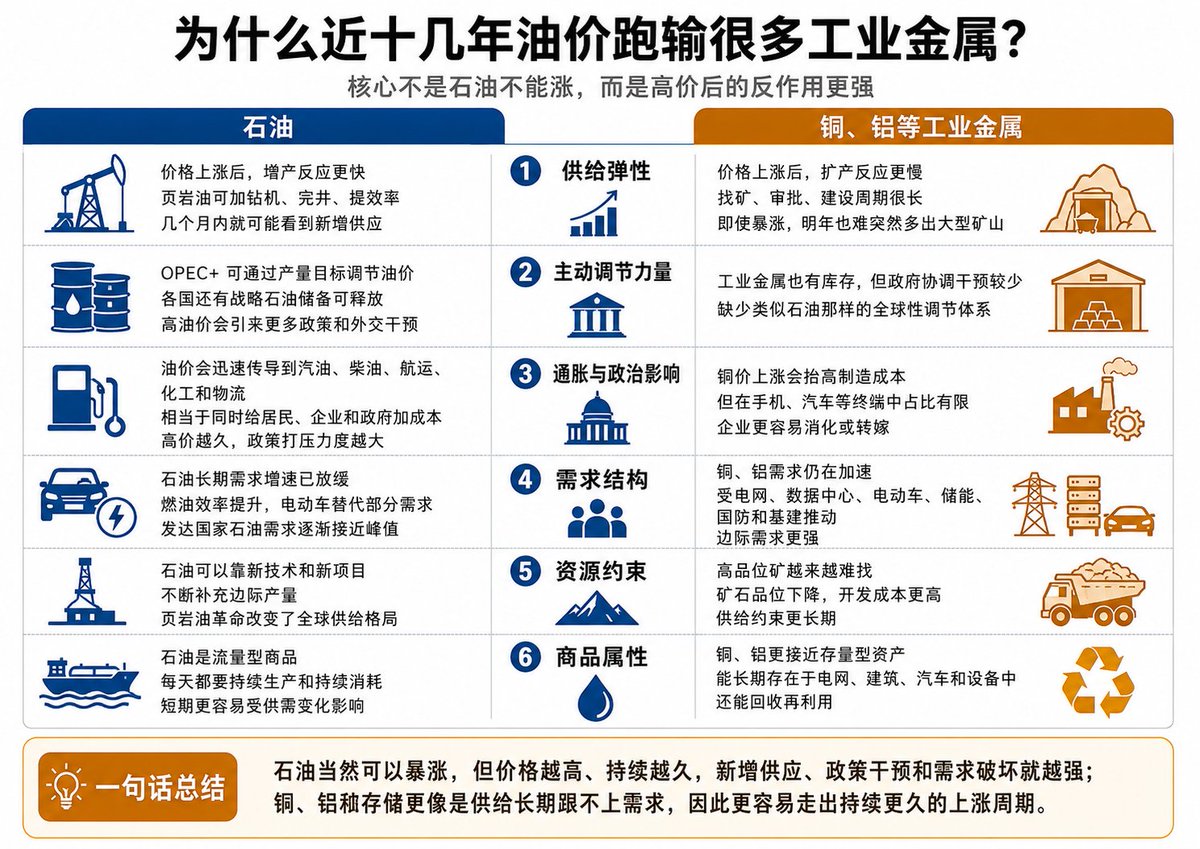
1. The supply elasticity of oil is high, while the supply elasticity of metals is low; this is one of the fundamental reasons for the divergence in their trends.
In simple terms, after the price of oil rises, the speed at which the market can increase production is usually faster than that of metals. Especially for U.S. shale oil, a project can be divided into numerous independent wells. After the price of oil goes up, oil companies can increase rigs, complete inventory wells, and improve the efficiency of individual wells, allowing for some new supply to be seen within months.
OPEC can also release idle capacity, and countries like Brazil, Canada, and Guyana will similarly increase investment when oil prices are high. The EIA expects that U.S. crude oil production will be about 13.7 million barrels per day in 2026 and may rise to 14.2 million barrels per day in 2027, indicating that high oil prices will continue to stimulate non-OPEC supply growth.
Copper mines, bauxite mines, and other large metal mines are completely different. First, sufficient good ore bodies must be discovered, followed by exploration, financing, environmental approvals, land negotiations, infrastructure construction, and mine construction. According to IEA statistics, it takes an average of about 16.5 years for mining projects from discovery to formal production.
In simple terms, even if copper prices spike today, it is very difficult to suddenly open a large copper mine next year.
This means that once oil prices rise, new supply will appear more quickly, while after metal prices rise, supply may lag behind for many years.
2. There has been a long-term force actively regulating supply in the oil market.
OPEC and OPEC+ manage oil prices through production targets. When prices are too low, they cut production; when prices are too high and demand is compromised, there is also a motivation to gradually restore output. Countries like Saudi Arabia and the UAE, which produce oil, certainly hope for rising oil prices but also do not want prices to stay high long enough to destroy demand, accelerate the replacement by new energy, or push the global economy into recession.
At the same time, oil also has strategic reserves as a buffer. The United States, China, Japan, South Korea, and Europe all store crude oil, which can be released from inventory to stabilize prices in the event of a sudden supply interruption. Industrial metals also have inventories, but they rarely have a globally coordinated government reserve system aimed at stabilizing prices and energy security like oil.
Thus, after oil prices rise, companies are not only faced with increasing production but also multiple interventions from OPEC policies, government reserves release, diplomatic negotiations, and military actions.
3. The impact of oil prices on global inflation and politics is far greater than that of any single industrial metal.
An increase in copper prices raises production costs for electricity grids, automobiles, and electronic products, but the cost proportion of copper in end products is limited. A 30% rise in copper prices will not lead to a simultaneous 30% increase in the price of a smartphone or a car; companies can absorb the increase by lowering profits, reducing other costs, using recycled copper, or delaying projects.
Oil prices quickly translate into gasoline, diesel, aviation fuel, shipping, chemicals, agriculture, and logistics. Almost all goods require transportation, and many industrial products also need oil as a raw material. Continued increases in oil prices essentially act as a tax on residents, businesses, and governments.
The higher the oil price, the greater the motivation for global government intervention, and central banks will also maintain high interest rates due to inflation. High interest rates further suppress real estate, automotive, aviation, and industrial activities, eventually impacting oil demand due to economic cooling.
Therefore, the world cannot withstand high oil prices, and the main limitation is not necessarily on the short-term peaks but on the duration of sustained high prices.
4. The long-term growth rate of oil demand has slowed down, while new demand for copper and aluminum is still accelerating.
Over the past decade, automotive fuel efficiency has continuously improved, electric vehicles have begun to replace gasoline vehicles, and oil demand in developed countries is gradually approaching its peak.
However, copper and aluminum face a different demand structure. The expansion of electricity grids, data centers, electric vehicles, energy storage, renewable energy, national defense, and infrastructure all require significant amounts of metal. The IEA expects that by 2040, copper demand may grow by about 30% from current levels, with one of the important sources of growth over the past two years being China's electricity grid investment.
5. New oil production can continually replace old supplies, but high-quality metal resources are increasingly difficult to find.
Oil fields do indeed decline, but oil companies can continuously seek new marginal production by relying on new technology to improve recovery rates and expand exploration ranges. The shale oil revolution is the most typical example, which directly changed the global oil supply landscape over the past decade.
The issue facing copper mines is the decline in ore grades. Even if the same amount of ore is extracted, the amount of copper that can be refined is decreasing, requiring more energy, water, and capital. Large, high-grade deposits are increasingly difficult to discover.
6. Oil is a flow commodity, while metals are closer to stock assets.
Once oil is extracted, it will ultimately be consumed in cars, airplanes, factories, and chemical production, requiring steady daily production. The amount of oil needed globally each day must be matched by continuous supply.
Once copper and aluminum are produced, they can exist for long periods in buildings, power grids, vehicles, and equipment, with a lifespan that can reach decades, as well as being recyclable. As global electrification increases, more copper and aluminum are being locked into infrastructure long-term, potentially reducing the amount of freely circulating inventory.
In simple terms, the biggest distinction between oil and copper or aluminum is that when oil prices rise, supply quickly increases, governments also intervene, and high prices will suppress demand. However, after the prices of copper and aluminum rise, new mines may take several years or even a decade to come online.
Therefore, it is not surprising for oil to rise to $120 or $140 during wartime, but the longer high prices are sustained, the stronger the counteraction will be. Copper, aluminum, and storage are more like a situation where supply lags behind demand for a long time; once prices enter an upward cycle, they often rise more than oil.
免责声明:本文章仅代表作者个人观点,不代表本平台的立场和观点。本文章仅供信息分享,不构成对任何人的任何投资建议。用户与作者之间的任何争议,与本平台无关。如网页中刊载的文章或图片涉及侵权,请提供相关的权利证明和身份证明发送邮件到support@aicoin.com,本平台相关工作人员将会进行核查。


