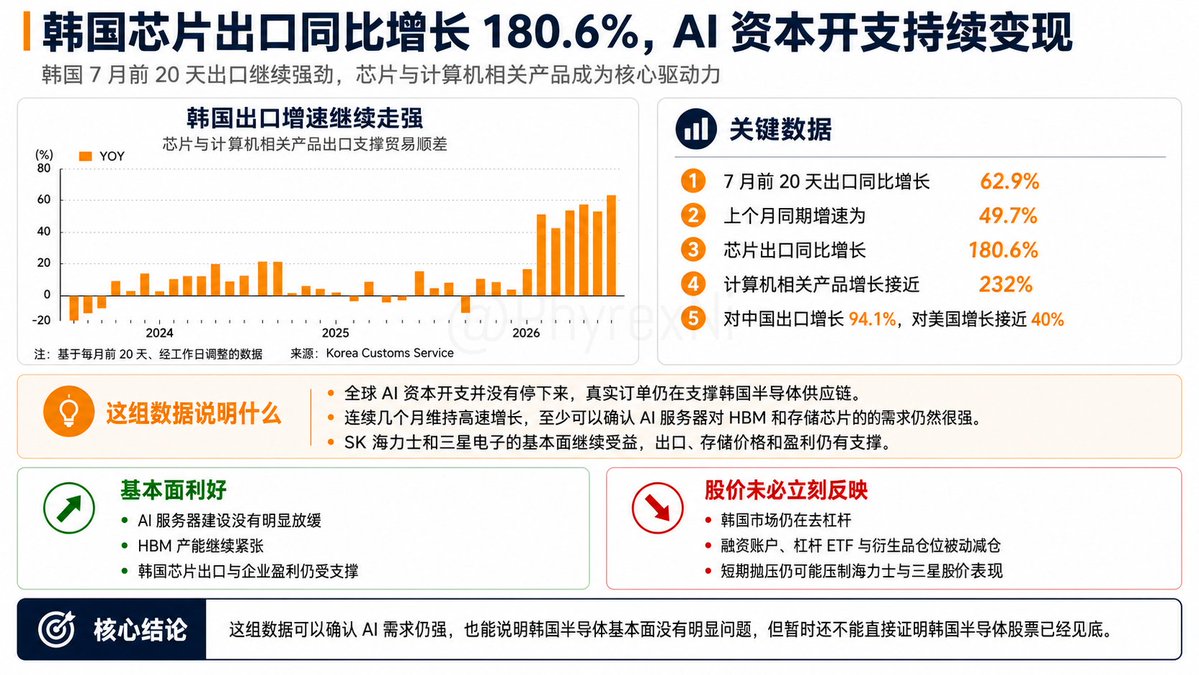
South Korean chip exports increased by 180.6% year-on-year, AI capital expenditure continues to realize profits.
In the first 20 days of July, South Korea's exports, after seasonal adjustments, grew by 62.9% year-on-year, higher than last month's 49.7% in the same period, and the export amount also reached a record high for July.
Among them, chip exports grew by 180.6%, and computer-related products increased by nearly 232%. Exports to China grew by 94.1%, while exports to the United States increased by almost 40%. This set of data indicates that global AI capital expenditure has not slowed down, and there is significant demand and actual orders supporting South Korea's semiconductor supply chain.
The sustained high growth over several months can at least confirm that the demand for HBM and storage chips from AI servers remains strong, customers continue to place orders, and South Korean semiconductor companies are still shipping products.
This is a direct benefit for SK Hynix and Samsung Electronics. As long as HBM capacity continues to be tight, and the construction of AI servers does not slow down, South Korean chip exports, storage prices, and semiconductor companies' profits can continue to be supported.
However, whether this benefit can directly translate into a rise in Hynix and Samsung stock is uncertain, as the biggest problem in the South Korean stock market currently is not poor performance, but that a large amount of domestic capital built through financing accounts, leveraged ETFs, and other derivatives is de-leveraging.
After the market declines, some investors need to sell stocks to replenish margins, and leveraged ETFs also need to reduce positions passively as net value declines, ultimately leading to a situation where stock prices fall, and more forced selling occurs.
In this trading structure, export growth and corporate earnings can support the company's long-term value, but may not immediately catch short-term sell-offs. Even if SK Hynix's subsequent orders and profits continue to grow, as long as the de-leveraging in the South Korean market is not over, stock prices may still face pressure.
Of course, the stronger the performance, the greater the potential for recovery after de-leveraging ends. Once the financing positions and leveraged funds are mostly cleared, strong chip exports and corporate earnings will be easier to reflect in the stock prices.
Thus, this set of data can prove that the demand for AI remains strong, and also that there are no significant problems in the fundamentals of SK Hynix and Samsung Electronics, but it does not yet prove that South Korean semiconductor stocks have reached the bottom.
@Gate Crypto, U.S. stocks, Hong Kong stocks, South Korean stocks, gold, CFD, one-stop trading for prediction markets.
免责声明:本文章仅代表作者个人观点,不代表本平台的立场和观点。本文章仅供信息分享,不构成对任何人的任何投资建议。用户与作者之间的任何争议,与本平台无关。如网页中刊载的文章或图片涉及侵权,请提供相关的权利证明和身份证明发送邮件到support@aicoin.com,本平台相关工作人员将会进行核查。


