TL;DR
- Bernstein estimates that under the 50GW scenario, the cumulative WFE spending from 2027 to 2029 will be approximately $736 billion.
- For every additional 1GW/year of AI computing power, about 46K-50K WSPM wafer capacity will be needed, with DRAM and HBM accounting for the majority.
- Applied Materials, Lam Research, and KLA have higher profit elasticity, but pipeline capacity does not equate to real orders.
Bernstein's latest report translates the expansion of AI data centers into semiconductor manufacturing equipment orders: If AI data centers add 50GW of computing power each year by 2030, the cumulative global WFE spending related to this could reach approximately $736 billion from 2027 to 2029, with about $291 billion in a single year in 2029.
WFE refers to wafer fab equipment spending, which is a key source of demand for equipment companies like Applied Materials (AMAT), Lam Research (LRCX), KLA (KLAC), ASML, and Tokyo Electron. For investors, the most direct question raised by this calculation is: How much additional orders and profit elasticity will continued expansion in AI computing power bring to equipment manufacturers?
At the time of the report's release, semiconductor equipment stocks had already experienced a significant rise, but recently retracted from high levels. Meanwhile, the pipeline for U.S. data center construction continues to grow. Public excerpts show that as of June 2026, the project pipeline capacity rose to 338GW, an increase of 217GW in the past 12 months, well above the current operational scale.
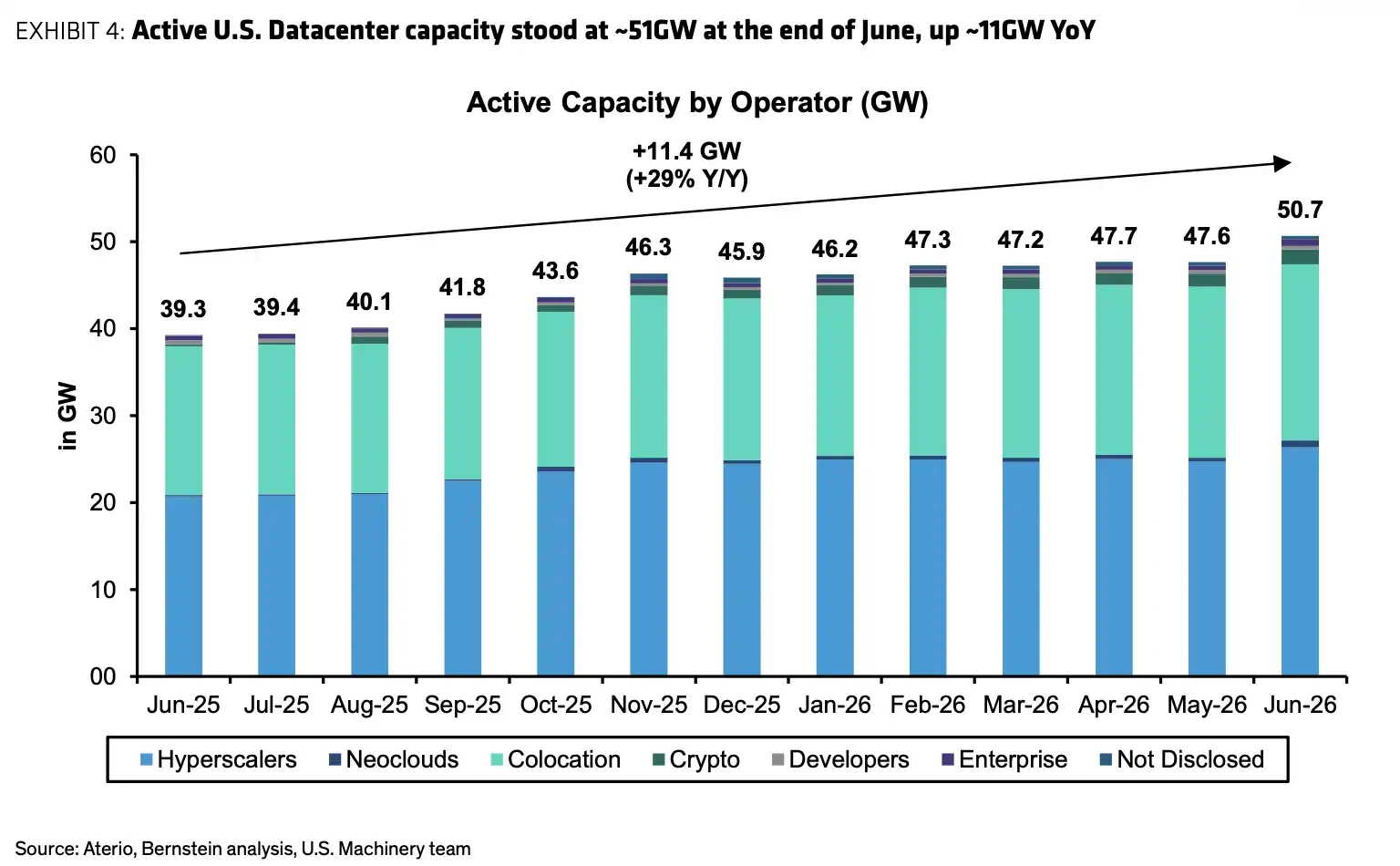
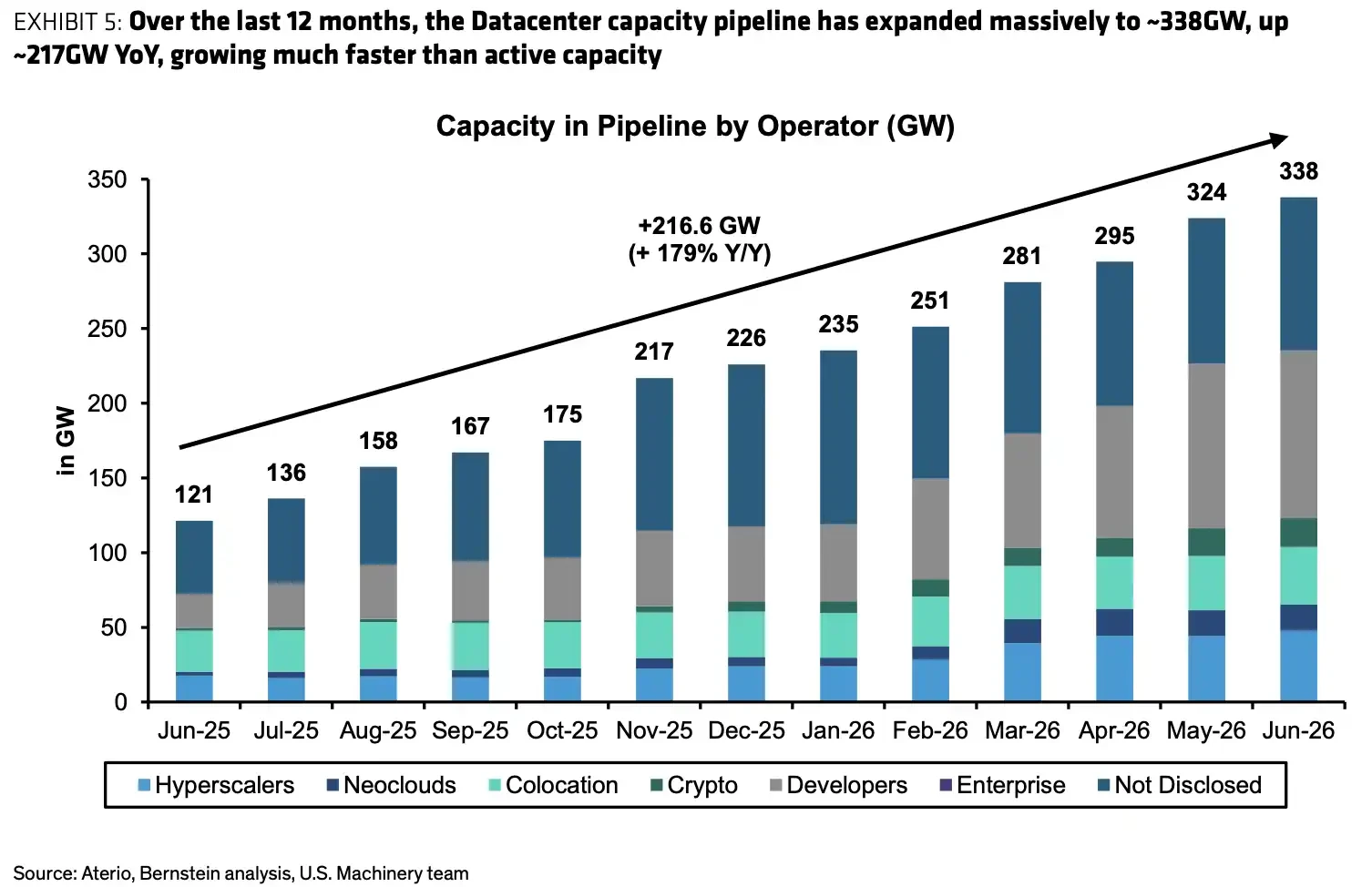
Changes in active capacity and project pipeline for U.S. data centers, with pipeline capacity increasing from 121GW to 338GW.
Each additional 1GW of computing power requires approximately 50,000 wafers/month of capacity
The core calculation of this report is that for every additional 1GW/year of AI computing capacity, approximately 46K-50K WSPM of new wafer capacity will be needed. WSPM refers to the number of wafers processed per month, a common metric for measuring wafer fab capacity.
Data center capacity itself does not directly translate into equipment orders. It is only when AI servers require more GPUs, HBM, DRAM, NAND, and advanced logic chips that fabs will need to expand, and equipment companies will see increased WFE spending.
Out of the estimated new demand of approximately 46K WSPM/GW, DRAM has the highest proportion, at about 53%; NAND is about 20%; HBM is about 16%; and advanced logic is about 11%. This means that the expansion of AI data centers not only drives the need for advanced GPU manufacturing processes but also increases the demand for memory capacity, especially for DRAM and HBM.
This is also why Applied Materials is the most focused on in this calculation. The incremental wafer demand mainly comes from DRAM, HBM, and NAND, and Applied Materials has a higher exposure in storage equipment, deposition, etching, and other segments, leading to more direct profit elasticity.
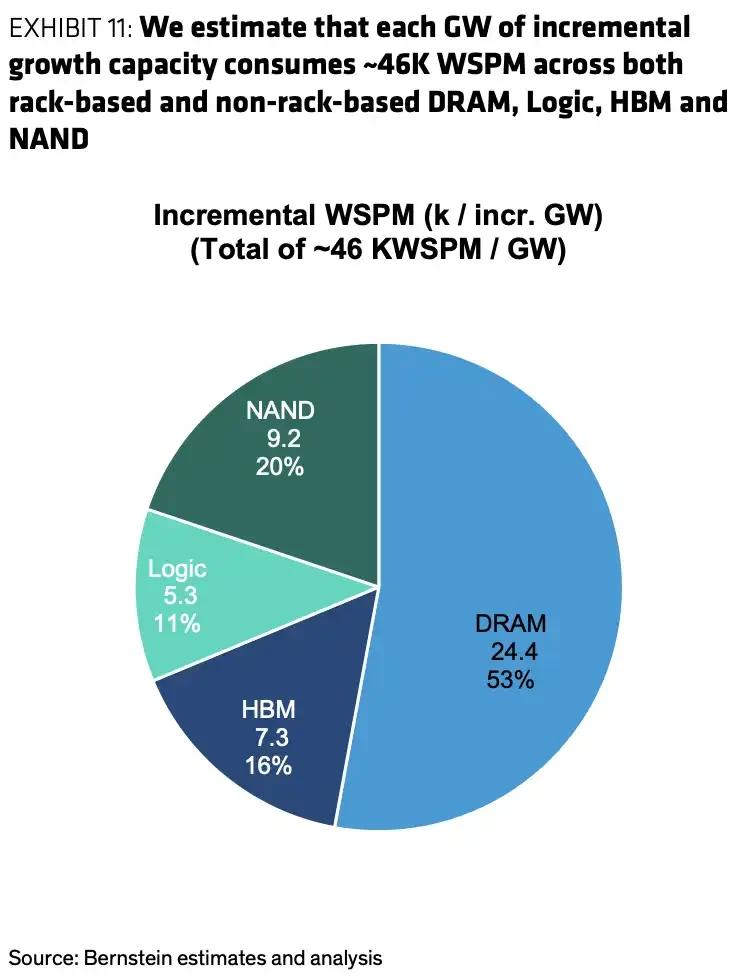
Each additional 1GW of computing power requires about 46K WSPM. DRAM 53%, NAND 20%, HBM 16%, Logic 11%.
WFE in 2029 could approach $291 billion in a single year
Under the baseline scenario, AI data centers will achieve an additional 50GW of computing power each year by 2030 compared to the 2026 baseline. To support this goal, related WFE needs to be gradually in place from 2027 to 2029.
Scenario calculations show that WFE spending driven by AI alone could cumulatively reach approximately $376 billion from 2027 to 2029; if we add about $120 billion annually in non-AI baseline spending, the total WFE spending over three years would be around $736 billion. The annual breakdown is about $200 billion in 2027, $245 billion in 2028, and $291 billion in 2029.
These figures are higher than the equipment spending assumptions in current conservative models. If the 50GW scenario materializes, WFE in 2029 will approach $300 billion; in higher GW scenarios, equipment spending may have more upward potential.
The report also provides a more aggressive scenario. Under the 75GW scenario, equipment companies may see profit increases of over 100%; under the 100GW scenario, the potential for WFE spending in 2029 is further amplified, and some company valuations could be pushed below 10 times.
However, these remain model calculations, not actual orders. They rely on whether the data center construction pipeline can convert into real operational capacity, whether shipments of AI servers can keep pace, whether fabs are willing to expand early, and whether the equipment supply chain has sufficient delivery capability.
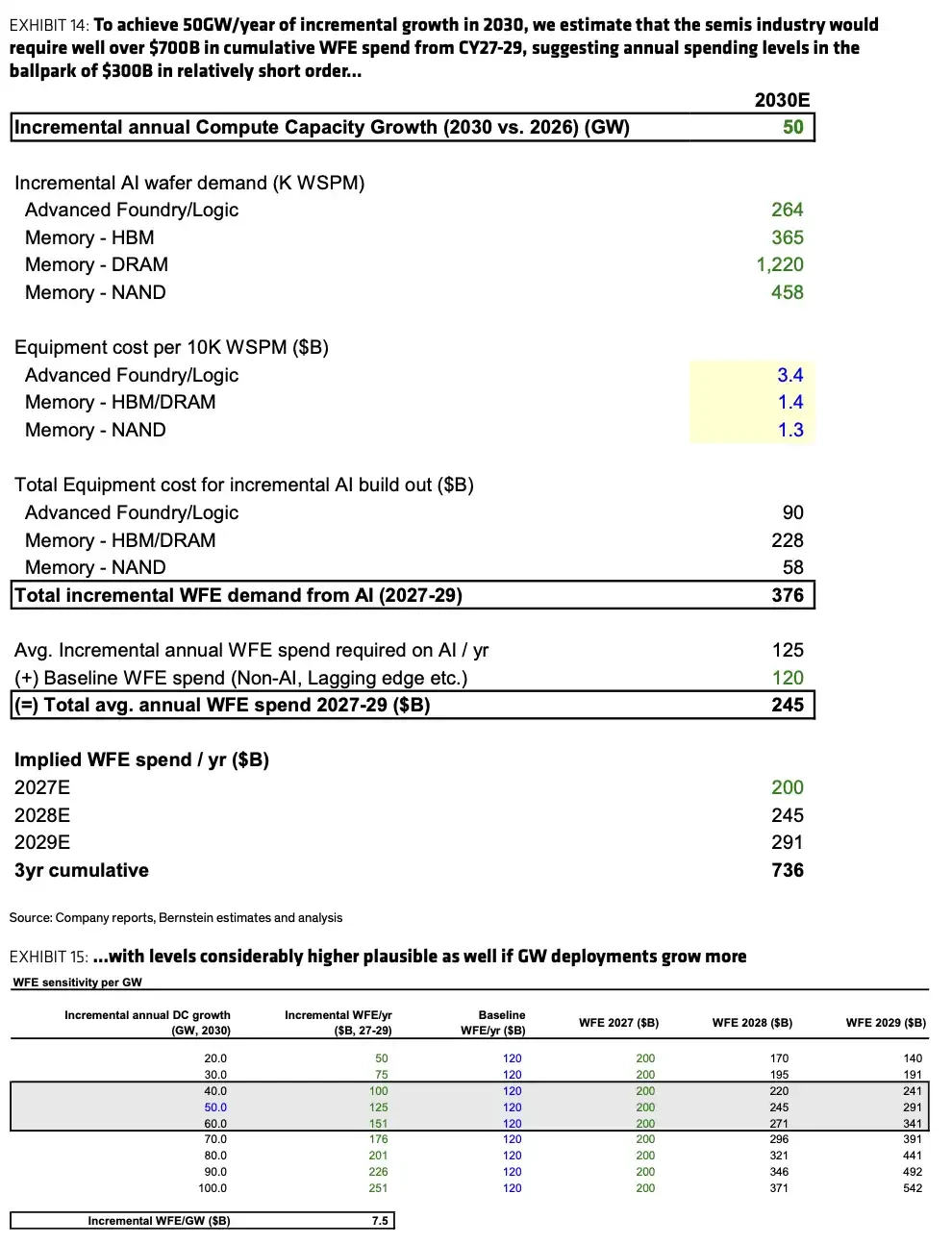
Under the 50GW scenario, cumulative WFE spending from 2027 to 2029 may reach approximately $736 billion, about $291 billion in 2029; under the 100GW scenario, approximately $542 billion in 2029.
Applied Materials has the greatest elasticity, and Lam and KLA also benefit
The impact on stocks is mainly concentrated in Applied Materials, Lam Research, and KLA.
Under the 50GW scenario, the EPS of the three companies could rise approximately 37%-60% by 2029 compared to current Wall Street consensus. This corresponds to forward price-to-earnings ratios potentially dropping to the range of 15-20 times, while current equipment stocks are generally still trading at higher multiples.
Among them, Applied Materials has the greatest elasticity. Under the 50GW scenario, its 2029 EPS is expected to rise nearly 60% compared to the consensus, corresponding to a forward price-to-earnings ratio of about 14.9 times; Lam Research's EPS is expected to rise about 54%, corresponding to about 18.4 times; KLA's EPS is expected to rise about 37%, corresponding to about 21.2 times.
The reason lies in the composition of wafer demand. The additional capacity brought by AI expansion is mainly concentrated in DRAM, HBM, and NAND, rather than solely in advanced logic. Applied Materials covers a broader range of storage-related equipment, making it easier to capture increments compared to companies that only benefit from specific segments.
According to the report, Bernstein maintains ratings for multiple equipment stocks such as Applied Materials, Lam Research, KLA, ASML, and Tokyo Electron to outperform the market, with Applied Materials still being the top choice. Screen has a neutral rating.
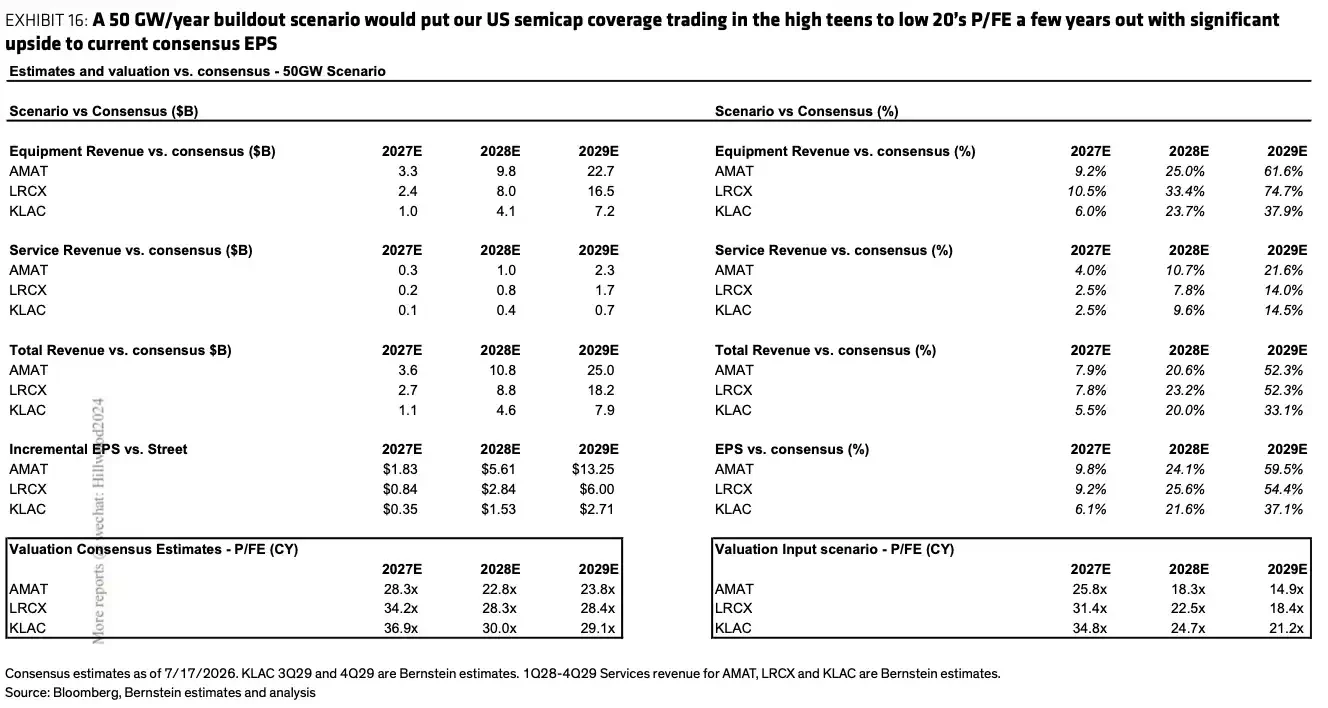
Under the 50GW scenario, AMAT/LRCX/KLAC's 2029 EPS may rise 59.5%/54.4%/37.1% compared to consensus, with price-to-earnings ratios dropping to 14.9x/18.4x/21.2x.
The pipeline capacity still needs to overcome power, financing, and delivery thresholds
The most easily misunderstood aspect of this calculation is treating the data center pipeline capacity as future equipment orders.
The significant expansion of the U.S. data center pipeline capacity in the past year indicates that the willingness to invest in AI infrastructure remains strong. However, there are multiple thresholds between the pipeline and operationalization: power access, land approvals, financing costs, GPU supply, customer demand, along with network and cooling infrastructure, all of which will influence the final implementation speed.
There are also constraints on the equipment side. If WFE levels are to surge to around $300 billion within a few years, equipment companies, component suppliers, and fabs all need to expand capacity simultaneously. The semiconductor equipment industry is not one that can scale up indefinitely quickly; advanced equipment, critical components, installation and debugging, and customer certification will all extend delivery cycles.
The model assumptions themselves also have limitations. The related calculations are based on specific GPU architectures, power consumption, chip sizes, and capital intensity assumptions, and assume WFE has to be in place by the end of 2029 to support the additional computing power in 2030. Changes in architecture, reductions in energy consumption per unit of computing power, improvements in chip yield, and adjustments in capital intensity may all change the final equipment demand.
Another potential deviation exists. If the replacement demand for outdated computing power before 2030 is not adequately considered, equipment demand may still have upward potential; however, if the monetization speed for AI applications is slower than expected, or if large cloud vendors slow down capital expenditures, the 50GW, 75GW, or even 100GW scenarios could be overly optimistic.
This report does not provide a definitive list of orders but rather a clearer calculation: For every additional 1GW in AI data centers, there may correspond roughly to 50,000 wafers/month of wafer capacity and approximately $8 billion in incremental WFE demand. Equipment stocks have already reflected some of the AI expectations in advance, with the divergence being whether the construction of data centers can fulfill to the extent sufficient to support a $300 billion annual WFE level.
免责声明:本文章仅代表作者个人观点,不代表本平台的立场和观点。本文章仅供信息分享,不构成对任何人的任何投资建议。用户与作者之间的任何争议,与本平台无关。如网页中刊载的文章或图片涉及侵权,请提供相关的权利证明和身份证明发送邮件到support@aicoin.com,本平台相关工作人员将会进行核查。


