After institutions and hedge funds, retail investors' buying of stocks has significantly slowed down.
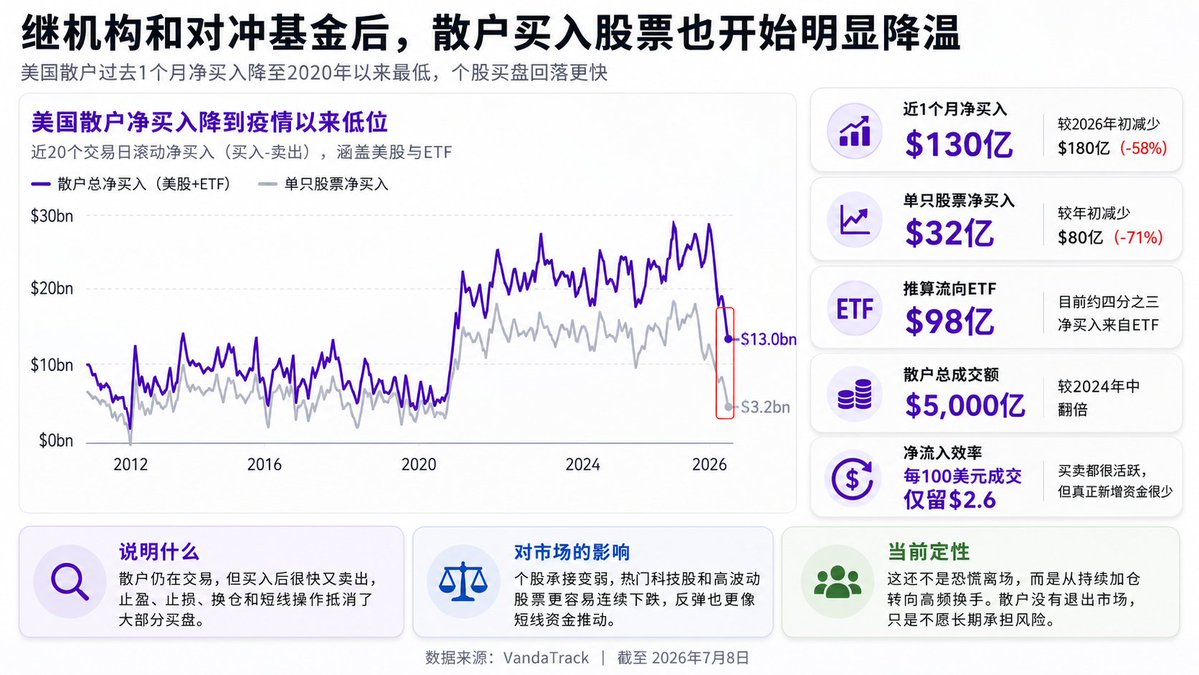
In the past month, U.S. retail investors' net purchases of U.S. stocks were about 13 billion dollars, which has dropped to the lowest level since 2020. Compared to early 2026, this represents a decrease of 18 billion dollars, a drop of 58%.
The cooling of single stocks is even more evident, with monthly net purchases remaining at only 3.2 billion dollars, a decline of 71% from the beginning of the year. Roughly calculated by subtracting the net purchases of individual stocks from the total net purchases, about 9.8 billion dollars has flowed into ETFs, meaning that currently about three-quarters of retail net purchases are from ETFs, and there is very little money directly betting on individual stocks.
However, the total trading volume for retail investors has reached a record 500 billion dollars, doubling compared to mid-2024. Based on this data, for every 100 dollars in transactions, the resulting net purchases amount to only about 2.6 dollars.
This indicates that although retail investors seem to be trading every day, they buy and then quickly sell, and actions like taking profits, cutting losses, reallocating, or short-term trading negate most of the buying pressure. Accounts appear very active, but the new funds actually staying in the market to take on long-term risks are increasingly scarce.
To put it simply, retail investors are currently engaging more in short-term trading and are less willing to take on long-term risks. In simpler terms, retail investors are starting to feel worried and fearful.
I have previously written that in the past few years, whenever there was a significant adjustment in the index or tech stocks, retail investors would usually buy quickly, providing a stable support to the market. Now, retail investors still buy the dips but also seem to be selling off existing positions, resulting in net funds left in the market being only a small fraction of what it used to be.
This means that after stock prices decline, even if there is a rebound, it is easier for these trades to turn into short-term transactions, making it difficult to form sustained capital pushes lasting several weeks.
The 71% decline in net purchases of individual stocks indicates that retail investors' willingness to bear risks on individual stocks is also weakening. When earnings reports fall short of expectations, valuations are too high, or institutions begin to reduce their positions, the amount of retail investment into popular tech stocks and high-volatility stocks will be less than in the past. Previously, a drop would quickly attract buyers, but now continuous declines are more likely, and after rebounds, significant selling pressure will also be encountered.
More funds staying in ETFs also indicate that retail investors are reducing their bets on specific companies. However, we still need to observe whether these fund flows are entering broad-based indices, sector ETFs, or leveraged and single-stock ETFs.
The rising proportion of broad-based ETFs represents a decrease in risk appetite, while the rising proportion of leveraged ETFs indicates that market volatility may increase.
Of course, this set of data does not yet indicate that retail investors are panicking and exiting the market, as the overall net purchases are still positive, and total trading volume is at historical highs. It simply indicates that retail investors have shifted from continual accumulation to a phase of high-frequency turnover, with the new funds being provided to the market rapidly decreasing.
Retail investors have not completely exited the market, but they are increasingly unwilling to leave their money in the market for the long term. The more lively the trading, the lower the net purchases, indicating that the patience and confidence of the funds are both declining.
@Gate Crypto, U.S. stocks, Hong Kong stocks, South Korean stocks, gold, CFD, one-stop trading for prediction markets
免责声明:本文章仅代表作者个人观点,不代表本平台的立场和观点。本文章仅供信息分享,不构成对任何人的任何投资建议。用户与作者之间的任何争议,与本平台无关。如网页中刊载的文章或图片涉及侵权,请提供相关的权利证明和身份证明发送邮件到support@aicoin.com,本平台相关工作人员将会进行核查。


