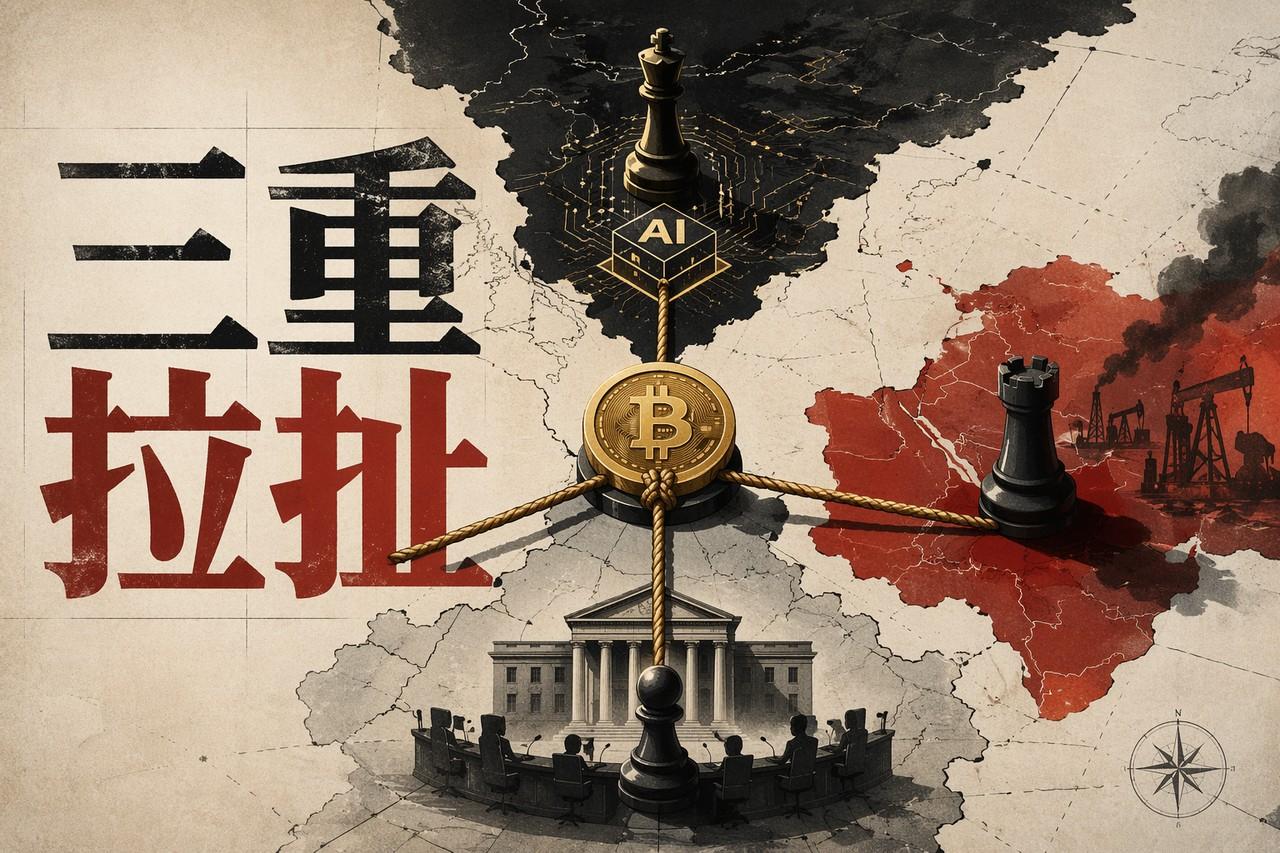
When Wash first struck the FOMC gavel as Chairman in June 2026, the answer given was "maintain the interest rate unchanged" — the committee unanimously agreed, with almost no willingness for further action internally, as if the last round of rate cuts hadn't truly concluded. But then inflation data reignited concerns, and Nick Timiraos reminded that maintaining this "static" consensus would become increasingly tricky in the weeks ahead. By July 13, the yield on the two-year U.S. Treasury bond was pushed to 4.2393%, a new 17-month high, and this curve, most sensitive to policy paths, began pricing in a tighter interest rate trajectory; at the same time, federal funds futures implied cumulative rate hikes of about 39 basis points before December 2026, meaning the market was betting that Wash would consider reversing last year's rate cuts. The federal funds rate itself is the anchor for global risk-free yields, directly embedded in the discount rates of high-risk, long-duration assets including BTC and ETH. When the "risk-free" curve shifts upwards overall, the risk premium gained by the crypto world over the past year under the low-interest narrative must be recalculated. Dollar-pegged tokens like USDT and USDC become conduits for dollar liquidity once again, serving as entry and exit points when risk appetite contracts. This macro shift driven by two-year Treasuries and interest futures forces all holders of BTC and ETH to answer a question anew: in the face of more expensive dollars, how high a return compensation do they require to continue taking risks.
Wash’s Dilemma: From Honeymoon Consensus to Rate Hike Shadows
Behind the upwards shift of this risk-free curve is a narrower policy corridor that Wash has entered. In June 2026, when he first chaired the FOMC meeting, the committee unanimously agreed to maintain the interest rate unchanged, and there was virtually no willingness for additional action, which felt more like a procedural meeting: the consensus was clear, and the risk narrative was simple, with the market still discussing "whether there is any room for a little more cut". Crypto traders were pricing BTC and ETH using a "prolonged low-interest world" story. A few weeks later, the situation turned sharply. New inflation data raised price concerns, and Nick Timiraos reminded that in the weeks ahead, maintaining the consensus of "being on hold" would become trickier, as the focus of the narrative completely flipped from "when to ease further" to "should we reverse the previous rate cuts and restart hikes," forcing a premature end to Wash's "honeymoon period."
On a macro level, the core variable has shifted from where the terminal rate might drop to whether the path needs to turn upwards. The market widely believes that one of the first major decisions Wash faces is whether to overturn last year's rate cuts; on July 13, the two-year U.S. Treasury bond yield rose to 4.2393%, a 17-month high, while federal funds futures implied bets on cumulative rate hikes of about 39 basis points before December 2026. The two-year Treasury itself is the most sensitive price indicator for the future policy rate path, and these figures essentially tell the FOMC: the market has already pulled you into the narrative of “adding one or two more times.” In such an environment, maintaining internal agreement is much more difficult than during the June meeting; any adjustment of forward guidance wording will amplify volatility on the global benchmark of the federal funds rate and, through the risk premium channel, will be transmitted to BTC and ETH, seen as high-risk and long-duration assets; for funds accustomed to switching between risk and dollars using dollar-pegged tokens like USDT and USDC, whether Wash can maintain credible expectation management amid this round of "to hike or not to hike" will itself be a key macro variable determining the future direction of crypto asset risk premiums.
39 Basis Points Bet and BTC/ETH Premium
Federal funds futures on July 13 implied cumulative rate hikes of about 39 basis points before December 2026, while the yield on the two-year U.S. Treasury bond reached 4.2393%, essentially shifting the entire risk-free rate curve upwards. For global funds using the federal funds rate as a discount benchmark, a rise of dozens of basis points in "risk-free returns" means that all future cash flows and forward returns have to be discounted with a heavier factor. The longer the duration and the stronger the reliance on future expectations, the more the theoretical fair value of such assets gets compressed. Even if BTC and ETH do not have traditional cash flows, they are treated as high-duration risk assets within the asset allocation framework and are automatically categorized as sensitive to rising interest rates.
In this "39 basis points" new world, BTC and ETH must provide higher risk premiums in the minds of investors to maintain their original position weights: either higher expected returns or lower entry prices. Global asset management agencies look at relative values — when the federal funds rate and two-year Treasuries provide higher risk-free yields, the threshold for excess returns on crypto assets is passively raised, and any growth story or on-chain narrative must first cross this "interest rate threshold." The result is that the market narrative originally driven by liquidity begins to retreat, replaced by a pricing framework driven by "risk compensation": off-chain dollar holders are more willing to park cash positions on-chain in USDT or USDC, only increasing high-risk exposure when they believe the expected returns on BTC and ETH are sufficient to cover the higher risk-free rates and loss of volatility.
Two-Year Treasury Hits New High: Dollar Funding Costs Rise Again
On July 13, the yield on the two-year U.S. Treasury bond surged to 4.2393%, a new 17-month high, effectively inserting a “new benchmark” into the short end of the rate curve. The two-year term is already one of the most sensitive durations to Fed policy paths; this level, in conjunction with the implied expectation of rate hikes of about 39 basis points in federal funds futures by year-end, indicates that the market no longer believes in the previous track of "moderate rate cuts + prolonged holding", but is repricing for tighter policy. For all dollar-denominated assets, this means an overall uplift in the risk-free discount rate: traditional equity and bond valuation models are forced to compress, and assets like BTC and ETH, viewed as high-risk and long-duration, see their future cash flow hypotheses become more directly compressed as they rely more on emotional premiums.
When short-end yields return above 4%, dollars themselves transform into "heavy assets" with coupons. Any decision to move dollars onto the blockchain must first compare the rate returns of off-chain T-bills and money market instruments. In the absence of real-time on-chain funding data, we can only deduce based on historical patterns and behavioral assumptions: on one hand, dollar-pegged tokens like USDT and USDC still serve as mainstream safe havens in the crypto world; when short-end rates rise, off-chain funds that choose to enter crypto are more inclined to pause in these types of "on-chain cash" while waiting for a higher risk premium entry price; on the other hand, higher dollar yields raise the opportunity cost of holding such tokens — the interest differential earned by issuers contrasts with the substantial returns that holders cannot share, leading some institutions to reduce on-chain dollar positions and reallocate funds back to off-line rate assets. The result is that the crypto market faces not only a dual squeeze of BTC and ETH's valuation space but also a change in the cost and supply elasticity of on-chain dollars themselves, causing the entire risk structure to be passively rearranged under higher dollar funding costs.
On-Chain Funds and Derivatives Wash Trading
After the yield on two-year Treasuries rose to 4.2393% and federal funds futures implied about 39 basis points of rate hikes before December 2026, what crypto traders see is not an abstract "Wash era", but a steeper risk-free yield curve. Historical experience shows that every time such tightening expectations rise, the first reaction of high-duration risk assets is to "reduce leverage first and talk about direction later": on-chain funds withdraw from high-beta assets, more remain in dollar-pegged tokens like USDT and USDC, with spot reflected as BTC and ETH trading for on-chain dollars, while in derivatives, high-leverage perpetuals are cut, and long positions are shifted to low leverage or pure spot. For institutions already deeply involved in yield strategies, a more typical combination is "holding on-chain dollars + shorting futures or perpetuals": retaining on-chain liquidity while hedging spot exposure through shorts, waiting for clearer interest rate paths around Wash's meeting on July 28-29 before deciding whether to re-leverage.
In this restructuring of trading activity, futures basis and perpetual funding rates become the thermometer for the "Wash trading". When rate hike expectations strengthen, historically BTC and ETH futures often narrow from positive basis or even turn to discounts, reflecting rising holding costs and hedging power surpassing speculative longs; perpetual funding rates fall from high levels, occasionally turning negative, indicating that the market is willing to pay costs for shorting rather than eagerly paying to go long. Currently, we lack real-time on-chain and derivatives data, so we can only reference this historical pattern that has repeatedly emerged during rate hike cycles: if before the Wash meeting, the basis continues to narrow, and the funding rate center shifts downward while balances of USDT and USDC increase rather than decrease, it often means that the market is re-pricing the risk premium of crypto assets through "reducing leverage + increasing on-chain dollars + futures hedging", and this structure itself is a collective bet on a higher path for the federal funds rate.
New Anchor for Crypto Pricing under Inflation Shadows
Wash chose to remain on hold in June, but before the meeting on July 28-29, he was pushed by the market to the crossroads of "whether to reverse last year's rate cut route". This decision itself is replacing the past narrative of easing, becoming the new macro pricing anchor for high-duration risk assets like BTC and ETH. The federal funds rate is the core benchmark for global risk-free yields. When federal funds futures implied a cumulative rate hike of about 39 basis points by year-end on July 13, and the yield on the two-year U.S. Treasury bond was pushed up to 4.2393%, the signal received by the crypto world is very direct: the discount rate curve is elevated, and risk assets need to provide a higher premium to offset the losses "discounted" by higher rates in future cash flows and narrative premiums. Against the backdrop of Nick Timiraos' statement that "maintaining the consensus of being on hold becomes trickier", what traders need to focus on is not just the price itself, but four lines: first, how federal funds futures continue to adjust their bets on the magnitude and timing of rate hikes; second, whether the yield on the two-year U.S. Treasury bond continues to rise with tightening expectations; third, whether the communication tone before the FOMC shifts from "patient observation" to "tightening if necessary"; fourth, the follow-up inflation readings, not detailed in this report, but everyone is waiting to see if they rise unexpectedly again. Before these signals provide clear direction, the crypto market can only maintain higher risk premiums and a more fragile emotional structure under the shadow of "potential rate hikes", with any slight disturbance in interest rate expectations or inflation narratives being sufficient to trigger re-pricing of BTC, ETH, and on-chain dollar positions.
Join our community to discuss and become stronger together!
AiCoin exclusive Hyperliquid benefits: https://app.hyperliquid.xyz/join/AICOIN88
AiCoin exclusive Aster benefits: https://www.asterdex.com/zh-CN/referral/9C50e2
On-chain Telegram community: https://t.me/AiCoinWhaleData
On-chain community: https://www.aicoin.com/link/chat?cid=N6OVMor5g
AiCoin on-chain Twitter: https://x.com/aicoinwhaledata
免责声明:本文章仅代表作者个人观点,不代表本平台的立场和观点。本文章仅供信息分享,不构成对任何人的任何投资建议。用户与作者之间的任何争议,与本平台无关。如网页中刊载的文章或图片涉及侵权,请提供相关的权利证明和身份证明发送邮件到support@aicoin.com,本平台相关工作人员将会进行核查。