Summary of Basic Knowledge about Leveraged ETFs — Knowledge may not increase profits, but it can reduce losses.
I have written three articles about the South Korean stock market, and one more discussing leveraged ETFs in the context of the South Korean market and their relevance to the U.S.
They are:
1. South Korean retail investors' financing hits a record, leveraged ratio drops to a low: https://x.com/PhyrexNi/status/2071467942269907224?s=20
2. South Korean stock market: heaven one day, hell the next — the index is rising, and volatility is also increasing: https://x.com/PhyrexNi/status/2073051792716480743?s=20
3. Behind the high volatility of the South Korean stock market — rapid expansion of leveraged ETFs: https://x.com/PhyrexNi/status/2073263132001353873?s=20
4. The rebalancing funds of leveraged ETFs have become amplifiers of volatility in the U.S. stock market: https://x.com/PhyrexNi/status/2074016524864721171?s=20
These four articles do not indicate that I am particularly adept at predicting market risks; that is not the case. They are based on data released by some traditional institutions. Many may not trust the data, but I am quite sensitive to it, so I wrote these four articles based on that data.
Moreover, the main meaning of these four articles is quite similar — that South Korean investors are more often leveraging the market through financing and leveraged ETFs. This also explains why the volatility of the South Korean stock market is so high; it is similar to the previous concept of the South Korean real estate market, which was also plagued by excessive leverage.
To use a term from the cryptocurrency sector, it is like using online loans to open three times leverage, and I have also discussed the erosion of capital with three times ETFs during volatile markets, specifically:
5. The difference between three times leveraged ETFs and three times contracts — same amplification of returns, but the sources of risk are completely different: https://x.com/PhyrexNi/status/2074077033907495036?s=20
6. What is volatility erosion, and why do multiple leveraged ETFs have higher erosion??: https://x.com/PhyrexNi/status/2074036163661443108?s=20
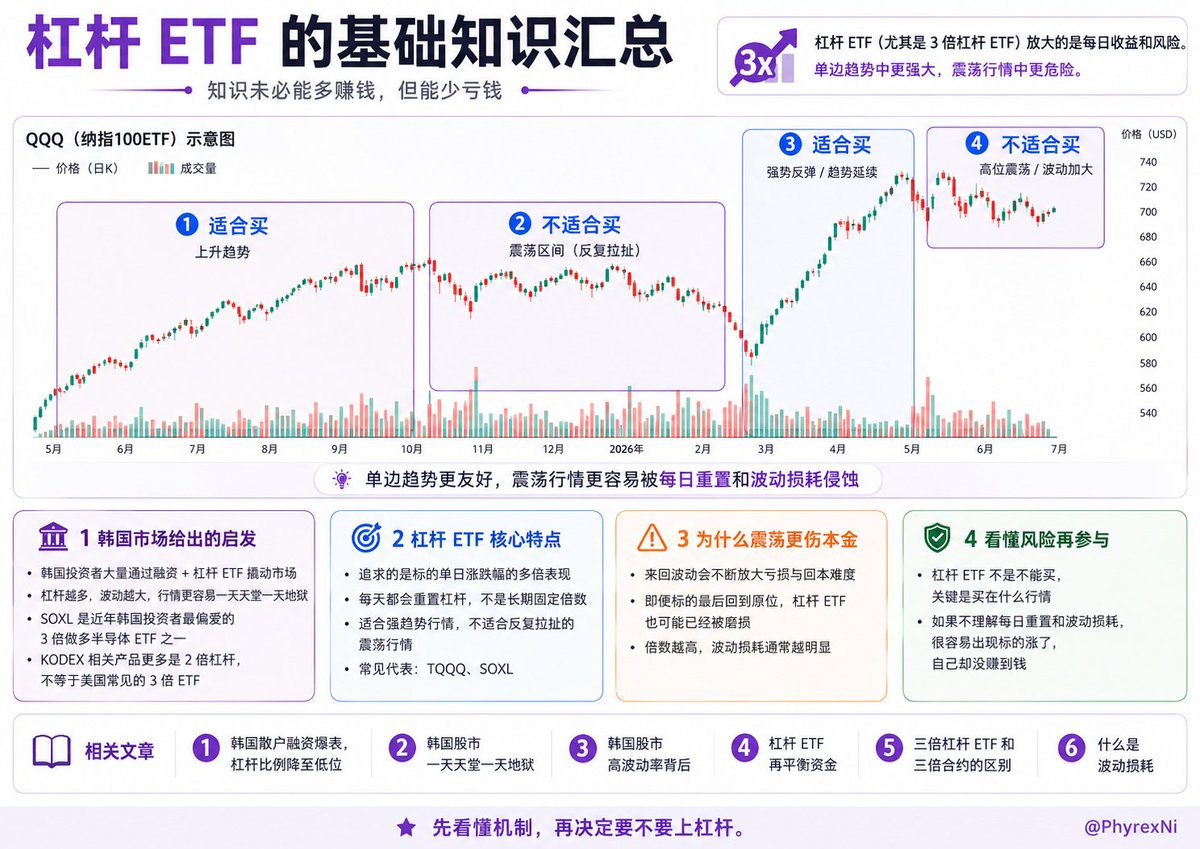
These two articles aim to inform friends about the risks of three times leverage, such as $TQQQ or $KODEX (which is two times) and $SOXL. Particularly, SOXL is the most purchased three times leveraged semiconductor ETF by South Korean investors, expected to be the main force of South Korean leveraged ETFs from 2024 to 2026.
This is not to say that three times leveraged ETFs are bad, but to recognize where the risks lie. I have roughly created a graphic indicating that the best time to buy leveraged ETFs is when a unilateral market dominates, because leveraged ETFs need to be reset daily; thus, in a volatile market, the cost price is rising.
The previous two posts have already introduced the resetting and erosion of leveraged ETFs in great detail. If you wish to purchase leveraged ETFs, I recommend reading them first; otherwise, it is easy to find oneself in a situation where the market is rising, but you are not making any profit.
免责声明:本文章仅代表作者个人观点,不代表本平台的立场和观点。本文章仅供信息分享,不构成对任何人的任何投资建议。用户与作者之间的任何争议,与本平台无关。如网页中刊载的文章或图片涉及侵权,请提供相关的权利证明和身份证明发送邮件到support@aicoin.com,本平台相关工作人员将会进行核查。


