SpaceX will go public on Nasdaq at the opening tomorrow.
At $135 per share, it plans to issue about 556 million shares, raising approximately $75 billion, corresponding to a valuation of about $1.75 trillion to $1.8 trillion. Market news indicates that subscription demand exceeds $250 billion, nearly 4 times oversubscription.
Goldman Sachs and Morgan Stanley serve as the two main underwriters, with a total of 23 investment banks participating in the underwriting syndicate. Goldman has secured the so-called "lead left" position, with its name printed in the top left corner of the S-1 front page, and is also the firm managing the book. The subtlety of this arrangement is that Morgan Stanley has had a relationship with Musk for over 15 years, following him from Tesla's IPO to the financing of the Twitter acquisition, but this time it ranks second.
In terms of regional distribution, Barclays is responsible for the UK, Deutsche Bank and UBS cover the European continent, the Royal Bank of Canada is responsible for Canada, and Mizuho handles Asia.
This luxurious lineup, based on fundraising scale estimates, suggests that this transaction could bring between $800 million to over $1 billion in underwriting fees to Wall Street.
This time there is no "price range". SpaceX bypassed the conventional IPO roadshow inquiry stage and opened subscriptions directly at a fixed price of $135, with the book expected to close from June 8 to 10 and pricing on June 11.
In terms of stock structure, SpaceX has previously been approved for a 5-for-1 stock split. After going public, Musk will still maintain a very high voting power, while common shareholders will receive economic exposure, not locked-in control. Insiders will have a 180-day unlocking period, with the timing precisely scheduled around the mid-December Nasdaq index rebalancing window, at which point passive funds will be compelled to buy in large amounts according to rules.
This IPO will issue about 556 million new shares, all of which will enter the circulation after listing, accounting for about 4.3% of the company's total share capital. Of this, 30% is allocated to retail investors, equivalent to about $22.5 billion, which is three times the usual 5% to 10% allocation for large IPOs in the U.S. Morgan Stanley's E*Trade platform will service small and medium retail investors, Bank of America will serve high-net-worth clients in the U.S., and Fidelity, Robinhood, Charles Schwab, and SoFi have all opened subscription channels.
Will SpaceX drain the market?
Intuitively, an IPO raising $75 billion with retail investors holding 30% of the newly issued shares will inevitably pull liquidity from elsewhere.
Retail investors need to gather this cash from somewhere, and the easiest way is to sell off stocks and crypto assets in hand. Bitcoin has been under pressure in recent weeks, and part of this may be coming from here.
So does an IPO from a large tech company necessarily mean market liquidity will be drained? We can first look at a set of background data.
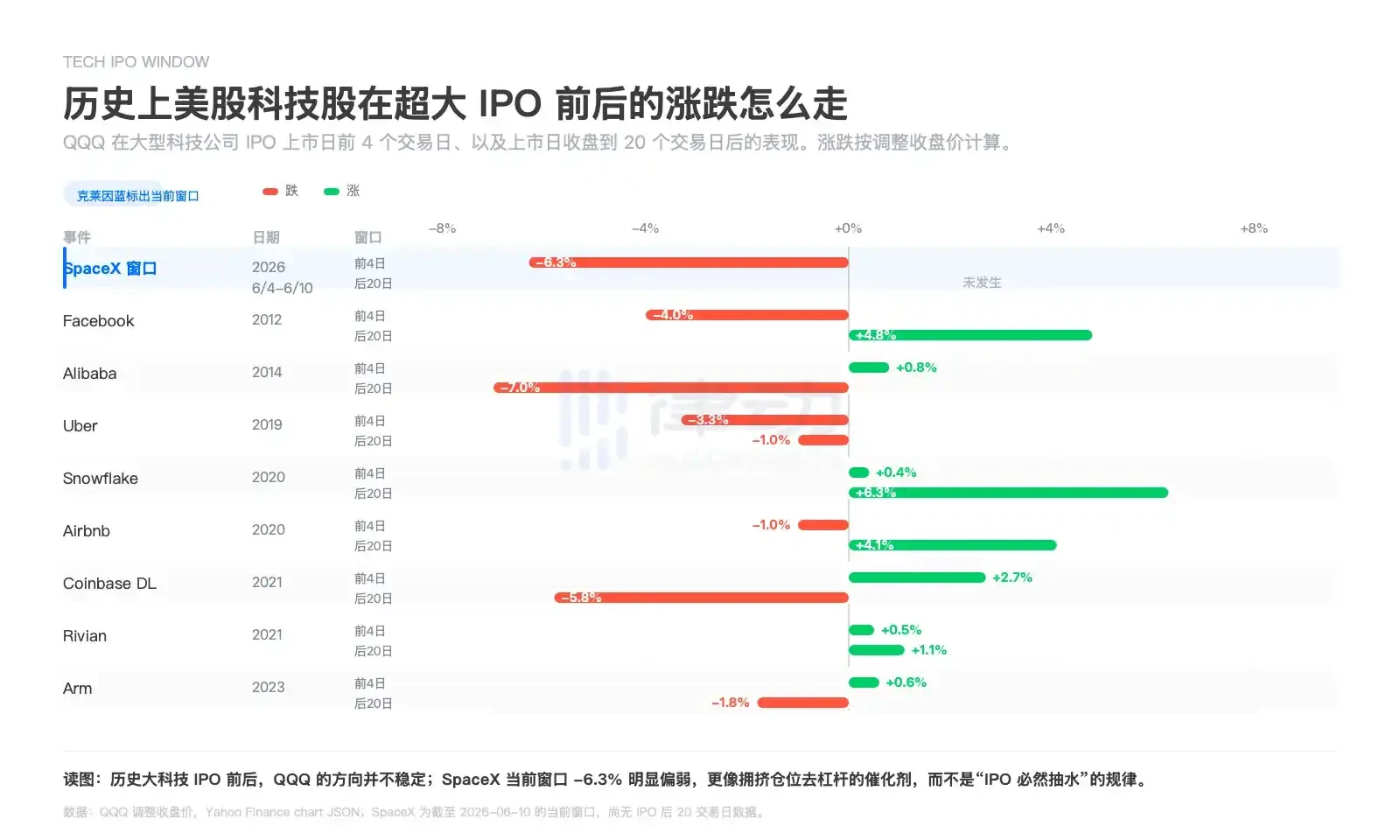
According to statistics, the performance of the Nasdaq ETF (QQQ) is notably diverging in the 4 trading days before and after large tech company IPOs and in the 20 trading days following listing.
Facebook, Snowflake, Airbnb, and Coinbase saw most of their stock record positive returns after 20 days of listing, while Uber, some phases of Alibaba, and Arm showed weakness or large volatility.
Current simulated IPO window data for SpaceX shows a cumulative return of about -6.3% in the first 4 days, weaker than most historical samples.
This set of data leans towards the conclusion that large tech company IPOs do not necessarily mean market liquidity will be drained.
But this does not mean that all assets are safe. SpaceX likely will compress funds that are most reliant on forward risk appetite at the margin, such as long-tail assets and high beta positions.
Andri Fauzan Adziima, head of research at Bitrue Research Institute, refers to this pressure as the "IPO tax."
Can financial data support the valuation?
This is also the most contentious issue SpaceX faces in its public listing.
Public documents show that SpaceX's revenue in 2025 is estimated to be about $18.7 billion, with a net loss of approximately $4.9 billion. Based on a valuation of $1.75 trillion, this corresponds to an estimated 94 times the revenue multiple for 2025, corresponding to a company that is still losing money.
In terms of business structure, the closest to a mature public company is the connection services where Starlink resides. Rocket launches provide deployment capacity and technological moat, while the true impetus to raise the valuation ceiling comes from AI. After SpaceX acquires xAI at a combined valuation of $1.25 trillion in February 2026, it is no longer just an aerospace company.
Musk’s vision is a longer chain: rockets reduce the cost of entering orbit, Starlink lays down global connectivity, Starship sends heavier equipment into orbit, AI business creates demand for computing power, and data centers ultimately end up in space.
The story is grand. But Musk packages all the businesses together for investors—not just the already established Starlink and proven Falcon 9, but also the uncommercialized Starship, the unproven orbital data centers, and the cash-burning AI business that is somewhat faltering.
Therefore, analysts and different markets have significant discrepancies in their estimates and reasonable valuations for SpaceX's revenue.
The most conservative estimates come from Morningstar, which calculates the fair value at about $780 billion, barely half of the IPO target. It does not deny SpaceX's technological capability, noting that the company accounted for more than half of last year's global rocket launches, but merely feels that the feasibility, timeline, and financial results of the orbital computing and AI business remain highly uncertain.
NYU finance professor Aswath Damodaran's model estimates a range of $1.22 trillion to $1.29 trillion, acknowledging the engineering advantage, but arguing that the upside above $1.75 trillion has become thinner. Long-term holder Scottish Mortgage has its anchor point at $1.25 trillion and has not followed through to the IPO target price.
On the underwriter side, however, the price is being pushed higher. Goldman forecasts that SpaceX's AI division will contribute $322 billion in annual revenue by 2030 alone, with the overall company revenue exceeding $470 billion. Morgan Stanley goes further, predicting revenue will reach $3.4 trillion by 2040, with adjusted EBITDA exceeding $2.7 trillion.
The most aggressive pricing comes from on-chain data. The SPCXUSDT perpetual contract launched by Binance in May reflects an expected valuation range of $1.75 trillion to $2 trillion, and over 70% probability betting on the final IPO valuation surpassing $2 trillion. Approaching the listing, Binance has adjusted the estimated number of SpaceX shares corresponding to the SPCXUSDT contract from 11.87 billion shares to 13.08 billion shares, resulting in a current estimated valuation exceeding $2 trillion.
Looking ahead, the next Starship test flight is scheduled for June. If it can enter commercial operations steadily, frequently, and at low costs, Musk might again successfully deliver a perfect narrative. However, if failures occur during the roadshow or progress lags behind expectations, many long-term narratives could be impacted, shaking the market value and stock price.
Will the unlocking come too fast?
Concerns regarding the unlocking is also a notable point of criticism from investors about the SpaceX IPO.
Typically, new stocks have a 180-day lock-up period, where insiders cannot sell during this time, intended to give the market a chance to establish a real price.
SpaceX, nominally also has a 180-day lock-up, but many do not know that it employs a tiered early unlocking structure, dividing the 180 days into several segments.
The first unlocking date comes right after the Q2 financial report is released, where qualifying insiders can sell 20% of their shares, which would be between mid-July and September.
In other words, just over a month after the listing, the first batch of unlocked shares may appear. Other insiders can start selling as early as the second trading day after the first quarterly report, likely in August.
There are further arrangements; if the stock price exceeds 30% above the issuance price for 5 days during the consecutive 10 trading days before the first quarterly report, an additional unlocking of up to 10% can occur. Coupled with releases spaced out at 70, 90, 105, 120, and 135 days, there could be an additional release of up to 28% after the Q3 report, with all unlocked by the 180th day (mid-December).
While Musk has committed to not selling for 366 days, all other early employees, venture capitalists, and bank syndicates who truly want to exit can start leaving after the first quarterly report.
For those who just bought at $135, the first wave of selling pressure they must absorb may arrive sooner than expected.
Index funds change rules overnight for SpaceX
The previous three points can be called SpaceX's own issues and controversies, while this point may pertain to broader market mechanisms.
Nasdaq changed its rules for this listing. Normally, new companies must wait about a year to qualify for inclusion in the main indices; this waiting period exists to allow the market to complete authentic price discovery.
Nasdaq’s "quick inclusion" mechanism compressed SpaceX’s window to enter the Nasdaq-100 to 15 trading days, FTSE Russell only requires 5 trading days, and MSCI has also confirmed a quick access path for large IPOs. The S&P 500 is one of the few that did not follow suit because it still requires companies to maintain profitability, which SpaceX does not meet, hence it cannot enter temporarily.
Another issue arises with the floating shares. The newly issued shares of SpaceX make up about 4.3% of total share capital, while over 95% is held by Musk, early employees, and institutional investors, all under lock-up and unable to circulate in the secondary market. In contrast, Microsoft's float ratio is 99.97%, NVIDIA 95.8%, and Amazon 90.5%.
Nasdaq also allows low-float stocks to have their weights calculated at up to three times their actual float amount. This effectively attaches a fictitious weight in the hundreds of billions to a tightly controlled real float in the tens of billions and forces a large amount of price-insensitive passive funds to buy in according to rules.
Some institutions estimate that passive funds could absorb about 30% of the free float in the 15 trading days following the listing, while the total asset tracking Nasdaq-100 amounts to about $14 trillion. What’s more troubling is that since no component stocks are removed to create space, each Nasdaq-100 fund must proportionally sell off all its other component stocks already held to buy into this one new stock. This means forced selling of all other stocks for the sake of one.
"Big short" Michael Burry shared criticisms of this rule, with some Wall Street veterans labeling it "shameless" index manipulation. A columnist from The Wall Street Journal described Nasdaq's quick inclusion rules as "arbitrary, unfair, and potentially dangerous," and a Financial Times journalist referred to it as "the largest hot potato game in history."
Overall, the core criticism from the market is: low-fee index funds were originally tools for ordinary people to gain market exposure at a very low cost, but now they may have become channels for early capital exit and risk transfer due to rewritten rules. Pumping money from retirement accounts into a new stock with a 94 times revenue multiple, without regard for price, is exactly the opposite of the problem index investing originally sought to address.
The bigger the tree, the more wind it attracts, and consequently, the more controversy it faces. SpaceX is the grandest IPO of this era, and also the most controversial one.
免责声明:本文章仅代表作者个人观点,不代表本平台的立场和观点。本文章仅供信息分享,不构成对任何人的任何投资建议。用户与作者之间的任何争议,与本平台无关。如网页中刊载的文章或图片涉及侵权,请提供相关的权利证明和身份证明发送邮件到support@aicoin.com,本平台相关工作人员将会进行核查。


