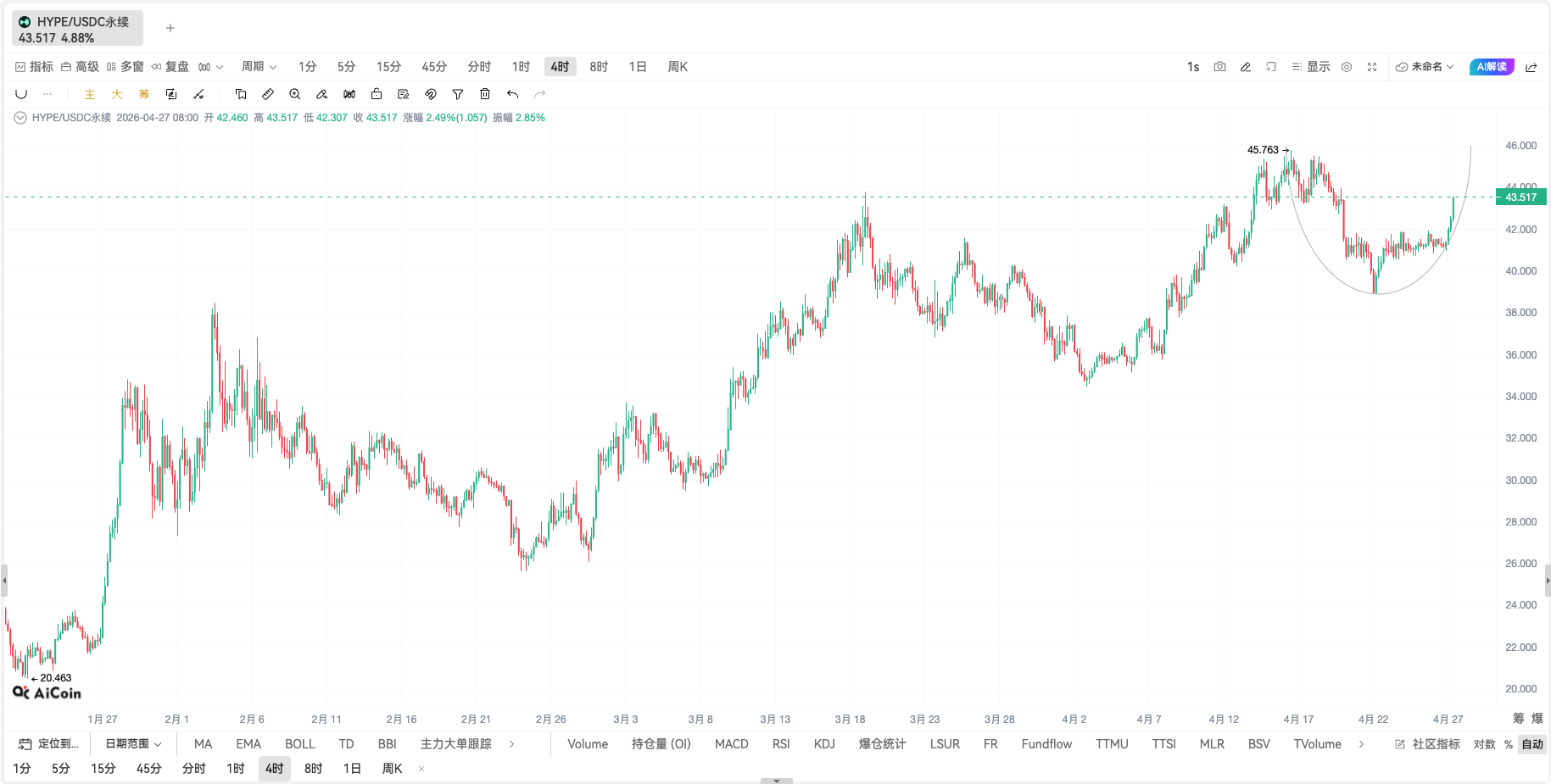
The same suspected "insider" address has once again accurately predicted the direction before the market surge. Let's rewind to around April 27, 2026; that set of wallets, which had previously been questioned by the community for their precise bottom-buying and selling of APE, did not vanish from the on-chain view but quietly shifted their focus to LDO, employing the same high-leverage long strategy.
The on-chain analysis platform Lookonchain tracked that this group of interconnected wallets established large long positions in LDO: one wallet has already chosen to exit early, closing its long position and taking away about 50,000 USD in realized profit; another wallet continues to hold about 5.96 million LDO, currently valued at approximately 2.65 million USD, with an unrealized profit of around 250,000 USD. The total for these two positions combines both realized and unrealized profits to roughly 300,000 USD, completing another "textbook" profit cycle in the open market.
What truly heated the sentiment was the combined effect of price and narrative. After the actions of this group of addresses on LDO were disclosed by on-chain monitoring accounts such as Lookonchain and amplified in reports by media including Jinse Finance, PANews, and TechFlow, LDO's price surged over 20% in a short time. Many participants perceive the scene of "suspected APE insider longs switching to LDO, getting in early, and then the price taking off" as glaring: on one side, there's a wallet labeled as "suspected insider trader" by the community, yet no regulatory or judicial bodies have officially classified it; on the other side, there are ordinary traders tracking large on-chain addresses, always a step behind.
On-chain transparency was supposed to mean openness and visibility, yet in this incident, it has been interpreted by many as a different kind of asymmetry: everyone can see how the addresses rolled out 300,000 USD in profit on LDO, yet no one knows who is behind the addresses, whether they are relying on luck, experience, or possess information that others cannot see. This unresolved gray area casts a shadow of "fairness" over LDO's surge and leaves the entire market teetering between excitement and tension.
From APE to LDO: The Repetitive Script of the Same Address
Before LDO, this group of interconnected wallets had already staged a "play" on APE. Earlier at some point, their successful trades on APE were scrutinized, analyzed, and eventually labeled as "suspected insider information trading" due to substantial returns and sensitive entry timing. At that time, no one could clarify who was behind those addresses, only tracing their trajectory in the cold, hard on-chain records, where they had preemptively placed bets and then exited smoothly—criticism followed, but there were no firm reports or identifications from judicial and regulatory bodies; the so-called "insider traders" remained more of a colloquial term.
Due to this history with APE, when the same entity or its associated wallets began to act on LDO, the market instinctively linked the two stories together. In the days leading up to April 27, 2026, these addresses chose once again a high-leverage long direction, establishing large positions before any information related to LDO was made public. The on-chain analysis platform Lookonchain linked this large long position in LDO to the suspected insider addresses from the APE incident through fund flows and address relations, leading to the release of a monitoring report that suggested familiar "protagonists" had returned to the stage.
What followed resembled a reenactment of the APE script. Lookonchain's data was relayed and reported by various media, and the narrative of "suspected APE insider traders spinning into LDO and repeating their high-leverage long operations" rapidly spread in the Chinese community. After on-chain monitoring and media dissemination, LDO's price noticeably strengthened, having accumulated a rise of over 20% since the exposure of the related wallet positions. Concurrently, one address among this group opted to close its LDO long position during the uptrend, realizing about 50,000 USD in profit; another address maintained its long position with about 5.96 million LDO, nominally worth around 2.65 million USD, with an unrealized profit of about 250,000 USD. The two combined resulted in nearly 300,000 USD in profit, making the sequence of "pre-accumulation—being exposed—price rising" particularly glaring.
In the APE incident, the community had become accustomed to explaining these precise operations as "mastering undisclosed information"; by the time of LDO, this déjà vu was further reinforced: both incidents involved quietly establishing large long positions before any news was revealed, with both the on-chain monitoring accounts pinpointing them and the media amplifying afterward. For many observers, this seemed more like a pattern rather than a coincidence.
However, it needs to be repeatedly emphasized that all these accusations and speculations are still at the level of community discussions and media expressions. There has been no authoritative confirmation regarding the specific principal scale and profit multiples during the APE phase; the leverage for the LDO longs, accurate opening times, and entry prices have not been disclosed through public channels either. Judicial and regulatory bodies have yet to classify these addresses as "insider trading", nor have they publicly confirmed or denied the relevant allegations. In other words, the label of "suspected insider trader" is merely a tag on social media, not a legal identity.
Amid the combination of information gaps and emotional amplification, this address's journey from APE to LDO has come to be seen by more and more people as a symbol of "smart money" on-chain, with many retail investors viewing themselves as potential liquidity providers for it. Whether it results from sharp judgment or the possession of unseen information remains to be conclusively determined.
5.96 Million LDO Longs: Where Does the 300,000 USD Profit Come From?
If we break down the positions of this group of addresses in LDO, we will find that it is not a "go all-in" isolated bet, but rather distributed across two wallets with different functions: one has "locked in gains," while the other continues to keep its chips on the table.
Let's first look at the side that has exited. One of the wallets associated with this entity chose to close its LDO long position when the wind had clearly shifted towards bullish and public opinion was continuously fermenting. The conclusion provided by on-chain data is straightforward—this operation has already realized about 50,000 USD in profit, and the funds have safely returned, leaving no further concerns. For this wallet, the LDO story has reached a conclusion, and what's left can only be discussed as past performance.
The other hand is still in play. Another associated wallet continues to hold about 5.96 million LDO longs, with a nominal position size of approximately 2.65 million USD at current market prices. This part of the position did not choose to conclude at the peak of public opinion but instead remains exposed to price fluctuations. In terms of gains and losses, this still-active long has an unrealized profit of about 250,000 USD—meaning the real driver behind this "LDO campaign's" profit performance is this wallet that has not yet exited.
Looking at both sides together, the total profit of this group of addresses on LDO can largely be divided into two parts: one part is the realized 50,000 USD, and the other is the remaining 250,000 USD in unrealized profit, totaling around 300,000 USD. The numbers themselves are not astonishing, but considering this is merely a short-term switch from APE to LDO, such a rhythm is certainly enough to remind onlookers of "skilled maneuvers."
Where does the profit come from? The answer given by the on-chain evidence is equally simple: price. Since this LDO position was exposed by on-chain monitoring accounts, LDO's price has surged over 20% in a short time. On a nominal long position of about 2.65 million USD, even if only a part of that rise is captured, the arithmetic result could easily translate into profits at the hundred-thousand-dollar level. The closed wallet locked in a segment of that rise, leaving 50,000 USD in hand; the open wallet continues to enjoy subsequent price increases, driving the unrealized profits toward 250,000 USD, so externally, this 300,000 USD "short-term harvest" appears to have been pieced together.
However, even with such transparency, the real details of this transaction remain hidden in a black box. Public data can only clarify a few things: it was a long position, not a short one; it is currently holding about 5.96 million LDO; and how much money this position has likely made at the current prices. These are cold numbers that can be tracked and recalculated step by step.
What truly determines the risk-reward profile of this transaction are the key parameters—such as the specific point in time when positions were added, the exact entry price, and how many multiples of leverage were applied—which are completely absent from the current public information. Many statements circulated in the market assert higher profit multiples and larger nominal positions, but if you trace the sources, most are merely second-hand retellings from social media that lack independently verifiable authoritative data support.
As a result, observers can only maneuver between "visible paper profits" and "invisible position details": on one side, there are clear holdings numbers and directions down to the decimal point; on the other, the opening logic and risk exposure are deliberately obscured. This information asymmetry also adds a layer of intrigue to the question "where does the 300,000 USD come from?" which should not be complicated.
On-Chain Tracking: Can Digital Fingerprints Lock Down Insider Trading?
Behind the "300,000 USD arithmetic problem" lies another more complex assignment exposed to the sunshine: a series of records of interactions among numerous addresses, pieced together by on-chain monitors into a portrait of "digital fingerprints."
The rules of a blockchain ledger are quite simple: all transfers, openings, and closings are recorded in the same publicly accessible ledger over time, allowing anyone to trace a specific address forwards or backwards, seeing when it deposited money into exchanges, interacted with which types of contracts, when it significantly increased or exited positions. This "visibility of everything" provides on-chain analysis platforms with natural material—they will consolidate seemingly independent wallets into one "entity" based on fund sources, flow paths, interacting contracts, and operation time distributions, and then observe how this entity repeatedly acts across different tokens.
In this incident, accounts like Lookonchain have effectively tied together the "successful bet on APE" and "this time's large long position in LDO": the same entity, similar high-leverage long direction, comparable rhythms—first quietly ambushing, then during the window of monitoring disclosure and media amplification, they experience a rapid price increase. The overlap in time between establishing positions, the public disclosure, and subsequent price increases constitutes what the community refers to as a "habituation pattern" and forms the foundation of the label "suspected insider trader."
From an on-chain perspective, such pattern recognition is not unfounded. Where the funds come from, where they are going, and when adjustments are made can often be pinpointed down to block height; the entity's preferences for which trading platforms to use, whether they prefer to enter large positions at once or spread them, and whether they often leverage heavily around news can all shape its behavioral profile. Even if real persons, institutions, or algorithmic strategies are concealed behind the public key address, the behavioral "digital fingerprints" remain clearly visible.
The issue is that similar behavior does not equal "insider trading" in a legal sense. Under traditional legal frameworks, to conclusively define insider trading, one must at least answer several questions that on-chain data currently cannot address: Where did the suspicious address's information come from? Does the party holding the information owe a confidentiality obligation? Did the trader knowingly use "undisclosed and significant" information when placing orders? These crucial links are often locked in internal company communications, email exchanges, and personnel relationship webs, requiring on-chain evidence to complement the investigation, rather than a series of cold transfer records.
Therefore, even if this LDO movement perfectly aligns with the narrative of "position establishment→monitoring disclosure→price surging over 20%", and the corresponding wallet has already realized around 50,000 USD in profit while still holding a long position with a nominal value of about 2.65 million USD, totaling around 300,000 USD in paper profit, the conclusions that on-chain fingerprints can provide still lead only to "a highly suspicious pattern replication" rather than "proven insider trading." The community can label, and the media can weave stories based on that, but in regulatory or judicial contexts, these are still far from forming a unique and sufficient basis for a conviction.
In reality, regulatory agencies in some countries and regions have already begun experimenting with on-chain analysis tools in other cases to help reconstruct the full picture of events using fund flows and behavioral patterns. These tools more often play the role of "clue amplifiers"—helping investigators filter out the most worth-tracking address groups, locking in time windows, and sorting possible information paths, while the true conclusions still rely on off-chain interviews, documentation, and compliance reviews. In other words, on-chain evidence can serve as a starting point for suspicion, but it is difficult to independently become the endpoint within the current frameworks.
The same applies to the story of "suspected insider longs." The public ledger allows everyone to see how the same stream of funds successfully replicated its trajectory on both APE and LDO, yet no one can read from the ledger itself "who told him the information" or "whether he knows that this information should not be used for trading." On-chain tracking has narrowed the gap between market participants and "smart money" while amplifying anxieties over information asymmetry and fairness. Still, turning a series of digital fingerprints into a legally defined "insider trader" remains separated by an entire set of evolving regulatory and compliance practices.
Retail Investors on the Other Side of the Information Gap
Emotions in the community are polarized. Several frequently appearing terms in the discussion forum—"insider trading," "knowing the news in advance," "retail investors being used as liquidity"—have almost become the unified labels for this incident. Some individuals angrily classify the relevant addresses directly as "mouse warehouses," their anger directed at the familiar script of "others knowing first, and I come in to take over"; others simply accept the framing: since it's impossible to prove he isn't a "news player," they will treat it as "smart money" and follow his trades.
The lack of authoritative voices has allowed this emotional divide to continue to fester. To this day, neither regulatory bodies nor project parties have provided any public clarification, nor explained the true identity and information sources behind those addresses. The only definite information is clearly written on-chain—two associated wallets have a combined profit of about 300,000 USD in LDO, with one already closing its long position and cashing out about 50,000 USD, while the other still holds approximately 5.96 million LDO long positions, with a nominal value of around 2.65 million USD and an unrealized profit of about 250,000 USD. The specifics of how positions were opened or how much leverage was used remain invisible blanks.
This numerical set has directly rewritten the decision-making logic of many retail investors. After seeing this 300,000 USD unrealized profit, some began to actively "align positions"—going long on LDO along the direction of the relevant addresses, with the reasoning being simple: since they don’t know the news itself, they might as well follow those who are most likely "in the know." Those who might only have tested small positions now, under this narrative, are willing to take on more aggressive directional risks, even if they understand they are merely following a layer behind "smart money."
On the other hand, a similarly noisy fear: the concern of being "used as liquidity" is written in countless comments. Some investors began to keep a watchful eye on LDO, even taking short positions; their logic is equally simple—when everyone is focused on the same address, that last buy is often the most expensive. This divergence is directly reflected in the market: one side sees buy orders piling on as funds follow, while the other side experiences selling pressure from hedging and skepticism, stretching LDO's market depth and order structure, making each price fluctuation feel like a psychological battle over "who’s grabbing the last stick."
The more similar the "suspected insider" stories become, the more attention it brings to an old problem: In this supposedly "entirely transparent" on-chain world, who is closer to the source of information? It seems that everyone can monitor accounts like Lookonchain in real-time, seeing when large addresses enter and exit, and even link this LDO long position trend to the prior APE incident. However, the reality is that the true advantage lies not in "seeing fund movements" but in who can better understand the implications behind those movements sooner and with a smaller sample.
For most retail investors, this gap is hard to bridge: they often see second-hand or even third-hand information that has already been amplified by media and reiterated by the community. When on-chain data transforms into advertisements for "smart money," information asymmetry does not disappear—it merely shifts form—from the closed-door gossip in traditional markets to the interpretive abilities surrounding on-chain funds' fingerprints. Standing on the other side of the information divide, retail investors must still make choices between anger and following, yet find it challenging to position themselves closer to the information source.
After the Incident: Where Will the Repetitive Long Game Lead?
From early fame in APE to staging high-leverage longs once again in LDO, culminating in about 300,000 USD in profits, this group of addresses has almost consistently executed a "double strike." The on-chain analysis platform Lookonchain is responsible for connecting the plot, with multiple media outlets amplifying it, transforming what originally existed only between block heights into a "repetitive script" that the public is keenly observing: the same entity, suspected similar news sensitivity, significantly betting at key moments, and then prices launch, with some positions realizing profits while others continue to enjoy unrealized gains.
This aptly reveals a difficult-to-reconcile tension: the utmost transparency on-chain contrasts sharply with extreme information asymmetry, without contradiction, even possibly layering together. Everyone can see that two wallets have established long positions worth about 2.65 million USD in LDO, still holding unrealized profits around 250,000 USD, and can accurately calculate that one wallet has already realized about 50,000 USD in profits. Yet no one knows who they are or what sort of off-chain intelligence they might be managing, or if they simply understand sentiments and narratives better than others. The on-chain transparency surrounds the "fund fingerprints," while the "sources of information" remain obscured.
More subtly, this uncertainty is still locked within a regulatory gray area. The label the community gives them is "suspected insider traders," yet no judicial or regulatory bodies have provided any formal conclusions as to whether it constitutes insider trading. The result is a split between fury and skepticism, alongside an inability to implement accountability—in a regulatory landscape that remains undefined, this pattern resembles a repeated experiment with longs playing out in the gaps.
If such behaviors continue to arise, consistently binding to sensitive time points and extreme price fluctuations, it is hard to imagine regulators will remain passive in the long run. The more realistic avenue may not simply be to "prohibit large address positions," but to intervene using a method of "on-chain behavioral patterns + off-chain evidence collection": first identify suspicious patterns through on-chain data, then complement the evidential chain by off-chain investigations involving accounts, personnel, and information flows. At that time, today's on-chain monitoring reports, which are treated as "smart money signposts," may become part of case materials.
Within the industry, there have been attempts to cool things down: an increasing number of teams and funds are beginning to disclose addresses and accept real-time monitoring, with large address tracking tools continually evolving, hoping to soothe the sense of unfairness that "only a few people know which way the wind blows." However, based on the chain reaction from APE to LDO, these efforts appear more as cushioning for asymmetry rather than a complete eradication of it. You may be able to more quickly notice "some are heavily invested," but you still lag behind "why they are heavily invested today."
For individual investors, the real danger lies here. The influence of on-chain monitoring accounts has been further magnified by this series of events, leading more and more people to closely monitor every move of large addresses, treating "following suspected insider addresses to go long" as a shortcut. Yet simply replicating those positions does not replace any form of position management and risk control:
● You do not know how high the leverage they are using is, where their stop-loss is, or how much more capital they can deploy;
● You also do not know whether in the aftermath of media and social networks glorifying this address, you have already become the liquidity providing for them at the last stick.
From APE to LDO, the story's protagonist remains that large address running at the forefront. But for observers, the more pivotal question may have transitioned from "Is he an insider?" to "At this stage where regulations, compliance, and tools are still catching up, am I willing to entrust my fate to a wallet address that reveals its funds yet conceals its soul?"
Smart money is worth studying, even deserving of respect, but it is not worth blind following. The real key to preserving your chips in the next enactment of a similar script is never having simply memorized a particular address, but whether you have upheld your own set of risk boundaries.
Join our community, let’s discuss and become stronger together!
Official Telegram community: https://t.me/aicoincn
AiCoin Chinese Twitter: https://x.com/AiCoinzh
OKX Welfare Group: https://aicoin.com/link/chat?cid=l61eM4owQ
Binance Welfare Group: https://aicoin.com/link/chat?cid=ynr7d1P6Z
免责声明:本文章仅代表作者个人观点,不代表本平台的立场和观点。本文章仅供信息分享,不构成对任何人的任何投资建议。用户与作者之间的任何争议,与本平台无关。如网页中刊载的文章或图片涉及侵权,请提供相关的权利证明和身份证明发送邮件到support@aicoin.com,本平台相关工作人员将会进行核查。