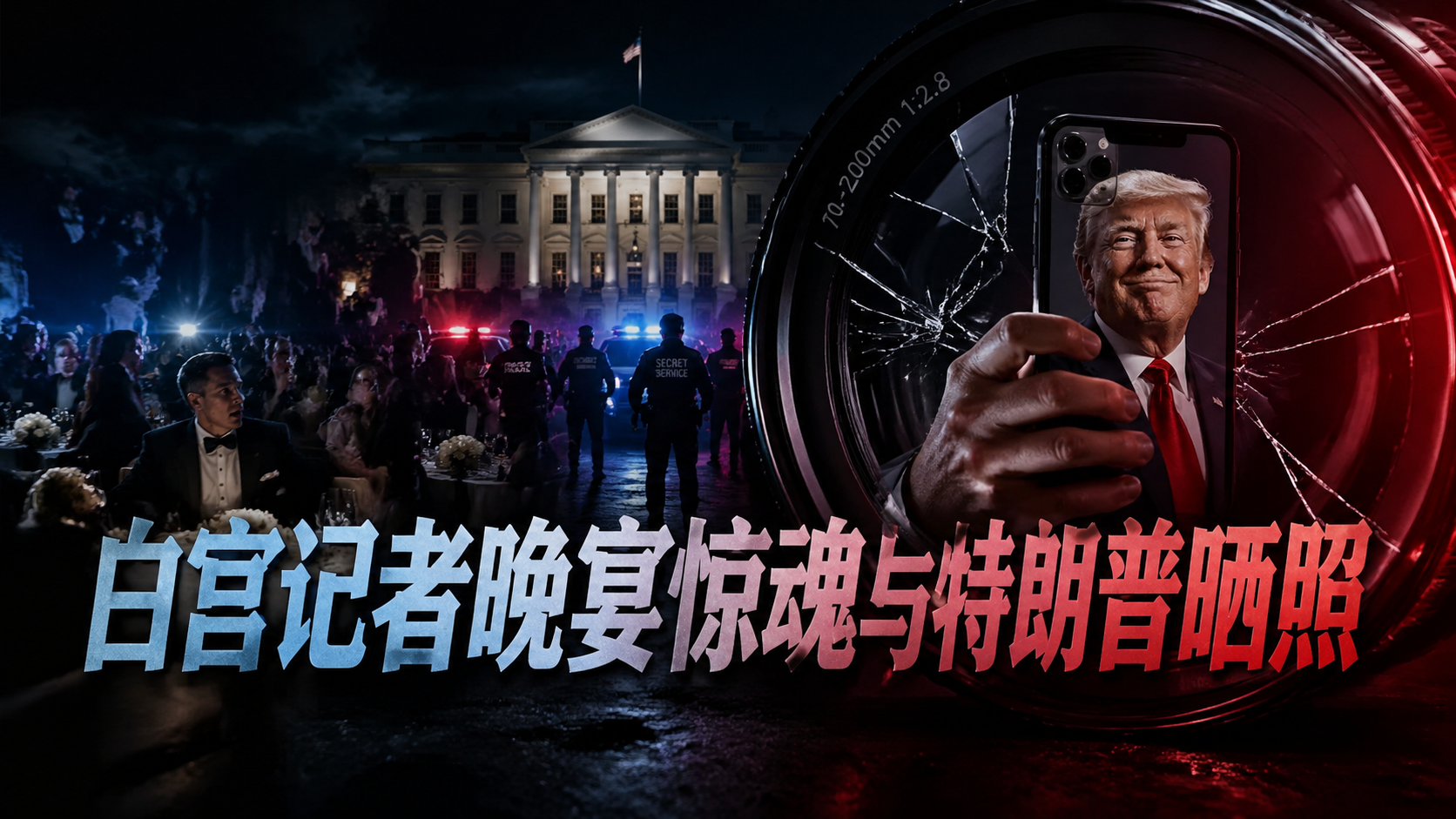
One night, the Hilton Hotel in Washington was brightly lit, and the White House Correspondents' Association dinner was taking place as usual—one of the most important political social events in the city, where the president typically throws out a series of self-deprecating jokes on stage to ease the political tension that has accumulated over the year. In the banquet hall, laughter and the clinking of cutlery intertwined, with media personnel, politicians, and lobbyists taking their places, waiting for Trump to make his appearance.
The atmosphere was abruptly interrupted in an instant. The host was hurriedly handed a piece of paper, and his expression visibly tightened, then he picked up the microphone to announce: a so-called "security incident" had occurred on site, and the event had to be temporarily halted. The lights didn't go out, but the air suddenly became heavy; some reported hearing what seemed like gunfire in the distance, and journalists began typing rapidly on their phones, sending words like "interruption" and "security threat" to the world—these details were difficult to discern as true or false, and could only be marked as "pending confirmation."
Almost simultaneously, multiple news outlets reported that the U.S. Secret Service acted swiftly, escorting Trump and First Lady Melania away from the banquet hall. Unverified information also mentioned that officials, including the Vice President, were evacuated to safer areas. On the other side, some media and onsite reporters indicated that a suspect had been apprehended and taken into custody around the hotel, but there has been no complete official explanation regarding who this suspect was, their motive, or whether they truly posed a lethal threat; there were no clear reports of casualties, and all statements regarding losses on site lingered in the realm of unverified rumors.
In this information vacuum, what truly made this incident memorable was not the interruption itself, but the subsequent "return." Sources indicated that the Secret Service did not want Trump to return to the banquet hall immediately after the security incident, for a simple reason: the risk had not been entirely eliminated, and protocols required further assessment. However, Trump insisted on returning—this was a brief but intense tug-of-war between him and the security team. Ultimately, under a thick wall of security and layers of screening, he reappeared near the banquet stage. The host announced to the somewhat anxious guests that the event would soon resume and that the president would still deliver his speech as scheduled.
From that moment on, this White House Correspondents' dinner was no longer just Washington's annual "Political Comedy Night." A security threat that had not been fully clarified, a president insisting on returning, and the Secret Service tugging in the background—these three elements intertwined to form the main line this article aims to track: when the contours of danger remain blurred, the personal will of the leader collides with institutional security logic, and this choice itself becomes a strong political symbol.
Interruption in the Banquet Hall: Secret Service's Swift Evacuation
What was originally a step-by-step program segment. The stage continued its routine teasing and jokes, while the guests engaged in clinking glasses and quiet conversations, as is typically the case at such banquets—where politics and entertainment intertwine, and the tension remains outside the venue. What truly interrupted all of this was a cold indication: the announcement of a "security incident" on site.
The abruptness of this moment, many present later described it as "not reacting immediately." According to a single-source on-site reporter's recollection, initially, only those close to the main table noticed the atmosphere was off; more guests only sensed that the laughter had suddenly thinned and visually searched the hall back and forth, unsure if they should stand or remain seated. No one was clear about what had happened, only knowing that the "Comedy Night" on stage had been abruptly paused.
The change truly became "visible" to the entire audience when the Secret Service began to act. Multiple news outlets reported that the U.S. Secret Service, with almost no warning, swiftly rose and encircled Trump and First Lady Melania, escorting them away from the banquet hall. For many who were still looking up in confusion, all they could witness was that the presidential couple, who had just been at the main table, disappeared from sight in a very short time, without lengthy explanations or symbolic farewells, only a series of brief, decisive actions.
It was this rhythm of "acting first, explaining later" that created a temporary vacuum in the banquet hall—messages were still on their way; the core of power had already been shifted. Some media and onsite reporters indicated that at that time, some heard what sounded like gunfire, and some reports mentioned that a suspect had been taken into custody in the hotel area, but whether the gunfire originated from this suspect, whether they were armed, or where they appeared from, there was currently only a single channel of information, lacking official public verification.
More troubling was that different media outlets provided slightly different versions regarding the timing, source of sounds, and the manner in which the suspect was apprehended. Before the complete narrative had been pieced together, each new piece of information was like a piece hard-pressed onto an unfinished puzzle. The only assured facts were twofold: the dinner was interrupted by a "security incident," and the president and First Lady were evacuated urgently; as for the exact nature of the threat that interrupted this night, whether a shooting truly occurred, who the suspect was, and why they appeared in that hotel, these crucial points remained at the level of "reportedly" and "a source said," pending further investigation and official explanation to fill in.
Those Who Would Not Leave: The Pull Between Trump and the Secret Service
In the first few minutes after the announcement of the security event, the narratives between the stage and backstage suddenly split into two lines. One was conveyed in phone alerts received by everyone: "the president was evacuated urgently"; the other existed only in limited internal communications: whether he should return.
According to a single-source account relayed to the media, after the Secret Service helped Trump and First Lady Melania leave the banquet hall, they did not wish for him to immediately return. Their reasoning was straightforward—there was a need to continue assessing risks: whether there was only one suspect, whether the threat had been fully eliminated, and whether the internal security checks and external lockdown formed a closed loop; these questions did not have publicly available answers at the time. According to past practices, allowing the president to appear again in the same space before threats were completely clarified was something the Secret Service instinctively sought to avoid.
The same source provided the other half of this story: Trump insisted on returning to the banquet hall. Ultimately, protected by the Secret Service, he returned to the banquet hall. The dinner host informed the attending guests that the event would soon resume and announced that Trump would deliver his speech as previously scheduled; this arrangement itself silently told the audience—at least on the political stage, everything was "as usual."
This was not merely a personality conflict, but a tug-of-war over who defines "security." For the Secret Service, "security" meant minimizing unknown risks, even at the cost of abruptly halting the dinner, leaving viewers in front of the television seeing only an incomplete narrative; for Trump, the other layer of meaning for "security" was to show the national audience that he was still in control and had not been intimidated by an unforeseen threat. The choice of whether the U.S. president should quickly make a public appearance after encountering a security threat has always been seen as a symbolic action to convey a sense of stability and control to the public; this time, he clearly chose to push that symbolism to the limit—even if it might make the security department uncomfortable.
From the perspective of political communication, the insistence on returning provided highly elastic imagery: being evacuated urgently, hearing suspected gunfire, the suspect being controlled—these fragmented pieces of information combined in the public's mind to create an atmosphere of "danger"; while the president returning to the same banquet hall to continue a supposed light-hearted dinner conversation would be interpreted as a stance of "not backing down." For political figures who habitually constructed their personal image on being "tough" and "resilient," this was an almost instinctual choice—despite the sources admitting that the specific degree of threat at the time remained full of details pending official reporting.
Yet this choice inevitably left new pressure marks on the security protocols of the Secret Service. In past similar incidents, cases of the president insisting on returning to the same venue so soon after being evacuated were rare, which suggested that if this "return" were normalized, future risk assessments would be more complex than ever. The Secret Service faced two asymmetrical consequences: refusing the leader's return could be interpreted as overly conservative or even "blocking political expression"; allowing the leader's return would have to bear the public and institutional responsibility in the event of any errors in threat assessment that led to irreparable consequences.
There were claims that Vice President JD Vance was also present at the scene and uninjured, but details regarding whether he was evacuated in tandem with the president, or under what conditions he was arranged to return, remained pending verification. Even with the currently limited public information, one can easily imagine when not just one leader, but the entire line of succession is involved in the same space, the Secret Service's risk tolerance must be re-measured.
As of now, the public has yet to see a detailed post-event security assessment report released by the authorities, and how the Secret Service internally negotiates between the leader's will and institutional security standards can only be inferred from fragmented pieces of "according to sources." This ambiguity itself is a new source of contradiction: on one side is the public's desire to see the "president not intimidated by threats," while on the other side are security agencies required to provide written answers to "what if this happens again." That night, Trump chose not to leave, while the Secret Service was forced to rewrite a version of the still-unpublished risk boundary behind the scenes.
Fear and Assurance Under the Media Lens
As the Secret Service rewrites the risk boundaries of that night behind the scenes, the reporters on site were already crafting a different version of the story. Some hurriedly connected to editors outside the banquet hall, summarizing in extremely short phrases: "a 'security incident' was announced on site, the banquet was interrupted, and a suspect was apprehended"—these statements were mostly prefixed with "according to sources" and "pending confirmation," but quickly made their way into the first round of breaking news from various media outlets.
The pre-prepared manuscripts, just moments ago focused on finding headlines for jokes at the dinner—this journalist dinner held at the Hilton Hotel in Washington was seen as an annual political stand-up comedy event: the president goes on stage, jokes about himself, media personalities comparing who has the sharpest satire in their scripts. The insertion of the "security incident" caused the camera and keyboard to instantaneously shift from mockery to documenting tension: exaggerated descriptions in sentences were deleted, replaced by cold timelines, action verbs, and the "security incident" in quotes.
This shift was particularly evident in the host's rhetoric. On-site reporting recollected that when the host returned to the stage after a brief interruption, he no longer continued with the previous humorous tone but instead spoke in a calm tone, even deliberately slowing down, informing attendees that the event would soon resume and that Trump was expected to return to the scene and deliver his speech—this statement was both information and reassurance: on one hand suggesting "the situation is under control," and on the other using "the president will come back" to suppress the low murmurs and anxieties spread across the audience.
On the other side of the screen, media outlets such as Fox News, the Associated Press, and Xinhua all pushed breaking news almost simultaneously, but the details of the versions differed. Some reports emphasized that the banquet was "temporarily stopped due to security considerations," while others placed the suspected gunfire and the suspect being "controlled" more prominently. Some reports directly quoted real-time information sources from social media, such as updates from accounts like @cnnbrk, @KaitlanCollins, and @rawsalerts, embedding them in the news narration while also noting that specific details such as timing, if there was a shooting, and whether the suspect had been "neutralized," remained unconfirmed by officials and were thus pending verification.
This "reporting while questioning" style of reporting was magnified to the extreme that night. On one hand, some media outlets quoted sources saying that the Secret Service did not want Trump to return to the scene after the security incident, while Trump insisted on going back; on the other hand, statements such as "Trump and Vice President JD Vance were unharmed" and "one suspect has been apprehended" were emphasized as coming from a single source and had not received multi-source official confirmation. What viewers saw on the news ticker was not a unified version of the truth but a series of conflicting fragments of information, all marked with "updating."
Thus, judging the severity of the event became a tug-of-war between the speed of dissemination and cautious notation. Some discerned a drama from the contrast of "the president was urgently taken away" and "returned shortly afterward," reading it as a situation interrupted by a threat, yet forcefully resumed by political symbolism; others were more concerned about those details that were repeatedly stated as "unverified," beginning to doubt whether the sections not yet released by the official were due to prudence or intentional obscurity. The media's immediate reporting, while informing the public of "what happened," also exposed a more difficult question to answer: in the absence of a complete investigative report and critical information still missing, where should people place their trust in the narrative—on the host promising "everything will return to normal" on stage, or on the news ticker continuously updating and self-correcting on screen?
From Annual Roast Dinner to a Security Exam
For the White House Correspondents' Association dinner, "danger" was not on the program. It was originally one of the most predictable rituals in the Washington political sphere: the president steps on stage, jokes about himself, the media, and rivals; the journalists below complete a symbolic "reciprocal salute" through laughter, cheers, and eye-rolls. The power dynamics and oversight of that evening were no longer confrontations in a hearing but were compressed into a participative roast show— the president willing to self-deprecate, and the media eager to criticize, this "allowed rudeness" formed a unique symbolic space in American political culture.
It was precisely because of this that the banquet hall of the Hilton Hotel was habitually viewed as "safe": safe not only in the physical environment but also in the script—the president would typically deliver a humorously self-deprecating speech step by step, while the media would record and comment accordingly, and the next day's headlines would often highlight which jokes were sharpest or which expressions were most inappropriate, rather than who was urgently evacuated. Placing power under the spotlight for ridicule was itself a display of confidence in the system.
This time, the script was interrupted. During the dinner, the announcement of a "security incident" was made, and multiple media outlets reported that the Secret Service quickly escorted Trump and First Lady Melania out of the banquet hall, while reports emerged that a suspect had been controlled and apprehended in the hotel area, but as of now, the official has yet to provide a clear account regarding the suspect's identity, motive, and whether a greater threat existed. The dinner, which symbolized "controllable risk," suddenly turned into a scene of missing details and fragmented information.
In the United States, security incidents during political gatherings and public events are not unheard of; each accident tends to lead to tighter security checkpoints and more intense Secret Service deployments. However, research briefs highlight that it is relatively rare for a president to be urgently evacuated yet insist on returning in such a short time. This choice transformed a technical issue typically belonging to security professionals into a confrontation between political symbolism and the baseline of safety: on one side, the Secret Service hoped the president would "fully depart" according to their risk control logic, while on the other, Trump insisted on returning to the banquet hall under Secret Service protection and continuing his planned speech for political reasons.
Within this tension, the symbolic meaning of the dinner underwent a subtle distortion. The president's return was interpreted by some as a stance of "not allowing himself to be intimidated by threats"—the host assured attendees that the event would soon resume and the president would speak as scheduled, using familiar ritualistic assurance to calm emotions; but for the security system, this kind of return also equated to lingering longer near a high-voltage line. The Secret Service was reluctant for him to return but had to reconstruct protection schemes on the premise of him going back; such internal forced compromises would unavoidably leave a long page in future security reviews.
More pragmatically, the real question is how this "scary interruption" will reshape future political activities. According to existing practices, such events always enter post-event assessment processes: whether traffic lines are designed reasonably, whether intelligence warnings are timely, whether the on-site command chain is clear, and how to redraw the boundaries of decision-making authority under unexpected circumstances for the president and the security team. Whether to establish formal rules at the institutional level, such as "the president must not return when facing certain types of threats," or to leave some flexibility for political symbolism is still hypothetical at this point—research briefs also indicate that whether to publicly adjust measures remains to be observed.
Meanwhile, multiple media outlets have already begun to treat this dinner as a model for future discussions on security strategies: on one side is the cautious restraint of official information, with core details regarding the suspect, motives, and threat levels still absent; on the other side, the imagery of the president’s return is repeatedly aired, becoming the most intuitive "conclusion" of this event in the public's memory. When symbolic courage and invisible risks are placed on the same table, the White House Correspondents' Association dinner may have to accept a new setting: it is no longer just an annual roast, but a constantly rewritten security exam.
The Next Encounter of Security Red Lines and Political Performance
The heart-pounding moments of this White House Correspondents' Association dinner tore open a long-standing crack that has rarely been directly addressed to the public: on one end, the obsession of leaders and their teams with an image of "strength" and "fearlessness"—insisting on returning to the stage immediately after the security event to deliver the scheduled speech; on the other end, the Secret Service's risk control logic based on the "worst-case scenario"—sources indicated they did not wish for Trump to return immediately but rather sought to extend assessment time and maintain an evacuation status. These two logics collided in the same banquet hall, leaving the image preserved in public memory as the president regaining the podium under the spotlight, rather than the debates and tensions sealed within the security briefs.
Based on the publicly available information, this confrontation actually occurred against a backdrop of extreme informational thinness. Officially, only the occurrence of a "security incident" and the apprehension of one suspect were confirmed; the statements regarding Trump and Vice President Vance being uninjured also came from a single source. As for the externally most concerned precise timeline, the suspect’s identity and motive, whether gunfire truly occurred, and if there were second or additional potential threats on-site, no authoritative conclusion has yet been made. Research briefs repeatedly emphasize the prohibition of fabricating dates, casualties, specific lists of suspects, etc., which in itself illustrates that even professional media and research institutions recognize the current fragmentation and high uncertainty of information.
What will truly play a decisive role going forward is not the eyewitness narratives on social media or the repeatedly aired footage of the return but whether and how the Secret Service or the White House will issue formal notifications in the coming days. That notification will answer two critical questions: what was the actual risk level of this "security incident"? In light of such risk assessment, was the short-term return of the president to the banquet hall a sound decision or a political gamble? The public’s final understanding of the seriousness of this event may very well be recalibrated according to the wording, phrasing, and the degree of detail disclosed in that document.
It is also worth noting that this tug-of-war between "security red lines" and "strongman narratives" is likely not just limited to that night. Similar scenes have already been scripted into American politics: whenever a security incident occurs at a public event, whether leaders choose to decisively evacuate or to emphasize personal courage and responsibility by returning and continuing their schedule will immediately be incorporated into campaign narratives, packaged by their teams as evidence of being "calm in a crisis" or "reckless." The media plays a dual role as both amplifier and judge—ramping up the scene at the speed of breaking news while labeling this choice with moral and political tags in subsequent commentary and columns.
Thus, the White House Correspondents' Association dinner is no longer just an annual roasting stage but a template that is likely to be repeatedly enacted in future American politics: security rules attempting to draw unbreachable red lines, media narratives continuously seeking the most dramatic footage, and political figures testing the audience's tolerance for "courage" and "risk" on the edge of the red line. No one knows when the next "security incident" will arrive, but it is certain—when the Secret Service's alert line is drawn again and the live broadcast signal is cut off once more, what is truly placed on the table will not only be the assessment of on-site safety but also the entire political performance boundaries and its costs.
Join our community to discuss and become stronger together!
Official Telegram community: https://t.me/aicoincn
AiCoin's Chinese Twitter: https://x.com/AiCoinzh
OKX Benefits Group: https://aicoin.com/link/chat?cid=l61eM4owQ
Binance Benefits Group: https://aicoin.com/link/chat?cid=ynr7d1P6Z
免责声明:本文章仅代表作者个人观点,不代表本平台的立场和观点。本文章仅供信息分享,不构成对任何人的任何投资建议。用户与作者之间的任何争议,与本平台无关。如网页中刊载的文章或图片涉及侵权,请提供相关的权利证明和身份证明发送邮件到support@aicoin.com,本平台相关工作人员将会进行核查。