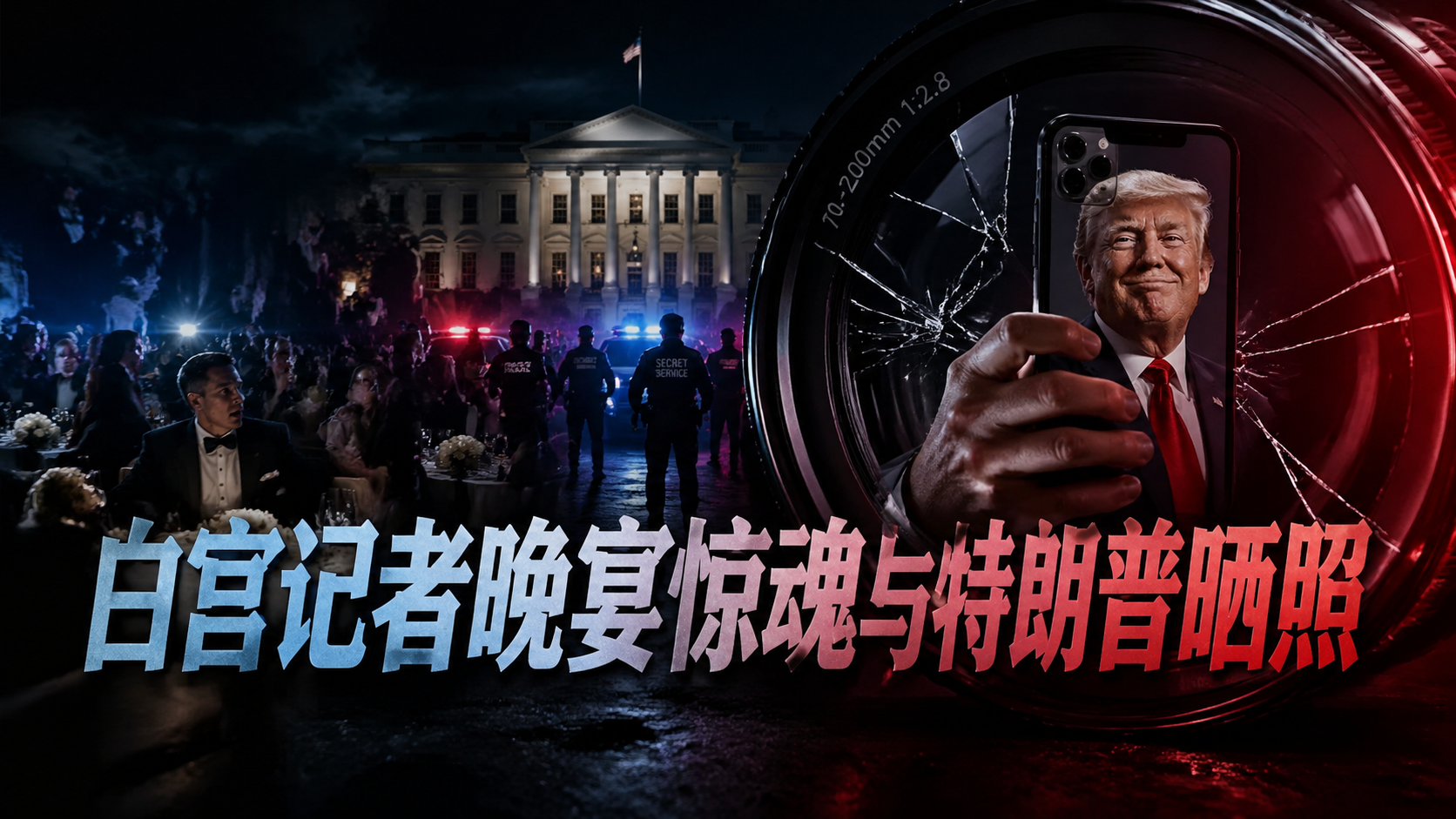
On April 26 in Washington, the camera should have only focused on the humor and wine glasses of the White House Correspondents' Dinner. But in an instant, the scene was interrupted as security personnel hurried into the venue—Trump and First Lady Melania were escorted out of the Washington Hilton, and there was no time for explanations on-site, nor did officials provide a reason immediately. Such an emergency evacuation on an annual political social stage is already rare, let alone on the same day he had just made a high-profile statement on another stage: at a cryptocurrency conference, he called crypto a "huge industry" and publicly warned the banking sector not to obstruct related legislation.
On the same day in Tehran, the Vice Speaker of Iran's Islamic Parliament, Nikkhzad, announced a different tone: Supreme Leader Mojtaba Khamenei has ordered that the Strait of Hormuz must not return to a pre-war state. For this globally critical energy passage, "non-pre-war state" means that tensions are not a temporary episode but could become the new normal. Traders did not need to wait for an official announcement; they had already made their choices on Polymarket—the odds of a contract stating "The US and Iran reach a permanent peace agreement before April 30" were pushed down to 4%–10%, declining about 7 percentage points within just 24 hours, and with a total transaction volume exceeding $50 million, this pessimism was backed by real money.
The on-chain world also provided its commentary on the same day. In September last year, a major address withdrew 50.1 million ASTER from Aster, and on April 26, early morning, it transferred 34.61 million ASTER (about $22.94 million) back to Aster. The return of funds did not bring about the anticipated positive effect; the price curve chose to vote with its feet: ASTER dropped from approximately $0.66 to around $0.63, with a short-term decline of about 5%. After this transfer, the address still held about 24.25 million ASTER, with the unchanged chips like a knife hanging over the market.
As Trump was escorted from the venue, Iran proclaimed the "non-pre-war state" of Hormuz, the Polymarket peace contract continued to bleed, and ASTER flashed down after large amounts returned on-chain, these originally unrelated narrative lines intertwined on April 26, pointing in the same direction: risk is being repriced. The cryptocurrency fear and greed index was at 31/100 on April 25, slightly rising to 33/100 on the 26th, seemingly better but still firmly stuck in the "fear" range—under such readings, the market's tone is not excitement but defense: good news can be remembered, but positions are more willing to prepare for the worst.
Emergency Evacuation at the White House Dinner: On the Same Day Trump Stands for Crypto
With the fear index still at a low level, the camera shifted from the exchange's candlestick chart back to the banquet hall of the Washington Hilton. The White House Correspondents' Dinner was underway—this annual high-profile political social event is known for its lights, laughter, and stand-up style humor, not sudden security directives.
On April 26, 2026, Trump and First Lady Melania were taken out of the venue by security personnel during the dinner. The sight of a president being urgently evacuated in this context is extremely rare, especially under the floodlights and live cameras. No explanation was given on-site, and afterwards, officials did not disclose specific reasons; up until current public information, it has not been confirmed whether the evacuation is related to any attack or specific threat. This kind of uncertain "lack of clarity" itself is a stress test for market nerves—security shadows suddenly pressed down on an already sensitive crypto narrative.
On the same day, a very different Trump appeared on another stage. He spoke at a cryptocurrency conference, publicly declaring that cryptocurrency is a "huge industry," his tone no longer downplaying it but acknowledging its scale and importance. More strikingly, he issued a warning to the banking sector: do not obstruct or undermine the advancing crypto legislation.
These two scenes overlap: one shows the president being escorted out by security in a traditional power setting, reminding everyone that political and security risks may break the script at any moment; the other is the same person, under the lights of the crypto industry, openly standing for this "huge industry" and speaking to the old forces of the financial system. For crypto investors, this sends not a single signal but a complex composite sound—on one hand, "political risks are heating up," while on the other, "the regulatory path may become clearer."
Thus, the market received a subtle guidance amidst fear: crypto is being drawn deeper into the macro and security game, at the cost of raised risk premiums, possibly leading to more defined regulatory boundaries. For those holding chips, this acts both as an alarm and as a call to arms.
Hormuz Does Not Look Back: The US-Iran Peace Contract Is Put on Ice
Just as the alarm sounded in Washington, another command from further away stretched the risk curve thoroughly. Ali Nikkhzad, the Vice Speaker of Iran's Islamic Parliament, reported that Supreme Leader Mojtaba Khamenei has ordered that the Strait of Hormuz must not return to a pre-war state. For those familiar with the importance of this waterway, this statement is almost equivalent to a decree—this confrontation will not end soon.
The Strait of Hormuz is a global critical energy passage, and here, "non-pre-war state" is not an abstract diplomatic phrasing but means military or security tensions will be preserved and even institutionalized. For traders accustomed to pricing risks along timelines, the meaning of this command is straightforward: do not expect a return to "normal" in the short term, risk premiums need to be repriced over a longer cycle.
The first to provide numerical responses were the on-chain predictors. On Polymarket, the price of the contract "The US and Iran reach a permanent peace agreement before April 30" has been pressed into single-digit probability ranges, currently hovering around 4%–10%. More striking is its slope—over the past 24 hours, this probability has dropped by about 7 percentage points. Peace is not entirely denied, but on the trading interface, it is left with odds nearly bordering on "miracle."
This is not an inconspicuous little pool. The accumulated transaction volume of this peace contract has exceeded $50 million, meaning whether speculative or hedging, a substantial amount of capital is expressing its judgments with real money. When the hardline signals from Tehran combined with the continuously declining odds in this contract, the simple and brutal conclusion jumps to the surface: the market is systematically and consistently pricing geopolitical tensions.
This pricing will not remain confined to a single prediction curve. For holders, the suddenly lowering peace probabilities on Polymarket are not just profit and loss changes of a specific event contract, but a reminder about the overall position risk: when a critical passage is clearly declared as "not returning to pre-war," risk appetite is no longer an abstract emotion, but a parameter that needs to be recalculated across all high-volatility assets. Next, this premium starting from Hormuz will further propagate along longer chains to broader crypto assets—the subsequent large-scale on-chain migrations are just one link in this transmission.
Whale Movement of 50.1 Million: ASTER Flash Crashes 5% in One Night
As the risk premium of Hormuz remained on the derivatives curve, an on-chain address that had been silent for half a year suddenly reached for its previously withdrawn chips.
This address had withdrawn 50.1 million ASTER from Aster last September and had been regarded as an "invisible whale" in the ecosystem. It remained dormant for several months until early morning on April 26, 2026, when this entity abruptly transferred 34.61 million ASTER (approximately $22.94 million) back to Aster. The funds were not distinctly directed towards any particular institution or platform in the public information, and who is behind the address and what their intentions are can only be speculated from on-chain traces. However, a clear consensus quickly formed: this was a large amount of chips substantial enough to change short-term supply and demand balance and could likely become a source of selling pressure.
The price reaction occurred almost simultaneously. After this large inflow, the price of ASTER dropped from about $0.66 to approximately $0.63, with a short-term decline of about 5%. Such a drop might not be fatal on the daily chart, but it reveals a more realistic issue: in an environment dominated by fear, the liquidity that ASTER can absorb is very limited. When a batch of tens of millions of chips heads toward the "exit," the depth and patience of buy orders appear significantly insufficient, and the price only needs a gentle push to slide down.
Even more unsettling is that this address did not "liquidate its positions." After transferring back 34.61 million, it still holds about 24.25 million ASTER. The exact corresponding dollar value is truncated in the current public data, but in terms of volume alone, this is still a chip that can sway the market. It is like a grenade that has been pulled but not thrown—there may not be an immediate explosion, yet it forces project teams and holders to keep it on the short-term risk list and continuously monitor it.
On a day when the peace probabilities were discounted by the market and the fear index remained at a low level, ASTER's flash crash served both as a manifestation of weak liquidity and an amplifier in a fragile emotional period: any slight movement from a whale could be magnified into a shock for the entire sector.
Fear Index Lingers at Low Levels: Risk Aversion and On-Chain Selling Pressure Resonance
If the return of the ASTER whale was merely a fuse, the sentiment had already been ignited the day before. On April 25, the cryptocurrency fear and greed index was only 31/100; by April 26, it slightly rose to 33/100 yet still firmly remained in the "fear" range. This indicator is itself a thermometer for measuring overall sentiment—the lower the value, the more unwilling the market is to take risks, and the stronger the risk-averse mentality. In other words, even before ASTER displayed that significant on-chain movement, the market was already in a state of "ready to withdraw at the slightest disturbance."
Coincidentally, on April 26, it was not just the fate of a specific project being reassessed but a whole array of risks being presented to traders at the same time: in the U.S. capital, Trump and Melania were urgently evacuated from the venue of the White House Correspondents' Dinner; almost on the same day, he also referred to crypto as a "huge industry" at a crypto conference and warned the banking sector not to obstruct relevant legislation; in the Middle East, Ali Nikkhzad publicly stated that Supreme Leader Mojtaba Khamenei ordered the Strait of Hormuz not to return to a pre-war state, effectively labeling this key energy passage with a "risk of continued or escalating tension." Systemic risks and policy uncertainty were bundled together, turning into an emotional combination that is difficult to deconstruct.
In the derivatives market, this concern was quantified into a specific number: on Polymarket, the contract for "The US and Iran reach a permanent peace agreement before April 30" saw its probability drop about 7 percentage points within 24 hours, now only oscillating between 4%–10%, with accumulated transactions surpassing $50 million. This is not a niche speculative play but a battlefield wager assessed by a significant amount of capital—peace probabilities are collectively discounted by the market, meaning systemic risk has not truly exited in the eyes of participants.
Against this backdrop, the return of the 34.61 million ASTER (about $22.94 million) from the whale is no longer merely a repositioning of assets from a specific address, but an experiment amplified by sentiment regarding whether an individual project can withstand shocks. After the transfer, the price of ASTER dropped from about $0.66 to about $0.63 in a short-term dip of nearly 5%. Rather than a simple selling pressure, this reflects the self-amplifying nature of low liquidity markets during periods of fear—what merely represents an action of one address is read on-chain as a signal of "who else is going to run."
Thus, on that day, macro and micro resonated on the same nerve: on one side, the downtrend in Polymarket peace contract probabilities reflects investors' pessimistic pricing regarding the US-Iran situation; on the other side, ASTER's short-term flash crash exposes individual project vulnerabilities under a magnifying glass. The fear and greed index remained in the "fear" range for two consecutive days, making this resonance more likely to evolve into a chain reaction—investors prefer to stand on the sidelines watching, or adjust their positions to be more "defensive," rather than willing to pay for uncertainty at this moment.
In this emotional structure, any large-scale on-chain movement is no longer regarded as neutral liquidity but potentially triggers severe price volatility or even short-term stampedes at any time. The shadow of systemic risk and the sudden amplification of individual risks intertwine to form a new fear: not fearing a particular bomb explosion, but fearing not knowing where the next bomb is.
Between Evacuation and Warning: How the Crypto Market Could Step Out of the Shadows
April 26 has become a folded negative: on one side, the president is urgently evacuated from the White House Correspondents' Dinner, with no official explanation provided; on the other side, the same Trump declares this a "huge industry" at the cryptocurrency conference, and warns the banking sector not to obstruct or undermine related legislation. For the market, these are two completely opposite beams of light: political risk is rising, yet policy expectations signal warming on the same day, with emotions pulled between alarms and positives.
On the same day, shifting the perspective away from Washington, the Strait of Hormuz resembles a nerve deliberately pulled tight. Ali Nikkhzad stated that Supreme Leader Mojtaba Khamenei has ordered that this globally critical energy passage "must not return to a pre-war state." Meanwhile, on the off-chain betting market, the Polymarket contract on "The US and Iran reach a permanent peace agreement before April 30" saw its probability drop to a low range of 4%–10%, having declined by about 7 percentage points in just 24 hours, with the accumulated transaction volume exceeding $50 million. The price itself is a form of language—here it expresses a near-total lack of hope for short-term peace, with geopolitical risks potentially continuing to suppress all risk assets.
On-chain, the ASTER whale materializes this tension. That address, which withdrew 50.1 million ASTER from Aster last September, had long been viewed as one of the key players in the ecosystem. By early morning on April 26, this address transferred 34.61 million ASTER (approximately $22.94 million) back to Aster, immediately triggering a price drop from about $0.66 to approximately $0.63, a flash crash of about 5%. More critically, this address still holds about 24.25 million ASTER, like a stone waiting to drop, hanging over the project, and also over the sentiment.
If each action of a whale is a detail under a magnifying glass, when the overall sentiment is already leaning towards panic, these details are even more likely to evolve into local stampedes. On April 25 and 26, the cryptocurrency fear and greed indices stood at 31/100 and 33/100, both firmly within the "fear" range—risk appetite declines, and risk-averse emotions rise, providing soil for all sudden price movements and on-chain events to be amplified. In such an environment, Trump's "stand" the command regarding the Strait of Hormuz, the pessimistic pricing on Polymarket, and the return of the ASTER whale collectively form a puzzle of fear without a center.
How to step out of this puzzle? At least in the coming days, what the market can truly do is not guess where the next bomb might be, but focus on a few clear clues:
● From Washington, the official explanation of the evacuation at the White House Correspondents' Dinner is the starting point for pricing political risk. Even if it is just a technical explanation of security processes, it will directly influence the market's judgment on "whether similar incidents could recur," thereby deciding whether Trump’s "evacuation + stand" combination is interpreted as an incidental event or the precursor to a greater storm.
● In the Middle East, every public statement regarding the US-Iran situation will leave traces of pricing on Polymarket. As April 30 approaches, whether the current low probability of the peace contract continues to dip or suddenly rebounds will become an immediate indicator for observing whether geopolitical tensions ease. That is not only a bet from contract participants but also a projection of broader risk asset sentiment.
● In the on-chain world, further actions from the ASTER whale address are key to whether local risks can be "sealed." If these 24.25 million ASTER remain static, the market may gradually view it as a "known risk," with fear digested over time; however, if a new large transfer occurs, under the backdrop of a continuing low fear index, similar flash crashes could easily mirror across other projects.
April 26 has tied together political security events, potential policy positives, geopolitical tensions, and whale movements, making the entire crypto market appear like a suspension bridge being pulled simultaneously at multiple cables. Stepping out of the shadows does not mean that risks will automatically disappear, but rather finding rhythm among these cables: using official information to correct rumors, using price signals like Polymarket to calibrate sentiment, and continuously tracking on-chain whales to bring the risk circle of individual projects back from the "unknown range" to the "visible range."
Fear will not dissipate simply due to one or two pieces of good news, but after observable indicators are laid out one by one, it can at least transform from a tangled fog into a priceable risk table. For this market, this is already the first step out of the shadows.
Join our community to discuss and become stronger together!
Official Telegram community: https://t.me/aicoincn
AiCoin Chinese Twitter: https://x.com/AiCoinzh
OKX Welfare Group: https://aicoin.com/link/chat?cid=l61eM4owQ
Binance Welfare Group: https://aicoin.com/link/chat?cid=ynr7d1P6Z
免责声明:本文章仅代表作者个人观点,不代表本平台的立场和观点。本文章仅供信息分享,不构成对任何人的任何投资建议。用户与作者之间的任何争议,与本平台无关。如网页中刊载的文章或图片涉及侵权,请提供相关的权利证明和身份证明发送邮件到support@aicoin.com,本平台相关工作人员将会进行核查。