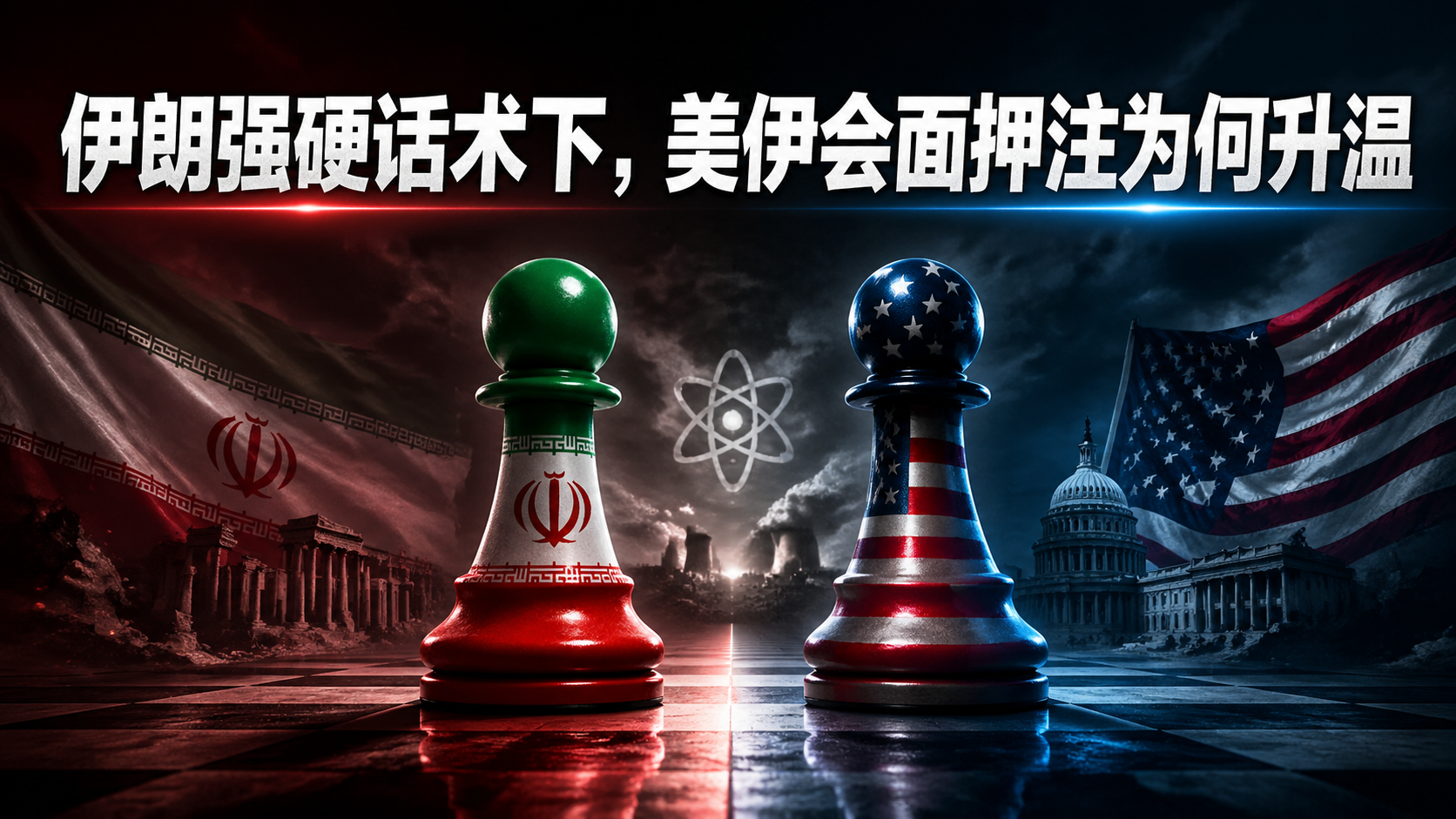
On April 25, multiple Chinese media outlets coincidentally suggested the same date—“April 27.” Panews, TechFlow, and Star Daily cited “sources” from Jinshi and New Delhi Television, claiming that the “second round of negotiations” between Iran and the United States is scheduled to take place on this date. It was explicitly marked as the “second round,” provided that: in the preceding time, the two sides had already completed a round of negotiations somewhere, the location, format, topic, and even the results of which were concealed from public reports.
In the same wave of reports, another clue was quickly woven into this narrative: Star Daily, Jinse Finance, and panews consistently stated that Iranian Foreign Minister Abbas Araghchi would travel to or return from Islamabad before Sunday, with this trip attributed to Saudi Arabia's Al Arabiya and Pakistani sources. Thus, alongside the timeline of the “April 27 second round of negotiations,” a frequently mentioned city—Islamabad—emerged; Araghchi's movements were narrative linked to this unconfirmed meeting.
However, amidst the overwhelming secondary citations, the true absence was the voices of the parties involved. Research briefs indicate that there has indeed been a round of contact between Iran and the U.S. recently, yet no verifiable details have emerged; and regarding the “second round of negotiations” pre-announced by the media for a specific date, as of now, neither Tehran nor Washington has provided a clear confirmation or detailed explanation. The date of April 27 and Araghchi's planned trip to Islamabad became repeated clues in the narrative framework but were simultaneously wrapped in enormous uncertainty.
Where the Second Round of Negotiations Comes From: The Narrative Driven by Sources
On April 25, the notion of a “second round of negotiations between the U.S. and Iran” was propelled to the forefront of the Chinese information sphere almost simultaneously. Media outlets such as panews, TechFlow, and Star Daily presented strikingly similar narratives: citing reports from Jinshi and New Delhi Television, referring to “sources” who claimed that the new round of negotiations between Iran and the U.S. “is planned for April 27, 2026.” From the reader's perspective, this seemed like a piece of information that had already been validated multiple times, but tracing the chain upstream reveals that the sole source at the top merely stated “sources said.”
These reports also shared a notably consistent tone: key phrases were almost invariably “sources stated” or “according to sources,” rather than “the Iranian Foreign Ministry announced” or “the U.S. State Department issued a statement.” In other words, the claim that “the second round of negotiations is scheduled for April 27, 2026” remains at the level of media recounting anonymous information, and there are no formal documents, announcements, or joint communiqués from either the Iranian or U.S. diplomatic apparatus to compare or verify. The research briefs themselves have also failed to provide any official texts, and this gap constitutes the core risk point of the entire narrative.
More subtly, it is how Abbas Araghchi's itinerary got entangled. While simultaneously citing Jinshi and New Delhi Television, Star Daily, Jinse Finance, and panews also continued to quote Saudi Arabia's Al Arabiya and “Pakistani sources,” stating that Araghchi would travel to or return from Islamabad before Sunday. Reports typically combined these two pieces of information in the same paragraph: on one hand, “the second round of negotiations is planned to be held on the 27th,” on the other hand, “the Iranian Foreign Minister will travel to Islamabad before Sunday.” With this arrangement, even if no one explicitly stated that the negotiations would be held in Islamabad, readers could easily connect the two in their minds.
The chain of information dissemination thus became clear: upstream are sources like New Delhi Television and Al Arabiya, which use “sources” as their origin, then undergo secondary processing by Jinshi, and finally get amplified synchronously by multiple Chinese media outlets like panews, TechFlow, and Star Daily. Each layer would reiterate the phrase “sources said, the second round of negotiations is scheduled for April 27,” while also mentioning Araghchi's trip to Islamabad. Once this set of phrases is replicated across enough platforms, the uncertainty of “sources” is diluted by the avalanche of retracings, transforming “the time has been set for April 27” and “the second round of negotiations is closely related to Islamabad” into seemingly self-evident “common knowledge” in public opinion.
Tehran's Silence and Denial of Rumors: Official Stance as the Biggest Gap
Tracing back along the narrative of “April 27 second round of negotiations,” one discovers an especially glaring blank: In currently available public channels, there has been no formal confirmation from Iran, nor an authoritative denial of the specific arrangements for this so-called “second round of negotiations.” Research briefs explicitly point out that, surrounding the “second round of negotiations,” any official-level confirmation or denial statement from Iran has been absent in verified channels thus far—this means that all claims regarding “April 27” and related trip arrangements remain at the level of “sources” and media recitations.
In contrast to this silence, there are several widely circulated “detail versions” that stem from a sole source. For example, the assertion that “Iran refuses to negotiate directly with the U.S., only accepting indirect meetings” currently appears only in tweet-level sources; another statement claiming “the Iranian official denies plans for a second round of ‘direct’ negotiations” also has yet to be verified in mainstream media reports or official statements. The research briefs label such content involving negotiation formats and official stances as “pending verification information,” and explicitly remind not to treat it as established fact for writing or inference.
In this structural context, Tehran's “silence” combined with these sporadic and unverified denial rumors instead amplifies external imaginations about the true state of the negotiations. On one hand, without formal terminology to delineate boundaries, any statement like “reject direct negotiations” or “only accept indirect meetings” could quietly shift from “rumor” to “position” during the process of recounting; on the other hand, the lack of authoritative wording to cite also compels various reports to revert generally to vague terms like “visit” or “meeting,” intentionally avoiding precise definitions of the nature, format, and location of “negotiations.”
As a result, a subtle tension emerges: a round of contact that has already occurred but whose details are obscured, combined with a widely cited but lacking official endorsement “April 27”; the segment which should logically have been filled by the Iranian diplomatic system, is instead left empty for tweets and secondary citations to fill. Tehran’s silence turns into the largest “source of statements”—any interpretation can slip into that blank, yet retreating when necessary with “only sources said,” allowing responsibility to linger in the air.
Islamabad Pushed to the Center Stage: Pakistan’s Subtle Role
In the narrative void created by Tehran's “silence,” the first thing that filled the space was not the negotiation topics but a geographical coordinate. On April 25, multiple Chinese media outlets—Star Daily, Jinse Finance, panews—quoted Saudi Arabia's Al Arabiya and Pakistani sources stating that Iranian Foreign Minister Abbas Araghchi would travel to or return from Islamabad before Sunday. Almost simultaneously, these reports recounted “sources” regarding the April 27 U.S.-Iran “second round of negotiations.” The two timelines combined, and Islamabad was drawn into the center of the story.
From the perspective of an official research brief, this puzzle is far from complete. The brief confirms, on one hand, that there has been a round of negotiations between Iran and the U.S. recently, while emphasizing, on the other hand, that key details about the “specific location of the second round of negotiations,” “whether the negotiations are direct talks or indirect talks mediated by Pakistan,” are completely absent in public materials. Even the assertion that “the second round of negotiations will be held in Islamabad and mediated by Pakistan” is clearly marked as information only mentioned by a single source and pending verification. In other words, any sentence that directly writes “Islamabad” into the negotiation scene must remain a rumor and cannot be stated as established fact.
However, the logic of public opinion operates differently than diplomatic documents. The overlap in timing between Araghchi’s trip and the “second round of negotiations” makes it hard for media and commentators not to connect the two: if the Iranian foreign minister indeed appears in Islamabad around Sunday, imagining this city as a potential stage for the “back-and-forth” between Iran and the U.S. seems entirely reasonable. Even if strictly speaking, the “traveling to or returning from Islamabad” itinerary itself still awaits confirmation from more sources, it remains sufficient to sustain an entire imaginative framework of “Islamabad mediation” at this information-poor juncture.
The reason Islamabad, not another city on the map, is placed under the magnifying glass is due to a deeper contextual inertia. The research brief characterizes Pakistan as a regional power that has long played an important role in surrounding security and diplomatic issues, thus is frequently expected to become a potential mediator. This expectation does not rely on the details of a specific meeting but is an accumulation of geopolitical impressions over many years: when tensions and confrontations require a “middle ground,” Pakistan's name will naturally surface. Therefore, when “Iranian Foreign Minister + Islamabad trip” is juxtaposed with “U.S.-Iran second round of negotiations” in reports on the same day, what many readers conjure in their minds is not an ordinary bilateral visit but some behind-the-scenes mediation role.
Under the premise that location and format have not been officially confirmed, such imagination itself becomes part of the event narrative: on one side, the research brief repeatedly reminds “not to fabricate negotiation locations and formats,” while on the other side, media headlines and social media recitations constantly blur the boundary between “rumor” and “fact.” Over time, “the second round of negotiations potentially taking place on April 27” in the impressions of many, naturally equates to “most likely occurring in Islamabad, mediated by Pakistan,” despite the clear distinction in evidentiary standards between the two.
Thus, Islamabad has been thrust into the spotlight, yet remains in a somewhat awkward position: from the perspective of publicly available information, it is currently just a stop on Iran's foreign minister's itinerary pending verification; from the narrative presented in public opinion, it is invested with symbolic significance far exceeding known facts, imagined as the venue for everything “potentially happening” between Iran and the U.S. The subtleties of Pakistan lie here—whether it is a mediator in the real diplomatic layout remains to be seen; yet in the narrative that has already been set, it has already been preordained as the “mediator that should appear.”
After the First Meeting: The Rhythm of U.S.-Iran Exploratory Communications
Before Islamabad continues to be projected as the stage for the “second round,” a quieter meeting has already taken place. The research brief confirms that there has indeed been a round of negotiations between Iran and the U.S. prior, but in public channels, there are no visible locations, formats, topics, or final outcomes. This round has nearly erased its details, leaving only a minimal footnote, yet it serves as the pretext for all rumors around the “second round.”
Regarding such a contact that leaves almost no trace, different channels began to fill in their own blanks: some tried to explain why it didn't immediately advance to the next step, while others claimed to grasp the “reasons for the impasse.” However, the brief has indicated that such assertions currently mostly originate from a single source, only able to be categorized as “pending verification,” and cannot be written into established historical facts. For the external audience, the credible part about the first round of negotiations is just four words—“did occur;” as for how it occurred, it remains a must-keep blank area.
On this blank canvas, today's repeatedly written “second round” emerges. From conventional diplomatic paths, in hostile or highly tense relationships, parties that genuinely want to achieve something rarely rely on a one-time “determining life or death” big event; instead, they conduct multiple rounds of contact to gradually test each other’s bottom lines: which words can be openly discussed, which can only stay within technical expressions; which conditions the other side absolutely will not budge on, and which could be packaged, delayed, or exchanged. Each round of meetings serves more like a “temperature check,” delineating the thermometer scales for the range and rhythm of the next negotiation rather than delivering an immediate definitive answer.
Therefore, when recent reports about U.S.-Iran contacts frequently appear in public opinion—some from anonymous “sources,” some speculation about itineraries, and some extrapolations of future arrangements—the overall impression no longer appears as a single decisive meeting but as a long-term rhythm of “engagement while confronting”: public firm statements do not exclude continued probing through opaque channels; conversely, the more each side needs to demonstrate its stance to its domestic audience, the more they need to seek a little room for maneuver in private.
In this rhythm, the “April 27 second round of negotiations” date cited by numerous Chinese media, along with the rumors pertaining to Islamabad, are no longer isolated news points but embedded in a longer exploratory communication curve. The research brief simultaneously reminds that outsiders currently have no way of judging whether the first round is “close to breakthrough” or “stuck,” nor can they responsibly predict the actual progress of the so-called second round—any certain tone of “an agreement is imminent” or “doomed to fail” is mere self-aggrandizement beyond the facts. What can truly be confirmed is only this directional sense: within the tight opposition framework, a vaguely visible dialogue channel is being continually probed and extended, and Islamabad is merely the latest coordinate projected onto this channel.
Observers in the Fog of Information: How to Interpret the Period Surrounding April 27
If the “Islamabad coordinate” is merely a shadow cast on a vague dialogue channel, then the next few days will require us to clearly delineate the boundary between shadow and substance.
First, it is necessary to deliberately distinguish two layers of information:
One layer consists of the narrative level that has been repeatedly quoted by multiple media outlets, yet remains at the “sources said” level. For instance, currently around the U.S.-Iran contact, the only temporal anchor point frequently mentioned by several Chinese media is the claim that “the second round of negotiations will be held on April 27;” Araghchi’s itinerary “will travel to or return from Islamabad before Sunday” is similarly referenced through Al Arabiya and Pakistani sources, and reiterated multiple times by Star Daily, Jinse Finance, and panews. The reason this information is striking is due to the long citation chain and high frequency of repetition, but it essentially relies on limited sources, categorized as “widely circulated statements,” rather than “official confirmations from the parties involved.”
The other layer, in contrast, consists of facts that have already been publicly confirmed by the parties involved. From the currently available public framework, this layer is exceedingly restrained: the research brief only confirms that “a round of negotiations has occurred between Iran and the U.S. recently,” yet clearly points out that the location, format, topics, and outcomes of that round of negotiations have not been disclosed; regarding “the specific location of the second round of negotiations,” “whether it will be held in Islamabad,” and “whether it is a direct meeting or indirect communication mediated by Pakistan,” public materials have no conclusions. The brief even delineates boundaries: one cannot arbitrarily write “Islamabad” as the predetermined venue, cannot fabricate the names and itineraries of U.S. envoys, nor treat plots such as “close to reaching an agreement” as ongoing realities.
In this proactively left blank structure, what signals around April 27 should be monitored? At least three main lines:
● Statements and itinerary updates from the Iranian diplomatic system. Including whether the Iranian Foreign Ministry will issue a formal notice regarding Araghchi's visit around this date, and whether there will be a clear confirmation, denial, or deliberately vague response to the notion of “the second round of negotiations.” Even if it is just a routine post-meeting press release, the wording and publicly disclosed meeting counterparts would be key pieces to reconstruct the event's outline.
● The attitudes from U.S. official or authorized channels. Current reports lack a public characterization from the U.S. side regarding this round of rumors. Around April 27, if the U.S. diplomatic system issues statements, interviews, or Q&A sessions relating to Iran, even without naming “Islamabad,” it may indirectly indicate Washington's positioning towards this dialogue channel: whether it is “routine communication” or “limited contact,” or if there are other considerations.
● Pakistan's role and self-positioning. The research brief reminds that Pakistan, as a regional power, has long been viewed as a potential mediator, which is a structural role and not a direct confirmation of this event. In the next few days, whether the Pakistani Foreign Ministry discloses arrangements for meetings with Iran and the U.S., whether it proactively mentions “promoting dialogue” or “acting as a bridge” in public statements, will influence external judgment regarding its level of participation in this round of rumors.
As for the news flow on April 27 itself, a “layered reading” strategy should be in place: if the three parties maintain silence before and after, with only media continuing to recount the same set of “sources,” then “the second round of negotiations” appears more as a possibility resting within the public opinion layer; if at least one side formally confirms “meetings” or “contacts” have taken place but deliberately avoids disclosing location or format, April 27 will become a timestamp for “dialogue exists but its outline is unclear;” only when multiple public pieces intersect and complement each other will this date transform from a “rumor node” to a “fact node.”
For investors and geopolitical observers, what’s more important is how to set expectations amidst such information noise, rather than being led by a single date or city.
First, do not treat the frequent appearance of media as “certainty.” April 27, Islamabad, Araghchi; these three are bound together because they are repeatedly mentioned in the current reporting framework, not because any party has stepped in to endorse this binding. In the absence of official confirmation, deriving so-called “inevitable trends” for energy, regional security, or other assets based on this narrative chain is essentially substituting story for information.
Second, organize expectations around “scenarios” rather than “results.” Within the fact boundaries delineated by the research brief, it is reasonable to assume several parallel scenarios: negotiations may happen on April 27 in some form; negotiations may be delayed or downgraded to technical contacts; the so-called second round may not take place at all, merely magnified by prior contact. Different scenarios correspond to different risk pricing, but until new evidence arises, none can be prematurely declared as “already occurred.”
Third, shift focus from “interpreting a single piece of news” to “observing the continuity of signals.” The research brief does not provide any specific market data or price changes, merely indicating that such diplomatic trends are often viewed as potential influencing factors by international public opinion and financial markets. This precisely serves as a reminder: what is truly important is not which tweet or exclusive scoop, but whether such messages receive multiple-source verification in the coming weeks, whether they initiate institutional arrangements, or whether they get written into longer-term policy narratives. Short-term price volatility in response to a single headline often reflects sentiment more than structural geopolitical changes.
In this stage where information is deliberately left blank and key details are missing, the most prudent stance is to acknowledge “unknown,” rather than hastily augmenting the unknown. April 27 may become an important footnote in later reflections, or it may simply be an ordinary date among many rumor nodes. For those seeking a sense of direction from it, a more rational approach is to treat it as a test—testing the discrepancies between media chains and official information, and testing whether one relies on story trading or evidence-based judgment in the face of uncertainty.
Join our community, let’s discuss and become stronger together!
Official Telegram community: https://t.me/aicoincn
AiCoin Chinese Twitter: https://x.com/AiCoinzh
OKX Welfare Group: https://aicoin.com/link/chat?cid=l61eM4owQ
Binance Welfare Group: https://aicoin.com/link/chat?cid=ynr7d1P6Z
免责声明:本文章仅代表作者个人观点,不代表本平台的立场和观点。本文章仅供信息分享,不构成对任何人的任何投资建议。用户与作者之间的任何争议,与本平台无关。如网页中刊载的文章或图片涉及侵权,请提供相关的权利证明和身份证明发送邮件到support@aicoin.com,本平台相关工作人员将会进行核查。