Original Title: "Will the Federal Reserve Lower Interest Rates? This Data Tonight is Key"
Original Author: Dong Jing, Wall Street Journal
Under the dual pressure of geopolitical conflicts and a rebound in inflation, market expectations for Federal Reserve interest rate cuts are experiencing extreme fluctuations.The core of the current market game is: Will high energy prices trigger sustained inflation, or will they undermine consumer demand and force the Federal Reserve to cut rates?
On April 21, according to news from the Wind Trading Platform, Citigroup provided clear reasons for a bullish view on rate cuts in its latest research report, believing that disruptions in oil supply are only temporary disturbances, and although the path to lower rates may be bumpy, the direction is clear; whereas Deutsche Bank poured cold water on the outlook, warning that the Federal Reserve's policy is already at a neutral position and is expected to maintain current rates indefinitely.
With the conflicting views of the two major investment banks, the upcoming March retail sales data will become the key touchstone to break the deadlock. This data will not only reveal the true destructive power of high oil prices on core consumption, but will also directly determine the recent policy path of the Federal Reserve.
Citigroup: Geopolitical disturbances are temporary, the direction for rate cuts remains unchanged
Despite the ongoing influence of geopolitical developments on the market, Citigroup firmly believes that the path to lower interest rates and a more dovish Federal Reserve policy still exists.
The core logic of this judgment is: The situation in the Strait of Hormuz is increasingly likely to be a temporary shock to oil supply, rather than a persistent source of inflation. On April 18, there were reports that the Strait of Hormuz would reopen, and although this was subsequently questioned, both bond yields and oil prices have retreated from their Thursday highs and remained at lower levels — this alone indicates that the market is pricing in a "short-lived impact" scenario.
The research report pointed out that Citigroup's logic chain is clear: Geopolitical conflict is temporary → oil price shock is not sustained → inflation pressure does not spread → conditions for the Federal Reserve to return to the rate-cutting track are in place.
In addition, a series of underlying economic data tracked by Citigroup shows that the macro financial environment is undergoing subtle changes:
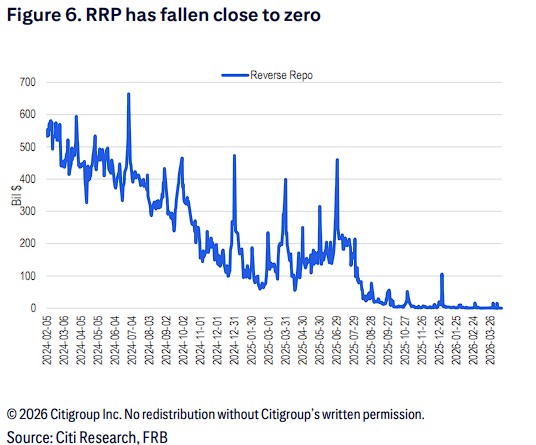
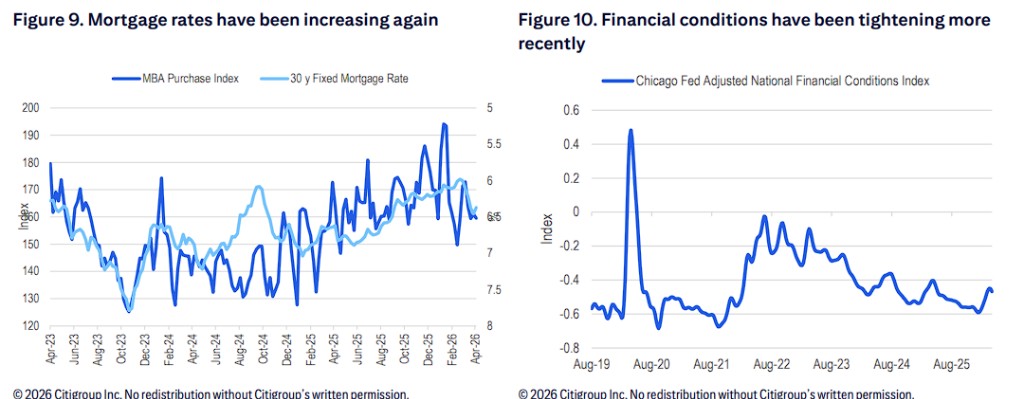
Liquidity and financial conditions: The scale of the Federal Reserve's reverse repo operations (RRP) has significantly decreased to nearly zero; meanwhile, recent financial conditions are tightening, and mortgage rates are also on an upward trend again.
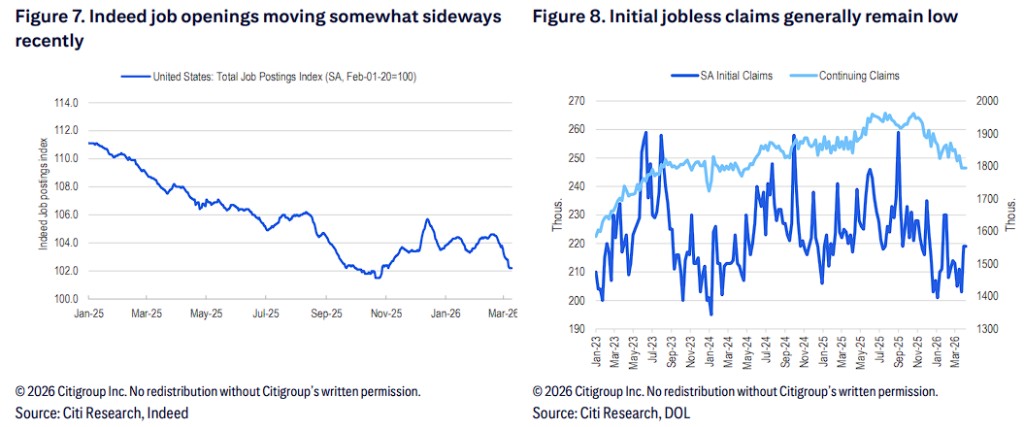
Labor market: Indeed job vacancy data has recently shown a sideways consolidation trend, but the initial claims for unemployment benefits remain generally at low levels.
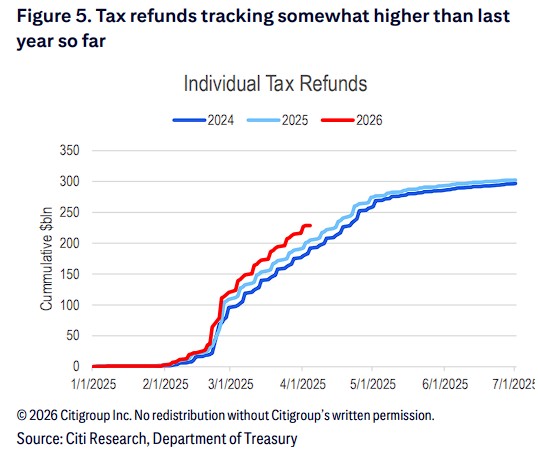
Funding conditions: So far this year, individual tax refunds (measured in billions of dollars) are slightly higher than the same period last year.
Tonight's Touchstone: Why is March "Control Group" Retail Sales Data Key?
As expectations for rate cuts fluctuate, the soon-to-be-released March retail sales data will provide investors with firsthand clues, revealing to what extent high gasoline prices have reduced consumer spending in other categories.
Citigroup emphasizes that investors must "strip away the surface" when interpreting this data. Due to rising gasoline prices, nominal retail sales in March are bound to show a spike. However, what truly determines the Federal Reserve's policy direction is the "control group" sales data.
The report indicates that this data excludes sales at gas stations and certain specific categories, allowing for a more genuine and accurate reflection of whether high oil prices have led to weak consumer spending in other areas. If "control group" data unexpectedly weakens, it will strongly confirm that high inflation is undermining demand, thus providing key data support for the Federal Reserve's logic of cutting rates.
Deutsche Bank's Cold Water: Policy has reached Neutral, Federal Reserve may remain on hold indefinitely
In stark contrast to Citigroup's optimistic expectations, Deutsche Bank has given a very cautious judgment on the prospect of interest rate cuts. Deutsche Bank clearly stated in its research report: The Federal Reserve is expected to maintain current rates indefinitely, as current policy is already at a neutral position.
Deutsche Bank's pessimistic expectations are mainly based on the following core points:
Stagnation in inflation reduction: Broad inflation indicators show that progress in combating inflation in the United States has stalled.
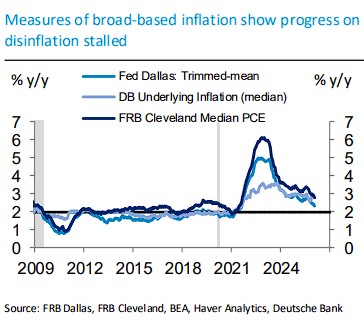
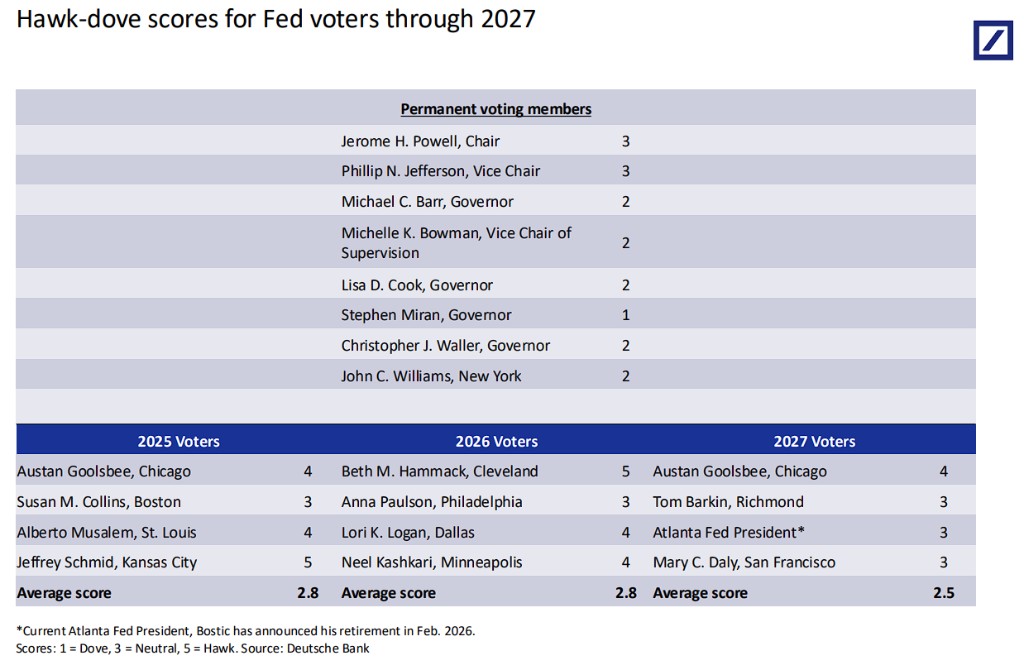
Officials' Stance Turns Hawkish: Deutsche Bank's tracking of Federal Reserve officials' speeches shows that officials like Waller and Miran have adopted a more hawkish tone, while most officials continue to believe the current policy stance is "well positioned". Specifically:
· Waller: Tending towards hawkish. He pointed out that if the conflicts in the Middle East become prolonged, it will obstruct the path to rate cuts; a series of shocks (tariffs plus oil prices) may trigger more persistent inflation; he also emphasized that core inflation, excluding the impacts of tariffs, is close to 2%, and there are vulnerabilities in the labor market;
· Miran: Currently the most dovish voice, supporting three or even four rate cuts this year, believing that the war has not changed the inflation outlook in 12 to 18 months, and that oil price shocks are temporary;
· Williams: Believes the policy "is exactly in the right position," raising the inflation forecast for 2026 to about 2.75%, while lowering the economic growth forecast for 2026 to between 2% and 2.5%;
· Hammack: Explicitly stated that rates will "remain unchanged for a considerable time";
· Goolsbee: Warned that if oil prices persist at $90 per barrel, it could spread to other prices; the likelihood of further rate cuts in 2026 is low, and cuts may need to wait until 2027;
· Daly: Believes the current policy is in "a very good position," and if the oil price shock persists until the end of the year, it would not be surprising for the market pricing to shift to "zero cuts".
The minutes from the Federal Reserve's March meeting also indicate that the vast majority of officials believe that the process of returning inflation to the 2% target will be delayed; some officials even discussed the necessity of including "two-way risks" wording in the meeting statement, suggesting that the possibility of rate hikes is not completely ruled out.
Deutsche Bank's hawk-dove rating of Federal Reserve officials shows that the average score for the 2026 voting committee is 2.8 (1 being the most dovish and 5 being the most hawkish), overall leaning slightly towards neutral but the dovish voices are clearly a minority.
Market pricing has completely reversed: Faced with ongoing inflation pressures and strong economic resilience, market expectations have undergone a dramatic change. According to Deutsche Bank’s data, current market pricing anticipates "zero rate cuts" throughout 2026, with the first rate cut expected only in the summer of 2027.
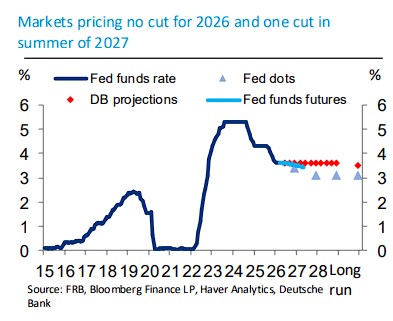
Deutsche Bank expects that under the baseline scenario, the federal funds rate will remain at 3.63% throughout 2026 to 2028, with no rate cuts for the entire year.
Original link
免责声明:本文章仅代表作者个人观点,不代表本平台的立场和观点。本文章仅供信息分享,不构成对任何人的任何投资建议。用户与作者之间的任何争议,与本平台无关。如网页中刊载的文章或图片涉及侵权,请提供相关的权利证明和身份证明发送邮件到support@aicoin.com,本平台相关工作人员将会进行核查。


