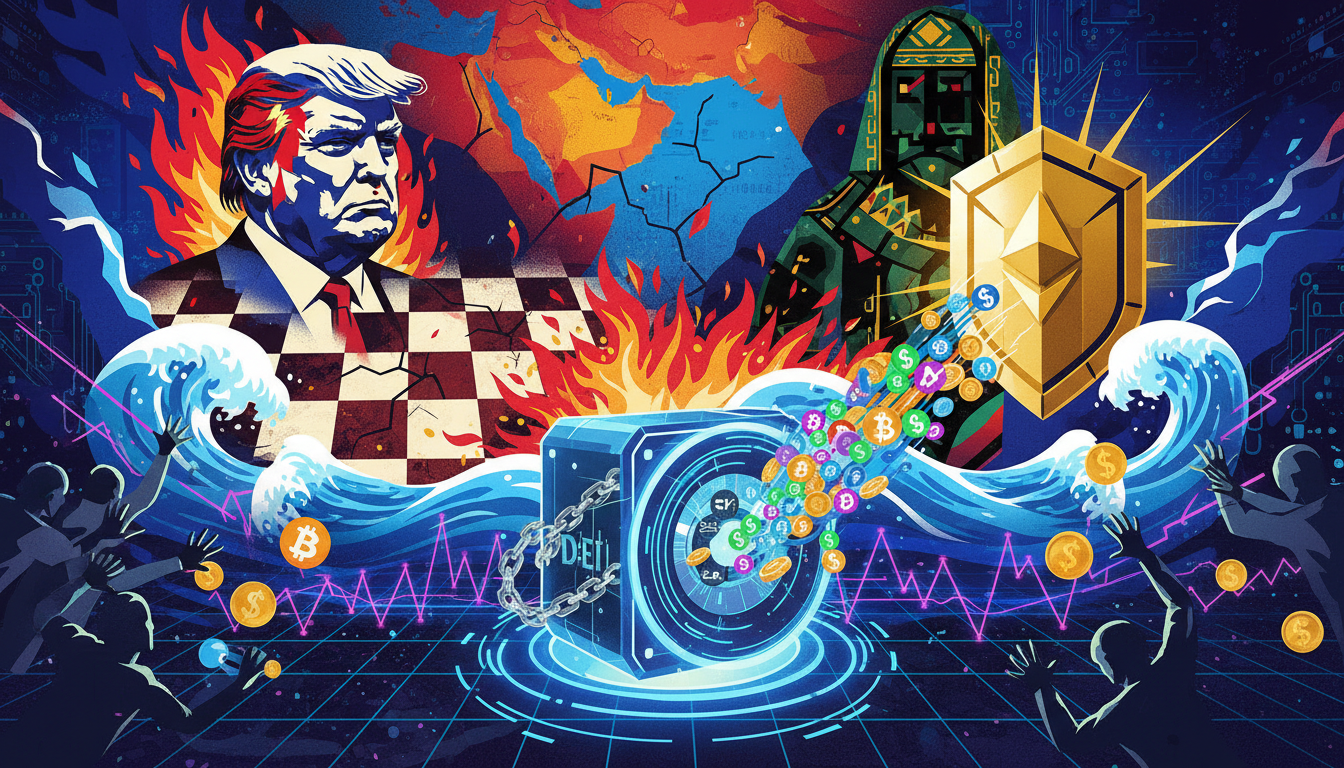
On April 19, 2026, Eastern Eight Time, the Iranian government was exposed for designating Bitcoin as the pricing and payment tool for oil transit fees in the Strait of Hormuz, directly pulling cryptocurrency assets into the charging system of the global energy throat. However, in stark contrast to this high-profile move, there emerged another key piece of information in the market - nominally branded as Bitcoin, but actual settlements primarily relied on one or more stablecoins. Thus the question becomes: is this a political declaration to show the world “we collect oil money in Bitcoin,” or a carefully designed practical project that uses a crypto combination to circumvent sanctions? To understand the significance of this move, one must pull back the perspective to the Strait of Hormuz—this area accounts for about 20% of global oil trade, and once the settlement logic changes, it will bring not only oil prices but also shocks to the geopolitical financial order.
Bitcoin Takes the Stage: The Iranian Official...
From the timeline perspective, April 19 marks a clear watershed - it was on this day that it was explicitly reported that Iran had designated Bitcoin as the pricing and payment tool for the oil transit fees in the Strait of Hormuz. Public information only provided the meanings of “designating Bitcoin” and “for oil transit fees”, without a complete set of official documents and operational guidelines, which means that what the outside world can currently confirm is the action itself, rather than all institutionalized written expressions. Key provisions, including pricing rules, conversion methods, and risk hedging mechanisms, have yet to be systematically disclosed through public channels.
In terms of factual dimensions, only three points can be repeatedly confirmed: first, the time anchor is April 19, 2026; second, the applicable scenario is the oil transit fees in the Strait of Hormuz, a specific charging item; third, Bitcoin has been included in the options for “pricing/payment tool.” Beyond these, any attempt to write “official rhetoric” on behalf of Iran or complete “unpublished provisions” would cross the information boundary. In the absence of formal details and complete original text, this article will only use the “known action” as a starting point for discussion, without re-creating the specific explanatory content of the Iranian government.
When this step is placed back into the context of the global energy map, its symbolic significance becomes clear. The Strait of Hormuz carries about 20% of the global oil trade, and is one of the few energy routes characterized by “systemic risk”. By elevating Bitcoin onto the pricing stage of the energy thoroughfare, Iran appears to diversify the means of charging, but in essence, at a highly sensitive geopolitical node, it incorporates cryptocurrency assets into the pricing system. This combination would not only be interpreted as a loosening of traditional dollar settlement practices but more like an open “hedging signal”: under repeated pressure from financial sanctions, Iran attempts to use decentralized assets to carve out a parallel corridor outside the dollar-dominated clearing system.
Bitcoin on Stage, Stablecoins Working Behind the Scenes
If one looks only at the title “designated Bitcoin”, this seems like a highly crypto-idealistic policy leap. However, another clue provided by insiders dismantled the scene of this drama. A key statement is: “Most fund flows do not settle directly on the Bitcoin chain.” This means that there is no one-to-one correspondence between the frequently appearing “Bitcoin collects oil money” on the ledger and in public opinion, and the actual migration of funds on the chain.
The key information currently confirmed is: from the outside, Iran indeed uses Bitcoin as the unit of pricing and payment — shipowners and trading partners can see the BTC symbol at the contract/bill level; but at the actual settlement level, according to information disclosed from a single channel, the primary value transfer is still done through stablecoins. Whether carried on any public chain or using any technical path, public materials do not provide the names of the coins or usage ratios, and no details sufficient to reconstruct the process are provided. What can be established is only one sentence: The main settlement work does not take place on the Bitcoin main chain, but is handled by crypto tools closer to a “digital dollar account”.
Therefore, this mechanism needs to be viewed in two parts. The first line is the accounting role of Bitcoin: it exists as a unit of external display and quotation, serving a symbolic function in political narrative and media communication of “Iran officially collects oil road money in Bitcoin”. The second line is the engineering role of stablecoins: it is responsible for the specific flow of cross-border funds, translating the abstract “BTC pricing” into tangible, verifiable, and redeemable stable value in friendly banks or OTC systems. These two lines interlock in practical operations but are intentionally or unintentionally layered together in public opinion.
At the information boundary, it must be emphasized that several points of restraint are necessary: currently, there is no reliable data to support the reconstruction of the scale of on-chain transactions, specific participants, or detailed routes, nor can a meaningful estimation of “the usage ratio of BTC and stablecoins in this corridor” be made. All analysis can only be based on the general consensus of “settling primarily through stablecoins”, discussing the institutional logic behind it, rather than fabricating a rough on-chain screenplay from scratch.
Why the Combination of Bitcoin and Stablecoins?
To understand why Iran adopted the dual-track structure of “Bitcoin + stablecoins”, one must start from the constraints of sanctions. For a long time, Iran has been locked out of the dollar-dominated clearing network for oil exports and related shipping settlements, where traditional bank wire transfers, correspondent bank networks, and even insurance and re-insurance processes have faced various levels of restrictions. Under this high-pressure situation, what Iran seeks is a value channel that can circumvent dollar clearing, reducing the risk of freezing and disruption—and on-chain assets, especially in multinational unlicensed crypto networks, naturally become the experimental field.
In this experiment, Bitcoin’s role is more inclined towards pricing and political signaling. As the most decentralized and censorship-resistant leading crypto asset, Bitcoin holds three layers of appeal for Iran: first, it is difficult to be frozen by any single sovereignty on the books, symbolizing a disengagement from “someone else’s clearing system”; second, it has formed a consensus price globally, making it easy for friendly parties to understand and convert; third, and most crucially, on the symbolic level - writing Bitcoin into the official rules of the energy channel within a framework constructed by dollars and traditional financial institutions is an open expression of “anti-dollar consensus”, serving as a demonstration effect for countries similarly pressured or willing to hedge.
In contrast, stablecoins excel in technology and practicality. Whether backed by fiat reserves or other asset collateral, the core characteristics are price anchoring and very low volatility, with a transfer experience close to that of dollar accounts. For high-value, low-error tolerance oil settlements, using the highly volatile BTC for direct transactions means complex hedging costs and settlement risks; while using stablecoins allows for rapid clearing on-chain, and its value closely aligns with the dollar, the on-chain liquidity and OTC absorption能力 far exceed most other crypto assets. From a purely engineering perspective, it is much more suited to bear the role of an “oil money mover”.
Thus, a relatively reasonable combination logic emerges: Bitcoin is responsible for “showing up and setting the tone”, while stablecoins are responsible for “moving and landing”. The former displays the sovereign's detachment from the dollar system and the determination to explore crypto, while the latter ensures the safety of trading counterparties' funds, exchange efficiency, and regulatory connectivity behind the scenes. This is both a realistic response to the sanction environment and a compromise in seeking balance between ideals and engineering—highlighting “de-dollarization” in institutional discourse while ensuring that oil money can be delivered in full, on time, and with low risk in actual operations.
The Strait of Hormuz Becomes a Crypto Testing Ground...
Pulling back the perspective from Iran itself to the regional level, the uniqueness of the Strait of Hormuz gives this crypto experiment a reach beyond a single country. This area carries about 20% of the global oil trade, and if Iran's version of “Bitcoin pricing + stablecoin settlement” is accepted by some friendly countries toward Iran, it could gradually form a localized on-chain settlement zone for energy trade around this thoroughfare. Even if in the early stages, only a small number of vessels and limited volumes of goods are involved, once the operational path is proven feasible, its demonstration effect will naturally spill over.
For traditional financial structures, the impact of this change lies in the emergence of parallel tracks in pricing and settlement systems. One track continues with the classic path of dollar pricing, SWIFT wire transfers, and international banking networks; the other forms a new link using Bitcoin and other crypto assets as pricing symbols and stablecoins as settlement media. Even if the absolute scale remains limited for a considerable duration, it objectively provides a “non-dollar account” operational paradigm for commodities like oil—an approach that holds strategic value for some countries.
In a larger narrative framework, Iran's attempts can be viewed as part of the long-term picture of “de-dollarization” and competition for financial sovereignty. Other countries similarly constrained by sanctions or positioned on the margins of the international financial system are likely at different stages of watching—small-scale pilots—opportunistic follow-up. Some may explore their national versions based on the idea of “BTC pricing + stablecoin settlement”, while others may respond with digitalization of their currency or regional settlement arrangements. These actions may not shake the dollar's primacy in pricing and reserve status in the short term, but will gradually accumulate micro-practices of “de-dollarization” in specific areas, routes, and categories.
It should be emphasized that all of this still remains at the level of early pilots. The publicly verifiable time point regarding related payment processes is April 8—at that time, the media disclosed a preliminary process, providing a draft institutional framework for Iran's follow-up actions. However, whether it was the disclosure on April 8 or the “designated Bitcoin” action on April 19, both seem more like an open test rather than a full rollout. In the absence of a longer period of data and more detailed official specifics, any assessment of its spillover effects must inevitably be provisional; real structural impacts will need to be validated over time through subsequent trading scale, participating countries, and on-chain fund flows.
Looking at the Future of Crypto Settlement Games Through an Oil Route
Returning to the initial question, the dramatic headline “Iran Collects Oil Road Money in Bitcoin” indeed carries real tension from the incomplete overlap of the two layers of logic. On one hand, Iran publicly embraces Bitcoin at the institutional and public opinion level, writing it into the rules for oil transit fees in the Strait of Hormuz; on the other hand, at the settlement level that truly bears the value transfer risk, there remains a high dependence on stablecoins to accomplish on-chain fund migrations. This reflects both a political posture aimed at the outside world and a pragmatic compromise with technological and financial realities.
For the market, the greatest insight is that when cryptocurrency assets enter bulk commodity trading, what is more likely to be presented is a division of labor and cooperation among multiple assets, rather than the absolute dominance of a single coin. Bitcoin provides pricing anchors, narrative symbols, and political signals; stablecoins are responsible for clearing efficiency, price stability, and connectivity with existing financial systems; more local digital currencies, regional settlement tokens, and others may also join in, forming a multi-layer structure. This significantly contrasts with the early community's imagination of “one coin ruling global payments,” and is more in line with the reality of a complex trading ecosystem.
Looking forward to the future game, several variables will determine how far this oil route can go: first is the attitude of various countries’ regulators towards cross-border settlements of stablecoins and Bitcoin, including compliance thresholds, KYC/AML requirements, and interface designs with domestic financial systems; second is the connections between traditional finance and on-chain finance—how banks view collateralization with on-chain assets and how they recognize on-chain settlement credentials will directly influence the speed of expansion for such models; finally, whether more energy-exporting countries choose to follow in localized scenarios will transform Iran's experiment into a broader regional practice.
At the current stage, an important self-reminder is: to deliberately distinguish between narrative and facts. The news headline about Iran “collecting oil road money in Bitcoin” is easy to exaggerate as a unilateral structural turning point, but at this stage, where data is limited and official details are not fully publicized, a more rational approach is to closely watch verifiable on-chain traces, adjustments in trading rules, and policy texts, rather than emotionally speculating on a single action. What truly deserves long-term attention is not which day a sensational headline appeared, but whether in the coming years, more crypto assets will participate along this oil route, more countries will engage, and whether that still narrow parallel track outside the dollar clearing system will slowly be deepened.
Join our community to discuss and become stronger together!
Official Telegram Group: https://t.me/aicoincn
AiCoin Chinese Twitter: https://x.com/AiCoinzh
OKX Benefit Group: https://aicoin.com/link/chat?cid=l61eM4owQ
Binance Benefit Group: https://aicoin.com/link/chat?cid=ynr7d1P6Z
免责声明:本文章仅代表作者个人观点,不代表本平台的立场和观点。本文章仅供信息分享,不构成对任何人的任何投资建议。用户与作者之间的任何争议,与本平台无关。如网页中刊载的文章或图片涉及侵权,请提供相关的权利证明和身份证明发送邮件到support@aicoin.com,本平台相关工作人员将会进行核查。