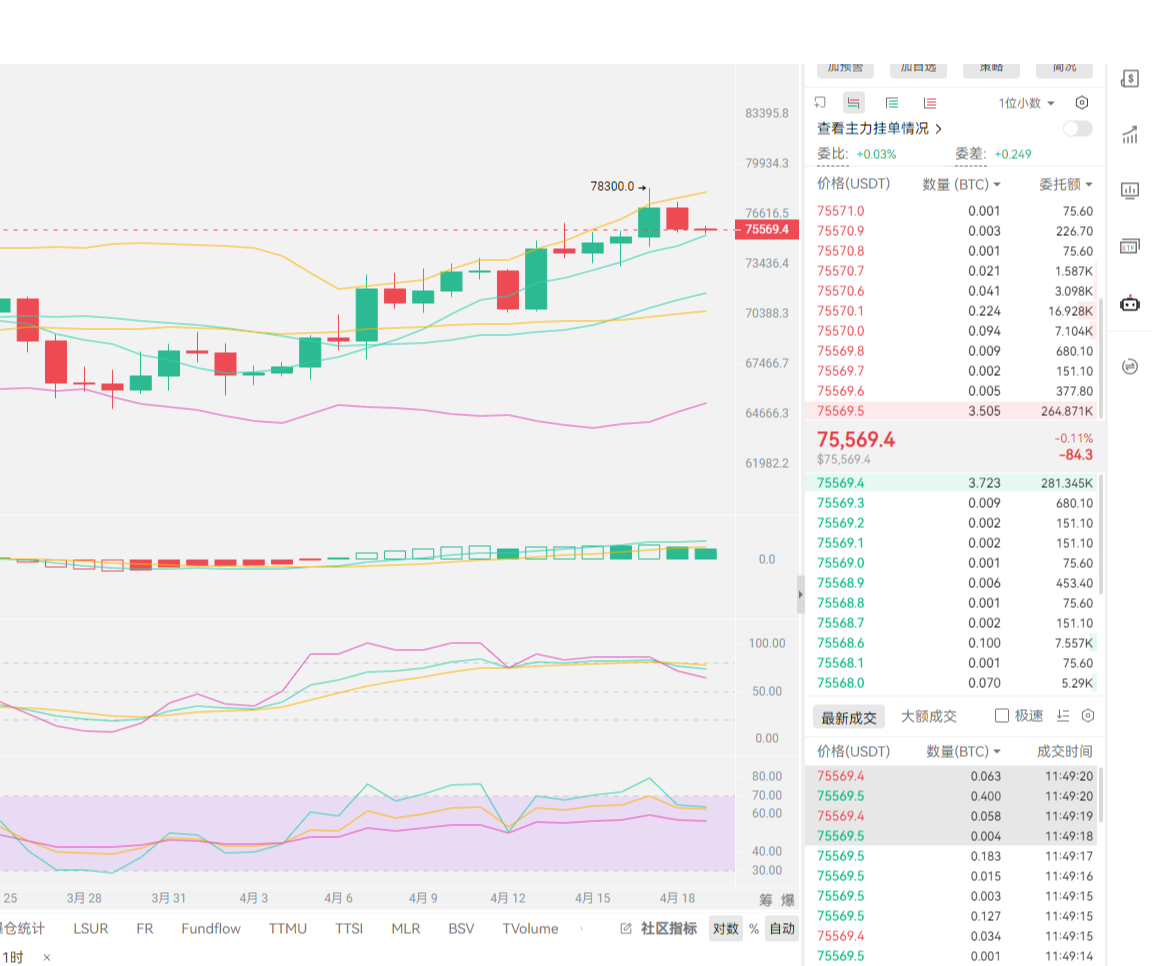
On April 19, 2026, East Eight Zone time, the TRUMP token team transferred 7.59 million TRUMP to the BitGo custody address in a single transaction, estimated to be approximately 21.81 million US dollars. Subsequently, this portion of chips was gradually transferred from the custody address to multiple centralized exchanges, evoking market associations with potential concentrated selling pressure and again bringing the team's fund security management into the spotlight. In the context of frequent hacking incidents in the current crypto market and heightened financial tension, any large transfers related to the team address are sensitively interpreted as risk signals, thus magnifying emotional fluctuations regarding the TRUMP transfer.
The path and trading pressure of 7.59 million TRUMP's removal from storage
From the on-chain visibility, this 7.59 million TRUMP was first transferred from the team-controlled address to the BitGo custody address. After completing the “centralized aggregation” action, the custody address then distributed to multiple CEX addresses. This linked action rapidly pushed chips that were originally scattered within the team into a high liquidity environment, reserving space for any subsequent trading behavior. As the research brief did not provide the precise distribution and transaction details of each exchange, we can only confirm the direction as “custody → CEX” but cannot further dissect the specific order structure and trading rhythm.
In terms of scale, the 7.59 million tokens, approximately 21.81 million US dollars, represent a relatively important chip weight for the TRUMP circulating supply, indicating that this is not a tentative move of marginal positions, but more like a significant repositioning with “clear objectives”. If such scale chooses to publicly place orders or sell at market price over time on the CEX side, it would leave a deep mark on the order book. From the micro-structural perspective of trading, regardless of whether it ultimately turns into actual bearish pressure, the market would first price in “possible selling pressure,” leading to a contraction in proactive buying and an increase in passive selling willingness, raising the risks of spread and slippage.
Concentrated entry into CEX will also change TRUMP's short-term liquidity structure. On the surface, having more chips enter exchanges means an increase in “tradeable circulating volume,” beneficial for large fund inflows and outflows; however, in a bearish sentiment environment, funds are more inclined to interpret this liquidity as “sellers can press a button at any time,” thus raising expectations for downward price fluctuations. Consequently, a custody and transfer operation has evolved from fund allocation issues into a collective anxiety around “when will selling pressure land.”
Selling shadow or safety line: the dual meaning of BitGo's role
From conventional practices, the team's choice of third-party custodians like BitGo often stems from several motivations: the first is to outsource professional security solutions like multi-signature, cold and hot wallet separation, reducing the technical risks of single point private key leakage; second, for compliance or auditing needs, to concentrate team assets in a transparent and traceable custodial account, facilitating external disclosure and internal management; third, to enhance asset dispatch efficiency across exchanges through the custodian's operational tools. Therefore, merely looking at “transfer to BitGo” itself does not inherently imply selling, but is rather a routine action regarding governance and security.
The real controversy arises from the custody address subsequently transferring large amounts to CEX. If the team's goal is long-term custody to reduce operational risk, the asset logic should lean more towards “returning from the exchange to custody”; however, what is now presented is that “custody is merely a transfer station,” rapidly sending large amounts of chips to the exchange, a path more akin to “preparing for potential trading.” In the absence of further disclosures on hedging, market making, staking, or other potential uses, the market will naturally prioritize the most intuitive interpretation—this is a signal to warm up for selling, even if this interpretation may not be complete.
It is essential to emphasize that there is currently significant information asymmetry. The research brief clearly indicates that the exact relationship between the BitGo custody address and the TRUMP team, along with contractual arrangements, lacks key information, and we cannot confirm whether this is a standardized custodial service, a cooperative asset management arrangement, or other customized financial solutions. Without more disclosures, overly conspiratorial speculations such as “BitGo colluding with the team to offload” or “back-end profit distribution,” are baseless imaginations. For ordinary participants, a more pragmatic approach is to regard this as an “objective liquidity event” and adjust positions based on observable chip flow rather than being swept up in emotions.
In an era of frequent hacking: how team funding actions amplify panic
The reason the TRUMP transfer can stir public opinion within a short period is largely due to its hitting the current security nerve. As Ryan Sean Adams, co-founder of Bankless, stated, “the frequency of hacking attacks in the crypto space has reached an all-time high,” with attack surfaces expanding over the past two years from cross-chain bridges to protocol governance and individual wallets, and on-chain participants remain highly alert to any abnormal fund movements. In this context, any significant operations by the team are difficult to be regarded as pure asset management actions.
Recently, it was reported in the L0 and rsETH incident that it may have been “due to private key leakage,” a point emphasized by Andre Cronje in a public statement. Compared to complex contract vulnerabilities, private key leakage touches on the most fundamental line of defense in the crypto world—key management, which is also one of the most common reasons for team custody, wallet changes, and dispersed signing. Thus, when the market has just experienced significant losses triggered by private key issues, and then sees large migrations from the TRUMP team's related addresses, the intuitive reaction is “are they dealing with potential security risks?” even associating with “not ruling out internal risks transferring chips in advance.”
In the highly concentrated backdrop of security incidents, any large transfers from team addresses are naturally interpreted as “risks”: the few records on the on-chain browser can easily be exaggerated and retold on social media into a binary narrative of “either getting hacked or fleeing.” TRUMP's path from team to BitGo and then to CEX has led many to directly categorize it as “either preparing for post-hack emergency or cashing out in advance”; even if the on-chain data itself does not support such extreme conclusions, panic sentiment can preemptively position itself before the facts, realizing itself in price and liquidity.
From AAVE's plunge to ETH getting locked up: the pressure chain of risky assets
Security panic is not an abstract concept; it directly manifests in asset prices and leverage structures. The research brief indicates that AAVE experienced a one-day drop of up to 15% following hacking-related incidents, a figure that reflects not only the pressure on the project itself but also signals that in the face of security shocks, the market’s tolerance for “protocol governance tokens” is very low. Once signs of an attack emerge, risk appetite quickly contracts, with high Beta assets being the first to suffer.
Meanwhile, the data showing that ETH's capital utilization rate on Aave has reached 100% reveals another thread: the demand for hedging and insurance is rapidly heating up. Capital, squeezing ETH and other mainstream assets on leveraged lending platforms for hedging or arbitrage, indicates that participants are more willing to stake chips on relatively stable assets and strategies rather than continue increasing exposure to high-risk speculative targets. In other words, the market is voting with its feet, pulling limited risk budgets from “story coins” and “emotional trades” towards more predictable allocations and hedging structures.
In this macro de-leveraging environment, high volatility, narrative-driven tokens like TRUMP are in a structurally fragile position. When the team moves large amounts of chips into CEX, even if it does not immediately result in substantial selling pressure, the market will preemptively price based on established “security incident—selling pressure—plunge” pathways observed in past cases like AAVE. The result is that speculative segments and project actions become intertwined: any fund management actions by the team are seen as potential exit signals, exacerbating the existing downhill pressure.
Old holders remain steadfast: a contrast with the TRUMP team's restructuring
Interestingly, on the other hand, on-chain data tells a completely different story. The research brief mentions that one ASTEROID holder has not moved their position for 580 days, resulting in an unrealized profit of about 2.6 million US dollars. This kind of “long-term holding” behavior sharply contrasts with the TRUMP team's large-scale repositioning: on one side is nearly zero operation over the past two years showcasing extreme patience; on the other is a one-time relocation of millions of tokens, reflecting completely different time perspectives and risk preferences.
From the time dimension, the ASTEROID holder's 580 days of silence has yielded 2.6 million dollars in unrealized profits, and the core logic lies in betting on the long-term value of the project while deliberately ignoring short-term volatility; while the TRUMP team's centralized migration appears more like “shortening the decision-making cycle”, preparing for possible future actions (whether partnerships, market making, cashing out, or others). The disparity between the two becomes a “sentiment mirror” for retail investors interpreting market signals: will they choose to trust the compound interest of long-term holding or let the team's every move dictate their path?
The market's interpretation of these two types of signals is also starkly different. “Project actions” are often viewed as foresighted layouts of knowledgeable players, with their capital migration frequently equated to “early cashing in on insider information”; thus, the TRUMP team's transfer of 7.59 million to BitGo and then into CEX is easily magnified within the community as a forewarning of “smart money exiting.” Meanwhile, “old hodlers not moving” is often romanticized as faith and perseverance, with the ASTEROID case serving as an emotional sample for bulls—proof that in certain fields, time can indeed be an ally.
In reality, most participants find themselves caught between these two narratives: fearing they might miss out on the next ASTEROID-style long-term wealth explosion while being extremely sensitive to every on-chain action from the project team. The TRUMP fund transfer incident essentially strikes at this psychological split—when the project team appears to be leaving room for future maneuverability, ordinary holders instinctively question: is their holding merely accompanying or paving the way for others to “take the last leg”?
A transfer that stirs emotions: what to look for after TRUMP
In summary, the TRUMP team transferring 7.59 million, approximately 21.81 million US dollars worth of tokens to the BitGo custody address and subsequently flowing to CEX will inevitably raise the market's expectations for price volatility in the short term. Regardless of the team's true intentions, the objective reality of chips concentrating into high liquidity environments is sufficient for participants to adjust their subjective probabilities regarding potential selling pressure, manifesting in trading behavior as reduced buying, heightened volatility, and a preference for conservative strategies of “reducing positions at peaks.”
At the same time, this incident also exposes critical uncertainties: we lack core information regarding the cooperation structure between BitGo and the TRUMP team, the ultimate use of funds, and the timeline, with the research brief explicitly prohibiting subjective speculations about the custody contract relationship. In this state of incomplete information, simplistically attributing everything to “signs of fleeing” or a “market manipulation script” will only amplify noise and undermine the rational basis for personal decision-making. What truly needs to be alerted to is not the conspiracy theories themselves but rather the impulsive trades driven by these theories.
For ordinary participants, a more pragmatic approach is to keep consistently tracking several key signals moving forward:
● On-chain movements: Observe the subsequent flow of these 7.59 million TRUMP at various CEX deposit addresses to see if there is a continuous outflow back to cold wallets or if they are gradually broken down into active trading addresses; compare transaction volume and position changes to assess actual selling strength.
● Project announcements and communications: Pay attention to whether the team gives a clear explanation regarding this fund migration, including whether it is used for market making, ecological incentives, staking arrangements, or other purposes. The timeliness and transparency of information disclosure are also key indicators of project governance quality.
● External security and macro environment: Continue monitoring the evolution of security and risk incidents similar to L0, rsETH, AAVE, and changes in capital risk appetite on mainstream assets and leveraged platforms, judging whether the overall liquidity and sentiment environment for TRUMP is tightening further or gradually recovering.
In an era of frequent hacking and tense emotions, the story of a transfer often does not stop at the on-chain records themselves but is layered with narratives from all sides. How to identify key signals amidst the noise and construct a risk-response framework based on them, rather than being engulfed by a single event, will be more deserving of energy than simply asking, “will this drop the market?”
Join our community to discuss together and become stronger!
Official Telegram community: https://t.me/aicoincn
AiCoin Chinese Twitter: https://x.com/AiCoinzh
OKX benefits group: https://aicoin.com/link/chat?cid=l61eM4owQ
Binance benefits group: https://aicoin.com/link/chat?cid=ynr7d1P6Z
免责声明:本文章仅代表作者个人观点,不代表本平台的立场和观点。本文章仅供信息分享,不构成对任何人的任何投资建议。用户与作者之间的任何争议,与本平台无关。如网页中刊载的文章或图片涉及侵权,请提供相关的权利证明和身份证明发送邮件到support@aicoin.com,本平台相关工作人员将会进行核查。